-
Watch: Geoff Dabelko on Climate Adaptation and Peacebuilding at SXSW
November 16, 2011 // By Wilson Center StaffMOREThe problems of climate adaptation, poverty alleviation, and peacebuilding are common to many parts of the world. Yet the efforts to address them are often pursued separately or with little coordination. Capturing the co-benefits of building institutional capacity critical to all three areas is an idea that will likely receive little attention at next year’s Rio+20 Earth Summit in Brazil, says ECSP Director Geoff Dabelko.
-
Friday Podcasts
Jotham Musinguzi on Investing in Family Planning for Development in Uganda
MORE “What we are seeing is not adequate, but we think we are seeing very good positive movement, and we want to build on that,” said Jotham Musinguzi, director of the African regional office for Partners in Population and Development (PPD) in Kampala, Uganda. Musinguzi is a public health physician by training who previously advised the government of Uganda on population and reproductive health issues. “We think that [the government] is now on a firm foundation to continue investing properly in family planning,” he said.
Family Planning for Development
Uganda’s high population growth rate (the country has a total fertility rate of 6.4 children per woman, according to the UN) presents a number of challenges, said Musinguzi, exerting pressure on education and health systems, as well as on basic infrastructure, particularly for housing and transportation. Additionally, high levels of poverty and unemployment can become a source of instability.
Policymakers in Uganda are beginning to recognize the urgency of the issue, however, particularly in regards to young people, said Musinguzi. “They don’t have access to jobs, they don’t have the skills, and therefore the challenges of poverty eradication become even more important.”
Nonetheless, the country’s contraceptive prevalence rate is low, at 24 percent, with 41 percent of married women expressing an unmet need for family planning services, according to the 2006 Demographic and Health Survey (DHS) for Uganda. Low levels of investment and lack of government involvement remain the primary obstacles, according to Musinguzi, in addition to socio-cultural and religious barriers.
Uganda historically depended primarily on donor finance, rather than government funding, to support family planning and reproductive health services, Musinguzi said. However, over the past two years, the Ugandan government has increased investment due to concerted efforts by PPD, as well as USAID, the UN Population Fund, and civil society groups. “Our point was that if the government does not fund family planning, then they are going to find that achievement of the Millennium Development Goals…is going to be very challenging,” he said.
“I think the low investment in family planning in Uganda is a thing of the past, and we are now looking forward to really better investment in this field,” Musinguzi said. “I am sure we are going to witness quite a big change [in the 2011 DHS] in terms of access as a result of the proper social investment that the government is trying to do now.”
South-South Collaboration
“I have a keen and strong interest in South-South collaboration in the field of reproductive health, family planning, population, and development,” Musinguzi said. Countries in the South have experience linking programming on population and development, and may face similar challenges, he said. For instance, Bangladesh and Vietnam had successful family planning programs that helped blunt rapid population growth rates.
“Countries, like Uganda, and others which haven’t gotten there yet, could learn from these other countries,” said Musinguzi, by sharing best practices and lesson learned, and replicating applicable solutions.
PPD also has a regional project reaching out to policymakers to increase commitment and accountability for family planning and reproductive health services. For instance, parliamentarians may not realize that they can play a significant role, but they have a unique function in providing government and budget oversight, Musinguzi said. Furthermore, they can create legal and administrative frameworks that prioritize family planning programs.
“We continue to make the case for more investment in family planning and reproductive health, but also making sure we hold leaders accountable, to show more commitment, and make sure they improve on the welfare of the people that they represent,” Musinguzi concluded.
The “Pop Audio” series is also available as podcasts on iTunes.
Sources: MEASURE DHS, UN Population Division.Topics: Bangladesh, development, family planning, Friday Podcasts, podcast, population, poverty, Uganda, Vietnam, youth -
From the Wilson Center
Healthy People, Healthy Ecosystems: Results From a Public-Private Partnership
MORE“A lot of people probably don’t think that an organization with a name like ‘World Wildlife Fund’ would have a program on population, health, and the environment,” said WWF’s Tom Dillon at the Wilson Center, but actually it is very natural. “Most of the people we work with are in rural areas, and they depend on their natural resources for their own livelihoods and for their own well-being. Of course, if you are in that situation, in order to be a steward of the environment, you’ve got to have the basics. You have got to have your own health.”
Dillon was joined by staff from WWF, as well as Scott Radloff, director of USAID’s Office of Population and Reproductive Health, and Conrad Person, director of corporate contributions at Johnson & Johnson, to talk about the results of a three-year partnership between USAID, WWF, and Johnson & Johnson. The joint effort, a formal Global Development Alliance, provided health and family planning services, clean water, and sanitation to communities in three of WWF’s priority conservation landscapes: The Salonga National Park in the Democratic Republic of Congo (DRC), the Lamu Archipelago in Kenya, and the Terai Arch Landscape in Nepal.
By creating an innovative public-private partnership that linked health objectives, particularly related to family planning and maternal and child health, to environmental and conservation activities, “this alliance was ahead of its time,” said Radloff.
Human Health Linked to Environmental Health
The project had four objectives, said Terri Lukas, WWF’s population, health, and environment (PHE) program manager: improve family health; reduce barriers to family planning and reproductive health services; improve community management of natural resources and habitat conservation; and document and promote successful approaches.
“Human health cannot be separated from environmental health anywhere,” Lukas said, “but most especially when we are working with very poor people who live very close to nature.”
Projects Provide Integrated Services
The Salonga National Park in the DRC is home to many endangered species, including the bonobo, one of the four great apes. Local communities are very isolated, and lack access to safe drinking water and sustainable livelihoods, as well as basic health and family planning services, according to Lukas. The PHE project was able to train 135 voluntary community health workers in family planning and maternal and child health care, including 55 women. One year after the training, health workers were distributing contraception to more than 300 new users per month, Lukas said.
The alliance has also integrated health and family planning services into conservation programs in Kenya’s Kiunga Marine National Reserve, in part, “to demonstrate to the people that we care about them as well as the environment, and also to show them the synergies that exist between the health issue and the environment issue,” said WWF Program Coordinator Bahati Mburah. The region has been suffering through a year-and-a-half-long drought, and has one of the highest population growth rates in east Africa, placing considerable pressure on natural resources.
“We talk to [the fisher folk] about health and family planning, and how they are related to the management of fisheries,” said Mburah. With improved transportation and mobile outreach services provided by the project, 97 percent of women are now able to access family planning services within two hours of their home, she said.
The third site is in the Terai region along the southern border of Nepal. In this lowland region, the alliance is attempting to safeguard and restore forest areas in order to allow wildlife to move and breed more freely, while at the same time improving the health and economic prospects of the people. By linking these goals, support for conservation efforts increased from 59 percent to 94 percent of households, with 85 percent attributing positive attitude changes to increased access to health services and safe drinking water, according to Bhaskar Bhattarai, project coordinator for WWF-Nepal.
Documenting and Promoting Successful Approaches
Cara Honzak, WWF’s senior technical advisor on population, health, and environment, said the global objective of the alliance was to document and promote successful PHE approaches. Comprehensive baseline and endline surveys provided critical evidence that integrated PHE programming increases family planning use in remote areas, improves conservation buy-in within communities, and leads to increased participation of women in community leadership and decision-making.
“We have played a key role in producing some of the evidence that has been used throughout Washington [D.C.], especially to provide information to government bodies that are making decisions about bringing more money into family planning, health, and particularly in the environmental sector,” said Honzak.
“After two decades in the field, and working in this area, I wasn’t expecting many surprises. I couldn’t have been more wrong,” Lukas said. “These three years have changed almost everything about the way I now view health development…I have long called myself a conservationist, but now I say to my international health colleagues: we are all conservationists, and if we aren’t, we should be.”
Event Resources- Bhaskar Bhattarai presentation
- Cara Honzak presentation
- Terri Lukas presentation
- Bahati Mburah presentation
- Photo gallery
- Video
Topics: conservation, DRC, environmental health, family planning, forests, From the Wilson Center, global health, Kenya, Nepal, PHE, population, USAID -
Eye On
Twin Challenges: Population and Climate Change in 2050
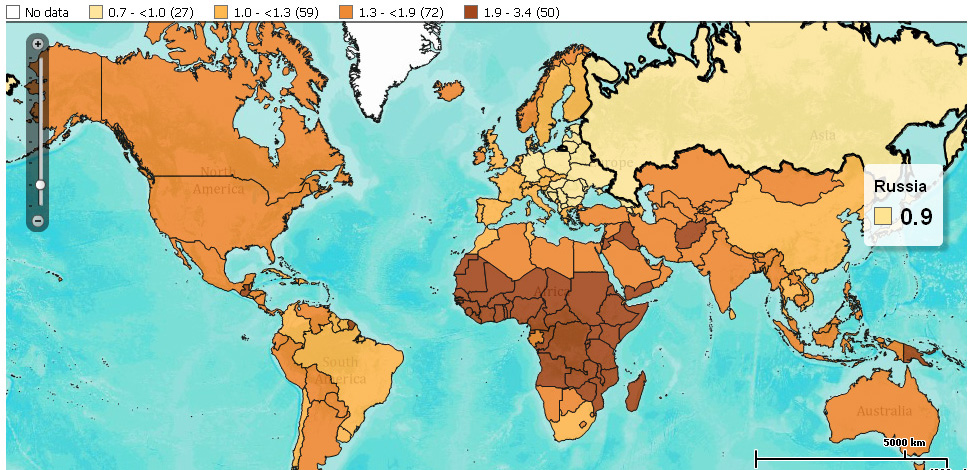
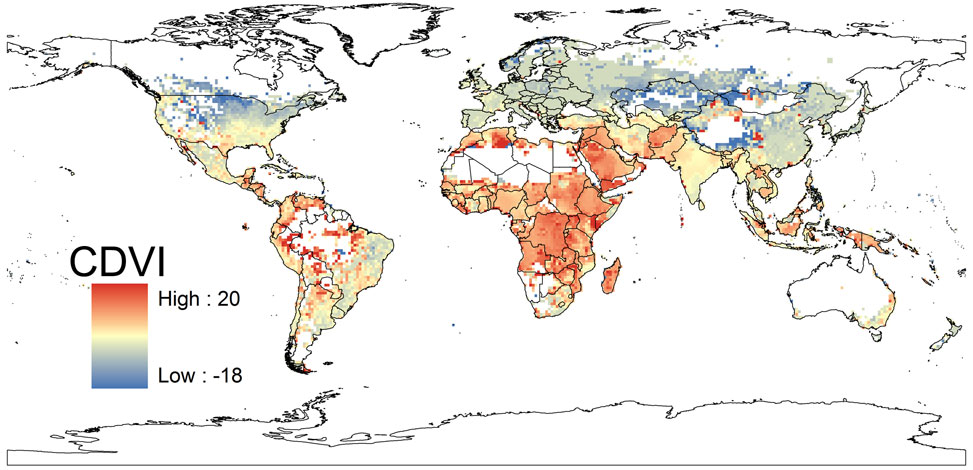
MOREWith global population reaching 7 billion, a lot of attention has been paid to the question of how to sustainably support so many people, much less the 9 billion expected by 2050, or the 10 billion possible by 2100. Add in the environmental variability projected from climate change and the outlook for supporting bigger and bigger populations gets even more problematic. Two new maps – one by the Population Reference Bureau (PRB), the other by McGill University PhD candidate Jason Samson – show how the world might change over the next 40 years in the face of these twin challenges.
Nine Billion in 2050
PRB’s map, built using their DataFinder tool, shows the world in 2050 in terms individual country growth rates between now and then. Japan, Russia, and countries in Eastern Europe are set to grow more slowly than anywhere else, and some of that group will actually shrink by 10 to 20 percent of their current size. Western, Central, and Eastern Africa will be home to the highest increases. Niger’s 2050 population is expected to be 340 percent its 2011 size – the largest growth of any country.
The map is based on country-level data pulled from a number of sources: the UN Population Division’s latest “World Population Prospects,” the UN Statistics Division’s “Demographic Yearbook 2008,” the U.S. Census Bureau’s International Database, and PRB’s own estimates. It’s unclear what numbers come from which sources, though it is clear that PRB’s 2050 estimates span the UN’s range of medium, high, and constant-fertility variants. In spite of these variations, none of PRB’s estimates come anywhere near the UN Population Division’s low variant estimates.
PRB’s map, echoing its 2011 World Population Data Sheet, shows a world where sub-Saharan Africa will bear the brunt of population growth. The average country in Africa in 2050 is projected to be slightly more than twice its 2011 size; the average European country is expected to barely break even. Africa is home to more countries whose populations are estimated to least double (34) or triple (4) than any other continent. Europe, meanwhile, is home to more countries whose populations will stagnate (8), or even shrink (19), than anywhere else. Interestingly, the Caribbean is a close second in terms of countries whose populations are projected to stay the same (seven to Europe’s eight), and Asia is second to Europe in terms of countries whose populations are projected to shrink (Georgia, Japan, Armenia, South Korea, and Taiwan).
More People, More Climate Change, More Vulnerability
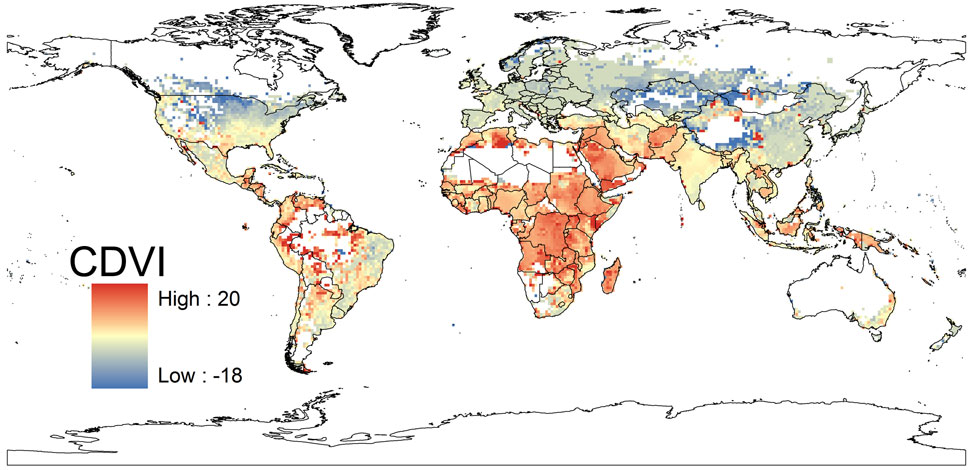
Samson’s map takes on the same time period but projects where people will be most vulnerable to the effects of climate change. Since his map takes into account population growth (measuring where people are most vulnerable, remember), unsurprisingly, Africa, the Middle East, Southeast Asia, and central South America are covered in bright red dots, indicating high vulnerability. Conversely, North America, Europe, and much of Central Asia are in shades of blue.Samson built his index using four environmental predictors – annual mean temperature, mean temperature diurnal range, total annual precipitation, and precipitation seasonality – taken from WorldClim’s 2050 forecasts, and 2005 sub-national population data from Columbia’s Center for International Earth Science Information Network. In spite of the sub-national population data, Samson makes a point to justify his use of supranational climate data in order to best reflect “the scale at which climate conditions vary.” He writes that localized issues like urbanization and coastal flooding “are probably best investigated with targeted regional models rather than by attempting to modify global models to include all factors of potential regional importance.”
Samson’s research shows that, generally, people living in places that are already hot will be more vulnerable to climate change over time, while people in more temperate climates will feel a negligible impact. Though he projects the largest real temperature changes will happen in temperate climates like North America and Europe, the comparatively smaller changes in Africa, the Middle East, Southeast Asia, and central South America are expected to have a greater impact because those regions are already very hot, their natural resources are stressed, and they are expected to bear the brunt of population growth over the next few decades.
These findings reflect a disparity between those responsible for climate change and those bearing the brunt of it, which, although not surprising, “has important implications for climate adaptation and mitigation policies,” said Sampson, discussing the map in a McGill press release.
Sub-National Data “Present a Very Different Picture”
Though they offer a useful approximate glimpse at what the world might look at in 2050, both of these maps fall prey to over-aggregation. By looking at national rather than sub-national data, we miss how nuanced population growth rates can be within a country. Stimson Center Demographer-in-Residence Richard Cincotta wrote in a recent New Security Beat post that “national level comparisons of total fertility rates tend to communicate the false impression of a world with demographically homogeneous states.” Sub-national data, including differences between urban and rural areas and minority-majority fertility rates, “present a very different picture.”
And that difference matters. When it comes to looking at how population interacts with other issues, like the environment, poverty, and conflict, the importance of a sub-national approach becomes evident. In its 2011 data sheet, PRB writes that “poverty has emerged as a serious global issue, particularly because the most rapid population growth is occurring in the world’s poorest countries and, within many countries, in the poorest states and provinces.”Edward Carr, an assistant geography professor at the University of South Carolina currently serving as a AAAS science fellow with USAID, argues that national-level data obscures our ability to understand food insecurity as well. The factors that drive insecurity “tend to be determined locally,” writes Carr in a post on his blog, and “you cannot aggregate [those factors] at the national level and get a meaningful understanding of food insecurity – and certainly not actionable information.”
The same is true when it comes to climate vulnerability. In a report from The Robert S. Strauss Center’s Climate Change and African Political Stability Program, authors Joshua Busby, Todd Smith, and Kaiba White write that “research announcing that ‘Africa is vulnerable to climate change,’ or even ‘Ethiopia is vulnerable,’ without explaining which parts of Ethiopia are particularly vulnerable and why, is of limited value to the international policy community.”
“It is of even less use to Africans themselves, in helping them prioritize scarce resources,” add Busby et al.
Understanding the joint problems of climate change and population growth on a global level helps frame the challenges facing the world as it moves toward 8, 9, and possibly 10 billion. But knowing the ins and outs of how these issues interact on a local level will be a necessary step before policymakers and others can hope to craft meaningful responses that minimize our vulnerability to these challenges over the coming decades.
Sources: Center for International Earth Science Information Network at Columbia University, Climate Change and African Political Stability Program at the Robert S. Strauss Center, McGill University, Population Reference Bureau, UN Population Division, UN Statistics Division, U.S. Census Bureau, University of South Carolina, WorldClim.
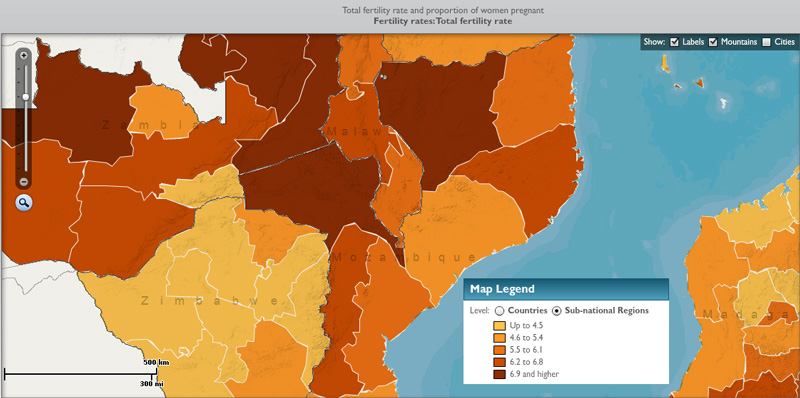
Image Credit: “2050 Population As a Multiple of 2011,” courtesy of PRB; CDVI map used with permission, courtesy of McGill University; Sub-national total fertility rates in Southern Africa, courtesy of MEASURE DHS, arranged by Schuyler Null.Topics: Africa, Asia, climate change, demography, development, environment, Europe, Eye On, population, poverty, security, urbanization, USAID -
Rwanda: Dramatic Uptake in Contraceptive Use Spurs Unprecedented Fertility Decline
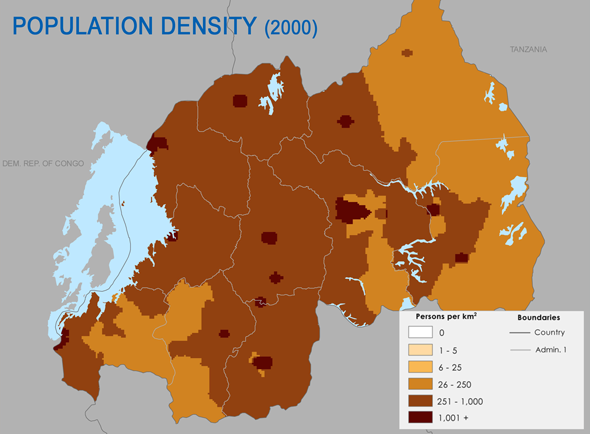
November 8, 2011 // By Elizabeth Leahy MadsenMOREWith over 400 people per square kilometer, the highest rate on the African mainland, population density is perhaps the most widely-discussed factor of Rwanda’s demography. Some scholars, notably Jared Diamond, have argued that it played a primary role in sparking the 1994 genocide through competition for land (although others present a more complex theory based in policies and governance).
-
Beat on the Ground
Coffee Farmer and Extension Manager Promotes Improved Health and Livelihoods in Rwandan Coffee Communities
MOREThis PHE Champion profile was produced by the BALANCED Project.
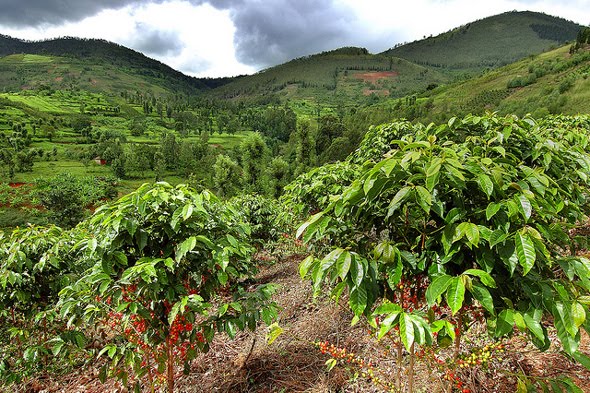
Mr. Pascal Gakwaya Kalisa has produced coffee in the densely populated country of Rwanda for the past nine years. A proud member of the 1,200 member Maraba Coffee Cooperative in Huye District in the Southern Province of Rwanda, Kalisa knows that a larger income alone does not ensure a better quality of life for his fellow coffee farmers and their families. He also knows that a successful coffee growing/exporting enterprise depends on preserving the fragile Rwandan soils, as well as on the health and well-being of farming families and communities. Therefore, Kalisa and other cooperative members treat the land and trees with a level of personal care that is necessary for optimum organic production and soil preservation.
Kalisa and the community have set up small, garden-sized coffee farms that are more productive than usual. Cooperative washing stations have enabled the small-scale farmers to improve product quality, and the cooperatives themselves are learning to negotiate better coffee prices with international buyers. Through such efforts and the support of many international donors and industry partners, Rwanda has become a producer of high quality specialty coffee since 2005, and its coffees are being marketed through renowned coffee roasters and importers in the United States, Europe, and Japan. In just six short years, Rwandan farmers have doubled their incomes and created 2,000 jobs, and the first renowned specialty coffee competition Cup of Excellence in Africa was held in Rwanda in 2008.
SPREAD: A Community Partnership
Recognizing the broad-based health, social, and economic needs of coffee farmers and their families in this part of East Africa, the U.S Agency for International Development initiated the Sustaining Partnerships to Enhance Rural Enterprise and Agribusiness Development project (SPREAD) to provide rural cooperatives and enterprises involved in high-value commodity chains with both appropriate technical assistance and access to health-related services and information. It is this combination of technical assistance and health-related outreach and services that has resulted in increased and sustained incomes and improved livelihoods.
Kalisa and other members of various cooperatives that SPREAD supports recognize that not only should farmers and their families preserve the land, but they must also preserve their own health in order to perform the labor needed to farm the crop that will produce the steady stream of high quality coffee upon which their livelihoods depend. Initiating community dialogues around issues such as protected sex, gender roles, and how coffee revenue is spent within households has also been crucial to project success among both youth and adults.
In his role as coffee zone coordinator for the SPREAD project, Kalisa works with coffee cooperatives to implement improved agricultural practices that improve the quality of their crop. This includes using cleaner environmental practices during coffee processing, such as introducing composting of coffee cherry pulp. Kalisa also helps disseminate integrated health and coffee messages through a weekly coffee talk-show produced by the National University of Rwanda’s Radio Salus, called Imbere Heza (“Bright Future”). In one show, for example, a man explained to a fellow farmer that to get good coffee cherries, he should thin his trees to renew his plantation.
Integrating Healthy Lives
Kalisa has also helped the SPREAD project’s health team deliver integrated messages on family planning, maternal and child health, alcohol, nutrition, gender issues, and the linkages between these. He uses examples such as the one about tree thinning to explain that families that space their children tend to be healthier, as they can plan the number of children to better fit with the financial and natural resources at hand.
Kalisa sees the benefits of using community agents to deliver integrated health, environment, and livelihood messages. This includes training extension agents to discuss environmental and human health issues in the context of coffee growing. Also, having coordinators from the coffee program and the health program go hand-in-hand to the field saves time, fuel, and other project costs. Kalisa believes that this campaign to educate coffee farmers and their families on the linkages between human health, a healthy environment, and strong livelihoods will lead to long-term change in their behavior, attitudes, and knowledge – change that will help them live better lives today and into the future.
This PHE Champion profile was produced by the BALANCED Project. A PDF version can be downloaded from the PHE Toolkit. PHE Champion profiles highlight people working on the ground to improve health and conservation in areas where biodiversity is critically endangered.
Photo Credit: “Rwanda photos 060,” courtesy of David Dewitt/counterculturecoffee. -
Eye On
STATcompiler: Visualizing Population and Health Trends
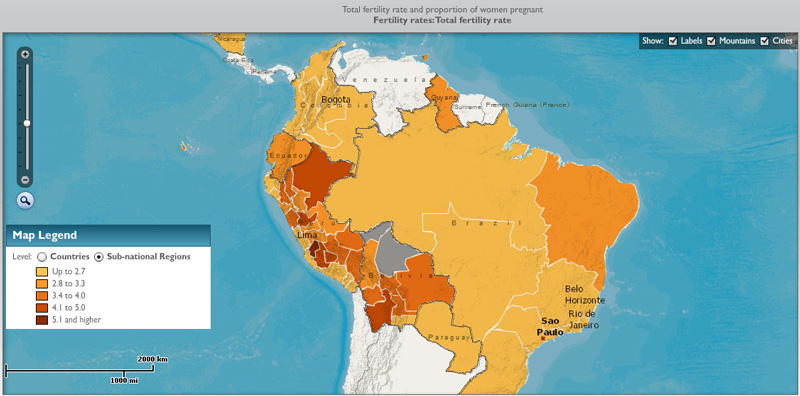
MOREWorld population is growing – earlier this week, the global community symbolically marked the arrival of the seven billionth person. But the unprecedented growth in global population over the last few decades has not affected everyone equally – in 1950, 68 percent of the world’s population lived in developing regions; today that number is 82 percent. MEASURE’s latest version of their STATcompiler tool helps visually highlight areas simultaneously experiencing the most demographic change and poor health indicators.
The revised STATcompiler – released in September – provides new ways for users to visualize data by generating custom data tables, line graphs, column charts, maps, and scatter plots based on demographic and health indicators for more than 70 countries. Users can select countries or regions of interest, and relevant indicators, including for family planning, fertility, infant mortality, and nutrition. Tables can be further customized to view indicators over time, across countries, and by background characteristics, such as rural or urban residence, household wealth, or education. In some cases, sub-national data is available. User-created tables and images are then exportable so that they may be easily used in papers or presentations.
Since STATcompiler is still in active development, certain functions are still being added. HIV data has not yet been integrated into the program, nor has the express viewer function, with customizable, ready-made tables for quick access. Additionally, updated information is not available for all countries, in all categories – for instance, the most recent data available for Mexico comes from a 1987 survey. If preferred, the legacy version remains available to users in the meantime.
MEASURE DHS – the Monitoring and Evaluation to Assess and Use Results Demographic and Health Surveys project – provides technical assistance for data collection on health and population trends in developing countries. Their demographic and health surveys, funded by USAID, provide data for a wide range of monitoring and impact evaluation indicators at the household level in the areas of population, health, and nutrition. They have become a staple data source for researchers, and the addition of better analysis functions and dissemination tools, via STATcompiler, will hopefully help advance understanding of demographic and health trends.
Image Credit: Map from STATcompiler, arranged by Schuyler Null. -
Seven Ways Seven Billion People Affect the Planet
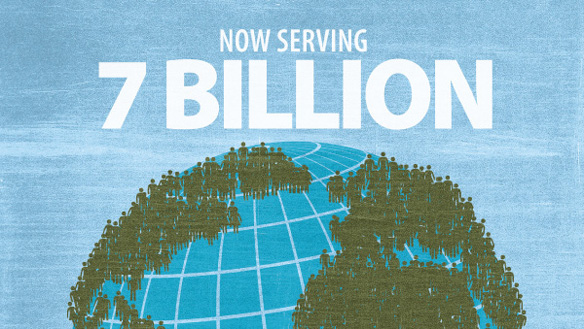
October 31, 2011 // By Geoffrey D. DabelkoMORESeven billion people now live on earth, only a dozen years after global population hit six billion. But the seven billion milestone is not about sheer numbers: Demographic trends will significantly impact the planet’s resources and peoples’ security.
Growing populations stress dwindling natural resource supplies while high levels of consumption in both developed countries and emerging economies drive up carbon emissions and deplete the planet’s resources. And neglected “youth bulges” could bolster extremism in fragile states like Somalia and destabilize nascent democracies like Egypt.
Here are seven ways seven billion people affect the planet, according to recent research:
Security: Nearly 90 percent of countries with very young and youthful populations had undemocratic governments at the end of the 20th century. Eighty percent of all new civil conflicts between 1970 and 2007 occurred in countries where at least 60 percent of the population is under age 30, says demographer Elizabeth Leahy Madsen. According to research by demographer Richard Cincotta, these countries may achieve democracy, but are less likely to sustain it.- Richard Cincotta: Tunisia Predicted: Demography and the Probability of Liberal Democracy in the Greater Middle East
- Elizabeth Leahy Madsen: Demographic Security 101
Water: By 2025, 1.8 billion people will be living in countries with water scarcity, and fully two-thirds will be living in conditions of water stress. People are using groundwater faster than it can be naturally replenished, putting us in danger of “peak water,” says MacArthur “Genius” Fellow Peter Gleick. “We cannot talk about water without also understanding the enormously important role of population dynamics and population growth.”- Peter Gleick: Population Dynamics Key to Sustainable Water Solutions
Forests: The growing demand for energy has helped devastate tropical forests, as more than two billion people depend on wood for cooking and heating, particularly in developing countries. Projects in Indonesia, Nepal, and Uganda are fighting deforestation by providing alternative energy and incomes along with health and family planning services.- Indonesia: Health in Harmony
- Nepal: Forests for the Future
- Uganda: Sharing the Forest
Future Growth: By 2050, the UN says global population could range anywhere from 8 billion to 11 billion – and where it ends up depends in large part on the status of women in developing countries. “Even if fertility rates remain constant at current levels (which is unlikely), developing regions would grow from 5.7 billion in 2010 to 9.7 billion in 2050, but the total population of developed countries would remain essentially unchanged,” writes Madsen.- Elizabeth Leahy Madsen: How Did We Arrive at 7 Billion – and Where Do We Go From Here? [Part One] [Part Two]
There are no quick solutions to these seven problems. But meeting the unmet need for contraception of more than 200 million women is an effective and inexpensive way to start.
Sources: Population Action International, UN, World Health Organization.
Image Credit: Used with permission courtesy of Scott Woods, The University of Western Ontario.
 A Publication of the Stimson Center.