-
Eye On
Mapping Muslim Population Growth
MORERecent unrest in Tunisia, Egypt, Yemen, and elsewhere across the Middle East has led to a resurgence of interest in the region’s demography, just in time, it turns out, for the Pew Forum on Religion and Public Life’s 2011 refresh of its report on Muslim population growth, which this year includes a new interactive feature, “The Global Muslim Population.”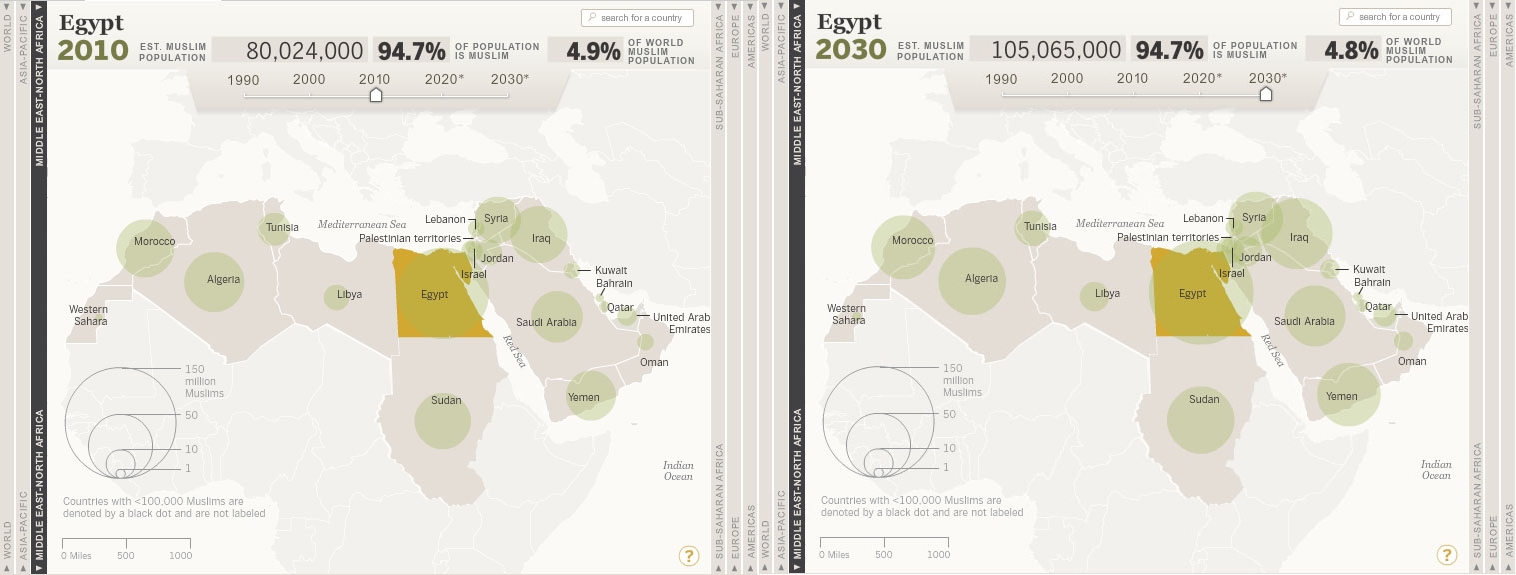
According to the report, current security hot-spots such as Afghanistan, Iraq, Yemen, Syria, Somalia, and Nigeria will continue to grow considerably faster than the mean.
On the flip side, the report also found that the median age in the Middle East-North Africa region is rising – a generally agreed upon good indicator for the prospects of more liberal, democratic regimes – and though global Muslim population will continue to grow faster than the world’s non-Muslim population, this growth will be slower than in decades past.The accompanying interactive feature allows users to select a region (the Americas, Europe, Middle East/North Africa, Sub-Saharan Africa, or Asia-Pacific), a specific country, and a decade (1990-2030) in their search. In the example above, Egypt will add 25 million Muslims to its population over the next two decades, representing a 30 percent increase. Comparatively, from 1990 to 2010, Egypt’s Muslim population increased by 48.5 percent.
The user is able to see the estimated Muslim population of the country, the percent of the total population that is Muslim, and the country’s percent share of the world’s total Muslim population (as seen in the example above of Egypt in 2010 and 2030). In addition, these variables can be sorted in tables.
It’s important to note though, write the authors of the report, that projections are not predictions:This report makes demographic projections. Projections are not the same as predictions. Rather, they are estimates built on current population data and assumptions about demographic trends; they are what will happen if the current data are accurate and the trends play out as expected. But many things – immigration laws, economic conditions, natural disasters, armed conflicts, scientific discoveries, social movements and political upheavals, to name just a few – can shift demographic trends in unforeseen ways, which is why this report adheres to a modest time frame, looking just 20 years down the road.
Image Credit: Pew Research Center’s Forum on Religion and Public Life.
Sources: Pew Forum on Religion and Public Life.Topics: Afghanistan, democracy and governance, demography, Egypt, Eye On, Iran, Middle East, Nigeria, population, security, Somalia, Syria, Tunisia, Yemen, youth -
Beat on the Ground
Improving Health and Preserving Ecosystems in the Democratic Republic of Congo
MOREThis PHE Champion profile was produced by the BALANCED Project.
In the remote forests of the Democratic Republic of Congo (DRC), Albert Lotana Lokasola is helping improve livelihoods by bringing much-needed health services to the communities living in and around the Kokolopori Bonobo Reserve. Officially recognized by the DRC government in May 2009, the reserve is a high biodiversity wilderness area covering an area about the size of Rhode Island (4,785 square kilometers).
Located 300 miles southwest of Kisangani, the reserve contains bonobos, a rare and highly endangered great ape species that is as closely related to humans as chimpanzees. In addition, the reserve is highly valued for its biodiversity, including several other flagship species such as leopards, elephants, Congo peafowl, Tshuapa red colobus, and Salonga monkeys.
Lokasola founded a nationally recognized organization called Vie Sauvage, or “Wild Life” in English. He serves as the president of the organization and works with international organizations to foster conservation and rural development in an integrated, holistic approach. As a native of Kokolopori, he believes that “the forest, men, and wildlife live together and should be protected together.”
In partnership with local residents and supported by the Bonobo Conservation Initiative, Lokasola and Vie Sauvage established the first medical clinic in the area in 2006. They garnered support for a doctor, nurses, and supplies from the Indigo Foundation in Australia and the Kokolopori-Falls Church Sister City Partnership.
Before the clinic was founded, community members had to walk or bicycle more than 50 miles to get to the nearest hospital in the territorial capital of Djolu. Now the Kokolopori clinic serves the 8,000 people who live in 30 villages along a 40-mile road in the reserve. One of the clinic’s goals is to help improve women’s health by training and equipping midwives and by providing access to other health services. Malaria and poor nutrition contribute to high maternal and child mortality, and women in Kokolopori do not yet have access to reproductive health services such as family planning.
Vie Sauvage articulates integrated health and conservation messages through their community education projects. They are also working with the community to prevent malnutrition by planting fruit trees in agroforestry fields to produce supplemental food supplies. At the same time, these trees will create corridors for wildlife movement and protect the genetic flow. They also create a sound micro-climate for people, sequester carbon dioxide, and filter the air. Through these efforts, Vie Sauvage and the people of Kokolopori are demonstrating the critical links between human well-being and conservation.
Vie Sauvage has garnered resources and participation from diverse partners (like the Kokolopori-Falls Church Sister City Partnership and the Indigo Foundation, mentioned above) which work together to support the clinic and fund medical staff salaries, training, supplies and equipment, and infrastructure improvements.
According to Lokasola, Vie Sauvage and partners are currently exploring potential partnership opportunities to integrate family planning and reproductive health into existing activities. His hope is that by providing these much-needed services, the community will be healthier and critical ecosystems will be sustainably preserved.
This PHE Champion profile was produced by the BALANCED Project. A PDF version can be downloaded from the PHE Toolkit. PHE Champion profiles highlight people working on the ground to improve health and conservation in areas where biodiversity is critically endangered.
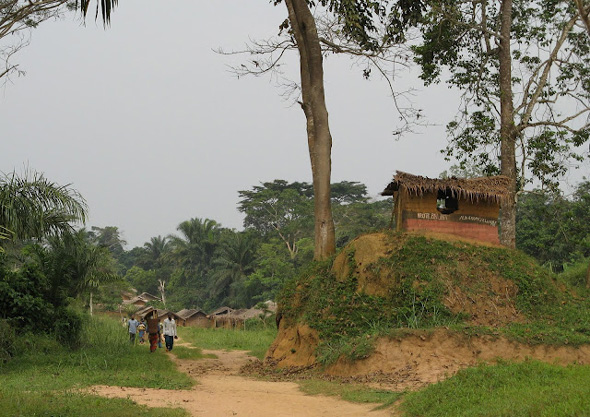
Photo Credit: Building along the road in Kokolopuri village serves as a messsage drum for sending messages from one village to the next, courtesy of Ingrid Schulze and the BALANCED Project. -
Book Preview: ‘Environmental Politics: Scale and Power’
February 1, 2011 // By Shannon O’LearMOREThe cover of my book, Environmental Politics: Scale and Power, shows two cows casually rummaging through piles of garbage on the streets of a city somewhere in India. It’s a colorful, but disturbing, image. Why not show cows in their “natural” setting, say, in a Kansas pasture? Who let them into the street? Why are they eating garbage? The image is symbolic of what the book aims to achieve: to get us out of our comfort zones in thinking about environmental issues and challenge us to reconsider how we think about issues like climate change, energy, food security, garbage, toxins, and resource conflicts.
The book draws from my experience teaching environmental policy, environmental geopolitics, international conflict, and human geography. It starts by asking some fundamental questions: What exactly is “the environment” anyway? Is there any part of the world that is completely untouched by human actions? How do different forms of power selectively shape our understanding of particular environmental issues (while obscuring other issues from our view)?
The book draws on the idea of the “Anthropocene” – a new geologic era characterized by irreversible, human-induced changes to the planet. Because these changes (which in large part have already occurred) are irreversible, Anthropocene-subscribers argue we should focus our efforts on mitigation, adaptation, and coming to terms with the realities of the environment as it is, rather than something that must be returned to some previous or “normal” state.
Our understanding of environmental issues is shaped by various types of power – economic, political, ideological, and military – and therefore tends to be limited in terms of spatial scale. Why do we tend to think of climate change as a global phenomenon instead of something we might experience (and contend with) locally? Is food security something we should be mindful of when we make individual choices about food? We tend not to discuss what happens to our garbage, but everyone knows about recycling, right?
Environmental Politics: Scale and Power offers non-geographers an appreciation of how and why geographers think spatially to solve problems. Commonly accepted views of environmental issues tend to get trapped at particular spatial scales, creating a few dominant narratives. When we combine a spatial perspective with an inquiry into the dynamics of power that have influenced our understanding of environmental issues, we can more clearly appreciate the complexity of human-environment relations and come to terms with adapting to and living in the Anthropocene era.
Today’s environmental challenges can sometimes appear distant and immense, but this book aims to show how decisions we make in our day-to-day lives – from buying bottled water and microwave popcorn to diamond jewelry – have already had an effect on a grand scale.
Shannon O’Lear is a professor of geography at the University of Kansas and the author of Environmental Politics: Scale and Power. She has recently completed a research project examining why we do not see widespread or sustained environmental resource-related conflict in Azerbaijan, as literature on resource conflict would suggest.
Image Credit: Environmental Politics: Scale and Power, courtesy of Justin Riley and Cambridge University Press. -
Guest Contributor
Is the Glass Half Full or Half Empty?
MOREThe much-anticipated Quadrennial Diplomacy and Development Review(QDDR) demands to be taken seriously. Its hefty 250 pages present a major rethink of both American development policy and American diplomacy. Much of it is to be commended:
-
Watch: Joan Castro on Resource Management and Family Planning in the Philippines
January 27, 2011 // By Wilson Center Staff“Sixty-percent of Filipinos live in the coastal areas,” said Joan Castro, executive vice president of PATH Foundation Philippines, Inc., in an interview with ECSP, and dwindling fish stocks are an issue across the archipelago. “With increasing population, the food that goes on the table for a lot of families in these coastal communities was an issue, so food security was the theme of the IPOPCORM project.”MORE
IPOPCORM (standing for “integrated population and coastal resource management”) was started in 2000 and ran for six years. It sought to address population, health, and the environment (PHE) issues together in rural, coastal areas of the Philippines.
“When we started IPOPCORM, there was really nothing about integrating population, health, and environment,” Castro said. IPOPCORM provided some of the first evidenced-based results showing there is value added to implementing coastal resource management and family planning in tandem rather than separately.
The PATH Foundation worked with local governments and NGOs to establish a community-based family planning system while also strengthening local resource management. The results showed a decrease in unmet need for family planning and also improved income among youth in the remote areas they worked in.
Today, Castro also serves as the PHE technical assistance lead of the Building Actors and Leaders for Advancing Community Excellence in Development (BALANCED) project – a USAID initiative transferring PHE know-how to regions of East Africa and Asia. -
China’s Biggest Environmental Stories of 2010/11
January 21, 2011 // By Wilson Center StaffMOREThe original version of this post first appeared on ChinaDialogue’s The Daily Planet blog, December 23, 2010.
Last month I spent a few days in Washington, DC meeting mostly with people working on U.S.-China environmental relations. Among others, I met with Jennifer Turner, director of the China Environment Forum at the Wilson Center (and my former boss), and we had an exciting conversation about the biggest China environmental stories covered in the United States in 2010, and what we hope to see in 2011. I was inspired to write this post based on our conversation. This is of course neither definitive nor exhaustive, but merely my perspective on how things look from Washington.China Is Winning the Clean Energy Race. Energy was the big story in 2010. Studies show that the United States will need to renovate or retire virtually all of its power plants by 2050, and China must build a modern energy sector to serve a growing population. Both countries emphasized their intentions to build a clean energy economy in 2010 and almost immediately competition was dubbed a “race.” Soon after it was declared a two-party race, it became evident that China was winning.
China’s clean energy investment is two times greater than that of the United States, according to a Pew Charitable Trust report published last year. The news has centered upon China’s ability to make sweeping changes to domestic energy markets, in stark contrast to the United States’ inability to pass climate legislation. Most notably in 2010, China passed a regulation requiring that a percentage of all electric company profits be used for energy efficiency every year.
Energy “Co-op-etion.” Perhaps as a response to fears of “losing” the energy race, public opinion in the United States focused on new and existing energy cooperation and on market fairness. The U.S.-China Clean Energy Research Center, signed in 2009, was officially launched in 2010 and is likely to formalize a great deal of on-going cooperation on energy between the United States and China. In December, Jonathan Silver, Executive Director of the U.S. Department of Energy’s Loan Guarantee Program, spoke at a conference in San Francisco and described the developing energy relationship between China and the United States as “co-op-etition” – the two countries have complementary markets and a lot to learn from each other but will compete in U.S., Chinese, and international markets to sell clean technologies.
Concerns about the fairness of the market – initially because of changes in China’s government procurement laws discriminating against foreign clean technology companies – peaked with the U.S. Steel Workers’ petition in October. Americans are concerned that their technologies will suffer in the international market because of Chinese clean technology subsidies.
China “Ruined” Copenhagen. Perception that China ruined Copenhagen dominated the U.S. news early in the year but was softened by a more positive outlook following Cancun. Anxiety in Washington, DC regarding the accuracy of China’s CO2 data colored many debates on American participation in international climate negotiations all year.
Oil and Rare Earths. The oil spill in Dalian in July made big news in the United States as it came in the wake of the BP oil spill in the Gulf of Mexico. Many comparisons were made, despite the enormous difference in scale between the two incidents. Rare earth elements (the spine of the clean technology industry) were another major concern that arose in 2010 in Washington. Many of America’s rare earth mines were shuttered decades ago when Chinese mines were able to produce more affordably. This year, China began restricting rare earth exports, at least partially for environmental reasons, forcing the United States to consider reopening many of its mines and how to deal domestically with the environmental effects of those mines.
In 2011 I hope that interest in China’s environment will continue in the United States, but I expect that we will see less on renewables, as stimulus money runs thin, and rising concern for more traditional pollutants and basic environmental governance in China (especially regarding water and air pollutants).
The 12th Five-Year Plan. Set to be released early 2011, the 12 Five-Year Plan will initially dominate energy stories as it outlines how China will meet its ambitious energy intensity targets. I expect nuclear energy will replace wind and solar as the big stories in 2011. Nuclear liability should be addressed in China in 2011, as it was in India in 2010. Because of the close energy business ties between China and the United States, liability laws in China are likely to be more sympathetic to the needs of American companies than India’s recent law, which exposes nuclear components suppliers to unlimited liability.
Soil Pollution Prevention and Remediation. China’s soil pollution survey was completed in 2009 and the draft Provisional Rules on Environmental Management of the Soil of Contaminated Sites was released by the Ministry of Environmental Protection for comment in December 2009. The problem is huge and significant in China’s development and construction boom, and little data has been publicly released from the survey. I expect that in 2011, we will start to see active management and enforcement, at least in major cities.
Water Quality and Quantity. Water has and will likely continue to be, the greatest environmental concern in China and abroad, given its transboundary nature. Turner suggests we will see more on control of and attention to nitrogen pollution in China’s waterways in 2011.
To chime in with your comments on what you feel were the biggest stories of 2010 and what you predict will dominate 2011, be sure to let us know below or on ChinaDialogue.
Linden Ellis is the U.S. project director of ChinaDialogue and a former project assistant for the Wilson Center’s China Environment Forum.
Sources: Asia Society, ChinaDialogue, The New York Times, Pew Charitable Trust.
Photo Credit: “Factory in Inner Mongolia,” courtesy of flickr user Bert van Dijk. -
Friday Podcasts
Elizabeth Malone on Climate Change and Glacial Melt in High Asia
MORE“There’s nothing more iconic, I think, about the climate change issue than glaciers,” says Elizabeth Malone, senior research scientist at the Joint Global Change Research Institute and Pacific Northwest National Laboratory. Malone served as the technical lead on “Changing Glaciers and Hydrology in Asia: Addressing Vulnerability to Glacier Melt Impacts,” a USAID report released in late 2010 that explores the linkages between climate change, demographic change, and glacier melt in the Himalayas and other nearby mountain systems.
Describing glaciers as “transboundary in the largest sense,” Malone points out that meltwater from High Asian glaciers feeds many of the region’s largest rivers, including the Indus, Ganges, Tsangpo-Brahmaputra, and Mekong. While glacial melt does not necessarily constitute a large percentage of those rivers’ downstream flow volume, concern persists that continued rapid glacial melt induced by climate change could eventually impact water availability and food security in densely populated areas of South and East Asia.
Rapid demographic change has potentially factored into accelerated glacial melt, even though the connection may not be a direct one, Malone adds.
Atmospheric pollution generated by growing populations contributes to global warming, while black carbon emissions from cooking and home heating can eventually settle on glacial ice fields, accelerating melt rates. Given such cause-and-effect relationships, Malone says that rapid population growth and the continued retreat of High Asian glaciers are “two problems that seem distant,” yet “are indeed very related.”
The “Pop Audio” series is also available as podcasts on iTunes. -
On the Beat
National Geographic’s Population Seven Billion
The short feature above and accompanying cover article in the January 2011 issue launch National Geographic’s seven-part year-long series examining global population. The world is set to hit seven billion this year, according to current UN projections, and may reach nine billion by 2045.MORE
The authors point out that today, 13 percent of people don’t have access to clean water globally and 38 percent lack adequate sanitation. Nearly one billion people have inadequate nutrition. Natural resources are strained. Is reducing population growth the key to addressing these problems?
Not according to Robert Kuznig, author of National Geographic’s lead article, who writes that “fixating on population numbers is not the best way to confront the future…the problem that needs solving is poverty and lack of infrastructure, not overpopulation.”
“The most aggressive population control program imaginable will not save Bangladesh from sea-level rise, Rwanda from another genocide, or all of us from our enormous environmental problems,” writes Kuznig. Speaking on NPR’s Talk of the Nation last week, he reiterated this message, saying global problems “have to be tackled whether we’re eight billion people on Earth, or seven, or nine, and the scale for them is large in any case.”
Instead, the challenge is simultaneously addressing poverty, health, and education while reducing our environmental impact, says Kuznig.
“You don’t have to impose prescriptive policies for population growth, but basically if you can help people develop a nice, comfortable lifestyle and give them the access to medical care and so on, they can do it themselves,” said Richard Harris, a science correspondent for NPR, speaking with Kuznig on Talk of the Nation.
Kuznig’s article highlights the Indian state of Kerala, where thanks to state investments in health and education, 90 percent of women in the state can read (the highest rate in India) and the fertility rate has dropped to 1.7 births per woman. One reason for this is that educated girls have children later and are more open to and aware of contraceptive options.
Whither Family Planning?
In a post on Kuznig’s piece, Andrew Revkin, of The New York Times’ Dot Earth blog, points to The New Security Beat’s recent interview with Joel E. Cohen about the crucial role of education in reducing the impact of population growth. Cohen asks: “Is it too many people or is it too few people? The truth is, both are real problems, and the fortunate thing is that we have enough information to do much better in addressing both of those problems than we are doing – we may not have silver bullets, but we’re not using the knowledge we have.”
Although the National Geographic article and video emphasize the connections between poverty reduction, health, education, and population growth, both give short shrift to family planning. It’s true that fertility is shrinking in many places, and global average fertility will likely reach replacement levels by 2030, but parts of the world – like essentially all of sub-Saharan Africa for example – still have very high rates of fertility (over five) and a high unmet demand for family planning. Globally, it is estimated that 215 million women in developing countries want to avoid pregnancy but are not using effective contraception.
Development should help reduce these levels in time, but without continued funding for reproductive health services and family planning supplies, the declining trends that Kurznig cites, which are based on some potentially problematic assumptions, are unlikely to continue.
As Kuznig told NPR, “you need birth-control methods to be available, and you need the people to have the mindset that allows them to want to use them.”
At ECSP’s “Dialogue on Managing the Planet” session yesterday at the Wilson Center, National Geographic Executive Editor Dennis Dimick urged the audience to “stay tuned – you can’t comprehensively address an issue as global and as huge as this in one article, and within this series later in the year we will talk about [family planning] very specifically.” Needless to say, I look forward to seeing it, as addressing the unmet need for family planning is a crucial part of any comprehensive effort to reduce population growth and improve environmental, social, and health outcomes.
Sources: Center for Global Development, Dot Earth, NPR, Population Reference Bureau, World Bank.
Video Credit: “7 Billion, National Geographic Magazine,” courtesy of National Geographic.Topics: climate change, demography, development, environment, family planning, On the Beat, population, poverty, video
 A Publication of the Stimson Center.