-
Friday Podcasts
Joseph Speidel on Population, the Environment, and Growth
MORE “If we could do something about unintended pregnancies – which are about 80 million a year – we could dramatically reduce population growth,” and reduce pressure on the environment, says Joseph Speidel in this short analysis from the Environmental Change and Security Program. Speidel discusses the connections between population, health, and environment issues, and offers solutions for the way forward.
The “Pop Audio” series offers brief clips from ECSP’s conversations with experts around the world, sharing analysis and promoting dialogue on population-related issues. Also available on iTunes. -
The Conflict Potential of Climate Adaptation and Mitigation
August 4, 2010 // By Schuyler NullMORE“Climate change and our energy future are issues that are really front and center in our policy debates and public debates,” said ECSP Director Geoff Dabelko in this collection of interviews from New Security Beat’s Backdraft series. “One specific set of questions within this larger debate is about how climate change connects to a broader security set of questions. In that context we have a lot of questions and a lot of concerns – [and] potentially some opportunities.”
-
Cleo Paskal: India Is Key to Climate Geopolitics
July 27, 2010 // By Wilson Center StaffMORE“Copenhagen was many things to many people,” said Chatham House’s Cleo Paskal, in a video interview with the Wilson Center’s Environmental Change and Security Program, but “what was very clear was that India, specifically, was playing quite a strong, clear role in deciding how alignments would be working.” We spoke to Paskal following her presentation at a recent Wilson Center event.
-
Landmark Law Takes Aim at the “Resource Curse”
July 22, 2010 // By Schuyler NullMOREBy signing the financial overhaul package on Wednesday, President Obama also enacted the first major U.S. government attempt to require transparency in the international oil, gas, and mineral trade, aimed at reducing the risk of “resource curse” scenarios that have plagued countries like Nigeria and the Democratic Republic of Congo.
The amendment, sponsored by Senators Bill Cardin and Richard Lugar, requires extractive companies registered with the SEC to publicly disclose their tax and revenue payments to foreign governments. The amendment singles out the DRC for additional scrutiny: companies trading in tin, coltan, wolframite, and gold – minerals found commonly in eastern Congo – will need to report whether they are sourcing from the DRC or its neighbors and disclose what steps they have taken to ensure that their supplies are conflict-free.
The international community will be eagerly watching the results of this effort. Can a U.S. law on conflict minerals reduce violence in the DRC’s complex civil war? I recently argued that while the legislation is a great initial effort, it will have little immediate impact on the violence and suffering in the country. In a recent interview with New Security Beat, EITI expert Jill Shankleman called the Cardin-Lugar bill “an important step” but pointed out that it only covers companies who are listed with the SEC and does not reduce the need for countries to enter into EITI.
Will this new law help Afghanistan – with its allegedly vast stores of valuable minerals – avoid the fate of the DRC? While some fear that corruption and lack of transparency may lead to conflict around the new Chinese contract to operate Afghanistan’s Aynak copper field, a recent U.S. Army War College paper argues that contrary to prevailing opinion, the Chinese approach to large-scale extractive investments could complement Western-led military stabilization efforts.
Photo Credit: “Wolframite” from the DRC, courtesy of flickr user Julien Harneis. -
Chad Briggs: Dealing With Risk and Uncertainty in Climate-Security Issues
July 21, 2010 // By Wilson Center StaffMOREWe must do more than simply take our current understanding of climate-change risk and extrapolate it into the future, asserted Chad Briggs of the Berlin-based Adelphi Research in a video interview with the Wilson Center’s Environmental Change and Security Program.
Topics: Arctic, backdraft, climate change, conflict, environment, military, natural resources, security, video -
Stacy VanDeveer: Will Using Less Oil Affect Petrostate Stability?
July 12, 2010 // By Schuyler NullMOREIf we were to actually use less fossil fuel, what would happen to today’s petrostates? “If the oil revenues dry up or even decline a little bit you might have a real serious crisis,” said Stacy VanDeveer of the University of New Hampshire, during an interview with ECSP. We spoke to VanDeveer following his presentation at the Wilson Center event, “Backdraft: The Conflict Potential of Climate Mitigation and Adaptation.”
Topics: backdraft, climate change, conflict, democracy and governance, economics, energy, Latin America, Middle East, oil, Russia, video -
The United States and China: Clean Energy Friends or Foes?
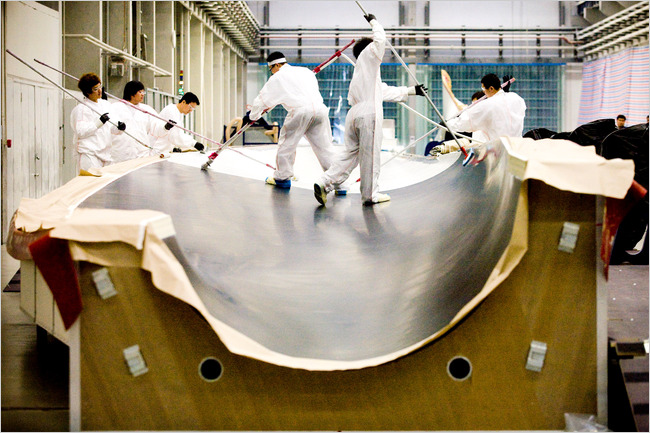
July 7, 2010 // By Joshua NickellMOREAs the world moves toward clean energy alternatives, companies in the United States and China are working to develop new, more cost-efficient manufacturing processes and increase their shares of the domestic and export markets for new renewable energy technologies. Controlling production lines and growing market share will certainly have important economic implications for both countries. But over the long term, a broader perspective suggests that cooperative initiatives to increase the capacity and reduce the cost of renewable energy technologies may produce benefits on both sides of the Pacific.
At an event co-hosted by the Wilson Center on the Hill and the China Environment Forum last month, John Romankiewicz, a senior analyst for China Clean Energy and Carbon Markets at Bloomberg New Energy Finance, and Ethan Zindler, head of North American Research at Bloomberg New Energy Finance, considered the big picture implications for U.S.-China clean energy cooperation and development.
Coming from an investment background, Zindler said that he looks at clean energy development “not as a social project, but as an industry.” The end goal, he asserted, is to produce clean energy more cheaply than fossil fuels. Zindler argued that if clean energy remains prohibitively expensive and uncompetitive without subsidies, it will be more difficult to implement and less likely to produce the desired environmental benefits.
Romankiewicz discussed China’s current supply of and growing demand for energy, pointing out that China’s power grid has grown by more than 70 gigawatts per year during each of the past 5 years, and that “at some point next year, the total installed capacity of China’s grid will surpass that of the United States.”
While coal and hydropower continue to play a significant role in meeting this growing demand, Romankiewicz noted that China also has set ambitious investment targets for wind farms, solar farms, biomass power plants, and other renewable energy sources.
China Looks to Go Global With Renewables
China is investing in clean energy not only to serve growing domestic energy demands, but also to become a major force in the international market, Romankiewicz asserted. Already, China has made impressive advances in clean energy industries: Of the top 15 wind turbine producers, four are Chinese and only two are American. Of the top 10 crystalline-silicon solar cell producers, six are Chinese.
But how will the United States impact China’s drive to become a major player in exporting clean energy technologies? Romankiewicz argued that breaking into the American market could prove exceedingly difficult for Chinese companies given the stiff competition from U.S. companies and other foreign firms.
The speakers also emphasized the importance of understanding the complex global economic implications of clean energy development. “If the Chinese are helping to drive down the cost… then they make solar less expensive,” said Zindler, “which means you can create more jobs in California or New Jersey.” Romankiewicz cautioned against reading too much into the “Made in China” label on clean energy technologies, as the supply chain could include parts from all over the world.
Though he maintained that focusing on the long-term benefits of clean energy investment in the United States would prove beneficial, Zindler advocated for a modicum of urgency. “I think a lot of opportunity would be missed potentially because there is innovation that doesn’t just come from a lab but comes from building newer and newer assembly lines,” Zindler remarked. But in the end, he characterized the U.S.-China battle for influence in the world’s renewable energy market as “a marathon, not a sprint,” asserting that “we’ve got a long way to go to determine who the winner will be in the clean energy race here.”
Joshua Nickell is a staff intern with the Program on America & the Global Economy at the Woodrow Wilson Center.
Photo Credit: <Wind Turbine Manufacture (in China),” courtesy of flickr user ANR2008. -
Eye On
U.S. Navy Task Force on Implications of Climate Change
What about climate change will impact us? That’s the question the Navy’s Task Force Climate Change is trying to answer. Rear Admiral David Titley explains the task force’s objectives in this interview by the American Geophysical Union (AGU) at their recent “Climate Change and National Security” event on the Hill.MORE
The task force is part of the military’s recent efforts to try to better understand what climate change will mean for the armed forces, from rising sea levels and ocean acidification to changing precipitation patterns. In the interview, Admiral Titley points out that for the Navy in particular, it is important to understand and anticipate what changes may occur since so many affect the maritime environment.
The Navy’s biggest near-term concern is the Arctic, where Admiral Titley says they expect to face significant periods of almost completely open ocean during the next two to three decades. “That has huge implications,” says Titley, “since as we all know the Arctic is in fact an ocean and we are the United States Navy. So that will be an ocean that we will be called upon to be present in that right now we’re not.”
Longer term, the admiral points to resource scarcity and access issues and sea level rise (potentially 1-2 meters) as the most important contributing factors to instability, particularly in places like Asia, where even small changes can have huge impacts on the stability of certain countries. The sum of these parts plus population growth, an intersection we examine here at The New Security Beat, is something that deserves more attention, according to Titley. “The combination of climate, water, demographics, natural resources – the interplay of all those – I think needs to be looked at,” he says.
Check out the AGU site for more information, including an interview with Jeffrey Mazo – whose book Climate Conflict we recently reviewed – discussing climate change winners and losers and the developing world (hint: the developing world are the losers).
Sources: American Geophysical Union, New York Times.
Video Credit: “What does Climate Change mean for the US Navy?” courtesy of YouTube user AGUvideos.Topics: Arctic, Asia, climate change, demography, environment, environmental security, Eye On, military, natural resources, oceans, population, security, video
 A Publication of the Stimson Center.