-
“Better Bang for the Buck”: Blogging From Ethiopia’s Population, Health, and Environment General Assembly
March 18, 2011 // By Schuyler NullMORE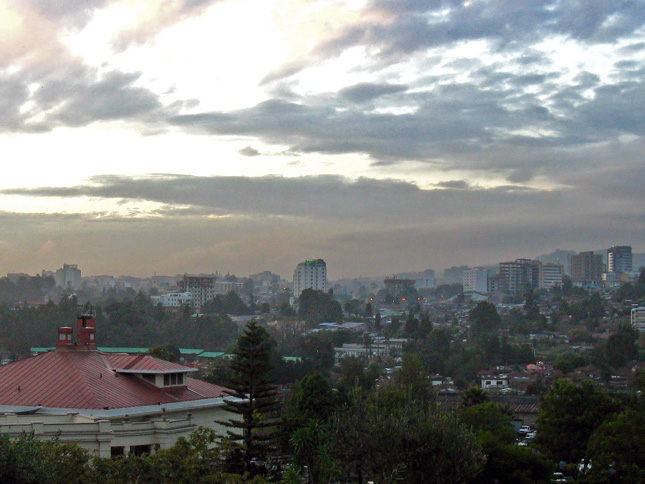
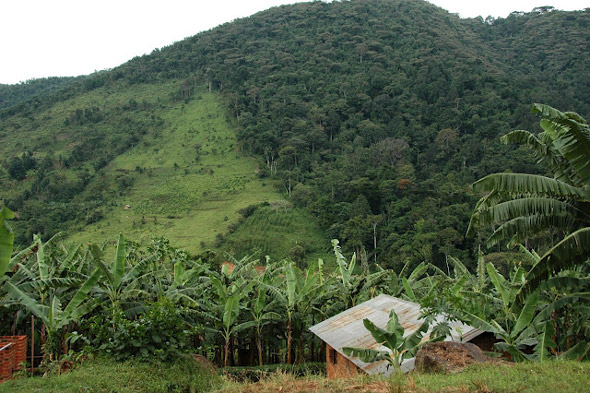
Hello from Addis Ababa, where I am blogging from the 5th annual general assembly of the Population, Health, and Environment (PHE) Consortium of Ethiopia (see further coverage here). Along with the Philippines, Ethiopia is the largest PHE programmer in the world, both in terms of number of programs and people affected, and for good reason: The country combines dire need, willing donors, and a great deal of local capacity and will.
-
From the Wilson Center
Make Sure Women Can Lead in the Middle East
MOREIn Libya, Egypt, Bahrain, Yemen, Tunisia, and elsewhere, women have stood with men pushing for change. In Libya, Iman and Salwa Bagaighif are helping lead, shape, and support protesters. And in Egypt, the Egyptian Organization for Human Rights, one of the oldest and most well-known non-governmental organizations in Egypt, estimated that at least 20 percent of the protesters were women.
For example, the 26-year-old co-founder of Egypt’s April 6 Youth Movement, Asmaa Mahfouz, mobilized thousands of youth in support of the protest through her impassioned YouTube video. In Yemen, a 32-year-old mother of three, Tawakkul Karman, helped organize protests against the current government.
History of Frustration
Yet women’s leadership is not a new phenomenon. In Iran, women have for many years successfully pushed for greater freedom in personal status law and greater employment and educational opportunities. Many Iranian women have been imprisoned simply for endorsing the Million Signature Campaign, which seeks equal rights and the repeal of laws that discriminate against women.
Women have been using social media and leveraged communications technology to pursue greater social and political openness since before the arrival of Iranian President Mahmoud Ahmadinejad. Notwithstanding a rich history of non-violent activism and extraordinary leadership, women have rarely been involved in political decision-making in the Middle East and North Africa region.
At an even more basic level, women do not feel confident that their rights will be preserved under the systems emerging from recent political transformations.
In Iraq, there have been female judges since the 1950s and thus many of women’s rights have been protected since 1978 by a personal status law. Yet in 2003, the new Iraqi Governing Council sought to strip women of these rights. Only in the face of domestic petitions, letter writing, and face-to-face advocacy were women successful in ensuring their rights were preserved. Iraqi women continue to face efforts to reduce their freedoms and each time they have defeated the assault.
Already Egyptian women are risking similar marginalization. There are no women on the committee revising the constitution. In an almost uncanny parallel to the struggle of Iraqi women after former President Saddam Hussein, Egyptians have drafted a petition, endorsed by over 60 local organizations, decrying women’s absence from transitional political bodies.
Bias embedded in the new draft constitution suggests that these concerns may be real.
“Prerequisite for an Arab Renaissance”
The international community and the new generation of progressive, democracy-minded leaders in the Middle East need to see women as critical partners for change. The evidence is indisputable. The 2005 UN Arab Human Development Report cautions that under-employment and under-investment in women severely drains overall well-being and concludes that “the rise of women is in fact a prerequisite for an Arab renaissance, inseparably and causally linked to the fate of the Arab world.”
The world has an unprecedented opportunity to transform nations held down for decades by oppressive regimes. We must make sure that this opportunity is open to all citizens, including women.
Women’s role must be honored in the struggle and protected against the fundamentalist push. Most importantly, their involvement will be key to enabling pluralistic, economically thriving societies to emerge in a region where progress has been stalled for generations.
The window is small but the time is now and the opportunity is enormous. As we celebrate the 100th anniversary of International Women’s Day, let’s remember how critical advancing the status of women will be to success.
Carla Koppell is director of The Institute for Inclusive Security. Haleh Esfandiari is director of the Wilson Center’s Middle East Program. This article was originally written for the Common Ground News Service.
Sources: UN Development Programme, Women Living Under Muslim Laws.
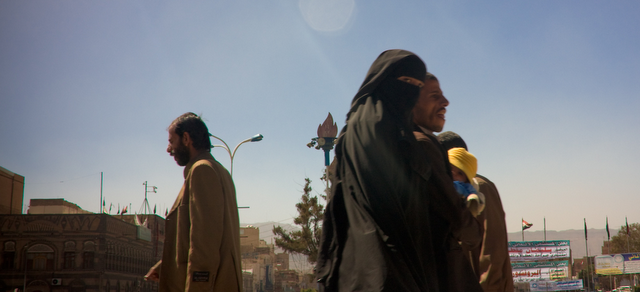
Photo Credit: Adapted from “Just Passing Through,” courtesy of flickr user Alexbip. -
Watch: Roger-Mark De Souza on the Scaling Advantages of Population, Health, and Environment Integration
March 11, 2011 // By Schuyler NullBy integrating population, health, and environment (PHE) efforts, development programs can make a difference in people’s lives in a real and meaningful way – one which they understand, appreciate, and desire, said Roger-Mark De Souza in this interview with ECSP. De Souza is the vice president of research and director of the Climate Program at Population Action International.MORE
The PHE approach “allows itself to be applied at different levels,” said De Souza. “It’s easily implemented at the level of a village, or a town, or a city where a number of individuals can say ‘these are concrete results and outcomes that we want in our lives and that we want to live our lives in an integrated way.’”
PHE interventions not only provide tangible results to individuals, said De Souza, but they also help accomplish broader policy objectives, including improving health and alleviating poverty.
“There are lessons to be learned from different areas of integration, not just population, health, and environment,” De Souza said. For example, initiatives that integrate food security and HIV/AIDS deal with issues “similar to the ones we deal with in integrating population, health, and environment,” he said. Lessons and experiences need to be shared between these communities, but they also share similar advantages: From a cost-efficiency stand point, integration simply provides greater “bang for the buck,” he said. -
Eye On
Mapping the Hot Spots of the 2010/11 Food Crisis
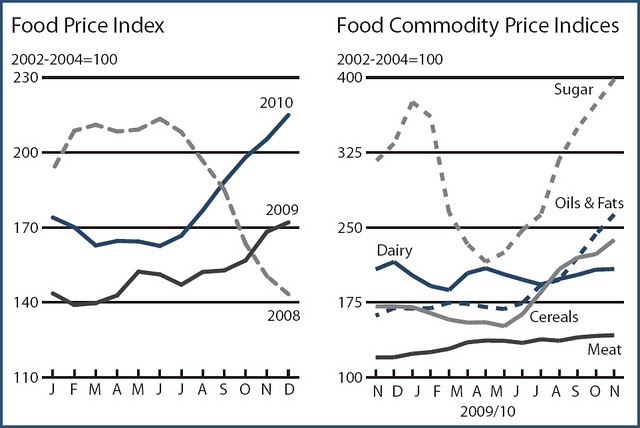
MOREIf you’ve taken a trip to the supermarket lately or scanned the headlines you may have noticed something: Food prices are on the rise. Worldwide, food prices are on track to reach their highest point since their peak in 2008. Using data from the Food and Agriculture Organization (FAO), the International Food Policy Research Institute (IFPRI), and the World Bank, the Environmental Working Group (EWG) and ActionAid have collaborated to create an interactive world map called, “Hot Spots in the Emerging Global Food Crisis.”
The focus of the map is to highlight the 52 most at-risk countries where increases in staple food prices could tip the scales of stability. There are three variants of the map to choose from: countries at risk which depend on imported cereals, countries where prices are already increasing (featured above), and countries with vulnerable economies and high rates of hunger.Food prices have become a hot topic of conversation lately for their alleged role in the instability that is rocking the Middle East/North Africa region. But the Middle East is not the only area affected: Besides in Algeria, Tunisia, Morocco, Jordan, and Egypt, food-related riots and protests have also broken out in Mozambique, Bolivia, and India. As the map’s accompanying text puts it, these food riots “feed deeper discontent about economic inequalities and hunger and help give rise to revolutions that can topple governments, as in Tunisia and Egypt.”
Scrolling over a country reveals more information, like, for example, the specific percentage increases in the price of wheat or rice over the past year (wheat prices have risen 15.9 percent in China vs. 54 percent in Kyrgyzstan) or the amounts of corn, soybean, and wheat annually imported and exported (Afghanistan exported 908 million metric tons of wheat in 2010 while Egypt imported 4,978).
Users can also click on vulnerable countries to see how many people are malnourished and their per capita income per day. In the Democratic Republic of the Congo, for example, an estimated 42 million people were undernourished between 2005 and 2007, and the average person lives on $0.28 per day. According to EWG and ActionAid, the total number of people living in extreme poverty rose by 25 million in 2008 during the last global food crisis. Since June 2010, the start of the current upward trend in prices, the World Bank estimates that 44 million people have fallen into extreme poverty.
One recommendation from EWG and ActionAid for developed countries and the United States in particular: Stop looking to biofuels as an energy option. In their view, “spending scarce taxpayer dollars to shift crops from food to biofuels at the expense of hungry people and already stressed resources like soil, water, and air is unsustainable.”
Image Credit: Map courtesy of the Environmental Working Group and ActionAid, and Food Price Index and Food Commodity Indices, extracted from Global Food Price Monitor, January 2011, courtesy of the Food and Agriculture Organization.
Sources: ActionAid International, BBC News, CNN, the Environmental Working Group, The European Union Times, Time, Voice of America, World Bank. -
Watch: Richard Cincotta on Political Demography and Unrest in the Middle East
March 9, 2011 // By Schuyler Null“Countries that have a high proportion of young people are typically more prone to political violence,” said demographer-in-residence at the Stimson Center, Richard Cincotta, in this interview with ECSP. “That is, not necessarily international war [but] internal conflict, which may take different forms,” including civil and ethnic strife, domestic terrorism, and violent political demonstrations.MORE
The role of unemployed and angry youths in the recent unrest that has swept the Middle East has received a great deal of coverage, but though the region in general is very young, some countries are more so than others.
Tunisia (median age of 29) is actually well into its demographic transition, where fertility declines towards replacement level. “Fertility – the number of children women have in their lifetime – is now lower than it is in the United States,” said Cincotta. As a result, Tunisia’s prospects for achieving a stable, liberal democracy – based on the historical relationship between age structure and political freedoms (see Cincotta’s full post on Tunisia and the two follow-ups for a more complete treatment of that relationship) – are about even.
In contrast, Egypt’s age structure remains young (median age of 24) and Yemen’s (median age of 17) is extremely young. “Those difference are very stark,” said Cincotta, and they play out in the risk of political violence: Tunisia is less likely to experience continuing political violence; Egypt, more so; and Yemen, even more likely.
The relationships between age structure and political violence and the emergence of democratic institutions can be useful in other conflict-prone regions as well. “Afghanistan, Pakistan, Iraq, the Palestinian Authority, most of the central band of sub-Saharan Africa – from Nigeria to the Congo, to Kenya and Ethiopia – we know that these countries are volatile, we’re not always sure why,” said Cincotta. But “age structure gives you a clue, because it tells you something about a lot of barriers that are important to development.”
Sources: UN Population Division.Topics: Afghanistan, Africa, conflict, democracy and governance, demography, development, DRC, Egypt, Ethiopia, Iraq, Kenya, Middle East, Pakistan, Tunisia, video, youth -
From the Wilson Center
Of Revolutions, Regime Change, and State Collapse in the Arab World
MOREThe original version of this article, by David Ottaway and Marina Ottaway, was published by the Wilson Center’s Middle East Program.
With breath-taking speed, massive popular protests across the Arab world have swept away two Arab strongmen and shaken half a dozen monarchies and republics to their core. But the Arab world has yet to witness any fundamental change in ruling elites and even less in the nature of governance.
Libya now seems poised to be the first country to see a true change in governance, thanks to Muammar Qaddafi’s megalomania and his amorphous jamahiriya (state of the masses). But such change may not have a happy ending. The damage Qaddafi has inflicted on his country is likely to extend well past his demise because he leaves behind a weak state without functioning institutions.
The uprisings sweeping across the Middle East have similar causes and share certain conditions: authoritarian and ossified regimes, economic hardship, growing contrast between great wealth and dire poverty, all worsened by the extraordinarily large number of young people who demand a better future. But the consequences will not be the same everywhere.
Tunisia and Egypt: A System Still in Place
Pro-democracy protesters in Tunisia and Egypt have been quick to use the word “revolution” to describe their astounding achievement in forcing Presidents Zine el Abidine Ben Ali and Hosni Mubarak from power after decades of rule. Tunisia’s “Jasmine Revolution” and Egypt’s “January 25 Revolution” have certainly injected the long-silenced voice of the people into the autocratic politics of the region. But they have not brought to the fore a new ruling class, system of governance, or the profound social and economic changes associated with the classical meaning of revolution. And it remains to be seen whether they will succeed in doing so.
Continue reading at the Wilson Center’s Middle East Program.
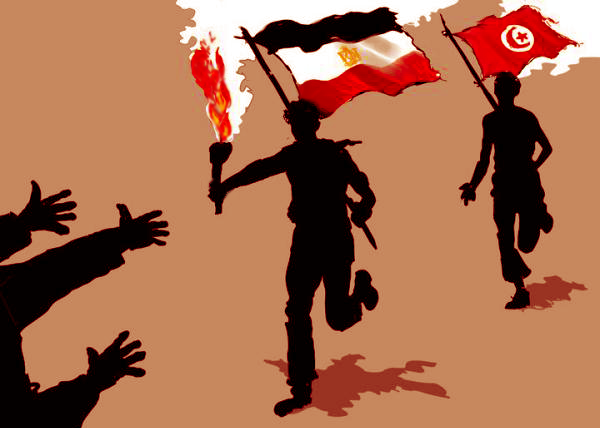
Photo Credit: Adapted from “Libya-protests_025,” courtesy of flickr user Crethi Plethi. -
Friday Podcasts
Joan Castro on Integrated Population and Coastal Resource Management in the Southern Philippines
MOREIn the southern Philippines, the innovative IPOPCORM program “worked in areas where there is high…marine biodiversity, high population, and high population momentum, which means…about 40 percent of the population are 15 years and below,” Joan Castro told ECSP in this interview. Castro, the executive vice president of PATH Foundation Philippines, Inc., recently spoke at the Wilson Center on the state of integrated development efforts in her country and elsewhere.
From 2000-2006, IPOPCORM (which stands for “integrated population and coastal resource management”) sought to integrate population, health, and environment (PHE) development efforts in Philippine communities. They had four primary objectives, said Castro: 1) improve the reproductive health of the community members; 2) improve management of the coastal resources; 3) increase knowledge of the linkages between population, health, and the environment; and 4) increase the capacity of community leaders to advocate for these links.
“The aspect of livelihoods was very essential,” said Castro, especially for empowering women in the communities. Through family planning services and micro-credit finance initiatives, women were able to better space their pregnancies and contribute to household incomes, she said. In addition, by establishing locally managed, marine protected areas, IPOPCORM increased the protection of high biodiversity zones and improved the likelihood that there will be enough fish to feed future generations.
The “Pop Audio” series is also available as podcasts on iTunes. -
Beat on the Ground
Encouraging Childhood Education and Birth Spacing as an Approach to Conservation
MOREThis PHE Champion profile was produced by the BALANCED Project.
Fifty-one-year-old Sam Rugaba is a dedicated teacher who loves his job at the Bujengwe Community Primary School. The school is the result of a community-based project located in the Bujengwe Parish of the Kayonza subcounty in the Kanungu district of Uganda – just 18 kilometers from the Bwindi Impenetrable National Park (BINP). The biodiversity-rich BINP is home to many rare species including the endangered mountain gorilla. Sam is also a Conservation Through Public Health(CTPH) community volunteer and community conservation health worker.
 A Publication of the Stimson Center.