Showing posts from category Africa.
-
Send in the Scientists, Says Finnish MP
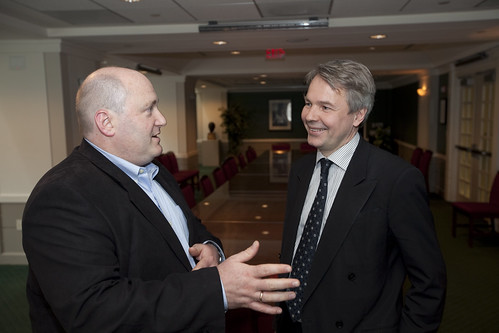
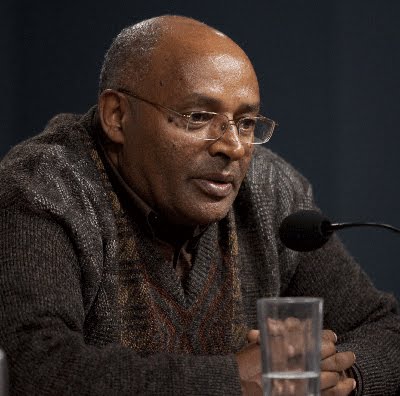
›April 1, 2010 // By Sean PeoplesPekka Haavisto, a Member of the Finnish Parliament, thinks an objective scientific investigation of rumored toxic waste in Somalia would be both doable and politically useful. Haavisto, the former Finnish minister of environment, visited the Woodrow Wilson Center last week and spoke with the Environmental Change and Security Program’s director Geoff Dabelko.
Dabelko wrote about Haavisto’s ideas for a Somalia environmental assessment after a conversation they had late last year in Helsinki:Haavisto is an enthusiastic advocate for environmental missions that may improve the desperate conditions resulting from violent conflicts. “We should be talking with all the factions,” he told me, to investigate the toxic waste charges. Such a thorough and objective assessment could provide a rare and potentially valuable avenue for addressing underlying suspicions and grievances some Somalis hold against those whom they claim dump waste off shore and overfish their waters.
It’s no surprise Haavisto focuses on using scientific environmental assessments in conflict settings. He is the former chairman of the UN Environment Programme’s Post-Conflict Assessment Unit (PCAU)—now called the Disasters and Conflicts Programme—the Geneva-based UNEP unit that assesses environmental threats, remediates hot spots, builds capacity, and supports peacebuilding around environmental issues in post-conflict settings. Haavisto presented UNEP’s work at the Wilson Center in a 2004 presentation. His colleagues, including UNEP Executive Director Achim Steiner, have subsequently launched more recent UNEP contributions at the Wilson Center. ECSP Director Geoff Dabelko serves on UNEP’s Expert Advisory Group on Environment, Conflict, and Peacebuilding. -
Guerrillas vs. Gorillas in the Congo Basin
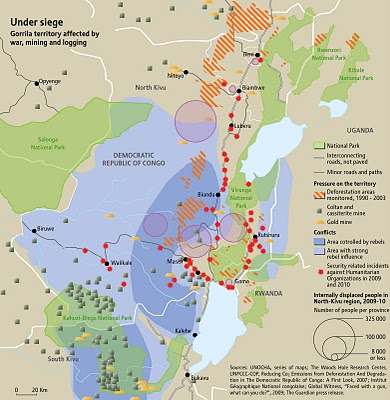
›Gorillas could disappear from the Congo basin in the next 10-15 years, according to a new report issued by the United Nations and Interpol. The Last Stand of the Gorilla – Environmental Crime and Conflict in the Congo Basin places responsibility for the decline of gorilla populations in the Democratic Republic of the Congo and its surrounding region squarely on the shoulders of resource-hungry militants, who poach gorilla bushmeat to feed hungry soldiers and mine workers and sell in local markets. Militants extract timber, charcoal, diamonds, and other resources to raise funds for arms, reducing gorilla territory.
Yet another rationale is retaliation against park rangers who attempt to limit their illegal activities within national parks. In the process, park rangers have found themselves, their parks, and their endangered charges targets of militant groups seeking to plunder and traffic goods through protected areas. “In Virunga Park alone, 190 park rangers have been killed in the last 15 years,” notes the report, which is also available in an interactive e-book edition.
Conflict with local communities also frequently leads to the slaughter of the gorillas and loss of their habitats. Displaced people and refugees also compete with gorillas for land. In several cases, gorillas facing shrinking natural domains have satisfied their appetites in banana plantations, and local farmers have struck back.Strengthening Law Enforcement
Not all, however, is dire. The report finds several success stories stemming out of transboundary law enforcement collaboration and recommends increased training and support for local and international law enforcement groups. “The gorillas are yet another victim of the contempt shown by organized criminal gangs for national and international laws aimed at defending wildlife,” said David Higgins, Interpol’s Environmental Crime Programme Manager. “The law enforcement response must be internationally coordinated, strong, and united, and Interpol is uniquely placed to facilitate this.”
Law enforcement in the Congo Basin faces an uphill battle, in part due to conditions present in peace agreements between guerillas and the Congolese government. Removing vehicle checkpoints from important border crossings was key to the insurgents agreeing to peace. While these agreements reduced violence, they have created a highway for illegal exports. This trade props up the militant groups and undercuts the chances for peace on a regional scale. It is an example of how large remaining quantities of automatic weapons and turns to poaching by ex-militants can render post-conflict environments even more damaging to local wildlife than war itself.
Toward Coexistence
In some locations, conflicts between gorillas and local farmers are disappearing with the construction of natural barriers and as local populations realize the potential of ecotourism to generate greater revenue from thriving gorilla populations than collapsing ones. Greater international coordination and local commitment, however, are necessary. Turning threatening competition into beneficial cooperation is possible.
Tara Innes is a PhD student at the University of Maryland, studying conflict-environment linkages.
Photos: Gorilla, courtesy Flickr user mrflip; Gorilla Territory Affected by War, Mining, and Logging courtesy UNEP/GRID-Arendal. -
The Plight of Urban Refugees in Nairobi
›“The Traditional image of life in tented sprawling camps no longer tells the full refugee story.”– Hidden and Exposed: Urban Refugees in Nairobi, Kenya
Coinciding with the end of UN-HABITAT’s 5th World Urban Forum, a new report and associated video, Hidden and Exposed: Urban Refugees in Nairobi, Kenya, have been released by the Humanitarian Policy Group (HPG) at the Overseas Development Institute (ODI) and the International Rescue Committee (IRC).
Hidden and Exposed removes the cloak of migration stereotypes and provides an unfiltered look at urban migrants’ struggle for daily survival. Focusing on seven neighborhoods with high refugee concentrations in Nairobi, the authors — through qualitative interviews and secondary data — found a unique, challenging urban environment for thousands of refugees. Aid and development groups often overlook these urban refugees, instead favoring work with traditional established camps on the urban periphery.
The HPG found that Nairobi’s 46,000 registered refugees represent a diverse mix of ethnic groups and nationalities, all trying to secure economic independence and security. While much research has been devoted to the traditional concept of displaced migrants in centralized ex-urban camps, such as Dadaab in Eastern Kenya, urban dwellers are just as vulnerable to insecurity, poverty, and harassment. With nebulous legal rights, facing discrimination and protected by only fragile support systems, the refugee community in Nairobi finds itself in a precarious situation.
In light of the challenges, the research team at HPG offered three basic recommendations as initial steps:
1. Protection:
2. Livelihoods:- Address confusion over legal rights to prevent issues of police harassment and community violence.
- Target a subset of donor funds for training local police forces and government agencies.
- Establish partnerships between the UNHCR and the Kenyan government to improve the latter’s Refugee Status Determination System.
- Funnel humanitarian and development aid toward legal aid services while also using innovative strategies to increase dialogue between urban refugees and the surrounding Kenyan communities.
3. Service Delivery:- Carry out surveys to better understand the Nairobi urban economy, including the informal sector.
- Support the government of Kenya in their efforts to help urban refugees to become self-reliant.
- Recognize the transition of refugees from sequestered camps to urban areas and develop an effective response.
- Secure Kenyan government permission for the issuance of work permits for refugees.
Fleeing conflict and attracted by the possibility of better jobs, services, or security, thousands of refugees have sought new lives in Nairobi. Yet the reality for many urban migrants is an existence burdened with inadequate assistance, a precarious legal status, and economic and physical insecurity. Through the implementation of these recommendations, HPG hopes to draw attention to these hidden refugees, and offer them the hope of improved livelihoods and effective security.- Design aid models to address the unique challenges faced by urban refugees in Nairobi.
- Ensure coordinated and comprehensive services, in conjunction with the Kenyan government and international organizations, to address the needs of the urban refugees and the surrounding communities, with particular attention granted to refugee women and girls.
-
Maintaining the Momentum: Highlights From the Uganda International Conference on Family Planning
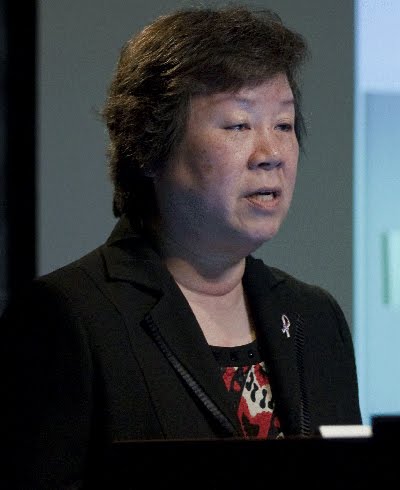
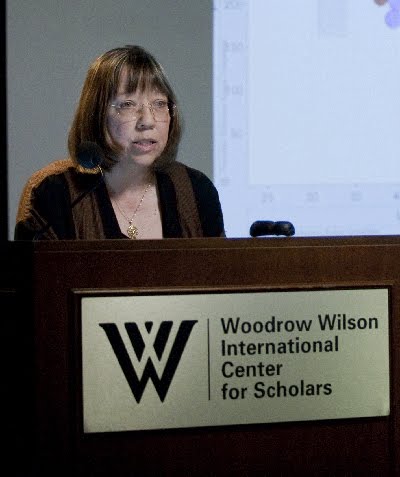
›“Family planning is to maternal survival what a vaccination is to child survival,” said Johns Hopkins professor Amy Tsui, quoting Khama Rogo of the World Bank, at the Woodrow Wilson Center event Maintaining the Momentum: Highlights From the Uganda International Conference on Family Planning on March 16. Rogo made the strong statement during the landmark November 2009 conference in Kampala, which has renewed interest in family planning and reproductive health among African leaders and development partners. Rhonda Smith of the Population Reference Bureau and Sahlu Haile of the David and Lucile Packard Foundation joined Tsui, the director of The Bill & Melinda Gates Institute of Population & Reproductive Health, to discuss their impressions of the Kampala conference and what it means for the future of family planning in Africa.
“An event that happened at the right time”
“Kampala was the work of a community,” said Tsui. More than 50 organizations—the U.S. Agency for International Development, the UN Population Fund, the World Bank, the World Health Organization, and the Gates and Packard Foundations—convened in Uganda, which was chosen not only for its central location, but also to highlight the country’s soaring unmet need for contraception—41 per cent—and rapid 3.1 percent population growth rate.Panels focused on key issues in family planning, including:- Integrating family planning into HIV/AIDS care
- Integrating family planning in post-abortion, postpartum, child, and other primary health care
- Expanding contraception delivery services by community health workers
- Increasing outreach to youth and men
- Capitalizing on private and public innovations in service delivery and financing
- The United States announced its foreign assistance budget will increase support for family planning from $450 million to $715 million for the next fiscal year.
- The Global Health Initiative identified maternal/child health and family planning as one of its main priority themes.
- Secretary of State Clinton positively discussed girls’ education, family planning, and reproductive health at the ICPD + 15 anniversary.
- The Women Deliver 2010 Conference, to be held in June, has identified family planning as a third pillar of maternal health.
Uganda on the MoveRhonda Smith’s presentation “Uganda on the Move”—which she also presented in Uganda—is a prototype of the Population Reference Bureau’s new ENGAGE (Eliminating National Gaps—Advancing Global Equity) project, which is designed to “engage policy audiences and promote policy dialogue around issues of high fertility and high unmet need for family planning and their costs, consequences, and solutions,” she said. By using stunning, innovative graphics and avoiding confounding technical terms, ENGAGE’s products are designed to reach non-technical policy audiences and influential decision-makers.
As one of the Uganda conference’s most talked about presentations, “Uganda on the Move” wows audiences with visuals created using Hans Rosling’s Trendalyzer software. The presentation shows that although Ugandans are increasingly healthier, have a higher life expectancy, and are more educated, maternal health remains in jeopardy. Tellingly, 46 percent of pregnancies in the country are unplanned, 6,000 women die each year from complications related to pregnancy, and 1,200 women die each year from undergoing unsafe abortions.
Maternal deaths, however, do not tell the whole story: For every one woman dying, Smith said, 20-30 women suffer from short-term disability, which places a major strain on economic growth. From 2004 to 2013, maternal death will cost Uganda US$350 million in lost productivity; and disability will cost and additional US$750 million.
What Next? The African Perspective“After 10 years of virtual clandestine work, [family planning] is just coming out of the closet,” said Sahlu Haile. Over the last few decades, family planning advocates have been struggling to: 1) keep family planning alive—without it being affected by political considerations 2) make family planning a health priority, without any associations with rights violations; and 3) be in solidarity with pioneering organizations of the family planning movement, like the International Planned Parenthood Federation, that were victims of discriminatory funding decisions.
The Uganda conference changed all that, said Haile. In Uganda, conference attendees were “talking about family planning…not reproductive health, not maternal/child health.” This, he said, was “probably the single most important lesson…that I took from the Kampala conference.”
Following the conference, Haile said that African government officials stressed family planning as a priority at meetings in Ethiopia and Nigeria—the first time he had witnessed such high-level attention to family planning from those countries in his 30-year career.
In Ethiopia, African leaders pledged to:- Prioritize family planning, since family planning is one of the most cost-effective development investments;
- Ensure access to contraception, as 40 percent of maternal deaths are associated with unwanted pregnancies; and
- Integrate MDG 5b, universal access to reproductive health, into their international development plans and budgets.
Haile credited the Kampala conference for spurring these efforts. In December, he joined a task force of 14 Ethiopian organizations to plan the next steps. They will jointly develop research capacities, generate evidence, and strengthen monitoring and evaluation practices, especially with regard to integrating population, health, and environment efforts. In addition, they will engage with wider audiences via new tools such as the blog RH RealityCheck and Gapminder Foundation’s Trendalyzer program.
Haile believes we need to “work together to encourage national-level efforts…to make sure family planning stays where it is now and make sure it is not abandoned.”
To be a part of the new online family planning community, join the Kampala Conversation.
Photo 1: A women and her children in Jinja, Uganda. Courtesy Flickr user cyclopsr. Photos of Amy Tsui, Rhonda Smith, and Sahlu Haile courtesy of Dave Hawxhurst, Woodrow Wilson Center. -
Healing the Rift: Mitigating Conflict Over Natural Resources in the Albertine Rift
›March 2, 2010 // By Dan AsinConservation practitioners realize they must deal with conflict but often lack the training to do so, says Dr. Andrew Plumptre, director of the Wildlife Conservation Society’s (WCS) Albertine Rift Program. Moreover, they don’t realize their conservation efforts—by restricting access to resources or creating new burdens, costs, and risks for communities—are at times directly responsible for spawning new conflicts where none existed before.
In a recent presentation—Healing the Rift: Mitigating Conflict Over Natural Resources in the Albertine Rift, sponsored by WCS and the Africa Biodiversity Collaborative Group—Plumptre used his work with WCS in the Albertine Rift as a launch pad to discuss how conservation practitioners can work to mitigate conflict.
Achieving “Conflict-Sensitive Conservation”
“Conflict-sensitive conservation,” as outlined in an International Institute for Sustainable Development‘s practitioners’ manual developed in conjunction with WCS, is a multi-step process:- Identify—What are the area’s current or potential conflicts?
- Prioritize—Which conflicts are the most serious?
- Target—Which high-risk conflict does my organization possess the capacity to address?
- Analyze—What are the causes and effects of conflict? Who are the stakeholders, what are the relationships between them, and which should we seek to engage?
- Design & implement solutions—With what strategy should the conflict be approached? At which point in the conflict cycle should we seek to intervene?
- Monitor—Continue to watch the area for new developments.
Plumptre’s fieldwork on the DRC’s Virunga National Park is one of the case studies in Renewable Natural Resources: Practical Lessons for Conflict-Sensitive Development, recently published by the World Bank. Conflict in the park began in 1996, when an influx of internally displaced persons from the war in the DRC poured into the area, placing severe strains on the park’s fish, wildlife, timber, and agricultural resources.
In 2006, Plumptre and his WCS colleagues entered Virunga and identified four challenges they could best address:- Overfishing on Lake Edward
- Military poaching
- Park encroachment
- Conflict with displaced Ugandan pastoralists
- To combat overfishing, WCS helped villages establish sustainable targets and implement internal policing mechanisms
- To curtail encroachment and poaching by the military and those living in the greater Virunga National Park area, WCS trained Congolese Park Authority (ICCN) staff in enforcement and monitoring techniques, established channels of communication with military commanders, and engaged in general and targeted environmental educational campaigns.
- To relieve resource pressures from the presence of Ugandan pastoralists, WCS worked with the Congolese and Ugandan governments to ensure pastoralists could safely and freely return to Uganda to settle elsewhere.
Beyond Virunga National Park
Since completing their project in 2007, Plumptre and his team have established similar projects in Kahuzi-Biega National Park, the Itombwe Massif, and Misotshi-Kabogo. Now, however, they are working to prevent conflicts before they take root. WCS has guided communities in the Misotshi-Kabogo area to work together to petition the Congolese government to turn their territory into the DRC’s 8th national park.
Climate change is predicted to spur local, often intra-state or regional, migrations in response to droughts and flooding. Could these migrations lead to similar resource conflicts in the future? The rate of migration, governance and carrying capacities of the absorbing communities, and economic status of the migrants will all come in to play. In cases where conflict might result, Plumptre’s work successfully demonstrates that “conflict-sensitive conservation” should have a place in the peacebuilders’ toolkit. -
Climate Change and Conflict
›Climate Change and Security in Africa: A Study for the Nordic-African Foreign Ministers Meeting, a collaboration between the International Institute for Sustainable Development and the Institute for Security Studies, examines the spectrum of literature devoted to the security implications of climate change in Africa. In particular, the study focuses on the economic sectors and regions most susceptible to climate change’s threat multiplier effects. It concludes that “climate change presents very real development challenges which, under certain circumstances, may contribute to the emergence and longevity of conflict.”The International Institute for Sustainable Development’s Rising Temperatures, Rising Tensions: Climate Change and the Risk of Violent Conflict in the Middle East determines that “climate change—by redrawing the maps of water availability, food security, disease prevalence, population distribution and coastal boundaries—may hold serious implications for [the Middle East’s] regional security.” The report identifies the Middle East’s history of conflict as a significant challenge to the region’s ability to cope with climate change’s threats of water scarcity, food insecurity, and volatile migration. Rising Temperatures, Rising Tensions also discusses strategies to advance both adaptation and peacemaking in the region.Using the coinciding outbreaks of regional drought and inter-communal violence in Kenya in 2009 as an illustration, Climate Change and Conflict: Lessons from Community Conservancies in Northern Kenya Conservation Development examines climate change’s potential to act as a threat multiplier in Northern Kenya. The study, jointly produced by the Saferworld, concludes “that the threat of increased conflict in northern Kenya as a result of climate change is real” and “that resource scarcity is already contributing to heightened insecurity and conflict in these areas.” The study also provides recommendations for responding to climate change, managing natural resources, and preventing conflict and ensuring security. -
VIDEO—Pape Gaye: Improving Maternal Health Training and Services
›February 12, 2010 // By Julia Griffin“Training is probably one of the biggest interventions in terms of making human resources available,” says Pape Gaye, President and CEO of IntraHealth International, to ECSP’s Gib Clarke in this interview on improving maternal health services in developing countries. “Unfortunately, there are a lot of problems associated with training.”
Gaye says obstacles to scaling up maternal health services in rural areas include employee gender inequalities, poor coordination of supplemental training, and a tendency to only offer in-service training in urban areas. Properly emphasizing pre-service education, he underscores, could remedy some of the problems associated with service provider training.
Increasing retention of medical practitioners is also critical to improving maternal health services in developing countries, Gaye explains. In his experience, however, attempts to address perceived security and financial compensation inadequacies produced mixed results. Instead, Gaye suggests that positive recognition may be one of the best methods for retaining health care workers. “We’re seeing some very good successes in places where we have just simple ways to recognize the work… because if people feel valued in a community, then they are likely to stick it out.” -
Video—Integrating Population, Health, and Environment (PHE) to Conserve Ethiopian Wetlands
›February 1, 2010 // By Julia GriffinIn our latest video interview about PHE programs in Ethiopia, Zuna–a village elder from the Mettu Woreda region of Ethiopia—describes how an integrated intervention by the Ethio-Wetlands and Natural Resources Association (EWNRA) has benefited her community.
EWNRA aims to raise awareness within Ethiopian communities and governmental organizations of the importance of sustainable wetlands management. The organization also imparts local-level training on resource conservation and wise-use labor techniques.
Zuna recounts how EWNRA provided welcome training in sanitation and housekeeping practices that increased both safety and sustainability within her community. The more efficient, cleaner-burning wood stoves introduced in Mettu Woreda, for example, have improved local air quality while decreasing the frequency of skin burns and amount of harvested fuel required for cooking and other activities.
“We are benefiting from all this and I think the benefits from this intervention are good,” she says through an interpreter. “I want them to keep doing this and hopefully we will improve our activities working with them.”