-
Opportunity Amidst Conflict: Margie Buchanan-Smith on Long-Distance Trade and Peace-Building in Darfur
January 17, 2014 By Laura Henson
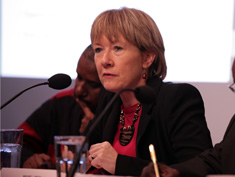
Trade is “the lifeblood of Darfur’s economy,” says Margie Buchanan-Smith in this week’s podcast.
Buchanan-Smith, a visiting fellow at Tuft University’s Feinstein International Center and the lead author of a recent study on livestock trade in Sudan, presented at the Wilson Center in November about the Feinstein Center’s collaboration with the UN Environment Program studying pastoralism in Sudan during the last decade of conflict.
Trade is “the lifeblood of Darfur’s economy,” says Margie Buchanan-Smith in this week’s podcast.
Buchanan-Smith, a visiting fellow at Tuft University’s Feinstein International Center and the lead author of a recent study on livestock trade in Sudan, presented at the Wilson Center in November about the Feinstein Center’s collaboration with the UN Environment Program studying pastoralism in Sudan during the last decade of conflict.
“The reason we think this work is so important is that actually you can understand a lot about the conflict dynamics by understanding trade dynamics – whose trading with who, where is it safe to trade, [and] which trading routes the trade is using,” she says. Trade is a “key point of connection between different livelihood groups and different ethnic groups, and it has, for decades and centuries, been a very important factor in building those social ties.”
Buchanan-Smith says she and her team saw “constantly shifting trading activity according to the conflict dynamics” during their three-year study. “As we know, traders are extremely flexible and adaptive, and Darfur’s traders I think have a reputation for their entrepreneurialism.” Based on rough estimates, Darfur’s livestock trade may have contracted by as much as 50 percent in the early years of the conflict – longer routes, armed guards, and informal taxes at security checkpoints increased costs by as much as 900 percent, she says. But still, trade continued. Pastoralists and traders developed longer trade routes to avoid the worst areas, reduced herd sizes to lessen risk, and shifted trade hubs to more secure towns.
The cash-crop market also contracted significantly during the violence and has only recently recovered, albeit marginally, says Buchanan-Smith. She explains that the conflict affected some crops more than others. For example, sesame has a very narrow harvest window of just one week; if the farmer losses access to the field during that week, then the harvest is lost.
“Yet there are some economic opportunities associated with Darfur’s shifting settlement pattern,” she says. Urbanization has created a burgeoning dairy industry, rising demand for meat, and a growing trade in hides and skin going to West Africa. “In both the livestock trade study and the cash crop study, we found examples of trade agreements being made between groups that were otherwise hostile to each other in the current conflict,” she says.
“When you have a conflict that’s going on for a decade and more, it’s incredibly important to understand that bigger picture, and to understand what’s happening in terms of the wider economy, particularly to inform any interventions to support livelihoods and to find ways of actually supporting the economy in the longer term.”
Buchanan-Smith spoke at the Wilson Center on November 13. Download her slides to follow along.
Friday podcasts are also available for download on iTunes.
 A Publication of the Stimson Center.