-
“The Himalayas Are Pushing Back”: Keith Schneider on Why India Needs to Forge Its Own Path to Development
April 11, 2014 By Donald Borenstein
India has the second largest – soon to be largest – population of any nation on the planet and boasts a rapidly developing economy, yet it consumes only a fraction of the energy of China or the United States. Much like China before it, the Indian government has proposed an ambitious system of hydroelectric projects in an attempt to catch up.
India has the second largest – soon to be largest – population of any nation on the planet and boasts a rapidly developing economy, yet it consumes only a fraction of the energy of China or the United States. Much like China before it, the Indian government has proposed an ambitious system of hydroelectric projects in an attempt to catch up.
But, says Keith Schneider of Circle of Blue in this week’s podcast, “the Himalayas are pushing back – the landscape is being soiled at an unbelievable rate, the water is already getting to a point of being untenable…it’s not possible, is my conclusion of this current project, that India can get there.”
Schneider recently traveled to India as part of “Choke Point: India,” a joint reporting and research project examining the intersection between water and energy in the sub-continent by the Wilson Center’s China Environment Forum and Asia Program alongside Circle of Blue, a water journalism organization.
“The Himalayas,” Schneider says, are, “if not the most dangerous place, the most treacherous place, the most difficult place to engineer, design, operate, and manage big dams, it’s at the top of the list.”
While India has planned new dams at an impressive rate and has an estimated 150,000 megawatts of hydropower potential, it has failed to bring new projects online as quickly, only adding about 1,000 megawatts of hydropower annually. At that rate, “it’s going to take India over a century to reach that 150,000 megawatt potential,” he says.
A “Wild West” for Coal Mining
As a result, “India’s GDP growth has been slowing over time, particularly in the last two or three years,” and the government has leaned more on coal power, “which also uses an enormous amount of water.”
The coal industry is notoriously unregulated and home to some of the most dangerous working conditions in the world, says Schneider. Box mines are no more than square pits, dug by hand in some cases, supported by multi-story ladders constructed from tree branches. The mining industry in Meghalaya State may be “the closest approximation of the Wild West in the United States in 1880 that may exist on the planet…an unregulated, market based, heavily polluted free-for-all.”
India’s imperative for energy isn’t set to slow down anytime soon, as it represents a major portion of the world’s population growth every year and extreme poverty persists. Though “growth in total energy consumption and production in India is rising very slowly,” the government wants to speed the process up, committing to generate a staggering 90,000 megawatts of power annually within the next five years, he says.
Schneider views this goal as admirable but unrealistic, especially given the natural constraints being encountered in the Himalayas.
“For India to succeed, in my view and in view of the project we just completed, India has to develop a new sense of what is the good life, which is deep in the culture of India,” he says. “Building dams in the Himalayas and operating them unsafely? Mining coal in 200-foot deep, incredibly dangerous box mines? And polluting the air the way it’s being polluted? And exposing so many of their people to rising seas? It’s not, in the end, a definition of the good life, and that’s what we found in ‘Choke Point: India.’”
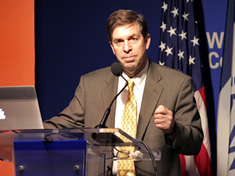
Keith Schneider spoke at the Wilson Center on April 2. Download his slides to follow along. Read more stories from “Choke Point: India” on CircleofBlue.org.
Friday Podcasts are also available for download on iTunes.
 A Publication of the Stimson Center.