-
Inaugural Lee Hamilton Lecture at the Wilson Center
Admiral Mullen: “Security Means More Than Defense”
›Chairman of the Joint Chiefs of Staff Admiral Mike Mullen delivered the inaugural talk in the Lee Hamilton Lecture Series on Civil Discourse and Democracy at the Wilson Center yesterday where he spoke on the importance of “taking the long-view” on U.S. engagement with the world and the changing field of 21st century geopolitics.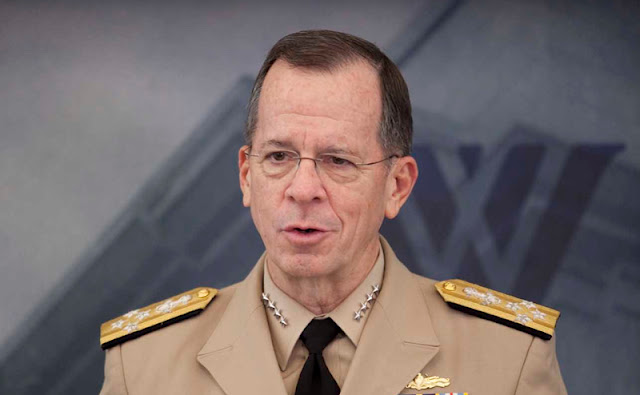
Mullen, whose aides, Captain Wayne Porter and Colonel “Puck” Mykleby, wrote the recently launched Mr. Y paper on a new national strategic narrative, echoed many of the same sentiments.
“[The Mr. paper] has some interesting things to say about how we are seeing a shift away from 20th century concepts of power and control to that of promoting strength and influence,” Mullen said. “Frankly, in this small, flatter, and faster world, I think any nation that believes it can, in a very clinical way, control events does so at their own peril.”
“The narrative also happens to share my long-held belief that we must remain engaged internationally if we wish to pursue the world that our children [and] our grandchildren deserve,” he continued:As challenging as engaging others with different views may be, the alternative of abandoning these partners in these regions is far worse. We’ve gone down that road before, and it is one that leads to isolation and resentment, ultimately making our nation less secure as we deceive ourselves into believing that ignoring these challenges will somehow make them go away.
Mullen also agreed with the Mr. Y authors’ view on adopting a more holistic view of national security:
…
Until we restore a sense of hope in these challenged regions, we will see again and again that security without prosperity is ultimately unsustainable.Wayne and Puck put it well when they said we must recognize that security means more than defense. And sustaining security requires adaptation and evolution, the leverage of converging interests, and interdependencies. We must accept that competitors are not necessarily adversaries and that a winner does not demand a loser.
The military’s energy initiatives are an important focus as well, Mullen said. “We’re the biggest consumer of energy in the U.S. government…and I don’t think we’ll ever get to a position where that’s not the case, but we certainly ought to recognize that and figure out a way to do it more effectively, efficiently, and at a much reduced cost.”
What we learned in Iraq is “there were too many people getting killed in long convoys,” Mullen said. The Marines were able to adapt to that threat by developing self-contained green cooling kits, and “that’s where we’re headed,” he said. “Our focus on and investments in the green world has taken off.”
“Now it is really mainstream: The service chiefs, combatant commanders, [they] talk about it,” Mullen continued. “There are investments being made, both from an S&T; standpoint – science and technology – as well as research and development.”
Read the transcript in its entirety here for the Chairman’s remarks on the continued importance of the UN, G-20, and NATO; the short-term intractability of challenges in Iran and North Korea; the rise of China; continued American military dominance; the defense budget; and the Arab Spring, which he called the “most significant change afoot in the world today.”
Photo Credit: Chairman of the Joint Chiefs of Staff Admiral Mike Mullen, courtesy of David Hawxhurst/Wilson Center. -
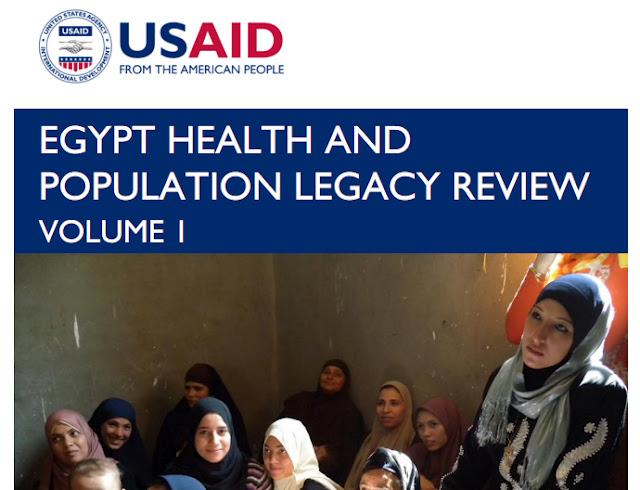
USAID Egypt’s Health and Population Legacy Review
›On May 23 the Middle East Program, ECSP, and the Global Health Initiative of the Woodrow Wilson Center, along with the Global Health Technical Assistance Project, hosted a panel of speakers discussing the past 30 years of the U.S. Agency for International Development’s health and population initiatives in Egypt, as outlined in the new Egypt Health and Population Legacy Review. Geoffrey Dabelko, director of ECSP and coordinator of the Global Health Initiative at the Wilson Center, moderated the event. [Video Below]
Peter McPherson, former administrator of USAID during the Reagan administration, and George Laudato, the administrator’s special assistant for the Middle East, presented on the historical context behind USAID in Egypt and the results of their efforts. McPherson pointed to three lessons that can be drawn from the recent report:- “Big payoffs” require long-term efforts; and
- Economic support for a country can have a dramatic impact; but
- The host country’s commitments and investments are still important.
Motaz Zahran, political counselor for the Embassy of Egypt, noted that USAID efforts were “just one sector of a fruitful partnership” between the United States and Egypt that he hoped would continue. He said the success story outlined by the report was reflective of improvements in coordination and addressing specific goals.
Other panelists outlined the successes of USAID in Egypt as related to their own areas of expertise. Leslie B. Curtin, co-author of the review and an expert in demographics and health outcomes, noted the dramatic improvements in a range of health sectors, in particular the rise in contraceptive prevalence and immunization rates and decrease in both maternal and infant mortality rates.
Nahed Matta, MD, senior maternal and newborn health officer at USAID, focused on improvements to the quality of maternal health, which she said were made possibly through better technology and increased fact-gathering to identify the key factors regarding maternal health trends. Sameh El-Saharty, MD, senior health policy specialist at the World Bank and Health Legacy Review Committee member, credited the increased number of health professionals in Egypt, better information gathering on health systems, and restructured models of health insurance, as successful strategies.
Concluding the session, Amie Batson, deputy assistant administrator for Global Health at USAID, discussed the lessons that other development initiatives can draw from the legacy of USAID efforts in Egypt. She highlighted the importance of country ownership, in which the developing country engages with other institutions and religious and political leaders at both national and local levels, and of policies that fund routine monitoring and evaluation. She also outlined the possibilities of innovation and south-to-south sharing on the local and international scale, referencing inroads made by two recent initiatives: the “MAMA” mobile device program, launched by Secretary Clinton in May 2011 to assist with disseminating maternal health information, and the Saving Lives at Birth initiative, launched by USAID in partnership with several other organizations in March 2011.
Laura Rostad is an intern for the Middle East Program at the Woodrow Wilson Center.
Image Credit: Adapted from cover of the Egypt Health and Population Legacy Review, courtesy of USAID; cover photo courtesy of Leslie Curtin. -
Elizabeth C. Economy, Council on Foreign Relations
The Truth About the Three Gorges Dam
›May 26, 2011 // By Wilson Center StaffThe original version of this article, by Elizabeth C. Economy, appeared on the Council on Foreign Relations’ Asia Unbound blog.
It has only taken 90 years, but China’s leaders have finally admitted that the Three Gorges Dam is a disaster. With Wen Jiabao at the helm, the State Council noted last week that there were “urgent problems” concerning the relocation effort, the environment and disaster prevention that would now require an infusion of US$23 billion on top of the $45 billion spent already.
Despite high-level support for the project since Sun Yat-sen first proposed it in 1919, the dam has had serious critics within China all along. One of China’s earliest and most renowned environmental activists, Dai Qing, published the book Yangtze! Yangtze! in 1989, which explored the engineering and social costs of the proposed dam. The book was a hit among Tiananmen Square protestors, and Dai spent a year in prison for her truth-telling. In 1992, when the dam came up for a vote in the National People’s Congress, an unprecedented one-third of the delegates voted against the plan.
Once the construction began in 1994, the problems mounted. The forced relocation of 1.4 million Chinese was plagued with corruption; former Premier Zhu Rongji accused the construction companies of shoddy engineering, and little of the pollution control measures that were planned were actually taken. Water pollution skyrocketed in the reservoir. As Chinese officials acknowledged a few years back, “The Three Gorges Dam project has caused an array of ecological ills, including more frequent landslides and pollution, and if preventive measures are not taken, there could be an environmental catastrophe.”
It would be easy to argue that the State Council’s admission was too little too late. However, the new transparency matters for at least two reasons. First, it plays into the hands of environmentalists who have been arguing against Beijing’s aggressive plans for additional large-scale hydropower plants. Premier Wen, who has tried to slow the approval process for dams over the past several years, now has a bit more ammunition. Second, any acknowledgement by the Party that mistakes have been made is an important step toward the public’s right to question future policies. Let’s hope that more such transparency is on the way.
Elizabeth C. Economy is the C.V. Starr Senior Fellow and director for Asia Studies at the Council on Foreign Relations.
Photo Credit: Adapted from “Construction of the Three Gorges Dam,” courtesy of flickr user Harald Groven. -
Environmental Action Plans in Darfur: Improving Resilience, Reducing Vulnerability
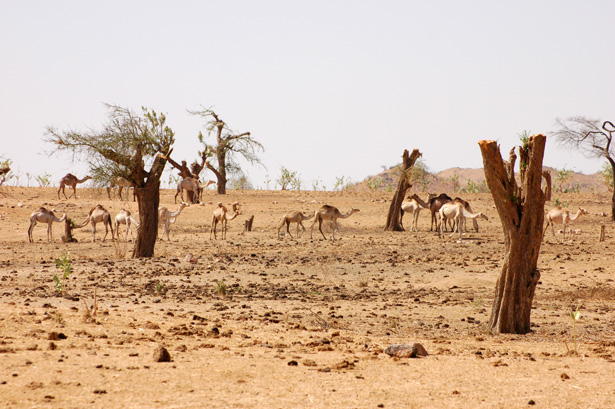
›Many villagers in Baaba, a community of 600 in South Darfur, remember a shady forest of mango and guava trees that provided food and a valuable income for the villagers and a pleasant picnic spot for people in Nyala, the nearby state capital. Over the last decade, that forest has degraded into eroded brush dotted by the occasional baobab – a transformation that is unfortunately a familiar sight throughout Darfur.
Most of Baaba’s trees have become firewood and charcoal for the people living in nearby internally displaced persons (IDP) camps. Baaba’s residents, who themselves returned from the camps to try to rebuild their lives at home, struggle to coax enough food from the soil, which has largely eroded away following deforestation. Afraid to venture any further than necessary from home for fear of violence and banditry in the countryside, they farm and graze the same land year after year without fallow periods – further depleting the soil and driving yields ever lower.
Baaba is like hundreds of Darfuri villages, which face a brutal mix of insecurity and environmental decline that leaves them one poor harvest away from being forced into the IDP camps. Baaba, however, is also a pilot participant in a new approach – the Community Environmental Action Plan – that aims to rehabilitate the local environment, enable people to sustainably manage natural resources, and ultimately to make communities more prosperous and resilient.
Most of Darfur has always been marginal land where farming and herding provide a meager livelihood and natural resources are few. Even before war broke out in 2003, soaring population growth (total population has quintupled since the 1970s) was putting intolerable pressure on the land, water, and trees of Darfur. The conflict in Darfur has since heavily disrupted traditional methods for sharing and maintaining natural resources, leading to environmental devastation. The worsening effects of climate change – though hard to separate from local environmental depletion – are also beginning to disrupt weather patterns and farming. The disheartening result is that even where fighting has subsided and displaced persons return home, they often find that the land no longer sustains them.
Traditional humanitarian aid and infrastructure projects are ill-suited to help, since persistent insecurity deprives humanitarian actors of access to communities for weeks or months at a time. Environmental decline didn’t start the humanitarian crisis in Darfur, but it threatens to prolong it and put a sustainable peace out of reach.
Community Environmental Action PlansThe International Organization for Migration (IOM), mandated to work on IDP and return issues in Darfur, aimed to address these challenges with Community Environmental Action Plans (CEAPs) in three pilot villages. CEAPs build comprehensive local capacity, enabling communities to manage natural resources sustainably and address environmental problems themselves without relying on outside support. The ultimate goal is to build the resilience and adaptive capacity of vulnerable communities. IOM worked with Baaba and two other villages to implement CEAPs, in partnership with the Swiss-based environmental NGO ProAct, the UN Environment Programme (UNEP), the government of South Darfur, and Darfuri environmental organizations. The project, funded by the Government of Japan, ran from early 2009 until mid-2010.
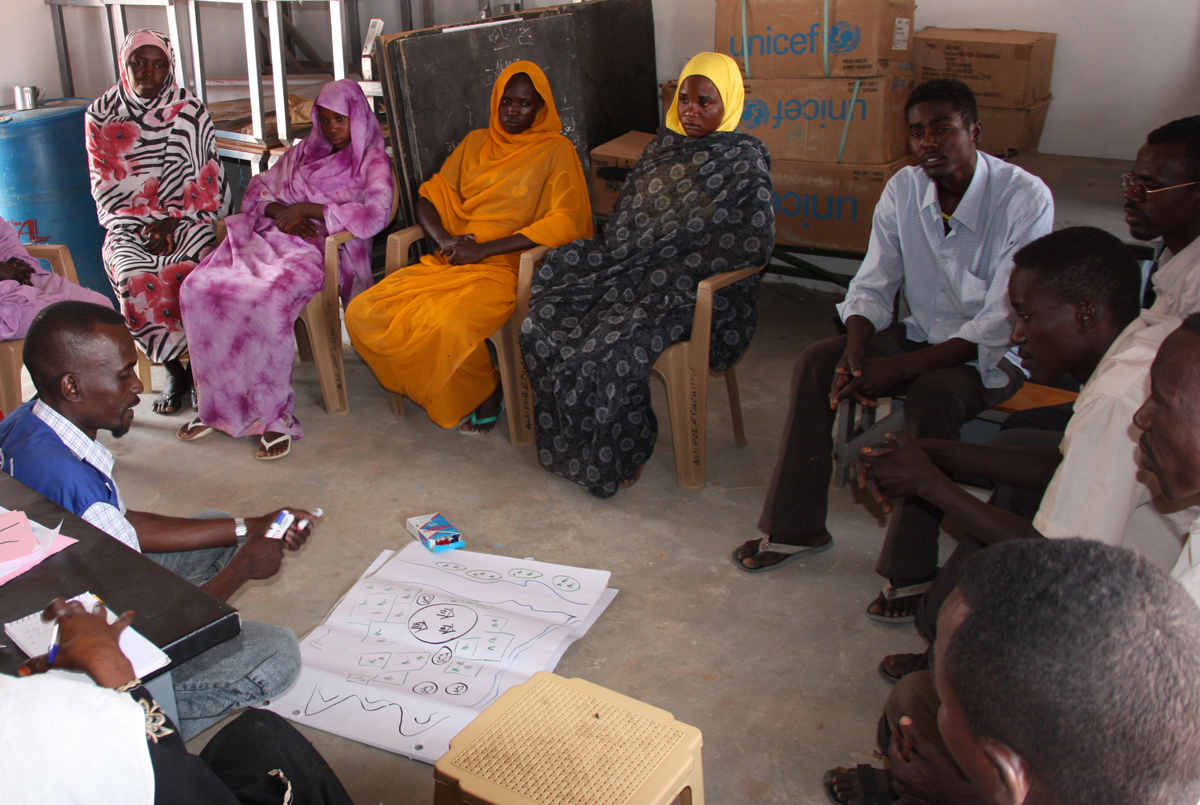
The CEAP process trains communities to understand the connections between a healthy ecosystem and a prosperous community and to promote livelihoods by rehabilitating the environment. Each participating village formed a CEAP governance committee, which was then trained to understand the environment as a single integrated system and to see how damaging one resource like trees can devastate other ecosystem services – such as pollination, groundwater retention, and soil fertility – that enable and promote human livelihoods. The communities then identified essential needs, including reforestation, water harvesting, and improved sanitation, and worked with IOM to develop appropriate responses. These activities were all implemented by the villages themselves, with technical and material support from IOM and its partners.
Building Local Capacity
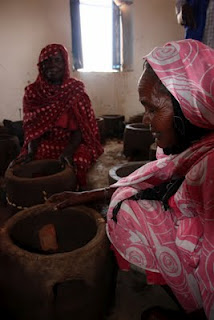
The communities built low-tech but highly productive tree nurseries, producing and planting over 200,000 seedlings to restore damaged land and provide a sustainable wood supply. Local women learned how to make highly fuel-efficient stoves using locally available materials, cutting their need for firewood and allowing them to sell stoves in the nearby Nyala market.Farmers received extensive training in sustainable agriculture techniques, including water harvesting, composting, agro-forestry, and intercropping (mixing complementary plant species together in the same fields). Volunteers were trained in effective hygiene practices and built latrines for each household. Water committees were trained to repair and maintain the villages’ indispensable but fragile water hand pumps, ensuring a more reliable source of drinking water. Each of these activities was governed by a community committee, including women and youth, trained to manage the projects for the benefit of the entire community and continue the work after the project’s end.
Through this approach, all three villages significantly boosted their livelihoods and agricultural productivity while becoming less dependent on the unsustainable exploitation of their fragile environment. The CEAP approach benefits greatly from focusing on capacity-building and local implementation, which fosters a strong sense of community ownership that persists after the project ends. Equally important, CEAPs attempt to address most or all of a community’s environmental issues simultaneously, reducing the risk that neglected environmental problems – particularly agricultural failure – will critically destabilize and displace a community in the future.
A Replicable Model
CEAPs aren’t a panacea, particularly in the conflict-prone areas where they are most needed. Insecurity, particularly a series of abductions of humanitarian workers from several organizations in 2010, cut off IOM’s access to the communities late in the project. Though the core activities were completed by working through local partners with more reliable access, the security situation left few opportunities for follow-up activities. Longer-term threats, particularly unrestrained population growth – which requires a comprehensive approach that includes addressing unmet need for family planning services – could undo much of the good that CEAPs accomplish.
Though insecurity prevented IOM from continuing the project, other organizations including UNEP are implementing and refining the CEAP approach elsewhere in Darfur and other regions in sub-Saharan Africa. As climate changes intensifies and the potential for related conflicts looms, the CEAP approach should be considered as a powerful and flexible tool to rehabilitate the environment and strengthen vulnerable communities.
Paul Rushton is a consultant for the International Organization for Migration, Sudan, and worked as a Programme Officer managing the CEAP projects in South Darfur from 2009 to 2010.
Sources: International Organization for Migration, UN.
Photo Credit: Camels graze in a destroyed and degraded village in Western Darfur, courtesy of UNEP; and pictures from CEAP sites in Southern Darfur, courtesy of Paul Rushton. -
Watch: Eric Kaufmann on How Demography Is Enhancing Religious Fundamentalism
›May 24, 2011 // By Schuyler Null“There’s a belief, often amongst political scientists and social scientists, that demography is somehow passive and that it doesn’t really matter,” said Eric Kaufmann, author of Shall the Religious Inherit the Earth: Demography and Politics in the 21st Century and professor at Birkbeck College, University of London in this interview with ECSP. “Part of the message of this book is that demography can lead to social and political change.”
“In this case what I’m looking at is the way that demography can change the religious landscape,” Kaufmann said. “It can actually enhance the power of religion, especially religious fundamentalism in societies throughout the world.”
“Purely secular people, who have no religious affiliation, they are leading the move towards very low levels of fertility, even down to the level of one child per woman,” Kaufmann said. On the other hand, fundamentalists are reacting to this trend and deliberately deciding not to make the demographic transition, he said. “In doing so, the gap between secular and religious widens” and is actually more pronounced in places where the two groups collide.
“You can see this in the Muslim world,” said Kaufmann. “If you look at urban areas such as the Nile Delta and Cairo, in those urban cities, women are who are most in favor of Shariah have twice the family size of women who are most opposed to Shariah, whereas in the Egyptian countryside, the difference is much less because they haven’t been exposed to the same modernizing pressures.”
These dynamics affect the Western world as well, especially when you factor in migration, said Kaufmann: “The fact that almost all the world’s population growth is occurring in the developing world, which is largely religious, means that a lot of people are moving from religious parts of the world to secular parts of the world,” he said. “That effects, for example, countries like the United States or in Western Europe, which are receiving immigrants, and it means in the case of Western Europe – which is a very secular environment – that immigrants bring not only ethnic change but on the back of that, religious change; they make their societies more religious.” -
Meeting Half the World’s Fuel Demands Without Affecting Farmland Joan Melcher, ChinaDialogue
Biofuels: The Grassroots Solution
›May 24, 2011 // By Wilson Center StaffThe original version of this article, by Joan Melcher, appeared on ChinaDialogue.
The cultivation of biofuels – fuels derived from animal or plant matter – on marginal lands could meet up to half of the world’s current fuel consumption needs without affecting food crops or pastureland, environmental engineering researchers from America’s University of Illinois have concluded following a three-year study. The findings, according to lead author Ximing Cai, have significant implications not only for the production of biofuels but also the environmental quality of degraded lands.The study, the final report of which was published in the Journal of Environmental Science and Technology late last year, comes at a time of increasing global interest in biomass. The International Energy Agency predicts that biomass energy’s share of global energy supply will treble by 2050, to 30 percent. In March, the UK-based International Institute for Environment and Development called on national governments to take a “more sophisticated” approach to the energy source, putting it at the heart of energy strategies and ramping up investment in new technologies and research programs.
The University of Illinois project used cutting-edge land-use data collection methods to try to determine the potential for second-generation biofuels and perennial grasses, which do not compete with food crops and can be grown with less fertilizer and pesticide than conventional biofuels. They are considered to be an alternative to corn ethanol – a “first generation” biofuel – which has been criticized for the high amount of energy required to grow and harvest it, its intensive irrigation needs and the fact that corn used for biofuel now accounts for about 40 percent of the United States entire corn crop.
A critical concept of the study was that it only considered marginal land, defined as abandoned or degraded or of low quality for agricultural uses, Cai, who is civil and environmental engineering professor at the University of Illinois in the mid-western United States, told ChinaDialogue.
The team considered cultivation of three crops: switchgrass, miscanthus, and a class of perennial grasses referred to as low-impact high-diversity (LIHD).
Continue reading on ChinaDialogue.
Sources: Sources: International Energy Agency, Journal of Environmental Science and Technology, Reuters, University of Illinois.
Photo Credit: Adapted from “Biofuels,” courtesy jurvetson. -
Mapping Population and Climate Change
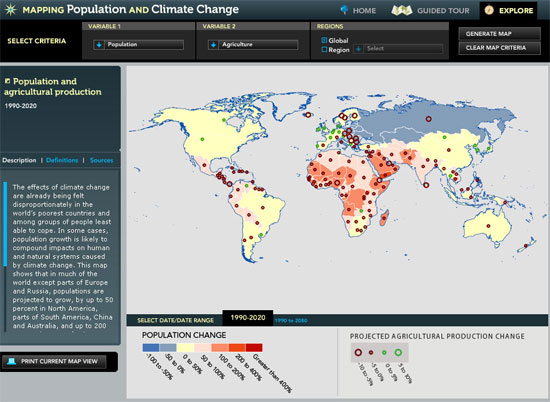
›Climate change, population growth, unmet family planning needs, water scarcity, and changes in agricultural production are among the global challenges confronting governments and ordinary citizens in the 21st century. With the interactive feature “Mapping Population and Climate Change” from Population Action International, users can generate maps using a variety of variables to see how these challenges relate over time.
Users can choose between variables such as water scarcity or stress, temperature change, soil moisture, population, agriculture, need for family planning, and resilience. Global or regional views are available, as well as different data ranges: contemporary, short-term projections (to the year 2035), and long-term projections (2090).In the example featured above, the variables of population change and agricultural production change were chosen for the time period 1990-2020. Unfortunately, no country-specific data is given, though descriptions in the side-bar offer some helpful explanations of the selected trends.
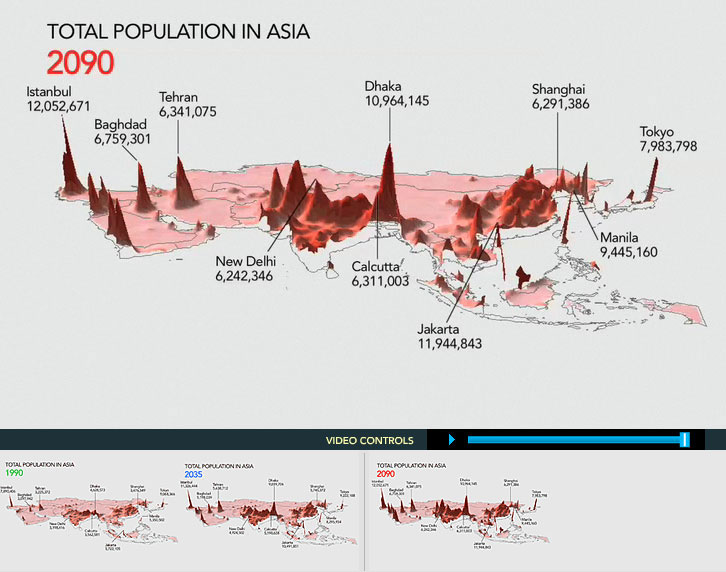
In addition, users can view three-dimensional maps of population growth in Africa and Asia for the years 1990, 2035, and 2090. These maps visually demonstrate the projected dramatic increases in population of these regions by the end of the century. According to the latest UN estimates, most of the world’s population growth will come from Africa and Asia due to persistently high fertility rates.
Image Credit: Population Action International. -
Rosemarie Calvert, Center for a Better Life
Winning Hearts and Minds: An Interview with Chief Naval Officer Admiral Gary Roughead
›May 23, 2011 // By Wilson Center StaffThe original version of this article, by Rosemarie Calvert, appeared in the Center for a Better Life’s livebetter magazine.
Few people understand “smart” power as well as Chief Naval Officer (CNO) Admiral Gary Roughead. To this ingenious, adept leader of the world’s largest and most powerful navy, it’s not just about military strategy or political science; it’s about heart. It’s about the measure of a man with regard to honor, courage and commitment. And, it’s about appreciation and respect for the natural world. As one of the U.S. Defense Department’s most powerful decision-makers, Roughead has helped mold a new breed of sailor who understands that preventing war is just as important as winning war – that creating partners is more important than creating opponents. Add mission mandates such as humanitarian assistance, disaster relief, and environmental stewardship, and it’s clear why Roughead and his brand of smart power are having a profound impact on international peace, national security, and natural security.
Engendering Environmental Advocacy
“You don’t live on the ocean and not love it. My appreciation for the environment came from a very early age – from just loving to be on the water. It’s something that’s had a very strong impact on me,” explains Roughead, who grew up in North Africa where his father worked in the oil business. He and his family lived along an uninhabited area of coastline where his father’s company built a power plant and refinery to process and transport Libya’s huge oil field finds to offshore tankers.
“We were the first people to move there; I was still in grammar school. The beauty in being the first was that the coastline was absolutely pristine. Even before school, I would get up and go skin diving. There were beautiful reefs, and fish were everywhere. The vegetation was just incredible. The company built an offshore loading area a few miles off the beach with 36-inch pipes pumping crude oil out to where these big supertankers would come in. Back then, there wasn’t a high regard for the environment, so when storms would kick-up and ships got underway in a hurry, they would just cast them off and all that oil would go into the ocean.
“Fast forward about five years, and the last time I went skin diving I didn’t see a living thing. The vegetation was dead. At that time I was visiting my folks on summer leave from the Naval Academy. There were periods when I would skin dive and then surface after being down about 35-40 feet, and my lungs would be ready to burst. I’d look up, having moved from my original location, and see this massive oil slick. And, I’d go, ‘Oh gosh…no!’ But, you didn’t have any choice. I would come home and actually have to clean the oil off with kerosene because it was caked on me.
“I saw and experienced environmental devastation, and it had an effect on me. Being at sea all the time – I love going to sea and seeing everything about it – drove me to the views I have. I really do think there’s compatibility between the Navy and the environment. We have things we must accomplish, but we can do them cleanly and responsibly. That’s what we’ve tried to demonstrate to those who have different views – that there has to be compatibility between the two.”
Continue reading on the Center for a Better Life.
Rosemarie Calvert is the publisher and editorial director of livebetter magazine and director of the Center for a Better Life.
Photo Credit: Adapted from “USS Nitze underway with ships from U.S. Navy, Coast Guard and foreign navies,” courtesy of flickr user Official U.S. Navy Imagery.
 A Publication of the Stimson Center.