Showing posts by Laura Rostad.
-
The Future of Women in the MENA Region: A Tunisian and Egyptian Perspective
›Lilia Labidi, minister of women’s affairs for the Republic of Tunisia and former Wilson Center fellow, joined Moushira Khattab, former minister of family and population for Egypt, on June 2 at the Wilson Center to discuss the role and expectations of women in the Egyptian and Tunisian revolutions, as well as issues to consider as these two countries move forward. Haleh Esfandiari, director of the Middle East Program at the Wilson Center, moderated the event.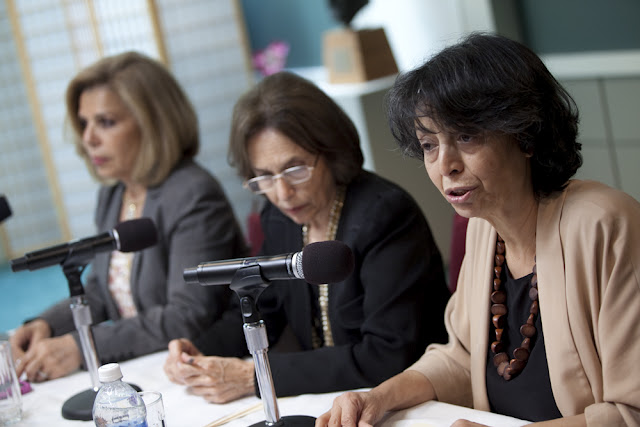
Labidi focused on the participation of women in the protests in Tunisia and their aftermath. She emphasized that these developments give hope, as they attest to the mixed nature of the demonstrations in which women were not sidelined but marched amongst men. (Editor’s note: The gender balance of the protests was a feature demographer Richard Cincotta also observed in his post about Tunisia’s age structure.) She pointed to the way that Tunisian women have entered the public space and played vital roles in spreading images and information about the protests around the world. Labidi said that although the future of women in Tunisia remains uncertain, it is unlikely that they will cease to be active and retreat to the private sphere. She commented on the new parity resolution calling for an equal number of male and female candidates for each party in Tunisia’s July elections and the opportunities afforded by an increase in political pluralism and media outlets.
Labidi also elaborated on her efforts as Tunisia’s minister of women’s affairs, discussing the ministry’s results and future goals. She stressed the importance of aiding women living in poverty, changing the cultural role of women, and boosting confidence in the government’s ability to address women’s needs. In particular, Labidi spoke of the work to expand the ministry’s regional offices to become more accessible to rural and non-elite sectors of Tunisian society. She hoped that recent events will encourage recognition of women as regional political actors and that the United States will expand intellectual and political ties with Tunisia.
Khattab pointed out the numerous similarities between the role of women in Tunisia and in Egypt, saying that women’s participation in public demonstrations and disseminating information to the media “has set the stage for a paradigm shift in the rights of citizens.” She noted that there are many advances yet to be made for women, youth, and other groups but that the protests have begun a change towards “a democratic, rights-based Egypt.”
Although she sees women’s involvement as a part of continuing progress in women’s rights, Khattab made note of the various obstacles to freedom that women in Egypt still face. She expressed concern that the politics of revenge against the previous regime might sideline women in politics, who already have less representation in the government than they did under Mubarak and have been excluded from the committee drawing up a new Egyptian constitution. She noted the need to change social perceptions that “women already enjoy all their rights.” She also discussed how the new media freedom gives fundamentalist groups a platform to propagate narrow interpretations of faith that call for the repeal of some of the existing women’s rights laws. She posed the question of what interpretations of the faith would allow for a greater harmonization with domestic laws based on the ideals of human rights.
Laura Rostad is an intern with the Middle East Program at the Woodrow Wilson Center.
Photo Credit: David Hawxhurst/Wilson Center. -
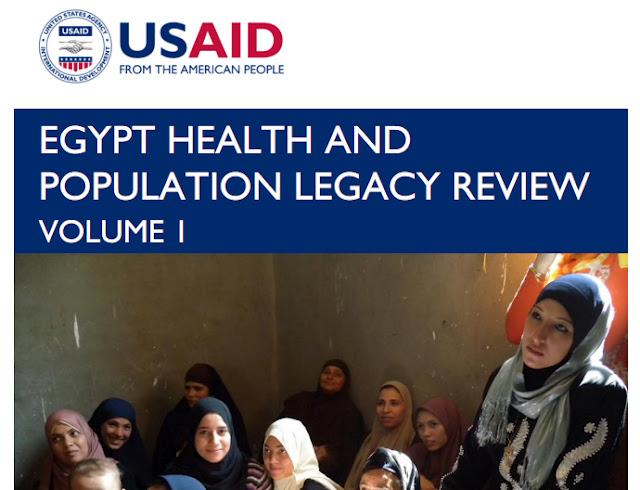
USAID Egypt’s Health and Population Legacy Review
›On May 23 the Middle East Program, ECSP, and the Global Health Initiative of the Woodrow Wilson Center, along with the Global Health Technical Assistance Project, hosted a panel of speakers discussing the past 30 years of the U.S. Agency for International Development’s health and population initiatives in Egypt, as outlined in the new Egypt Health and Population Legacy Review. Geoffrey Dabelko, director of ECSP and coordinator of the Global Health Initiative at the Wilson Center, moderated the event. [Video Below]
Peter McPherson, former administrator of USAID during the Reagan administration, and George Laudato, the administrator’s special assistant for the Middle East, presented on the historical context behind USAID in Egypt and the results of their efforts. McPherson pointed to three lessons that can be drawn from the recent report:- “Big payoffs” require long-term efforts; and
- Economic support for a country can have a dramatic impact; but
- The host country’s commitments and investments are still important.
Motaz Zahran, political counselor for the Embassy of Egypt, noted that USAID efforts were “just one sector of a fruitful partnership” between the United States and Egypt that he hoped would continue. He said the success story outlined by the report was reflective of improvements in coordination and addressing specific goals.
Other panelists outlined the successes of USAID in Egypt as related to their own areas of expertise. Leslie B. Curtin, co-author of the review and an expert in demographics and health outcomes, noted the dramatic improvements in a range of health sectors, in particular the rise in contraceptive prevalence and immunization rates and decrease in both maternal and infant mortality rates.
Nahed Matta, MD, senior maternal and newborn health officer at USAID, focused on improvements to the quality of maternal health, which she said were made possibly through better technology and increased fact-gathering to identify the key factors regarding maternal health trends. Sameh El-Saharty, MD, senior health policy specialist at the World Bank and Health Legacy Review Committee member, credited the increased number of health professionals in Egypt, better information gathering on health systems, and restructured models of health insurance, as successful strategies.
Concluding the session, Amie Batson, deputy assistant administrator for Global Health at USAID, discussed the lessons that other development initiatives can draw from the legacy of USAID efforts in Egypt. She highlighted the importance of country ownership, in which the developing country engages with other institutions and religious and political leaders at both national and local levels, and of policies that fund routine monitoring and evaluation. She also outlined the possibilities of innovation and south-to-south sharing on the local and international scale, referencing inroads made by two recent initiatives: the “MAMA” mobile device program, launched by Secretary Clinton in May 2011 to assist with disseminating maternal health information, and the Saving Lives at Birth initiative, launched by USAID in partnership with several other organizations in March 2011.
Laura Rostad is an intern for the Middle East Program at the Woodrow Wilson Center.
Image Credit: Adapted from cover of the Egypt Health and Population Legacy Review, courtesy of USAID; cover photo courtesy of Leslie Curtin.