• woodrow wilson center
  • ecsp

New Security Beat

Subscribe:
  • rss
  • mail-to
  • Who We Are
  • Topics
    • Population
    • Environment
    • Security
    • Health
    • Development
  • Columns
    • China Environment Forum
    • Choke Point
    • Dot-Mom
    • Friday Podcasts
    • Navigating the Poles
    • Reading Radar
  • Multimedia
    • Water Stories (Podcast Series)
    • Backdraft (Podcast Series)
    • Tracking the Energy Titans (Interactive)
  • Films
    • Water, Conflict, and Peacebuilding (Animated Short)
    • Paving the Way (Ethiopia)
    • Broken Landscape (India)
    • Scaling the Mountain (Nepal)
    • Healthy People, Healthy Environment (Tanzania)
  • Publications
  • Events
  • Contact Us

NewSecurityBeat

The blog of the Wilson Center's Environmental Change and Security Program
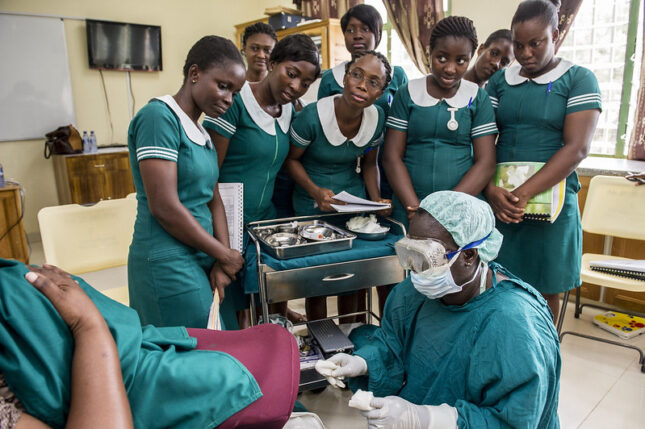
  • Strengthening our Health Systems Means Giving Voice to Women Leading the Nursing & Midwifery Professions

    ›
    Covid-19  //  Dot-Mom  //  May 13, 2020  //  By Peter Johnson
    Bonnie Yeh

    Since the onset of the pandemic, nurses and midwives have been asked in some facilities to work without personal protective equipment. Nurses have been sent home and lost their jobs simply because they insisted on following evidence-based practices, such as wearing masks. Some question whether the masks, gloves, gowns, and other commodities in short supply are more important than nurses who question the ethics of showing up when essentials aren’t available.

    MORE
  • COVID-19 Shines Spotlight on Race and Gender Inequities in Healthcare

    ›
    Covid-19  //  Dot-Mom  //  From the Wilson Center  //  May 12, 2020  //  By Deekshita Ramanarayanan
    49837047782_fa480c0713_c

    “While COVID-19 has wreaked havoc the world over, history has proven, and recent data agrees that the hardest hit will be the world’s women and girls and populations already impacted by racism and discrimination,” said Sarah Barnes, Project Director of the Maternal Health Initiative and Women and Gender Advisor at the Wilson Center, at a recent event on the impact of COVID-19 on race and gender inequities. Coronavirus has hurt women and girls in many ways. Among them, women have been pushed back into the home.  And healthcare workers and caregivers who are mostly women are jeopardizing their own health, caring for others.

    MORE
  • Fair Trade Seeks a Foothold in Artisanal Gold Mining

    ›
    Guest Contributor  //  May 11, 2020  //  By Kristin Sippl
    7205603428_9118573680_b

    COVID-19 isn’t the only problem going viral. Economic insecurity is driving gold prices to record highs around $1,700 per ounce, causing levels of global mercury pollution to rise too. In the United States coal-fired power plants drive mercury pollution, but globally, the leading cause is small-scale ‘artisanal’ gold mining. Roughly 30 million men, women, and children in poor countries depend on mining for subsistence incomes. Unfortunately, the cheapest and easiest way to mine gold uses mercury, a highly toxic heavy metal the United Nations is striving to eliminate.

    MORE
  • The COVID-19 Pandemic and Vulnerable Populations: A Wilson Center NOW Interview with James Hollifield

    ›
    Covid-19  //  From the Wilson Center  //  May 8, 2020  //  By Eliana Guterman
    49757481401_8a79e7ed44_o

    Refugees and migrants are the most vulnerable and will bear the brunt of the Covid-19 pandemic, said James Hollifield, a Wilson Center Global Fellow, in a recent episode of Wilson NOW. These populations are often already at higher risk due to insufficient water and food supplies, and those confined in large camps are at greater risk of spreading the disease. According to Hollifield, although we have not yet seen the full extent of the damage, “we can see with both refugees and migrants in particular, especially seasonal migrants, that there’s a great danger here of the virus spreading like wildfire in the camps and in the dormitories.”

    MORE
  • Flying High: Q&A with Birding Beijing’s Terry Townshend

    ›
    China Environment Forum  //  Q&A  //  May 7, 2020  //  By Teresa Kennedy

    shutterstock_1642481314On March 20, the lawsuit filed by the three organizations successfully blocked the construction of the Jiasajiang I Hydropower Station in Yunnan Province, meaning that at least for now, these long-legged endangered birds are safe. This environmental victory for China’s birds builds on the designation of some of China’s Migratory Bird Sanctuaries along the coast of the Yellow Sea-Bohai Gulf as UNESCO World Heritage sites in July 2019, with more planned in the next two to three years. However, these highpoints in avian protection do not negate the fact that nearly 40 percent of China’s endemic birds are listed as threatened and require greater protection.

    MORE
  • Water for the Most Vulnerable Could Help Stop Spread of Covid-19

    ›
    Covid-19  //  Guest Contributor  //  May 6, 2020  //  By Mara Tignino & Tadesse Kebebew
    49730443576_a7f0284279_c

    “To attack water is to attack an entire way of life.” —International Committee of the Red Cross

    Development specialists are sounding the alarm. The pandemic will not be stopped unless we provide safe water to the world’s most vulnerable people, according to UN experts. Soap and clean water are part of the arsenal of weapons we can deploy on the frontlines of the battle to halt the virus’ spread. Yet Covid-19 continues to pose an unprecedented threat to more than 2 billion of the world’s poorest people who lack the access to safe water, sanitation, and health services (WASH) needed to protect them during infectious disease outbreaks, according to the World Health Organization.

    MORE
  • International Day of the Midwife: A Global Call to Action

    ›
    Covid-19  //  Dot-Mom  //  May 5, 2020  //  By Sarah Barnes
    China for IDM2020_10

    “Today is the International Day of the Midwife, a day when we come together as a global health community to celebrate midwives, and the commitment of the midwifery profession globally to saving lives and upholding the rights of women to a safe and positive birth,” write the authors of the Global Call to Action: Protecting Midwives to Sustain Care for Women, Newborns and their Families in the COVID-19 Pandemic. Midwives are essential to the health and protection of women and newborns. The World Health Organization (WHO) estimates that 83 percent of all maternal deaths, stillbirths, and newborn deaths could be averted with the full package of midwifery care.

    MORE
  • Navigating Land and Security When Climate Change Forces People to Relocate

    ›
    Guest Contributor  //  May 4, 2020  //  By John R. Campbell
    36691066001_f70e0b3e04_c

    At an event organized by the Coalition of Atoll Nations on Climate Change in December 2019, Tabitha Awerika, 21, from Kiribati, urged world leaders to listen to the climate science and to the pleas of those living in the South Pacific. “I will not leave the lands of my ancestors,” she said. “I will not abandon my motherland. I refuse to leave the only place I call home.”

    MORE
Newer Posts   Older Posts
View full site

Join the Conversation

  • RSS
  • subscribe
  • facebook
  • G+
  • twitter
  • iTunes
  • podomatic
  • youtube
Tweets by NewSecurityBeat

Trending Stories

  • unfccclogo1
  • Pop at COP: Population and Family Planning at the UN Climate Negotiations

Featured Media

Backdraft Podcast

play Backdraft
Podcasts

More »

What You're Saying

  • Volunteers,At,The,Lagos,Food,Bank,Initiative,Outreach,To,Ikotun, Pan-African Response to COVID-19: New Forms of Environmental Peacebuilding Emerge
    Rashida Salifu: Great piece 👍🏾 Africa as a continent has suffered this unfortunate pandemic.But it has also...
  • A desert road near Kuqa An Unholy Trinity: Xinjiang’s Unhealthy Relationship With Coal, Water, and the Quest for Development
    Ismail: It is more historically accurate to refer to Xinjiang as East Turkistan.
  • shutterstock_1779654803 Leverage COVID-19 Data Collection Networks for Environmental Peacebuilding
    Carsten Pran: Thanks for reading! It will be interesting to see how society adapts to droves of new information in...

What We’re Reading

  • Rising rates of food instability in Latin America threaten women and Venezuelan migrants
  • Treetop sensors help Indonesia eavesdrop on forests to cut logging
  • 'Seat at the table': Women's land rights seen as key to climate fight
  • A Surprise in Africa: Air Pollution Falls as Economies Rise
  • Himalayan glacier disaster highlights climate change risks
More »
  • woodrow
  • ecsp
  • RSS Feed
  • YouTube
  • Twitter
  • Facebook
  • Home
  • Who We Are
  • Publications
  • Events
  • Wilson Center
  • Contact Us
  • Print Friendly Page

© Copyright 2007-2021. Environmental Change and Security Program.

Woodrow Wilson International Center for Scholars. All rights reserved.

Developed by Vico Rock Media

Environmental Change and Security Program

Woodrow Wilson International Center for Scholars

Ronald Reagan Building and International Trade Center

  • One Woodrow Wilson Plaza
  • 1300 Pennsylvania Ave., NW
  • Washington, DC 20004-3027

T 202-691-4000