Showing posts from category DRC.
-
Rwanda: Dramatic Uptake in Contraceptive Use Spurs Unprecedented Fertility Decline
›November 8, 2011 // By Elizabeth Leahy Madsen
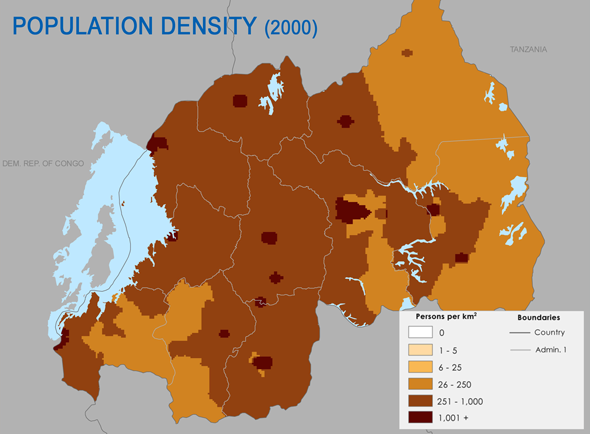
With over 400 people per square kilometer, the highest rate on the African mainland, population density is perhaps the most widely-discussed factor of Rwanda’s demography. Some scholars, notably Jared Diamond, have argued that it played a primary role in sparking the 1994 genocide through competition for land (although others present a more complex theory based in policies and governance).
-
Robert Draper, National Geographic
People and Wildlife Compete in East Africa’s Albertine Rift
›The original version of this article, by Robert Draper, appeared on National Geographic.
The mwami remembers when he was a king of sorts. His judgment was sovereign, his power unassailable. Since 1954 he, like his father and grandfather before him, has been the head of the Bashali chiefdom in the Masisi District, an undulating pastoral region in eastern Democratic Republic of the Congo (DRC). Though his name is Sylvestre Bashali Mokoto, the other chiefs address him as simply doyen – seniormost. For much of his adult life, the mwami received newcomers to his district. They brought him livestock or other gifts. He in turn parceled out land as he saw fit.
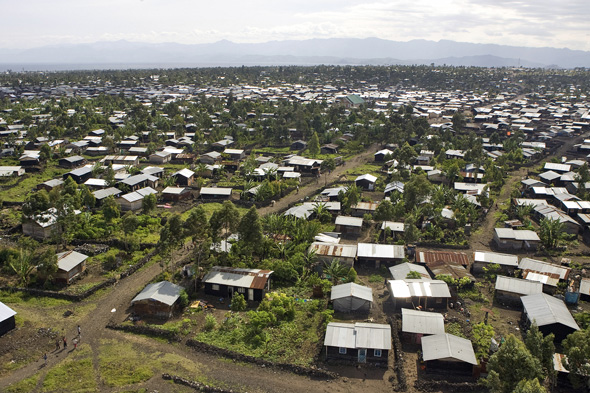
Today the chief sits on a dirty couch in a squalid hovel in Goma, a Congolese city several hours south of Masisi. His domain is now the epicenter of a humanitarian crisis that has lasted for more than a decade yet has largely eluded the world’s attention. Eastern Congo has been overtaken by thousands of Tutsi and Hutu and Hunde fighting over what they claim is their lawful property, by militias aiming to acquire land by force, by cattlemen searching for less cluttered pastures, by hordes of refugees from all over this fertile and dangerously overpopulated region of East Africa seeking somewhere, anywhere, to eke out a living. Some years ago a member of a rebel army seized the mwami’s 200-acre estate, forcing him, humiliated and fearing for his safety, to retreat to this shack in Goma.
The city is a hornet’s nest. As recently as two decades ago Goma’s population was perhaps 50,000. Now it is at least 20 times that number. Armed males in uniform stalk its raggedy, unlit streets with no one to answer to. Streaming out of the outlying forests and into the city market is a 24/7 procession of people ferrying immense sacks of charcoal on bicycles or wooden, scooter-like chukudus. North of the city limits seethes Nyiragongo volcano, which last erupted in 2002, when its lava roared through town and wiped out Goma’s commercial district. At the city’s southern edge lies the silver cauldron of Lake Kivu – so choked with carbon dioxide and methane that some scientists predict a gas eruption in the lake could one day kill everyone in and around Goma.
The mwami, like so many far less privileged people, has run out of options. His stare is one of regal aloofness. Yet despite his cuff links and trimmed gray beard, he is not a chief here in Goma. He is only Sylvestre Mokoto, a man swept into the hornet’s nest, with no land left for him to parcel out. As his guest, a journalist from the West, I have brought no gifts, only demeaning questions. “Yes, of course my power has been affected greatly,” the mwami snaps at me. “When others back up their claims with guns, there is nothing I can do.”
Continue reading on National Geographic.
Photo Credit: “Aerial View of Goma,” courtesy of UN Photo/Marie Frechon. -
Certification: The Path to Conflict-Free Minerals from Congo
›This summer, the Wilson Center’s Africa Program, in co-sponsorship with the Enough Project, assembled a panel of experts from American, British, and Congolese governments, private industry, and the NGO community to discuss the deplorable situation in the eastern Democratic Republic of the Congo (DRC) involving conflict minerals and certification as a way forward.
After introductory remarks by Wilson Center President Jane Harman, Africa Program Director Steve McDonald introduced John C. Bradshaw, executive director of the Enough Project, who moderated the panel discussion. [Video Below]
Under Secretary of State Robert D. Hormats began by saying the “extremely traumatic” humanitarian situation in the restive areas of the eastern DRC requires “a bold, resolute, and morally inspired response by the United States and other countries.”
Sasha Lezhnev, policy consultant for the Enough Project, explained how the demand for tin, tantalum, tungsten, and gold – for use in batteries, circuit boards, and screens in computers and cellphones – are, in effect, driving the conflict in the DRC.
However, Ambassador to the United States from the DRC Faida Mitifu pointed out that a significant 70 percent of the economy in the eastern regions of the country depends on mining, thus any initiative would have to take into account the livelihoods of the people. In order to assist those communities while a process is formulated, Lezhnev called for targeted development projects in the most affected regions.
The Kimberley Process: A Potential Model?
“If we want to have a lasting impact, we’re going to need a certification process,” Lezhnev said, and we must learn lessons from the Kimberley Process (KP) in order to implement a suitable framework in the DRC.
Clive Wright, who served as the diplomatic negotiator for the KP and head of the foreign policy team for the British High Commission in Ottawa, described the intricacies of the process and its genesis. Under the provisions of the KP, the trade of rough diamonds is permissible, provided that there is a certificate from the country of origin and complementary legislation is in place in the importing country. This agreement was made through consultations and dialogue between the private sector and civil society.
Though successful in certain respects, Wright listed several shortcomings of the KP: it is not legally binding, therefore there are no levers to pull that compel government action; the process is void of an independent monitoring mechanism; and a consensus clause allows one government to block any action which clears the way for the status quo to prevail.
To implement a policy similar to the KP that guarantees legitimate minerals trade in the DRC, Under Secretary Hormats highlighted four key actors that have critical roles independently and collaboratively: 1) regional governments; 2) industry; 3) civil society; and 4) the U.S. government.
Regional Governments
Governments in the region face considerable challenges, said Hormats, as rebel groups trade across borders and evade efforts to rein in the commerce of precious gems, minerals, and arms. The states surrounding the Great Lakes – including Uganda, Rwanda, Burundi, Zambia, Kenya, and the DRC – have coalesced around these issues and developed a plan that will require effective coordination to ensure credibility. Some countries have already established traceability schemes, which are crucial for states that share borders with the DRC, since smuggling is incessant.
With regard to rebel factions, Kinshasa has occasionally participated in joint operations with the governments of Rwanda and Uganda “to stabilize [and] contain the activities of armed groups,” said Ambassador Mitifu. Progress, though slow, has also been made in demilitarizing the mining areas in the Kivu provinces as well as Maniema and in weakening the Congrès National pour la Défense du Peuple’s (CNDP) parallel administration.
The government in Kinshasa has made significant steps toward a certification framework and taken punitive action against military personnel who have engaged in illicit trade, said Ambassador Mitifu. She outlined the efforts the Kabila administration has made to address the issue, including initiatives to put in place a credible certification system so that clean minerals can be exported. In conjunction with MONUSCO – the UN peacekeeping mission in the DRC – the Congolese government has introduced centers where miners can bring their products and feed them into a legitimate supply chain. Finally, Kinshasa is working closely with the private sector, international organizations, and local NGOs to minimize fraud and enhance cooperation. Nevertheless, governance and corruption represent a formidable roadblock in the implementation of any certification process.
Industry Responsibility
Tim Mohin, the director of corporate responsibility for Advanced Micro Devices – one of the largest semiconductor manufacturers in the world – argued that industry can positively influence the supply chain by creating conflict-free smelter programs and a due diligence bulwark where anyone along the supply chain can trace their resources back to a certified smelter.
Customers, Mohin said, are going to have to insist that businesses comply with this tracking system. Under Secretary Hormats agreed with this sentiment, saying that companies that look into the origin of their minerals send a powerful message to the region and the world. He also expressed hope that “companies [would] work to find ways to adhere to legislation [Dodd-Frank] and honor their obligations to their shareholders without shunning the region’s minerals entirely.”
The most difficult stretches along the supply chain are getting buy-in from the miners and the smelters; overcoming the constraints of socio-economic realities on the ground and geo-politics; and the lack of a sustainable tracing system that spans the spectrum of the supply chain. In addition to shored-up U.S. involvement, Mohin called for increased public-private sector partnerships with incentives reminiscent of the Fair Trade system, development aid to assist displaced people, and enhanced security for artisanal miners and their businesses.
Civil Society and Government
Hormats commended the pivotal role civil society has played and must continue to play in highlighting the humanitarian issues at stake, as governments and companies have been only “dimly aware of the link between human rights abuses and the minerals trade.” Furthermore, Wright encouraged civil society’s participation because it serves as a “great policeman” that monitors the bad behavior of governments, especially when the allure of profiteering seeps into deliberations. Moving forward on boosting security for civil society on the ground in the Congo will be essential.
The U.S. government, Hormats asserted, has to do its part to support initiatives on the table to create conflict-free supply chains. If more revenue is invested in legitimizing supply chains, a substantial portion of the problem would be solved. USAID and the State Department are working with civil society to take action against those responsible for illegitimate trade and exacerbating the conflict. Of course there remains work to be done, but as Under Secretary Hormats indicated “this is the most significant moral issue of our time.”
Derek Langford is a program assistant with the Wilson Center’s Africa Program.
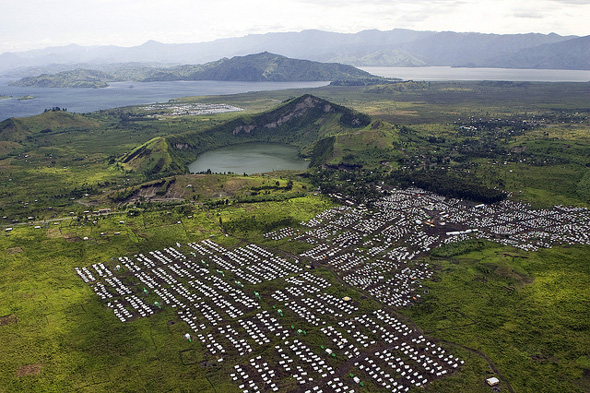
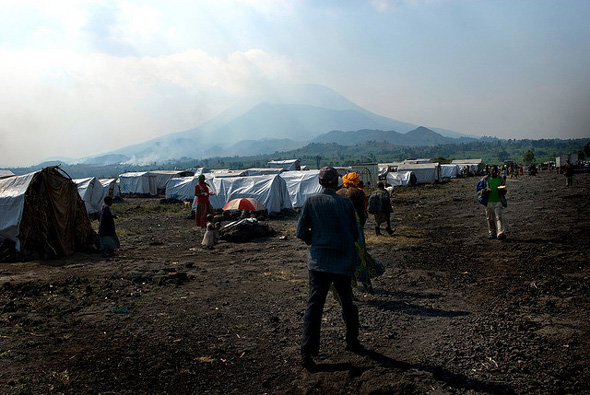
Photo Credit: “Aerial View of Camps for People Displaced by Conflict,” courtesy of flickr user United Nations Photo. -
Conflict Minerals in the DRC: Still Fighting Over the Dodd-Frank Act, One Year Later
›August 11, 2011 // By Schuyler NullOne year after the Dodd-Frank Act passed Congress with a provision that was aimed at preventing the sourcing of “conflict minerals” by SEC-registered companies, backlash seems to be growing over the impact of the measure, particularly on artisanal miners in the Democratic Republic of the Congo (DRC).
-
PRB’s Population Data Sheet 2011: The Demographic Divide
›August 9, 2011 // By Kellie Furr“Today, most population growth is concentrated in the world’s poorest countries – and within the poorest regions of those countries,” write the authors of the 2011 Population Data Sheet, an analysis tool published annually by the Population Reference Bureau (PRB). The population projections between poor and rich countries are “stark and very sad,” said Carl Haub Haub, senior demographer at PRB, at the July 28 web-based launch of the Data Sheet: “We call it the demographic divide. It shows the vast difference that has developed between the rich and poor countries of the world.”
The Population Data Sheet offers insight on global population trends using detailed statistical information along 18 demographic, population, health, and environment indicators for more than 200 countries and regions. The data sheet is based on the latest projections of the UN Population Division. Carl Haub and James Gribble of PRB discussed the long-term implications of the data sheet’s projections during web-based launch that included open questions.
Conflicting Trends
“Even though the world population growth rate has slowed from 2.1 percent per year in the late 1960s to 1.2 percent today, the size of the world’s population has continued to increase – from 5 billion in 1987, to 6 billion in 1999, and to 7 billion in 2011,” write the authors in PRB’s July Population Bulletin, “The World at 7 Billion.” To put those population totals into perspective, it took from the inception of human existence until the year 1800 – a total of approximately 50,000 years – to reach the first billion.
Fortunately, the recent (relative) decline in global growth rate has already curbed what could have been a considerable surge in the world’s population: “If the late 1960s population growth rate of 2.1 percent – the highest in history – had held steady, world population would have grown by 117 million annually, and today’s population would have been 8.6 billion,” said PRB President Wendy Baldwin in a press release. However, the world’s population still grows significantly at 77 million people annually, according to the UN, and we’re slated to reach 8 billion in just another 12 years. How can this dichotomy of large population totals in the face of lowered fertility be explained?
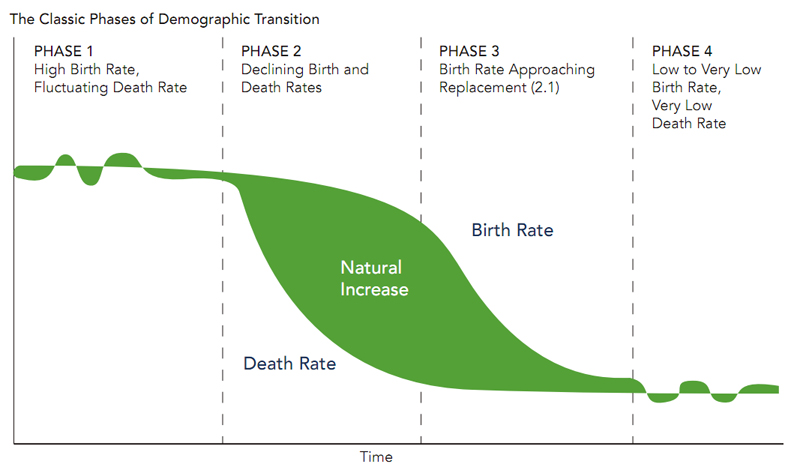
The Phases of Demographic Transition
“To understand global, we actually have to think local,” said PRB in their film short, “7 Billion and Counting,” released alongside the data sheet. Individual countries go through demographic transitions at different times, and the disparity in where countries are along in their progression varies greatly.
A demographic transition essentially hinges on two trends: the decline of birth and death rates over time. These trends do not necessarily change simultaneously however, resulting in most cases, first, a natural increase (when mortality rates decline but birth rates remain high) followed by a natural decrease in population (when birth rates also decline). Though the timing and magnitude of these trends differ from place to place, there are broad similarities across countries which have been conceptualized as phases by demographers, such as Carl Haub and James Gribble.Phase one is characterized by high birth rates and fluctuating death rates, found in countries such as Niger, Afghanistan, and Uganda; typically only death rates decline in this phase. Phase two, encompassing mostly lower-middle income countries such as Guatemala, Ghana, and Iraq, is marked by a continued decline in death rates but only slightly lower birth rates. The potential for large population growth exists in these countries, as they still possess a large youth population.
Countries in phase three have yet lower birth and death rates and overall total fertility rates close to the widely-accepted replacement level of 2.1 children per woman; these countries are home to approximately 38 percent of the world’s population and include India, Malaysia, and South Africa. Phase three countries often still possess a disproportionately large working age population as an echo of their previous growth, which allows them to take advantage of the “demographic dividend.”
Finally, phase four countries have the lowest birth and death rates, with some even seeing negative growth as total fertility rate falls at or below the natural replacement rate; countries in this phase include most of Europe and other developed countries, such as Japan and the United States (though relatively high levels of immigration keeps overall growth higher).
The data sheet shows that most developing countries still remain in the earlier phases of demographic transition, especially those in sub-Saharan Africa and the Middle East. Relatively recent public health improvements in these countries have decreased death rates at a rapid rate, and though total fertility rates (TFR) have declined as well, they have not kept the same pace: “This lag between the drop in death rates and the drop in birth rates produced unprecedented levels of population growth,” wrote Haub and Gribble in the Population Bulletin.
A Tale of Two Worlds
The data sheet authors observe that poverty is strongly associated with countries which are stalled in their progression through the demographic transition:Poverty has emerged as a serious global issue, particularly because the most rapid population growth is occurring in the world’s poorest countries and, within many countries, in the poorest states and provinces…Relatively high population growth rates make it more difficult to lift large numbers of people out of poverty.
In her primer video on demographic security for ECSP, demographer Elizabeth Leahy Madsen said, “we are in an era of unprecedented demographic divergence,” and characterized the phenomenon of population trends moving simultaneously in different directions as “rapid” and “unprecedented.”
Haub used Italy and the Democratic Republic of Congo (DRC) as an example to illustrate the divide. Although both countries currently sit at around 60 million people each, Italy is only projected to grow by 2 million through 2050, while the DRC is projected to reach a staggering 149 million people. Italy has a gross national income per capita of about $35,000, whereas DRC has only $180 per capita, according to the World Bank.
This observation has been corroborated by other demographers: “In 1950, 68 percent of the world’s population resided in developing regions. Today that’s up to 82 percent. But in the year 2050, it’s projected to be 86 percent,” said demographer David Bloom on NPR’s global health blog, Shots.
Demography ≠ Destiny
A poor country is not necessarily tethered to its projections, which are based on assumptions, said the authors, “but when, how, and whether [the demographic transition] actually happens cannot be known.”
Low development indicators do not always dictate that a country will lag in a demographic transition. “Government commitment to a policy to lower [birth rates] has succeeded quite well in countries with a low level of development,” said Haub in a 2008 PRB discussion on the demographic divide. Bangladesh and Iran are two examples of countries that significantly affected their demographic trajectories in the 20th century with targeted programs.
Proactivity certainly plays a role, as the PRB “7 Billion and Counting” video puts it (see above): “Understanding how and why the world’s population is growing will help nations better plan for the future…and for future generations.”
Sources: NPR, Population Reference Bureau, UN-DESA, UNICEF, World Bank.
Video and Image Credit: “7 Billion and Counting,” courtesy of PRB’s Youtube channel, and stages of demographic transition courtesy of PRB’s 2011 Population Data Sheet. -
Beyond Supply Risks: The Conflict Potential of Natural Resources
›While the public debate about resource conflicts focuses on the risk of supply disruptions for developed countries, the potentially more risky types of resource conflict are usually ignored. As part of a two-year research project on behalf of the German Federal Environment Agency, adelphi and the Wuppertal Institute for Climate, Energy, and Environment have analyzed the risks of international conflict linked to natural resources in a series of reports titled Beyond Supply Risks – The Conflict Potential of Natural Resources.
Resource extraction, transportation, and processing can create considerable crises and increase the risk of conflicts in producing and transit countries. This phenomenon – widely referred to as the “resource curse” – impacts consuming countries only if it leads to shortages and higher prices. However, in the producing and transit countries it can have much wider destabilizing effects – from increasing corruption to large-scale violent conflict. In addition, the extraction, processing, and transportation of resources often create serious environmental risks. Overexploitation, pollution, and the degradation of ecosystems often directly affect the livelihoods of local communities, which can increase the potential for conflict.
The eight reports that comprise Beyond Supply Risks explore plausible scenarios over the next two decades, focusing on four case studies: copper and cobalt in the Democratic Republic of Congo; the Nabucco natural gas pipeline project across Southern Europe and Turkey; lithium in Bolivia; and rare earth minerals in China.
Lithium in Bolivia
Bolivia possesses the world’s largest known lithium deposits, a potentially important resource for the development of electric vehicles. While the development of Bolivia’s lithium reserves could provide major economic benefits for one of the poorest countries in Latin America, our analysis identifies two main potential risks of conflict.
First, the environmental consequences of developing industrial-scale lithium production might have negative effects on the livelihoods of the local population. The local population in the lithium-rich department of Potosí has shown that it is capable of organizing itself effectively in defense of its interests, and past resource conflicts have turned violent, making a conflict-sensitive approach all the more important.
Second, the Bolivian economy is largely dependent on natural resources, and consequently is susceptible to price shocks. At present, this risk is primarily associated with natural gas. But lithium production, if developed, might be subject to the same dynamics, which could potentially destabilize the political system.
For consuming countries, these conflicts threaten supplies of lithium only if local protests or broader destabilization were produce bottlenecks in the supply chain.
Rare Earths and China
Like lithium, rare earths are likewise essential for some new technologies. China’s well publicized monopoly on 97 percent of the global production spurred a heated debate on the security of supply of strategic minerals. While our case study identifies supply risks for consuming countries, it also outlines some of the conflict risks China might face internally.
First, local populations could protest against the severe ecological impact of rare earth mining and production. In addition, conflicts might arise if those who profit from economic development (entrepreneurs or regional power-holders) undermine the traditional centralized party structures and expand their own influence.
International conflicts over access to Chinese rare earth resources, while they dominate the headlines, do not appear to be the dominant risk. Instead, internal political tensions could result in a weakened China that is not able to exploit its monopoly position for foreign policy gains. Or the government could enter into multilateral agreements and thus avoid a confrontational approach towards consumer nations.
Ultimately, the actual rate of diffusion of environmental technologies and the development of new technologies remain the key factors in determining whether relative shortages in global supply of rare earths will in fact occur. If industrialized nations and emerging economies commit to the same technologies to attain climate policy goals, international resource governance and coordinated promotion of (environmental) technology will also play a role in preventing conflict and crisis over rare earths.
The Way Forward
The series concludes with five recommendations to mitigate the risks of future resource conflicts:- Introduce systematic policy impact assessments to understand how policy goals and strategies, especially in regard to climate and environmental policy, interact with resource conflict risks.
- Increase the transparency of raw material markets and value creation chains to prevent extreme fluctuations in prices and improve information on markets, origins, and individual players.
- Improve the coherence of raw material policy by linking raw material policies with security, environmental, and development policies.
- Demand and promote corporate social responsibility along the whole value chain.
- Increase environmental and social sustainability as a means of strengthening crisis and conflict prevention by systematically taking into account social and conflict-related aspects in the resource sector.
The individual reports from the project can be downloaded here:- Conflict Risks (GERMAN only)
- Supply and demand (GERMAN only)
- Case Study: Nabucco Pipeline (GERMAN only)
- Case Study: Congo
- Case Study: Bolivia
- Case Study: China
- Conflict Resolution Strategies (GERMAN only)
- Summary and Recommendations
Sources: Government Accounting Office.
Photo Credit: “Potosí: miners in darkness,” courtesy of flickr user Olmovich. -
Failed States Index 2011
›“The reasons for state weakness and failure are complex, but not unpredictable,” said J.J. Messner, one of the founders of the Fund for Peace’s Failed States Index, at the launch of the 2011 version of report in Washington last month. The Index is an analytical tool that could aid policymakers and governments seeking to prevent and mitigate state collapse by identifying patterns of underlying drivers of state instability.
The Index ranks 177 countries according to 12 primary social, economic, and political indicators based on analysis of “thousands of news and information sources and millions of documents” and distilled into a form that is meant to be “relevant as well as easily digestible and informative,” according to the creators. “By highlighting pertinent issues in weak and failing states,” they write, the Index “makes political risk assessment and early warning of conflict accessible to policymakers and the public at large.”
Common Threats: Demographic and Natural Resource Pressures
The Index reveals that half of the 10-most fragile states are acutely demographically challenged. The composite “Demographic Pressures” category takes into account population density, growth, and distribution; land and resource competition; water scarcity; food security; the impact of natural disasters; and public health prevention and control. Additional population indices are found in “Massive Movement of Refugees or Internally Displaced Persons (IDPs),” and health indicators, including infant mortality, water, and sanitation, are spread across several categories.
Not surprisingly, some of the most conflict-ridden countries show up at the top of the list. The Index highlights some of the lesser known issues that contribute to their misery: demographic and natural resource stresses in Afghanistan, Iraq, Nigeria, Pakistan, and Yemen (a list that would include Palestine, if inclusion in the Index were not contingent on UN membership); the DRC’s conflict minerals; and Somalia and Sudan’s myriad of environmental and migration problems, which play major roles in their continued instability.
Haiti, with its poor health and lack of infrastructure and disaster resilience, was deemed the Index’s “most-worsened” state of 2011. The January 2010 earthquake and its ensuing “chaos and humanitarian catastrophe” demonstrated that a single event can trigger the collapse of virtually every other sector of society, causing what Messner termed the “Humpty Dumpty effect” – while a state can deteriorate quickly, it is much harder to put it back together again.
The inclusion of natural resource governance within the social and economic indicators would render the Index a more complete analytical tool. In a 2009 report, the UN Environment Program (UNEP) found that “since 1990, at least eighteen violent conflicts have been fueled by the exploitation of natural resources,” and that effective natural resource management is a necessary component of conflict prevention and peacebuilding operations.
The Elephant in the Room: Predicting the Arab Spring
Why did the Index fail to predict the Arab Spring sweeping the Middle East and North Africa? Many critics assert that the inconsistent ranking of the states, ranging from Yemen (ranked 13th) to Bahrain (ranked 129th), demonstrates that the Index is a poor indicator of state instability. Particularly, critics argue that many of the countries experiencing revolutions were ranked artificially low.
“Of course, the Failed States Index did not predict the Arab Spring, and nor is it intended to predict such upheavals,” said Messner at the launch event. “But by digging down deeper into the specific indicator analysis, it was possible to observe the growing tensions in those countries.” The Index has consistently highlighted specific troubling indicators for the region, such as severe demographic pressures, migration, group grievance, human rights, state legitimacy, and political elitism.
Blake Hounshell, a correspondent with Foreign Policy (long-time collaborators with the Fund for Peace on the Index), wrote that the Index was never meant to be a “crystal ball” – even the best statistical data cannot truly encapsulate the complex realities that lead to inherently unpredictable events, such as revolutions. “It’s thousands of individual decisions, not rows of statistics, that add up to political upheaval,” Hounshell continued.
Demographer Richard Cincotta’s work on Tunisia’s revolution illuminates how the Index’s linear indicators can mask a complex reality. Whereas the Failed States Index simply measures “demographic pressure” as a linear function of how youthful a population is, Cincotta pointed out at a Wilson Center event that it was actually Tunisia’s relative demographic maturity that paved the way for its revolution and gives it a good chance of achieving a liberal democracy. Other countries in the region are much younger than Tunisia (Yemen being the youngest). The Arab Spring demonstrates that static indicators alone often do not have the capacity to predict complex social and political revolutions.
Sources: Foreign Policy, The Fund for Peace, UNEP.
Image Credit: Failed States Index 2011, Foreign Policy. -
Watch: Richard Cincotta on Political Demography and Unrest in the Middle East
›March 9, 2011 // By Schuyler Null“Countries that have a high proportion of young people are typically more prone to political violence,” said demographer-in-residence at the Stimson Center, Richard Cincotta, in this interview with ECSP. “That is, not necessarily international war [but] internal conflict, which may take different forms,” including civil and ethnic strife, domestic terrorism, and violent political demonstrations.
The role of unemployed and angry youths in the recent unrest that has swept the Middle East has received a great deal of coverage, but though the region in general is very young, some countries are more so than others.
Tunisia (median age of 29) is actually well into its demographic transition, where fertility declines towards replacement level. “Fertility – the number of children women have in their lifetime – is now lower than it is in the United States,” said Cincotta. As a result, Tunisia’s prospects for achieving a stable, liberal democracy – based on the historical relationship between age structure and political freedoms (see Cincotta’s full post on Tunisia and the two follow-ups for a more complete treatment of that relationship) – are about even.
In contrast, Egypt’s age structure remains young (median age of 24) and Yemen’s (median age of 17) is extremely young. “Those difference are very stark,” said Cincotta, and they play out in the risk of political violence: Tunisia is less likely to experience continuing political violence; Egypt, more so; and Yemen, even more likely.
The relationships between age structure and political violence and the emergence of democratic institutions can be useful in other conflict-prone regions as well. “Afghanistan, Pakistan, Iraq, the Palestinian Authority, most of the central band of sub-Saharan Africa – from Nigeria to the Congo, to Kenya and Ethiopia – we know that these countries are volatile, we’re not always sure why,” said Cincotta. But “age structure gives you a clue, because it tells you something about a lot of barriers that are important to development.”
Sources: UN Population Division.