-
Call for Papers: 2015 Graduate Student Paper Competition on Reducing Urban Poverty
›
To encourage a new generation of urban policymakers and promote early career research, the Wilson Center’s Urban Sustainability Laboratory is teaming with USAID, the International Housing Coalition, World Bank, and Cities Alliance to sponsor the 6th Annual Urban Poverty Paper Competition for students enrolled in a Master’s or PhD program working on topics relating to urban poverty in the developing world.
-
The Future of Political Demography and Its Impact on Policy
›March 9, 2015 // By Schuyler Null“Political demography is a discipline whose time has come,” said Rob Odell of the National Intelligence Council at a gathering of demographers and researchers in New Orleans. “You can sense this inherent dissatisfaction” with a lot of analytical and predictive tools in international relations, he said, and “political demography provides policymakers a way to think about long-term trends.”
-
India’s Growing Water Risks, Illustrated
›Guest Contributor // March 3, 2015 // By Tien Shiao, Andrew Maddocks, Christopher Carson & Emma Loizeaux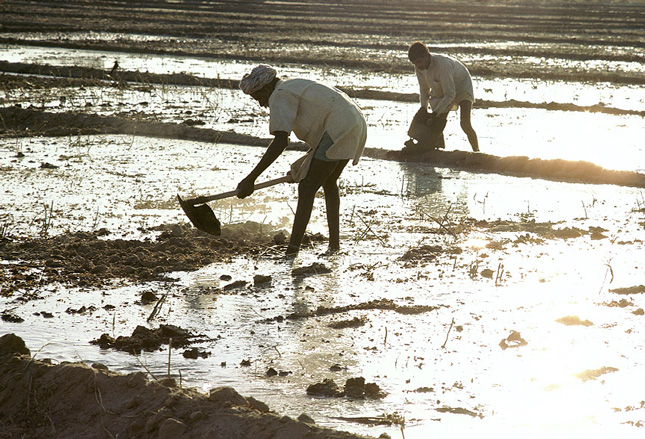
India is one of the most water-challenged countries in the world, from its deepest aquifers to its largest rivers. Groundwater levels are falling as farmers, new urban residents, and industries drain wells and aquifers. What water is available is often severely polluted, and the future may only be worse, with the national supply predicted to fall 50 percent below demand by 2030.
-
In Food Riots, Researchers Find a Divide Between Democracies and Autocracies
›Though the bull market for metals and energy may be ending, global food prices remain stubbornly high. The inflation-adjusted FAO Food Price Index is down from the near historic heights of 2007-08 and 2011 but still higher than at any point in the previous 30 years, putting a brake on several decades of progress in reducing world hunger.
-
Eric Chu on Translating Climate Adaptation Theory to Action on the Local Level
›“Adaptation is very theoretical. When you talk about ‘resilience,’ you draw these Venn diagrams and you draw these really complex issues, but at least at the IPCC level, we didn’t spend a lot of time thinking about what people were actually doing,” says Eric Chu in this week’s podcast.
-
Are We Keeping up With Asia’s Urbanization?
›There is widespread agreement, and untold publications, that argue urbanization is the defining issue of our time. There are more cities, both large and small, and more people living in those cities than anytime in human history.
-
New Data Explorer Explains Assumptions Behind Population Projections
›Population projections undergird many important policy decisions, from the U.S. government’s Feed the Future program to the Sustainable Development Goals. But they’re not as straightforward as they appear. Demographers often base their estimates on complicated assumptions that aren’t obvious to the end user.
-
What Climate Conflict Looks Like: Recent Findings and Possible Responses
›Climate change and conflict – what’s the relationship? In a recently completed set of field-based studies for USAID, the Foundation for Environmental Security and Sustainability set aside “yes-or-no” questions about whether climate change causes conflict and replaced them with pragmatic and politically informed questions about how climate change is consequential for conflict in specific fragile states.
Showing posts from category urbanization.