-
Water Wars? Think Again: Conflict Over Freshwater Structural Rather Than Strategic
›
The global water wars are almost upon us!
At least that’s how it seems to many. The signs are troubling: Egypt and Ethiopia have recently increased their aggressive posture and rhetoric over the construction of the Great Ethiopian Renaissance Dam in the headwaters of the Blue Nile, Egypt’s major artery since antiquity. India continues to build new dams that are seen by its rival Pakistan as a threat to its “water interests” and thus its national security. Turkey, from its dominant position upstream, has been diverting the Tigris and Euphrates rivers and increasing water stress in the already-volatile states of Iraq and Syria.
-
Double Dividends: Population Dynamics and Climate Adaptation
›
If current projections hold, Africa’s population will more than double in 40 years, putting more people at risk of food, water, health, and economic insecurity as the climate changes, as well as negating progress made in reducing carbon emissions per person. But what if it didn’t? [Video Below]
-
Assessing Climate Vulnerability and Adaptation: IPCC Working Group II in Their Own Words
›The latest report by the United Nations Intergovernmental Panel on Climate Change (IPCC) brings new evidence to bear on the real and potential impacts of climate change, emphasizing the need to manage risks and build resilience. In a dramatic, slickly produced video accompanying the much-anticipated Working Group II contribution to the report, released on March 30, several of the working group’s dozens of authors discuss key issues addressed in their section, which covers “impacts, adaptation, and vulnerability.”
-
A New Dimension to Geopolitics: Geoff Dabelko on the Latest IPCC Report
›“The Intergovernmental Panel on Climate Change is an attempt to get an international group of scientists together to assess what we know about climate change,” says Geoff Dabelko in an interview with the Wilson Center’s Context program. “That is not a quick process.”
-
Kathleen Mogelgaard: Four Steps to Better Link Climate Adaptation and Reproductive Health Strategies
›Climate change vulnerability is closely tied to population dynamics, says Kathleen Mogelgaard in this week’s podcast. “We know that population size, composition and spatial distribution around the world is constantly changing, and that these changes do have implications for climate change exposure, sensitivity, and adaptive capacity – the three elements of vulnerability.”
-
Vulnerability to Climate Change Institutional as Well as Environmental, Says Janani Vivekananda
›Vulnerability to climate change is in part determined by exposure to specific changes – proximity to low lying coastal areas or areas of likely drought – but state capacity also plays a major role. And interventions targeting either must reflect the complex links that bind the two, says International Alert’s Janani Vivekananda in an interview with adelphi’s Environment, Conflict, and Cooperation platform.
-
USAID Administrator Rajiv Shah on Public-Private Partnerships and the Future of Aid
›What’s the best way for America’s chief development agency to help other countries reach prosperity and democracy? Increasingly, it’s creating partnerships not just with other governments, but with the private sector too, says USAID Administrator Rajiv Shah in this week’s podcast. -
Have Ideas About Reducing Urban Poverty in the Developing World? In Graduate School? Apply Within
›The Wilson Center’s Urban Sustainability Laboratory, in partnership with USAID, International Housing Coalition, World Bank, and Cities Alliance, is pleased to announce the 5th Annual Urban Poverty Paper Competition for graduate students. The competition calls on students currently enrolled in a Master’s or PhD program to submit paper abstracts on topics relating to urban poverty in the developing world.
Showing posts from category risk and resilience.
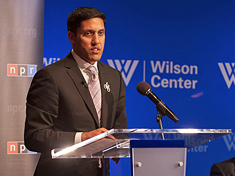 What’s the best way for America’s chief development agency to help other countries reach prosperity and democracy? Increasingly, it’s creating partnerships not just with other governments, but with the private sector too, says USAID Administrator