• woodrow wilson center
  • ecsp

New Security Beat

Subscribe:
  • rss
  • mail-to
  • Who We Are
  • Topics
    • Population
    • Environment
    • Security
    • Health
    • Development
  • Columns
    • China Environment Forum
    • Choke Point
    • Dot-Mom
    • Friday Podcasts
    • Navigating the Poles
    • Reading Radar
  • Multimedia
    • Water Stories (Podcast Series)
    • Backdraft (Podcast Series)
    • Tracking the Energy Titans (Interactive)
  • Films
    • Water, Conflict, and Peacebuilding (Animated Short)
    • Paving the Way (Ethiopia)
    • Broken Landscape (India)
    • Scaling the Mountain (Nepal)
    • Healthy People, Healthy Environment (Tanzania)
  • Publications
  • Events
  • Contact Us

NewSecurityBeat

The blog of the Wilson Center's Environmental Change and Security Program
Showing posts from category mitigation.
  • Mapping China’s Dam Rush – and the Environmental Consequences

    ›
    China Environment Forum  //  Eye On  //  April 1, 2014  //  By Luan "Jonathan" Dong
    dams-feature-thumb
    To see the full bilingual interactive map, visit WilsonCenter.org.

    In southwestern China, three parallel rivers – the Nu, Lancang, and Jinsha (also known as the Upper Mekong, Salween, and Yangtze, respectively) – form a series of corridors that connect the tropical rainforests of Southeast Asia to the Tibetan Plateau. These areas are some of the most biodiverse in the world, and scientists argue they have value as “climate refugia” – places worth preserving in order to allow species to retreat to cooler, more suitable climates as temperatures rise. A cascade of dams, however, has been planned for the region, threatening to submerge habitats, reduce the flow of tributary rivers, and make the area less suitable for many plant and animal species.

    MORE
  • Ready for Change: Notre Dame Launches the Global Adaptation Index

    ›
    From the Wilson Center  //  January 27, 2014  //  By Laura Henson
    ND-GAIN-screen

    In 2008 and 2010, the price of many basic food stuffs soared, sparking a series of riots and food crises around the world. People in the poorest countries – those living with the smallest margins – were most affected, while the economies of developed nations were able to absorb the price changes. According to Notre Dame’s Global Adaptation Index, how climate change will impact different countries depends not only on their vulnerability to physical changes, but also their ability to absorb these impacts. [Video Below]

    MORE
  • Talking Science: Climate Change and Health Communications in a Skeptical Era

    ›
    From the Wilson Center  //  January 8, 2014  //  By Laura Henson

    Communicating complex scientific concepts to general audiences is difficult given today’s information overload. Capturing the attention of time-pressed policymakers long enough to explain multifaceted issues like climate change and global health is an even greater challenge. The Environmental Communications Division of the National Communication Association co-sponsored two panels at the Wilson Center on November 22 featuring communication directors and professors of communications to explore this issue. [Video Below]

    MORE
  • Gender Gaining Ground at Climate Change Negotiations

    ›
    Guest Contributor  //  December 9, 2013  //  By Maria Prebble
    COP19-gaining-ground

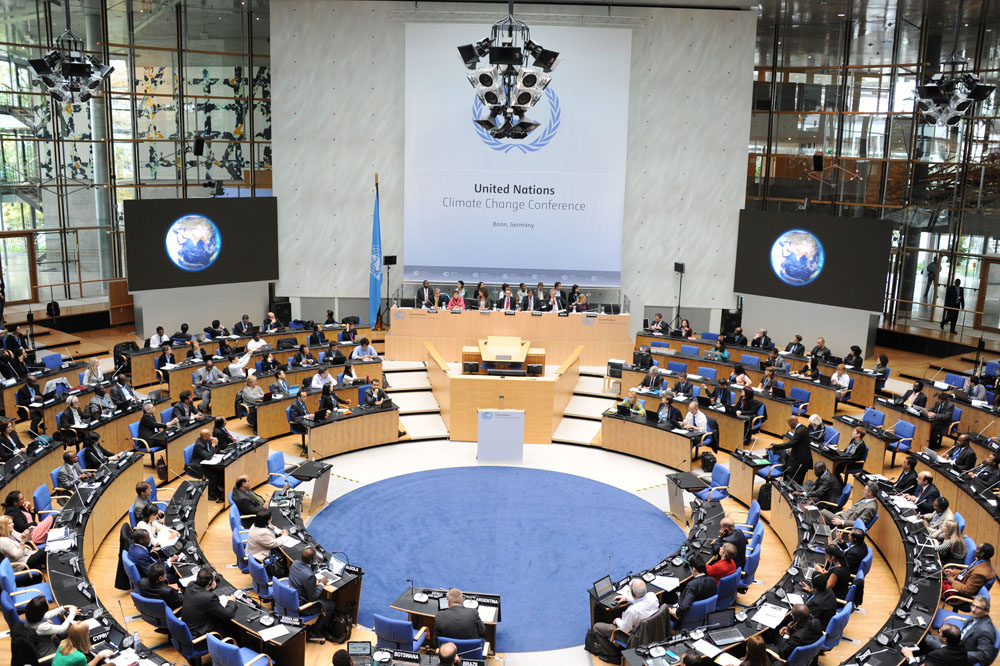
    Last month, more than 10,000 negotiators from 189 countries attended the latest UN climate change conference, known as the 19th Conference of the Parties, or COP-19, this year held in Warsaw. To many, COP-19 fell frustratingly short of its already low expectations: there were no significant new agreements and 132 developing countries along with many major non-government groups staged a walkout in protest. However, it was notable for several signs of continued progress in bringing women’s voices to the negotiating table.

    MORE
  • Anthropocene Visualized: Video Summarizes Key Findings of IPCC Fifth Assessment Report

    ›
    Eye On  //  November 29, 2013  //  By Jacob Glass

    “Humanity is altering Earth’s life support system. Carbon dioxide emissions are accelerating; greenhouse gas levels are unprecedented in human history,” says a new video summarizing some of the most striking finds of the Intergovernmental Panel on Climate Change’s latest report. The climate system is changing rapidly, and it is “extremely likely,” the video quotes the IPCC, that humans are the central reason why.

    MORE
  • Climate Change in a Growing, Urbanizing World: Understanding the Demography of Adaptation (Book Launch)

    ›
    From the Wilson Center  //  November 7, 2013  //  By Jacob Glass
    dogs-vs-children-san-franci

    The effects of climate change are often conveyed through the lens of changing physical landscapes. Shifting weather patterns, the intensification of drought, flooding, and coastal erosion are all primary areas of climate research. But do researchers know enough about changes in the size, distribution, and composition of human populations as they relate to climate vulnerability? [Video Below]

    MORE
  • Flooding and Food Security in Trinidad and Tobago: Roger-Mark Interviewed for ‘A Sea Change’

    ›
    August 21, 2013  //  By Schuyler Null

    “Climate change is one of the greatest challenges that we are facing in today’s world; it is particularly important for us in the Caribbean and for a country like Trinidad and Tobago,” says ECSP Director and Trinidad-native Roger-Mark De Souza in an upcoming documentary by Sustain T&T, a non-profit based in the islands.

    MORE
  • Stacy VanDeveer: “Green Economy” May Bring More of the Resource Curse

    ›
    Friday Podcasts  //  July 12, 2013  //  By Jacob Glass
    Stacy VanDeveer podcast

    “We can’t talk about a ‘green economy,’ ‘green technologies,’ or ‘green energies’ only by talking about technologies that are stamped out at one end of a large global process and deployed for cleaner energy,” says Stacy VanDeveer in this week’s podcast.

    “The green economy, or green energy transition, requires a lot of metals, and a whole lot of things that are mined,” he says. “Because of the scale of the industry now, the scale of the environmental and social change being driven by mining globally is actually quite stunning.”

    MORE
Newer Posts   Older Posts
View full site

Join the Conversation

  • RSS
  • subscribe
  • facebook
  • G+
  • twitter
  • iTunes
  • podomatic
  • youtube
Tweets by NewSecurityBeat

Trending Stories

  • unfccclogo1
  • Pop at COP: Population and Family Planning at the UN Climate Negotiations

Featured Media

Backdraft Podcast

play Backdraft
Podcasts

More »

What You're Saying

  • Volunteers,At,The,Lagos,Food,Bank,Initiative,Outreach,To,Ikotun, Pan-African Response to COVID-19: New Forms of Environmental Peacebuilding Emerge
    Rashida Salifu: Great piece 👍🏾 Africa as a continent has suffered this unfortunate pandemic.But it has also...
  • A desert road near Kuqa An Unholy Trinity: Xinjiang’s Unhealthy Relationship With Coal, Water, and the Quest for Development
    Ismail: It is more historically accurate to refer to Xinjiang as East Turkistan.
  • shutterstock_1779654803 Leverage COVID-19 Data Collection Networks for Environmental Peacebuilding
    Carsten Pran: Thanks for reading! It will be interesting to see how society adapts to droves of new information in...

What We’re Reading

  • Rising rates of food instability in Latin America threaten women and Venezuelan migrants
  • Treetop sensors help Indonesia eavesdrop on forests to cut logging
  • 'Seat at the table': Women's land rights seen as key to climate fight
  • A Surprise in Africa: Air Pollution Falls as Economies Rise
  • Himalayan glacier disaster highlights climate change risks
More »
  • woodrow
  • ecsp
  • RSS Feed
  • YouTube
  • Twitter
  • Facebook
  • Home
  • Who We Are
  • Publications
  • Events
  • Wilson Center
  • Contact Us
  • Print Friendly Page

© Copyright 2007-2021. Environmental Change and Security Program.

Woodrow Wilson International Center for Scholars. All rights reserved.

Developed by Vico Rock Media

Environmental Change and Security Program

Woodrow Wilson International Center for Scholars

Ronald Reagan Building and International Trade Center

  • One Woodrow Wilson Plaza
  • 1300 Pennsylvania Ave., NW
  • Washington, DC 20004-3027

T 202-691-4000