Showing posts from category population.
-
Population and Development, Scarcity and Fairness
›Monica Das Gupta, John Bongaarts, and John Cleland’s World Bank working paper, “Population, Poverty, and Sustainable Development: A Review of the Evidence,” analyzes the evidence so far on three questions: 1) Does high fertility affect low-income countries’ prospects for economic growth and poverty reduction?; 2) Does population growth exacerbate pressure on natural resources?; and 3) Are family planning programs effective at lowering fertility, and should they be publicly funded? They find the answers to these questions mainly to be “yes,” but more so in low-income countries with “poor policy environments,” where reducing fertility can lessen the pressure on natural resources – the management of which frequently faces “deep challenges” – and allow economic growth. Gupta et al. highlight sub-Saharan Africa in particular as a region that could gain from these policy levers. Resource Scarcity, Fair Shares and Development, a discussion paper by Alex Evans of the Center on International Cooperation at New York University, published in cooperation with WWF and Oxfam, tackles what Evans writes is an oft-ignored issue in relation to resource scarcity: the notion of fairness in a world of environmental limits. The need to advocate for “fair shares” will become a major issue for poor people and poor countries, and is therefore an important part of the development agenda, he writes. “Scarcity isn’t just relevant to specialists in environment, climate and rural livelihoods,” writes Evans. “On the contrary, resource scarcity will become increasingly central to governance, economics, social development and conflict advisers, and should be incorporated into training and professional development across these areas.”
 -
Michael Kugelman, Huffington Post
Pakistan’s Biggest Threats May Not Be What You Think They Are
›August 30, 2011 // By Wilson Center StaffThe original version of this article, by Michael Kugelman, appeared on the Huffington Post.
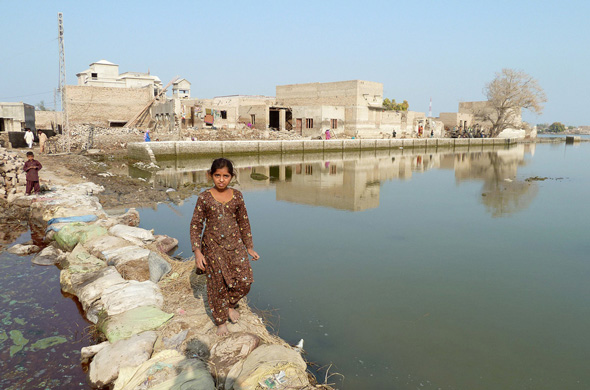
The most troubling news to emerge from Pakistan in recent days has little to do with militancy or other headline-grabbing scourges that afflict the country. Rather, it relates to a new Oxfam report’s finding that more than a third of the country’s population – about 60 million people – is undernourished.
Pakistan may well be convulsed by extremist violence; according to Pakistani estimates, it has killed or injured 30,000 in recent years. Yet contrary to what U.S. media coverage may suggest, this is not the greatest threat to the Pakistani people.
Numerous candidates contend for this dubious honor. One, underscored by Oxfam, is hunger. Even before last year’s devastating floods, which destroyed more than 2 million hectares of arable land, the World Food Program estimated that 77 million Pakistanis were going hungry. Another is water insecurity, one of Pakistan’s biggest killers. With a third of Pakistanis lacking access to clean water, no wonder waterborne illness claims the lives of 1.2 million Pakistanis per year – and 630 children every day. Lack of education also tops the list. More than 40 million of Pakistan’s 70 million school-age children (those between the ages of 5 to 19) are not in school. And then there is Pakistan’s energy crisis. Due to power shortfalls, some Pakistanis suffer outages for as long as 20 hours per day – crippling industry and bringing misery to millions of households. All of this is compounded by state corruption, which constrains access to these precious resources and services.
Continue reading on Huffington Post.
Sources: Business Recorder, Oxfam International, PBS, World Food Program.
Michael Kugelman is a program associate with the Wilson Center’s Asia Program.
Photo Credit: “People returning home as soon as the water recedes enough,” courtesy of flickr user DFID – UK Department for International Development. -
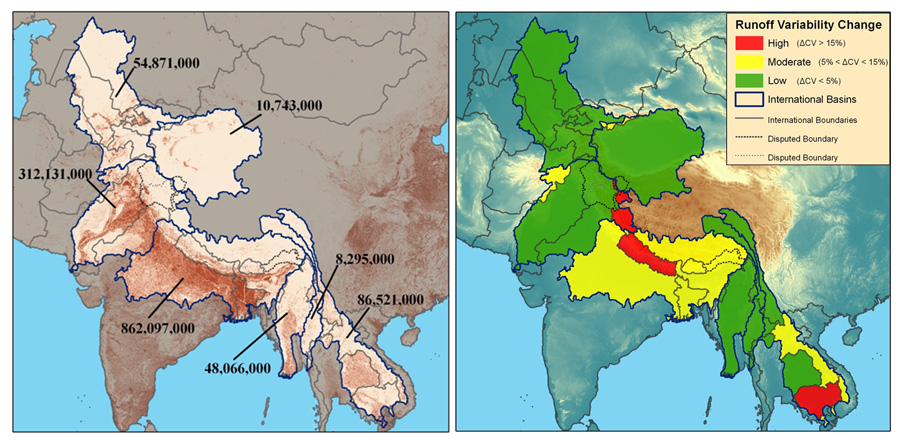
Redrawing the Map of the World’s International River Basins
›Understanding why conflict over water resources arises between nations begins with a solid understanding of the geography of international river basins. Where are the basins? How big are they? How many people live there? Who are the riparian nations, and what is the significance of each to the basin?
-
What’s in a Name? Watch Don Lauro on PHE, HELP, and HELPS
›Population, health, and environment (PHE) expert Don Lauro has worked on integrated projects for decades as a scholar, an implementer, a donor, and an evaluator. He recently visited the USAID-funded BALANCED Project in Tanzania as part of a wider look at this integrated approach. In an interview with ECSP, Lauro said the effort “made me think more broadly…about this area that we call population, health, and environment and what’s really in a name like that.”
“We commonly say PHE, and we all know what we’re talking about,” Lauro said of the population and development community, “but when you look deeply into these projects – or even not so deeply – you see that there’s other things going on as well.”
For example, Lauro pointed to the focus on livelihoods that many PHE programs have: “In the project I saw in Tanzania, there were many microcredit groups on the ground – mostly women – taking small loans for developing little enterprises that they had, like baking bread, raising bees, buying a cow…little enterprises to make their lives a little bit better.”
“Some people don’t use the term ‘PHE’…maybe it’s a ‘HELP’ project; that is health, environment, livelihoods, and population,” Lauro said. “Other people would say it’s maybe something even longer, ‘HELPS’ – health environment, livelihoods, population, and sustainability (or ‘security’ – Ed.).” When he was at the Wilson Center, Gib Clarke coined the “HELP” term in ECSP’s FOCUS Issue 20, arguing that livelihoods is such a critical component that it ought to be more formally recognized.
But, said Lauro, “on the ground they don’t use these terms – they say things like, ‘this is a healthy community program’ or ‘this is a green community program.’”
“I think it’s very important for us to realize what happens on the ground is lot different, and maybe more real, than how we talk about it.” -
Youth Bulge and Societal Conflicts: Have Peacekeepers Made a Difference?
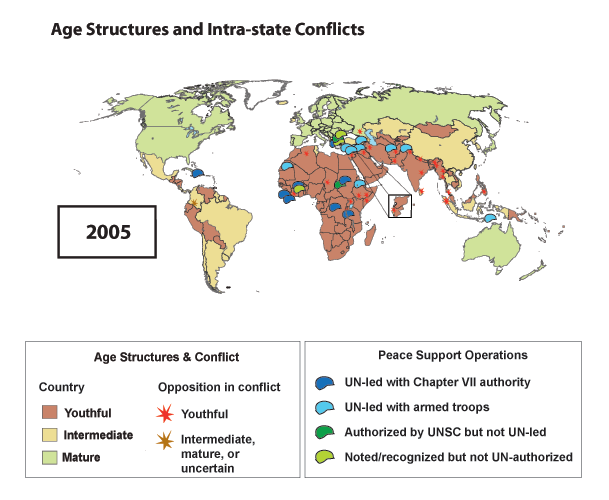
›August 22, 2011 // By Richard CincottaUntil recently, the question of which countries are at the most risk of violent societal conflict could be answered with a terse, two-part response: “the young and the war-torn.” This simple characterization regarding youth and conflict worked well, until the first decade of the 21st century. The proportion of youthful countries experiencing one or more violent intrastate conflicts declined from 25 percent in 1995 to 15 percent in 2005. What’s behind this encouraging slump in political unrest? One hypothesis is that peace support operations (PSOs) – peacekeepers, police units, and specialized observers that are led, authorized, or endorsed by the United Nations – have made a difference.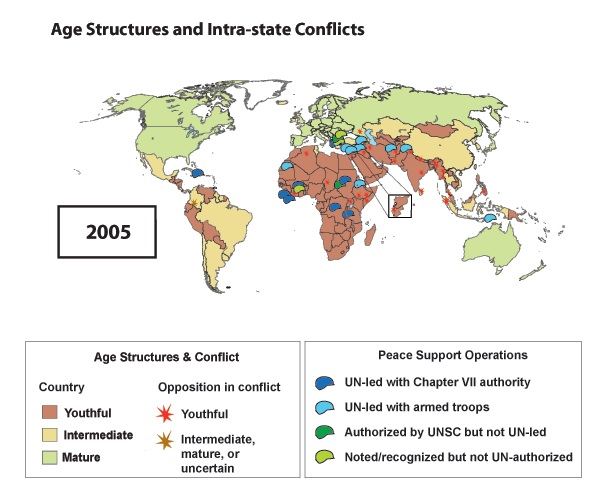
From the 1970s through the 1990s, more than 90 percent of all societal conflicts broke out in countries with a youthful age structure – a population with a median age of 25 years or less. And wherever civil and ethnic wars emerged, they tended to persist. The average societal conflict that began between 1970 and 1999 continued without a one-year break in battle-associated fatalities for about six years. Some – including the Angolan civil war, Northern Ireland’s “Troubles,” Peru’s war against the Shining Path, and the Afghan civil war – endured for decades. In contrast, inter-state conflicts that began between 1970 and 1999 lasted, on average, less than two years (see the UCDP/PRIO Conflict Database).
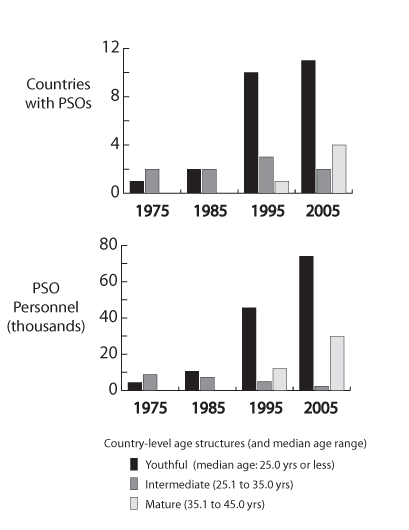
Taking on Intra-State ConflictsBeginning in the early 1990s, however, there was a marked expansion in size and number of PSOs deployed in the aftermath of societal warfare, which appears to have dampened the persistence of some conflicts and prevented the reemergence of others. The annual number of active PSOs deterring the re-emergence of societal conflict jumped from just 2 missions during 1985 to 22 in 2005. In contrast, those led, authorized, or endorsed by the UN to maintain cease-fire agreements between neighboring states during that same period only increased from three active missions to four. By 2009, nearly 100,000 peacekeepers were stationed in countries that had recently experienced a societal conflict. About 70 percent were deployed in countries with a youthful population (see Figures 2A and B). Why the sudden expansion in use of PSOs?
According to William Durch and Tobias Berkman, this upsurge was less a change of heart or modification of a global security strategy and more an outcome of the unraveling web of Cold War international relations. Before the 1990s, the majority of PSOs were United Nations-led operations that were mandated to monitor or help maintain cease-fires along mutual frontiers. Because insurgents were typically aligned with either the Soviets or a Western power, Security Council authorization to mediate a societal conflict was difficult to secure.
This situation changed with the breakup of the Soviet Union and the initiation of PSOs by regional organizations, including operations by the Economic Community of West African States (ECOWAS) in Liberia and Sierra Leone and the NATO-led Kosovo Force in 1998-99.
Demographic Forecasting
What do national demographic trends suggest for the demand for PSOs over the next two decades? For societal conflict, political demographers foresee that the demand for PSOs will continue to decline among states in Latin America and the Caribbean – with the exception of sustained risk in Guatemala, Haiti, Bolivia, and Paraguay. Similarly, demand for peacekeeping is expected to continue to ebb across continental East Asia.
Gauged by age structure alone, the risk of societal warfare is projected to remain high over the coming two decades in the western, central, and eastern portions of sub-Saharan Africa; in parts of the Middle East and South Asia; and in several Asian-Pacific island hotspots – Timor-Leste, Papua New Guinea, the Philippines, and Solomon Islands. But even in some countries that are losing their youthful blush, domestic political relations could turn out less rosy than this simple age-structural model forecasts.
In other words, there are roadblocks to a “demographic peace.” Among them is an increasing propensity for a specific demographic configuration of ethnic conflict: warfare between state forces and organizations that recruit from a minority that is more youthful than the majority ethnic group. Examples of these conflicts include the Kurds in Turkey, the Shiites in Lebanon, the Pattani Muslims in southern Thailand, and the Chechens of southern Russia.
However, this twist on the youth bulge model of the risks of societal conflict is a discussion for another installment on New Security Beat. Suffice it to say that when political demographers look over the UN Population Division’s current demographic projections, they see few signs of either the waning of societal warfare, or the withering of the current level of demand for PSOs.
Richard Cincotta is a consultant on political demography for the Wilson Center’s Environmental Change and Security Program and demographer-in-residence at The Stimson Center.
Sources: PRIO, The Stimson Center, UN Population Division.
Chart Credit: Data courtesy of the UN Population Division 2011, PRIO, and Durch and Berkman (2006). Arranged by Richard Cincotta. -
Deborah Mesce, Behind the Numbers
Kenya’s New Data Website Puts the Ball in Media’s Court
›The original version of this article, by Deborah Mesce, appeared on PRB’s Behind the Numbers blog.
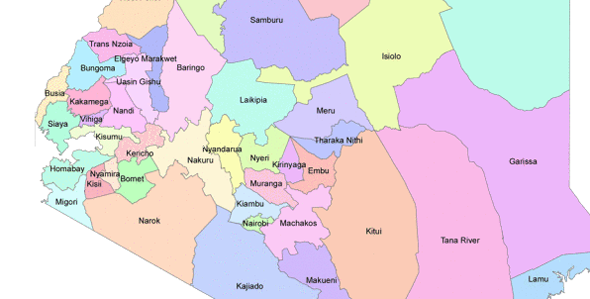
The Kenya government took a bold step toward transparency a few weeks ago when it fired up its Open Data website and posted loads of data in a format that makes the information easily understood by the average person. The data sets include national census statistics as well as government spending, and the government promises more data to come. This is a boon for journalists willing to wade into the numbers to examine what’s going on in their country and hold their government accountable. I’m waiting now to see how they will use this new tool.
We always hear that information is power, but that works only if the information is used. Lots of information begins as numbers, statistics, and data sets, with lots of good stories tucked away in there to be found by the journalist willing to go the extra mile, examine the numbers, and do the math. In many developing countries, the information – numbers, statistics, data sets – isn’t easily accessible, if it is available at all. Governments keep a tight hold on it, or if it’s made available, the average person would be hard pressed to make heads or tails out of it.
Continue reading on Behind the Numbers.
Image Credit: Open Data. -
Zo Zatovonirina, PHE Champion
Improving Human Health and Conservation in Madagascar’s Forest Communities
›This PHE Champion profile was produced by the BALANCED Project.
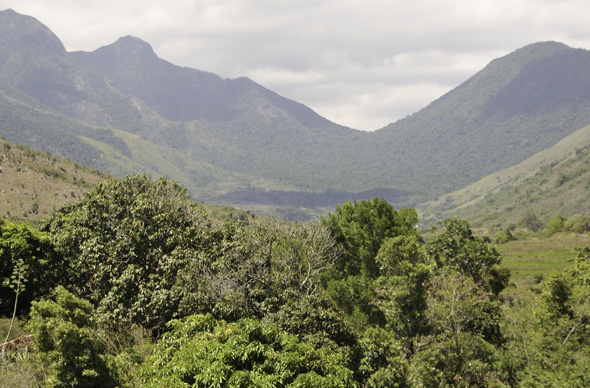
Madagascar is one of the world’s most unique ecosystems, with a total of eight plant families, five bird families, and five primate families that live nowhere else on Earth. Madagascar’s tropical forests and marine environments are home to endemic species of flora and fauna, although tragically 15 species are now extinct. At the same time, Madagascar is rich in freshwater resources, yet more than 60 percent of the island’s 19.7 million people do not have access to safe drinking water.Since 2003, Zo Zatovonirina has worked for Conservation International (CI) in Madagascar, and he has seen up-close the challenges of reaching remote forest communities, often requiring one- or two-day hikes over treacherous roads. As coordinator for USAID’s Healthy Families, Healthy Forests Program, Zo worked with two Malagasy nongovernmental organizations (NGOs), MATEZA, and the Association for Health Action and Security, to implement integrated population, health, and environment (PHE) approaches in response to community needs in the Ankeniheny Zahamena forest corridor in eastern Madagascar.
From 2003-2008, CI and partners reached more than 25,000 village residents with PHE messages; increased contraceptive prevalence in target zones from 17 percent in 2005 to 30 percent in 2008; constructed 3,000 latrines; and improved environmental health in all priority sites.
Today, biodiversity in Madagascar is under increased pressure, in light of political instability since 2009 and continued population pressures. Recognizing CI and partner experience and investments in conservation efforts to improve human well-being, USAID Madagascar and World Learning recently awarded a new 15-month grant to CI Madagascar and two Malagasy NGO partners – Voahary Salama and Ny Tanintsika – to implement an integrated PHE project in the southeastern Ambositra Vondrozo forest corridor. All three organizations have implemented PHE projects in Madagascar, and they have established trusting relationships with the people living in these fragile ecosystems.
Madagascar has a rich history of implementing successful PHE projects, and this project represents a new PHE pilot phase in the midst of political uncertainty. According to Zo, PHE approaches remain constant – simultaneously addressing several complex and linked problems such as poverty, child survival, and unsustainable dependency on natural resources. In Zo’s experience, CI’s PHE approach touches on all these aspects and delivers a pragmatic, integrated package of interventions designed to increase community capacity to better manage their health and environment. Utilizing PHE approaches, CI, Voahary Salama, and Ny Tanintsika will strive to reach communities for the first time ever with family planning, water, sanitation, and hygiene services while helping them conserve their biological heritage.
This PHE Champion profile was produced by the BALANCED Project. A PDF version can be downloaded from the PHE Toolkit. PHE Champion profiles highlight people working on the ground to improve health and conservation in areas where biodiversity is critically endangered.
Photo Credit: The forests of Madagascar, courtesy of Conservation International/Russ Mittermeier, and Zo Zatovonirina, courtesy of Conservation International. -
Russell Sticklor, World Politics Review
The Hungry Planet: Global Food Scarcity in the 21st Century
›August 16, 2011 // By Wilson Center StaffThe original version of this article, by Russell Sticklor, appeared on World Politics Review.
At the dawn of the 20th century, the world population was inching toward a modest two billion. In the 111 years since, notwithstanding the impact of war, genocide, disease, and famine, the global population has soared, reaching three billion around 1960 and now quickly approaching the neighborhood of seven billion. By 2050, the planet will likely be home to two billion more.
We may not be witnessing the detonation of the “population bomb” that Paul Ehrlich warned of in his seminal 1968 book, but such rapid demographic change is clearly pushing the international community into uncharted territory. With a limited amount of arable land and a finite supply of fresh water for irrigation, figuring out how to feed a planet adding upward of 70 million people each year looms as one of the 21st century’s most pressing challenges.
The push to ensure global food security transcends the desire to avoid repeating the famines that devastated the Soviet Union, China, North Korea, Ethiopia, and so many other corners of the world during the past century. Instead, aid and development organizations today rightly view food insecurity problems as deeply intertwined with issues of economic development, public health, and political stability, particularly in the developing world. To maintain order in the international community and prevent the emergence of new failed states in the decades ahead, it will be critical to find innovative means of feeding the rapidly growing populations of sub-Saharan Africa, the Middle East, and South and East Asia.
Continue reading on World Politics Review.
Note: World Politics Review has graciously white-listed all entrances from NSB for this article, so as long as you use the above link, you should be able to read the full article for free.
Russell Sticklor is a consultant for the Environmental Change and Security Program.
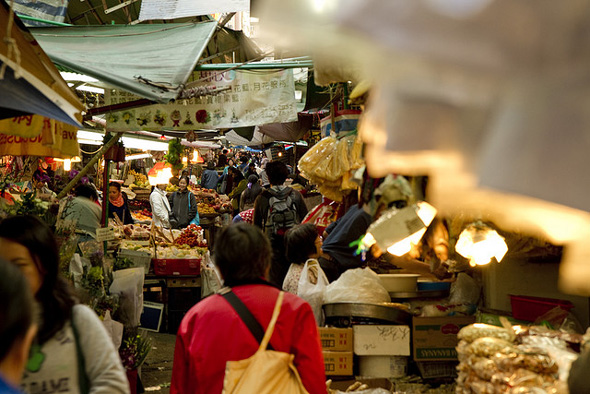
Photo Credit: “Crowded market street,” courtesy of flickr user – yt –.