• woodrow wilson center
  • ecsp

New Security Beat

Subscribe:
  • rss
  • mail-to
  • Who We Are
  • Topics
    • Population
    • Environment
    • Security
    • Health
    • Development
  • Columns
    • China Environment Forum
    • Choke Point
    • Dot-Mom
    • Friday Podcasts
    • Navigating the Poles
    • Reading Radar
  • Multimedia
    • Water Stories (Podcast Series)
    • Backdraft (Podcast Series)
    • Tracking the Energy Titans (Interactive)
  • Films
    • Water, Conflict, and Peacebuilding (Animated Short)
    • Paving the Way (Ethiopia)
    • Broken Landscape (India)
    • Scaling the Mountain (Nepal)
    • Healthy People, Healthy Environment (Tanzania)
  • Publications
  • Events
  • Contact Us

NewSecurityBeat

The blog of the Wilson Center's Environmental Change and Security Program
  • Michael Kugelman, Huffington Post

    Pakistan’s Biggest Threats May Not Be What You Think They Are

    August 30, 2011 By Wilson Center Staff
    The original version of this article, by Michael Kugelman, appeared on the Huffington Post.

    The most troubling news to emerge from Pakistan in recent days has little to do with militancy or other headline-grabbing scourges that afflict the country. Rather, it relates to a new Oxfam report’s finding that more than a third of the country’s population – about 60 million people – is undernourished.

    Pakistan may well be convulsed by extremist violence; according to Pakistani estimates, it has killed or injured 30,000 in recent years. Yet contrary to what U.S. media coverage may suggest, this is not the greatest threat to the Pakistani people.

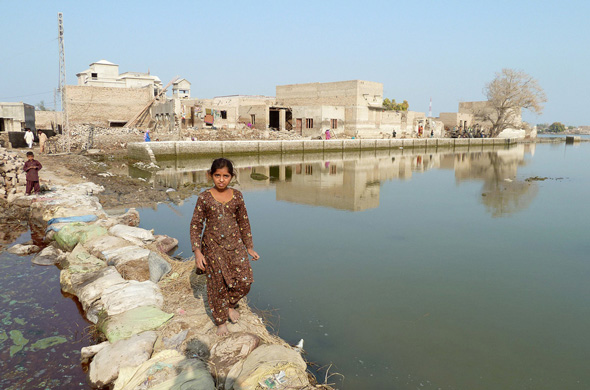
    Numerous candidates contend for this dubious honor. One, underscored by Oxfam, is hunger. Even before last year’s devastating floods, which destroyed more than 2 million hectares of arable land, the World Food Program estimated that 77 million Pakistanis were going hungry. Another is water insecurity, one of Pakistan’s biggest killers. With a third of Pakistanis lacking access to clean water, no wonder waterborne illness claims the lives of 1.2 million Pakistanis per year – and 630 children every day. Lack of education also tops the list. More than 40 million of Pakistan’s 70 million school-age children (those between the ages of 5 to 19) are not in school. And then there is Pakistan’s energy crisis. Due to power shortfalls, some Pakistanis suffer outages for as long as 20 hours per day – crippling industry and bringing misery to millions of households. All of this is compounded by state corruption, which constrains access to these precious resources and services.

    Continue reading on Huffington Post.

    Sources: Business Recorder, Oxfam International, PBS, World Food Program.

    Michael Kugelman is a program associate with the Wilson Center’s Asia Program.

    Photo Credit: “People returning home as soon as the water recedes enough,” courtesy of flickr user DFID – UK Department for International Development.
    Topics: development, food security, global health, Pakistan, population, security, U.S., water

Join the Conversation

  • RSS
  • subscribe
  • facebook
  • G+
  • twitter
  • iTunes
  • podomatic
  • youtube
Tweets by NewSecurityBeat

Trending Stories

  • unfccclogo1
  • Pop at COP: Population and Family Planning at the UN Climate Negotiations

Featured Media

Backdraft Podcast

play Backdraft
Podcasts

More »

What You're Saying

  • Volunteers,At,The,Lagos,Food,Bank,Initiative,Outreach,To,Ikotun, Pan-African Response to COVID-19: New Forms of Environmental Peacebuilding Emerge
    Rashida Salifu: Great piece 👍🏾 Africa as a continent has suffered this unfortunate pandemic.But it has also...
  • A desert road near Kuqa An Unholy Trinity: Xinjiang’s Unhealthy Relationship With Coal, Water, and the Quest for Development
    Ismail: It is more historically accurate to refer to Xinjiang as East Turkistan.
  • shutterstock_1779654803 Leverage COVID-19 Data Collection Networks for Environmental Peacebuilding
    Carsten Pran: Thanks for reading! It will be interesting to see how society adapts to droves of new information in...

Related Stories

No related stories.

  • woodrow
  • ecsp
  • RSS Feed
  • YouTube
  • Twitter
  • Facebook
  • Home
  • Who We Are
  • Publications
  • Events
  • Wilson Center
  • Contact Us
  • Print Friendly Page

© Copyright 2007-2021. Environmental Change and Security Program.

Woodrow Wilson International Center for Scholars. All rights reserved.

Developed by Vico Rock Media

Environmental Change and Security Program

Woodrow Wilson International Center for Scholars

Ronald Reagan Building and International Trade Center

  • One Woodrow Wilson Plaza
  • 1300 Pennsylvania Ave., NW
  • Washington, DC 20004-3027

T 202-691-4000