• woodrow wilson center
  • ecsp

New Security Beat

Subscribe:
  • rss
  • mail-to
  • Who We Are
  • Topics
    • Population
    • Environment
    • Security
    • Health
    • Development
  • Columns
    • China Environment Forum
    • Choke Point
    • Dot-Mom
    • Friday Podcasts
    • Navigating the Poles
    • Reading Radar
  • Multimedia
    • Water Stories (Podcast Series)
    • Backdraft (Podcast Series)
    • Tracking the Energy Titans (Interactive)
  • Films
    • Water, Conflict, and Peacebuilding (Animated Short)
    • Paving the Way (Ethiopia)
    • Broken Landscape (India)
    • Scaling the Mountain (Nepal)
    • Healthy People, Healthy Environment (Tanzania)
  • Publications
  • Events
  • Contact Us

NewSecurityBeat

The blog of the Wilson Center's Environmental Change and Security Program
Showing posts from category global health.
  • Fishing for Families: Reporting on Population and Food Security in the Philippines

    ›
    From the Wilson Center  //  On the Beat  //  February 11, 2013  //  By Carolyn Lamere

    “My income is just right to feed us three times a day,” Jason Bostero told Sam Eaton in the rural Philippine village of Humayhumay. “It’s really, really different when you have a small family.” Eaton traveled to the Philippines to report on the connections between food security and population for Homelands Productions, creating a short film and radio piece that ran on NewsHour and Marketplace as part the Food for Nine Billion series last year. [Video Below]

    MORE
  • Behind the Numbers

    Reproductive Health and Population Issues in the MDGs: An Interview With Stan Bernstein

    ›
    February 8, 2013  //  By Wilson Center Staff

    The original version of this article appeared on the Population Reference Bureau’s Behind the Numbers blog.

    Stan Bernstein, a retired UNFPA senior policy adviser and former health adviser on the UN Millennium Project, recently attended the Seventh Annual Research Conference on Population, Reproductive Health, and Economic Development in Oslo, Norway. During the conference, Bernstein reflected on the presence of reproductive health and population issues among the Millennium Development Goals (MDGs) and their indicators. He also commented on prospects for including relevant reproductive health and population goals or indicators in the development agenda beyond 2015. Bernstein hailed the role of research from the PopPov network in the past and its potential contributions to future development agendas. He answers some questions for PRB below.

    MORE
  • Malaria and Maternal Health: Treating Pregnant Women Reveals Need for Integration

    ›
    Dot-Mom  //  February 5, 2013  //  By Lauren Herzer Risi

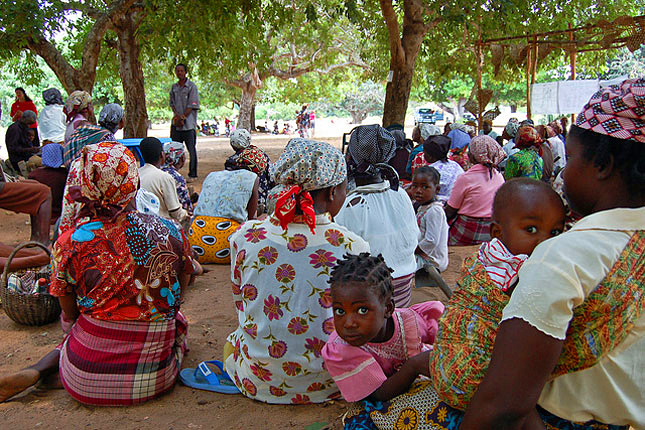
    Ten years ago, a study was conducted in Mozambique to determine the impact of a new medicine for pregnant women with malaria. Over 1,000 women participated in a controlled trial of intermittent preventative treatment with sulphadoxine-pyrimethamine – half received a placebo, the other half received the actual drug. All were given an insecticide-treated net.

    MORE
  • Sam Loewenberg, The New York Times

    Learning From Failure

    ›
    Dot-Mom  //  February 5, 2013  //  By Wilson Center Staff

    The original version of this op-ed, by Sam Loewenberg, appeared in The New York Times.

    Americans love success stories. Go to the web sites of the United States Agency for International Development, the Bill and Melinda Gates Foundation, or a plethora of global health and development organizations, and you’ll find articles, charts, and videos documenting their triumphs and innovations, with the promise of more on the way.

    MORE
  • Setting Development Goals for Population Dynamics and Reproductive Rights

    ›
    From the Wilson Center  //  January 30, 2013  //  By Carolyn Lamere

    “I’d like to start by stating emphatically that since addressing global inequality and inequity are our overall principles in revising the MDGs [Millennium Development Goals], we must focus on health inequities to have a meaningful and lasting impact on human development,” said Beth Schlachter of the State Department’s Bureau of Population, Refugees, and Migration, speaking at the Wilson Center on January 9. “And for the most vulnerable – women and girls – that means we must focus on sexual and reproductive health and reproductive rights.” [Video Below]

    MORE
  • Nadya Ivanova, Circle of Blue

    Across Much of China, Huge Harvests Irrigated With Industrial and Agricultural Runoff

    ›
    China Environment Forum  //  Choke Point  //  January 24, 2013  //  By Wilson Center Staff

    The original version of this article, by Nadya Ivanova, appeared on Circle of Blue.

    The horizon gleams with a golden hue from the wheat fields that spread in all directions here in Shandong, a prime food-growing province on the lower reaches of the Yellow River. As hundreds of farmers spread the wheat like massive carpets to dry on country roads, combine machines are busy harvesting the grain. The same afternoon that the wheat harvest is finished, farmers will already be planting corn and other crops. This is how China feeds 1.4 billion citizens and millions of livestock.

    MORE
  • Rachel Yavinsky, Behind the Numbers

    Energy-Saving Stoves and Family Planning Benefit Women and Families in Rural Uganda

    ›
    January 23, 2013  //  By Wilson Center Staff

    The original version of this article, by Rachel Yavinsky, appeared on the Population Reference Bureau’s Behind the Numbers blog.

    After 45 minutes on Lake Victoria in a wooden fishing boat, my PRB colleague and I arrived on Busi Island, one of the Ugandan sites of the HOPE-LVB (Health of People and the Environment – Lake Victoria Basin) project. PRB, who partners on this project, came to Busi Island to see HOPE-LVB in action.

    MORE
  • Migration Flows, New Growth Demand New Ways to Do Urban Development

    ›
    Guest Contributor  //  January 22, 2013  //  By Patricia Weiss Fagen

    A majority of the world population now lives in urban settings, but many of the most rapidly growing cities are unprepared to accommodate their new citizens. Newly swollen municipalities in poor and institutionally fragile countries are especially disadvantaged by poor planning and management, deficient public services, and citizen insecurity.

    MORE
Newer Posts   Older Posts
View full site

Join the Conversation

  • RSS
  • subscribe
  • facebook
  • G+
  • twitter
  • iTunes
  • podomatic
  • youtube
Tweets by NewSecurityBeat

Trending Stories

  • unfccclogo1
  • Pop at COP: Population and Family Planning at the UN Climate Negotiations

Featured Media

Backdraft Podcast

play Backdraft
Podcasts

More »

What You're Saying

  • Volunteers,At,The,Lagos,Food,Bank,Initiative,Outreach,To,Ikotun, Pan-African Response to COVID-19: New Forms of Environmental Peacebuilding Emerge
    Rashida Salifu: Great piece 👍🏾 Africa as a continent has suffered this unfortunate pandemic.But it has also...
  • A desert road near Kuqa An Unholy Trinity: Xinjiang’s Unhealthy Relationship With Coal, Water, and the Quest for Development
    Ismail: It is more historically accurate to refer to Xinjiang as East Turkistan.
  • shutterstock_1779654803 Leverage COVID-19 Data Collection Networks for Environmental Peacebuilding
    Carsten Pran: Thanks for reading! It will be interesting to see how society adapts to droves of new information in...

What We’re Reading

  • Rising rates of food instability in Latin America threaten women and Venezuelan migrants
  • Treetop sensors help Indonesia eavesdrop on forests to cut logging
  • 'Seat at the table': Women's land rights seen as key to climate fight
  • A Surprise in Africa: Air Pollution Falls as Economies Rise
  • Himalayan glacier disaster highlights climate change risks
More »
  • woodrow
  • ecsp
  • RSS Feed
  • YouTube
  • Twitter
  • Facebook
  • Home
  • Who We Are
  • Publications
  • Events
  • Wilson Center
  • Contact Us
  • Print Friendly Page

© Copyright 2007-2021. Environmental Change and Security Program.

Woodrow Wilson International Center for Scholars. All rights reserved.

Developed by Vico Rock Media

Environmental Change and Security Program

Woodrow Wilson International Center for Scholars

Ronald Reagan Building and International Trade Center

  • One Woodrow Wilson Plaza
  • 1300 Pennsylvania Ave., NW
  • Washington, DC 20004-3027

T 202-691-4000