-
Jeffrey Gettleman, The New York Times
Mosquito Nets Used for Fishing Raise Sustainability, Health Questions
›January 28, 2015 // By Wilson Center Staff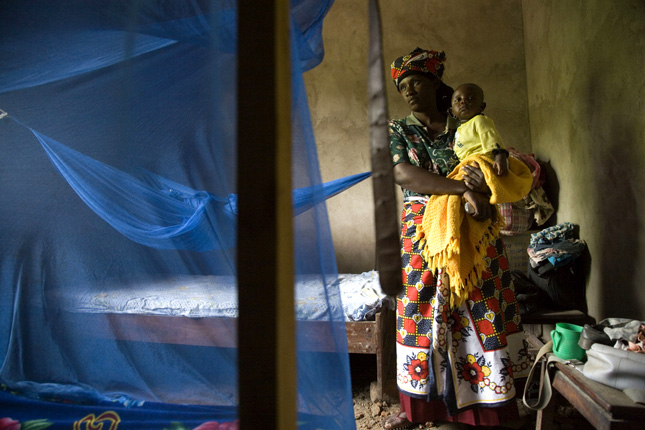
BANGWEULU WETLANDS, Zambia – Out here on the endless swamps, a harsh truth has been passed down from generation to generation: There is no fear but the fear of hunger.
-
New Data Explorer Explains Assumptions Behind Population Projections
›
Population projections undergird many important policy decisions, from the U.S. government’s Feed the Future program to the Sustainable Development Goals. But they’re not as straightforward as they appear. Demographers often base their estimates on complicated assumptions that aren’t obvious to the end user.
-
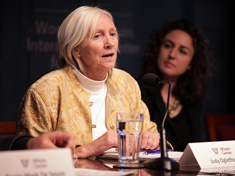
Judy Oglethorpe: Fighting Environmental Change in Nepal Through Community Empowerment
›“We believe that ecosystems can help people to adapt,” says Judy Oglethorpe in this week’s podcast. “But at the same time, people have to help ecosystems to adapt in order to continue to provide environmental services.”
-
Bridging the Gap: Family Planning, Rights, and Climate-Compatible Development
›“There is no magic bullet or solution to resolving climate change quickly,” said the Population Reference Bureau’s Jason Bremner at the Wilson Center on October 28. “Our next 100 years will be far different from the last 100 or the last 1000…and it has become clear that nations will have to pursue many strategies in order to reduce emissions, build resilience, and adapt.” [Video Below]
-
The U.S. Military’s Role in Global Health; Motivating Behavioral Change Through Personal Health
›Climate change mitigation efforts are more broadly supported when they are framed as a public health issue, according to results recently published in Climatic Change. After polling U.S. participants with political identities ranging from very liberal to very conservative, authors Nada Petrovic, Jaime Madrigano, and Lisa Zaval found most participants, except those who identified as very conservative, believed “health” to be the most compelling reason to reduce fossil fuels. -
Dr. Luther-King Fasehun, Maternal Health Task Force
To Turn the Tide of Maternal Mortality in Nigeria, Go State by State
›It is no longer news that Nigeria is a peculiar country, a nation with huge human and natural resources, and whose diversity of peoples and internal geographies is a blessing. Sadly, it is also not news that the country represents at least 10 percent of the global maternal mortality burden, with a currently estimated maternal mortality ratio (MMR) of 487 per 100,000 livebirths (as of 2011).
-
Reporting on the Spaces Between: How to Cover Climate, Population, and Health Connections
›In his 2007 best-seller, The World Without Us, Alan Weisman explored what would happen to the planet if the human race suddenly vanished – the gradual deterioration of the built environment, the geologic fossilization of our everyday stuff, and the ecological processes that would rebound and thrive without continual and growing human pressure. [Video Below]
-
Chernor Bah: Girls Invisible in Most Youth Development Policies
›“Youth in many countries is synonymous [with] masculinity,” says Chernor Bah in this week’s podcast. “Across governments – and I’ve looked at a lot of youth policies – girls are invisible.”
Showing posts from category global health.