-
PRB’s 2012 World Population Data Sheet
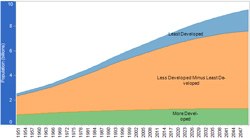
› “The most rapid population growth in many ways [occurs in] the countries that can least afford it,” said Carl Haub in a webinar on July 19 to launch the Population Reference Bureau’s (PRB) 50th annual World Population Data Sheet. This year, the report explores aging populations in more developed countries, rapid population growth in less developed countries, and the increased global prevalence of non-communicable diseases in an interactive map, which concisely illustrates global trends. PRB estimates that the world’s population is 7,057,075,000 as of mid-2012; the global population crossed the seven billion threshold in October 2011.
 “The most rapid population growth in many ways [occurs in] the countries that can least afford it,” said Carl Haub in a webinar on July 19 to launch the Population Reference Bureau’s (PRB) 50th annual World Population Data Sheet. This year, the report explores aging populations in more developed countries, rapid population growth in less developed countries, and the increased global prevalence of non-communicable diseases in an interactive map, which concisely illustrates global trends. PRB estimates that the world’s population is 7,057,075,000 as of mid-2012; the global population crossed the seven billion threshold in October 2011.
Aging Europe and East Asia
Haub explained that population growth in Europe has been declining since the 1970s and is more or less a “pre-programmed destiny” for these countries. People of child-bearing ages make up a smaller percent of the population in many more developed countries, so unless there is an “enormous increase” in total fertility rates, these populations will continue to decline for the foreseeable future.
Haub noted that these aging populations are unprecedented. In Germany and Italy, for example, 21 percent are over the age of 65; many other European countries have similar figures, as do other developed countries like Japan and South Korea. PRB expects these percentages to increase throughout the next century and for European countries to struggle to support greater numbers of retirees.
Many such states have already found it difficult to raise the retirement age, even though medical advances allow people to work until later ages. PRB projects that in Japan, 42 percent of their population will be over the age of 60 in 2050; if such a large percentage of the population is no longer in the labor force, it will be difficult for to find the resources to support them.
The report shows that the United States, on the other hand, is still experiencing modest population growth. The higher birthrate is in part due to immigration, as recent immigrants to the United States tend to have more children. Haub noted that European states have been reluctant to accept greater numbers of migrants to try to reverse their declining population.
Youthful Developing Countries
While the demographic destiny of aging countries is somewhat determined, the future for less developed countries is more uncertain. Many countries in sub-Saharan Africa, the Middle East, and South Asia have large and growing youth populations, and how many children these “future parents” will have is uncertain. That uncertainty is underscored by the variety of scenarios for future population growth. The UN has four variants – high, medium, low, and constant fertility – which vary considerably in their projections for future populations, and PRB’s global projections for 2050 are some 600 million people more than the commonly-used medium variant UN projection.
Rapid growth in the least developed countries is hardly a new phenomenon, but PRB breaks down the numbers to an impressive degree. The 2012 Data Sheet provides updated net migration rates, projected population as a multiple of today’s, infant mortality rates, rate of natural increase, and other basic statistics. PRB also provides population pyramids from the wealthiest and poorest quintiles of the population of Malawi, as an example of the utility of desegregating data to better allocate resources to the underserved. They found that while birthrates have begun to decline for the wealthiest one-fifth of Malawians, the poorest citizens still have a total fertility rate of over seven children per woman.
Measuring Health Systems
Devastating infectious diseases – malaria, tuberculosis, and HIV/AIDS – have long been entrenched in some of the least developed and most rapidly growing parts of the world. But this year, PRB began to assess health on a broader level by tracking deaths attributed to non-communicable diseases as well. Diseases like cardiovascular disease, diabetes, respiratory illness, and cancer are leading causes of death in developed countries, but they have also increased in prevalence in developing countries at an alarming rate.
PRB is not the only organization to take note of the change in disease predominance. The World Health Organization has issued guidelines targeting four factors which increase the risk of these illnesses: tobacco use, alcohol abuse, poor diet/obesity, and physical inactivity. The UN also called a special session last September to discuss non-communicable diseases. President of PRB Wendy Baldwin noted that the last such discussion on a health issue was 10 years ago about HIV/AIDS.
Baldwin also pointed out that non-communicable diseases can increase the burden on the health systems of developing countries even more so than in developed states. She reported that in south Asia, for example, people have heart attacks on average six years earlier than people in developed countries, meaning more families lose their primary breadwinners.
The risk factors for these non-communicable diseases are difficult to target, especially with increasing urbanization in developing countries. But in a video accompanying the report, Baldwin mentioned that raising the price of cigarettes is an effective way to reduce tobacco consumption, especially for youth. Some countries have also made progress in increasing physical activity through sports programs and making urban areas safer for pedestrians. “The low and middle income countries have a real opportunity to take really positive steps to confront that rise in non-communicable diseases and to address the risk factors that drive them,” she said.
The Data Sheet Over Time
The World Population Data Sheet has long been a vital resource for those in the population, health, and environment fields and has grown to include far more data than its first iteration in 1962. At first, the sheet had only four indicators: a population estimate for the year, annual rate of increase, crude birth rate, and crude death rate. Over time, PRB began measuring a greater number of key figures like infant mortality and life expectancy at birth. Population projections, a staple of the current version, were not added until 1978, perhaps in response to the inception of the United Nations World Population Projections in 1974.
Over the past five decades, the data sheet has been witness to some major shifts in global population trends. While PRB discourages researchers from comparing past data to current figures because the measures and methods of gathering information have likely changed over time, it is still possible to see the rise of importance in several trends based on the indicators PRB chose to focus on each year. For example, extremely young populations have been found to have profound effects on a country’s stability and prosperity, as have aging populations. The 1966 data sheet was the first to measure the percentage of the population under the age of 15, and it didn’t become a consistent data point until 1977.
The number of people living in cities in the developing world surpassed those in the developed in 1970, according to the UN, and in 1972, PRB began tracking the percentage of populations living in urban areas. HIV/AIDS indicators were added in 2000, as global awareness and a commitment to fighting the disease was rising.
PRB’s demonstrated commitment to continually adding more data and refining existing projections makes the data sheet is a valuable resource to those studying the problems of today and the future. Fifty years on, the amount of information collected is staggering. The data sheet provides a glimpse at not just how many people there are in the world, but also where and how they live.
For more information, take a look at the full data sheet!
Sources: Population Reference Bureau, UN Population Division.
Image Credit: PRB; Video: Noncommunicable Diseases and Youth in Developing Countries. -
Iran’s Surprising and Shortsighted Shift on Family Planning
›August 8, 2012 // By Elizabeth Leahy Madsen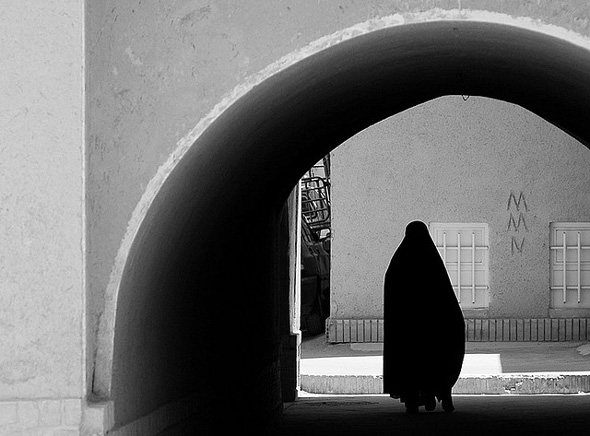
In late July, Iran’s government announced that it would no longer fund family planning programs, a dramatic reversal following 20 years of support. The change is especially abrupt for a country that has been lauded as a family planning success story, with thorough rural health services and an educated female population contributing to one of the swiftest demographic transitions in history.
-
Three UN Millennium Development Targets Reached and a Review of the Human Drivers of Climate Change
›“It is plausible that key transitions in human evolutionary history have been driven in large part by climate change,” write Eugene A. Rosa and Thomas Dietz in “Human Drivers of National Greenhouse-Gas Emissions,” a literature review published by Nature Climate Change. “Changes in climate will doubtless be a key force in the future evolution of social systems, including all aspects of social, economic, and political life, while impinging on the health and well-being of the individuals who populate them.” Rosa and Dietz cite numerous studies to argue that nearly every facet of society will be affected by climate change. “The critical point,” they write, “is that population, affluence, technology, and all other drivers act not alone or additively but in a multiplicative fashion.” For example, rapid population growth can lead to an increase in urbanization, which generates “substantial demand for goods and services that can induce emissions in distant places.” They conclude that huge changes must be made in technology and consumption in order to combat the effects of climate change that are being caused by a growing population and an increasingly affluent world.The United Nations’ 2012 Millennium Development Goals Report, released last month in New York City, announces that three of the eight major human development goals have been reached ahead of their 2015 targets. The Millennium Development Goals, set at a conference in 2000, were established to “uphold the principles of human dignity, equality, and equity at a global level.” The 2012 report indicates that the number of people living in extreme poverty has been halved since 1990; the proportion of people in the world without sustainable access to safe drinking water has also been halved; and more than 200 million slum dwellers have “gained access to either improved water sources, improved sanitation facilities, or durable or less crowded housing.” At the report launch, UN Secretary-General Ban Ki-moon noted that “these results represent a tremendous reduction in human suffering and are a clear validation of the approach embodied in the MDGs, but they are not a reason to relax.” Goals that have yet to be achieved include universal primary education; gender equality; reduced child mortality and improved maternal health; reducing rates of diseases such as HIV and malaria; and creating a global partnership for development.
Keenan Dillard is a cadet at the United States Military Academy at West Point and an intern with the Woodrow Wilson Center’s Environmental Change and Security Program. -
Lawrence K. Altman, The New York Times
A World Without AIDS, Still Worlds Away
›August 6, 2012 // By Wilson Center StaffThe original version of this article, by Lawrence K. Altman, appeared on The New York Times.
Is the world on the verge of ending the AIDS epidemic and creating an AIDS-free generation, even though a cure and a vaccine are still distant hopes?Yes, roared enthusiasts among the nearly 24,000 participants at the 19th International AIDS Conference here last week. Their hopes are based on the extraordinary scientific gains made since the conference was last held in the United States, 22 years ago, when an AIDS diagnosis was a sure death sentence.
Among those gains: antiretroviral drug combinations for women to prevent infection of their newborns; drugs to treat and prevent infection with HIV, the virus that causes AIDS, among adults; and evidence that voluntary male circumcision can reduce the risk of female-to-male transmission by 50 to 60 percent.
Today, HIV has become a chronic disease that, if treated appropriately, can be held at bay in a newly infected young adult for decades — if the patient adheres to the rigid daily drug regimen.
Continue reading on The New York Times.
Lawrence K. Altman is a senior scholar for the Woodrow Wilson Center’s United States Studies Program.
Photo Credit: “Secretary of State Hilary Rodham Clinton speaks at the International AIDS Conference,” courtesy of Roxana Bravo/World Bank. -
Population Aging: A Demographic and Geographic Overview
›The original version of this article, by Richard Cincotta, appeared on the National Intelligence Council’s Global Trends 2030 Blog. It is the first post in a series on population aging, featuring Jack Goldstone, Richard Jackson, Jennifer Dabbs Sciubba, Ronald Lee, Andrew Mason, Toshi Yoshihara, Elizabeth H Stephen, David Coleman, and Eric Kaufmann.
This series, Population Aging to 2030, begins with an introductory essay aimed at familiarizing readers with some of the demographic and geographic particulars of this phenomenon, and with several key demographic terms. The term most in need of definition is, of course, “population aging.” -
Linking Water, Sanitation, and Biodiversity Conservation in Sub-Saharan Africa
›July 25, 2012 // By Kate DiamondWater, poverty, and the environment are “intrinsically connected,” and the development programs targeting them should be as well, writes David Bonnardeaux in Linking Biodiversity Conservation and Water, Sanitation, and Hygiene: Experiences From sub-Saharan Africa, a new Africa Biodiversity Collaborative Group briefing. In a review of 43 programs across sub-Saharan Africa, including four in-depth case studies, Bonnardeaux finds that natural synergies between water, sanitation, and hygiene (WASH) programming and conservation work provide opportunities for greater effectiveness in addressing both.
Integrating WASH and Conservation: A Natural Match
“WASH interventions are generally reliant on natural resources and processes, whether indirectly or directly,” he writes, and “WASH services produce outputs that are potentially detrimental to the environment if not managed properly.” At the same time, poor ecosystem management can “threaten biodiversity and jeopardize the vital services that these ecosystems in turn provide to humanity, in the form of regulation of stream flow, erosion prevention, water filtration, aquifer recharge, carbon sequestration, wildlife habitat, outdoor recreation, and flood abatement.”
Given the connections between the two, WASH and conservation efforts would benefit from programmatic integration, according to Bonnardeaux. To bring the two closer together, he recommends three tools for policymakers and development programmers: integrated river basin management and basin planning; payments for watershed services (also known as payments for environmental services); and population, health, and environment (PHE) programming.
A Whole-of-Basin Perspective
“The causal link between WASH and ecosystem health and integrity is most accentuated when
dealing with freshwater ecosystems,” writes Bonnardeaux.
In Tanzania’s Pangani River Basin, one of his in-depth case studies, a growing reliance on hydropower, urbanization, and increased agricultural demand is altering a valuable ecosystem marked by endemism and iconic landscapes, including Mount Kilimanjaro.
In response, the government and international organizations are partnering through the Pangani River Basin Management Project to developing a greater understanding of the basin’s hydrology and ecosystem, how local populations interact with that ecosystem, and how potential development scenarios could impact the basin in the future. That knowledge, paired with an intensive training program for local water officials, is enabling stronger integrated resource management, which in turn could lay the groundwork for integrating WASH and conservation interventions, writes Bonnardeaux.
Economic incentives – in this case, payments for watershed services – offer another valuable tool for building support for conservation efforts, especially when upstream communities bear a disproportionate burden of safeguarding watersheds.
In South Africa, another case study country, “increased economic development and urbanization have taken its toll on” the country’s wetlands, while unemployment and poverty have remained a persistent problem in slum areas, writes Bonnardeaux. Through the government-run Working for Wetlands program, both the environmental and socioeconomic problems of development are being targeted for improvement. The program hires “the most marginalized from society” to clear wetlands of invasive plants in order to improve its natural filtration capabilities and, in turn, improves the quality of water feeding the burgeoning urban areas.
Although Working for Wetlands, now 17 years old, has been “hugely successful,” Bonnardeaux warns that such economic incentive programs are, more often than not, extremely difficult to carry out effectively. “While there is great potential for this incentive-based conservation approach,” Bonnardeaux notes, “the reality is there are many barriers to its effective implementation.”
Building Long-Term Support for Conservation With Near-Term PHE Successes
Building support for conservation can be a difficult task. The impacts of conservation programming are “often undervalued,” Bonnardeaux writes, in part because results tend to become apparent only over the longer term. By pairing conservation efforts with nearer-term programming, like PHE efforts targeting immediate health needs, development workers can foster the kind of local support that is essential for pursuing long term goals.
The Jane Goodall Institute’s Lake Tanganyika Catchment Reforestation and Education Project (TACARE), in northwest Tanzania, offers a case in point. Established in 1994, TACARE began as a conservation program meant to protect the areas around Gombe National Park, where Goodall first began her chimpanzee research in the 1960s. Local communities, however, were more interested in better health, “with an emphasis on clear water and reduction in water-borne diseases like cholera,” writes Bonnardeaux.
By adopting local health and poverty priorities, he writes, TACARE was able to establish trust and goodwill with the communities it served, which in turn enabled it to pursue longer-term conservation goals aimed at protecting the region’s natural biodiversity.
Bonnardeaux’s work shows that regardless of how policymakers choose to combine WASH and conservation goals, well-implemented integration can yield immense benefits for practitioners, funders, and local communities.
“Linking various sectors such as WASH, forestry, agriculture, population, and community development,” he writes, “can result in cost and effort sharing which in turn can increase the effectiveness of the project including improved conservation and improved livelihoods and health.”
Sources: Bonnardeaux 2012.
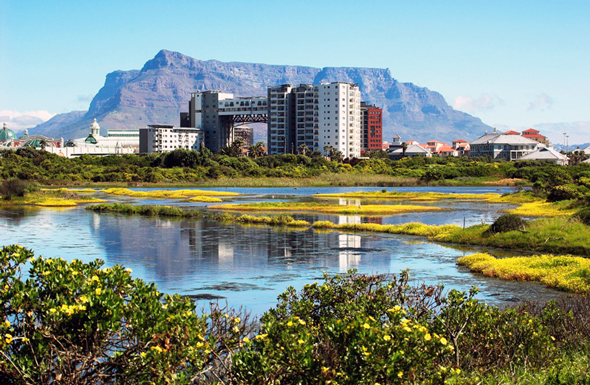
Photo Credit: “Intaka Island towards Table Mountain,” courtesy of flickr user Ian Junor. -
‘Motherland Afghanistan’ Shows Maternal Mortality Not Just A Health Issue
›Afghanistan has one of the highest rates of maternal mortality in the world: 327 out of every 100,000 women who give birth die during childbirth. Despite some recent improvements, political, social, cultural, and economic factors present enormous challenges. Last month, the Center for Population and Development Activities hosted an online viewing and dialogue discussion of the PBS Independent Lens film Motherland Afghanistan, which follows Afghan-American filmmaker Sedika Mojadidi and her father, Dr. Qudrat Mojadid, as they return to their home country and visit the Laura Bush Maternity Ward in Kabul. The conditions they find are devastating and underscore not only the need for greater commitment to reproductive health services, but also the advancement of women’s and girl’s access to education, security, and political participation.
-
Nine Strategies to Stop Short of Nine Billion
›Although most analysts assume that the world’s population will rise from today’s seven billion to nine billion by 2050, it is quite possible that humanity will never reach this population size.
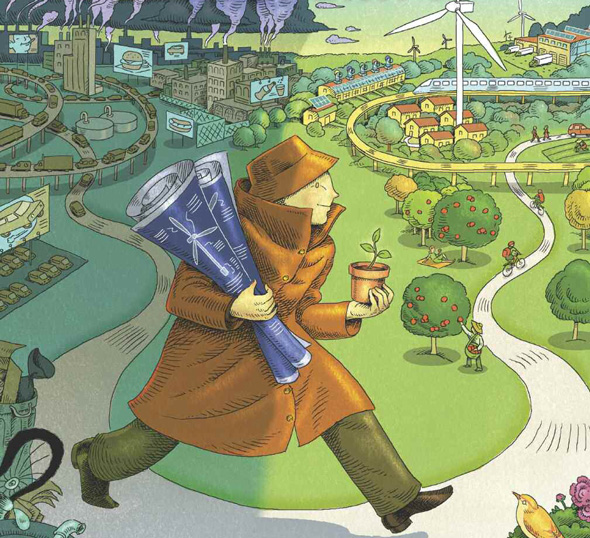
My chapter in this year’s State of the World 2012: Moving Toward Sustainable Prosperity, “Nine Population Strategies to Stop Short of 9 Billion,” outlines a series of strategies that would prompt significant declines in birth rates. Based purely on the intention of women around the world to have small families or no children at all, these initiatives, policies, and changes in attitude could end population growth before mid-century at fewer than nine billion people.
Examples from around the world demonstrate effective policies that not only reduce birth rates, but also respect the reproductive aspirations of parents and support an educated and economically active society that promotes the health of women and girls. Most of these reproduction policies are relatively inexpensive to implement, yet in many places they are opposed on the basis of cultural resistance and political infeasibility.
In creating this list, I sought to eschew the language and approaches of “population control” or the idea that anyone should pressure women and their partner on reproduction. Instead, I hoped to highlight strategies that could put human population on an environmentally sustainable path:- Provide universal access to safe and effective contraceptive options for both sexes. With two in five pregnancies reported as mistimed or never wanted, lack of access to good family planning services is among the biggest gaps in assuring that each baby will be wanted and welcomed in advance by its parents.
- Guarantee education through secondary school for all, especially girls. In every culture surveyed to date, women who have completed at least some secondary school have fewer children on average, and have children later in life, than do women who have less education.
- Eradicate gender bias from law, economic opportunity, health, and culture. Women who can own, inherit, and manage property; divorce; obtain credit; and participate in civic and political affairs on equal terms with men are more likely to postpone childbearing and to have fewer children compared to women who are deprived of these rights.
- Offer age-appropriate sexuality education for all students. Data from the United States indicates that exposure to comprehensive programs that detail puberty, intercourse, options of abstinence and birth control, and respecting the sexual rights and decisions of individuals can help prevent unwanted pregnancies and hence reduce birth rates.
- End all policies that reward parents financially based on the number of children they have. Governments can preserve and even increase tax and other financial benefits aimed at helping parents by linking these not to the number of children they have, but to parenthood status itself.
- Integrate lessons on population, environment, and development into school curricula at multiple levels. Refraining from advocacy or propaganda, schools should educate students to make well-informed choices about the impacts of their behavior, including childbearing, on the environment.
- Put prices on environmental costs and impacts. In quantifying the cost of an additional family member by calculating taxes and increased food costs, couples may decide that the cost of having an additional child is too high. Such decisions, freely made by women and couples, can decrease birth rates without any involvement by non-parents in reproduction.
- Adjust to an aging population instead of boosting childbearing through government incentives and programs. Population aging must be met with the needed societal adjustments, such as increased labor participation, rather than by offering incentives to women to have more children.
- Convince leaders to commit to stabilizing population through the exercise of human rights and human development. By educating themselves on rights-based population policies, policymakers can ethically and effectively address population-related challenges by empowering women to make their own reproductive choices.
Kathleen Mogelgaard assisted with research for this piece.
Robert Engelman is the president of the Worldwatch Institute and contributing author to State of the World 2012: Moving Toward Sustainable Prosperity.
Sources: Bloom et al. (2011), Guttmacher Institute, Kohler et al. (2008), Population Reference Bureau, UN, UNFPA, The Wall Street Journal, Yadava and Yadava (1999).
Image Credit: Worldwatch Institute, State of the World 2012: Moving Toward Sustainable Prosperity.
Showing posts from category global health.
 “The most rapid population growth in many ways [occurs in] the countries that can least afford it,” said Carl Haub in a webinar on July 19 to launch the Population Reference Bureau’s (PRB) 50th annual