-
After the London Summit on Family Planning: What Happens Now?
›September 21, 2012 // By Carolyn Lamere
People are still talking about this summer’s London Summit on Family Planning, which was hosted by the Bill and Melinda Gates Foundation and the UK’s Department of International Development (DIFD) on July 11. On Monday here at the Wilson Center, the Environmental Change and Security Program featured representatives from USAID, DFID, and Gates Foundation for a standing-room only panel discussion of the landmark event.
-
The Challenges and Benefits of Addressing Young Adolescent Reproductive Health
›There are 1.2 billion adolescents (ages 10 to 19) in the world today, accounting for 17 percent of the global population. They are the largest youth cohort in history, and 90 percent live in the developing world. Within that broad age group, very young adolescents (ages 10 to 14) often fall through the cracks of international development work, especially when it comes to health, and reproductive health in particular.
-
Jill Hagey, Behind the Numbers
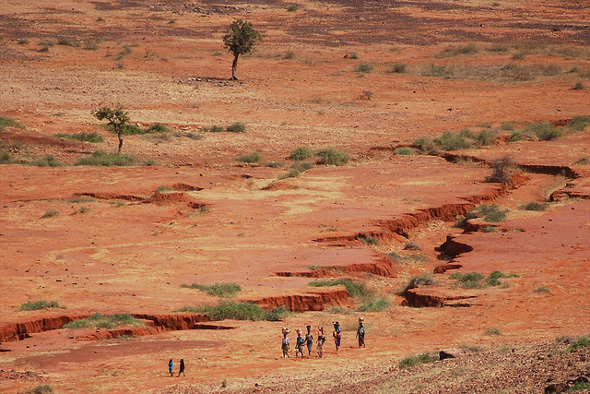
Sahel Drought: Putting Malnutrition in the News
›
The original version of this article, by Jill Hagey, appeared on the Population Reference Bureau’s Behind the Numbers blog.
Over the past few months, the Sahel drought has sparked attention of news media and concerned citizens around the world. Throughout this media blitz, I have been struck by the sharp contrast between this coverage and how the devastating effects of malnutrition are usually portrayed. Malnutrition is often overlooked in favor of more “newsworthy” diseases, and it takes a crisis to focus our attention on this public health issue. Yet an emergency such as this drought – affecting more than 18 million people, including nearly 2 million children – is difficult to ignore.
-
Farzaneh Roudi for the Middle East Program
Iran Is Reversing Its Population Policy
›Excerpted below is the introduction by Farzaneh Roudi. The full report is available for download from the Wilson Center’s Middle East Program.
Once again, the Iranian government is reversing its population policy – its fertility policy, to be more precise. Alarmed by the country’s rapidly aging population, Iran’s Supreme Leader Ayatollah Ali Khamenei is now calling on women to procreate and have more children, and the Iranian Minister of Health and Medical Education Marzieh Vahid Dastjerdi has recently said, “The budget for the population control program has been fully eliminated and such a project no longer exists in the health ministry. The policy of population control does not exist as it did previously.”
-
Geoff Dabelko on the Evolution of Integrated Development and PHE
›August 27, 2012 // By Schuyler Null“Population-health-environment [PHE] connections have really been a focus of ours here at the Wilson Center for the last 15 years,” said outgoing ECSP Director Geoff Dabelko in an interview at the Wilson Center. The goal of ECSP’s project – HELPS (health, environment, livelihoods, population, and security) – is “really trying to understand these issues together.”
-
Michael Kugelman, Dawn
Silence Surrounds Pakistan’s Most Serious Threats
›August 18, 2012 // By Wilson Center StaffThe original version of this article, by Michael Kugelman, appeared on Dawn.
There’s been much discussion lately about the “water kit,” a mysterious contraption that a purported Pakistani engineer insists will enable cars to use water as fuel.
Yet missing from this debate is a basic but critical fact: Pakistan is dangerously water-deficient. Per capita availability hovers just above the scarcity threshold of 1,000 cubic meters. In several decades, availability could plummet to 550 cubic meters.
-
Hans Rosling on Religion, Babies, and Poverty
›“I’m going to talk about religion. But it’s a broad and very delicate subject, so I have to limit myself. Therefore I will limit myself to only talk about the links between religion and sexuality…I will talk on what I remember as the most wonderful – it’s the moment when the young couple whispers, ‘tonight, we are going to make a baby,’” said Hans Rosling, the eclectic Swedish doctor and statistician known for his Gapminder tool, in a TedxSummit presentation in April.
-
U.S. Drought, Climate Change Could Lead to Global Food Riots, Political Instability
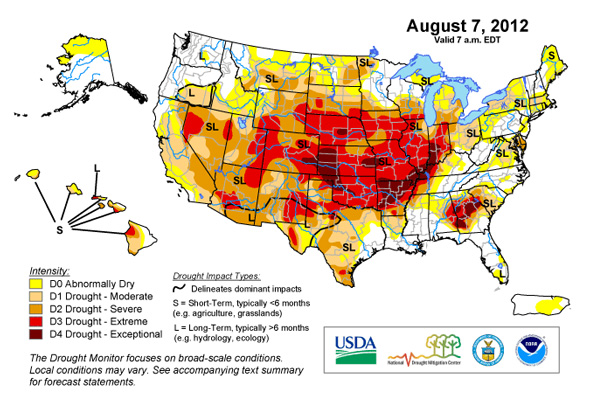
›August 15, 2012 // By Graham NorwoodIt’s been a difficult year for U.S. agriculture. Record high temperatures and the country’s worst drought since 1956 have combined to decimate crops across the nation, and some forecasters are predicting more heat and dryness in the months ahead. Things have been so bad that many experts fear a recurrence of the food riots and instability that shook the world in 2007-8, and again in 2010-11. Others point to this year’s unusual weather in the United States and elsewhere as a harbinger of how climate change might impact humanity in the 21st century.
Things started out well enough earlier this year, as America’s farmers took advantage of the warmest March weather on record by planting the largest corn crop in 75 years. As late as May 10, the USDA was projecting that previous corn production and yield records would be shattered. “We’re looking at the potential for just a true bin-buster of a crop [this year],” grain expert and Iowa State University economics professor Chad Hart told The Huffington Post at the time. “There’s going to be a lot of corn flying around here.”
But those predictions came before a historic drought descended upon the country’s heartland, accompanied by soaring summer temperatures. In July, the USDA slashed its estimate for corn production by 12 percent, the largest such adjustment in a quarter century. The organization released an even bleaker update last Friday. Meanwhile, many commodity traders, believing the worst may still be yet to come, have reduced their own projections even further. Soybeans, which are frequently intercropped with corn, have also struggled with this summer’s conditions.
As optimism for the corn and soybean harvests has faded, commodity prices have surged. Corn futures have reached record highs, and soybeans have also seen dramatic price increases. Both commodities have now surpassed their peaks from the 2007-8 crisis that led to riots in more than two dozen countries across the world.
Even wheat, which is primarily a winter crop, has experienced a price increase of about 50 percent over the past two months. “If the price of corn rises high enough, it also pulls up the price of wheat,” Robert Thompson, a food security expert at the Chicago Council on Global Affairs, told The Guardian. Wheat has not yet outpaced its high from the 2007-8 crisis, but it is trading higher than after the Russian wheat export ban that helped lead to another crisis in 2010-11 (and ultimately, some analysts say, to the Arab Spring).
Crisis Catalysts Beyond the U.S. Drought
The United States is vital to the global food market, being the world’s largest exporter of corn, soybeans, and wheat. However, several other key grain-producing regions have been affected by abnormal weather this year as well.
Summer heat waves in southern Europe have adversely impacted corn crops from Italy to Ukraine – a region that produces 16 percent of the world’s exports, according to Bloomberg. Below average rainfalls in parts of South America and Australia threaten other strategically important production areas.
And that’s not all. Spain suffered its worst drought in 70 years this past winter, leading analysts to reduce projections for Europe’s wheat crop. Flooding in Japan, India and Bangladesh has jeopardized rice crops. And an unusually cold winter in the Himalayas has dramatically slowed glacial melting, leaving farmers to cope with a greatly reduced Indus River and as much as an 80 percent reduction in available water for irrigation.
Add to all this the fact that world grain stocks are reportedly headed for a five-year low, and it isn’t difficult to see why there is such concern about the global food market.
Causes for Concern
Rising grain prices are expected to lift overall food costs throughout the world over the next six months. That spike is unlikely to have much of an impact in the United States, where consumers spend on average just 13 percent of their household budgets on food. However, in less developed countries – where the portion of household income used for purchasing food is often 50 percent or higher – there is cause for concern that a new round of food riots may be in the offing.
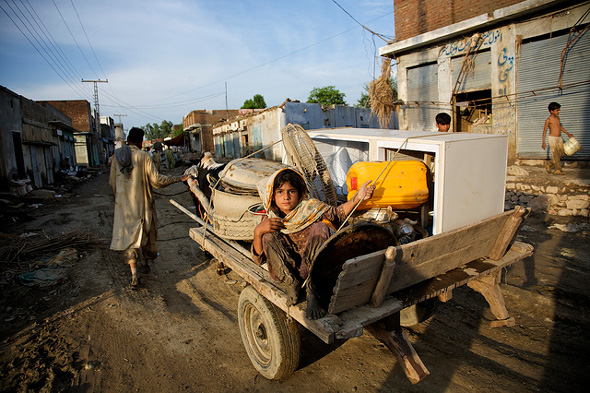
Kaitlin Shilling on climate conflict and export crops in sub-Saharan Africa “Large numbers of people live very close to the edge,” Save the Children’s Justin Forsyth recently told The Financial Times. “Failed rains and high food prices have tipped lots of people over the edge from being able to cope to not being able to cope.”
“Based on my research on the natural disasters-food prices-social unrest nexus, I think we will observe increased social unrest in the next 6 to 12 months,” warned Duke University professor and agricultural economist Marc Bellemare in an email exchange, stressing the distinction between social unrest (i.e., food riots) and civil war or intra-state conflict.
“The similarity between now, 2007-8, and 2010-11 is that they are all episodes of high food prices caused by a series of natural disasters,” he continued. “The difference is that this time around, the natural disasters in question – episodes of extreme temperature and drought – are taking place in our backyard instead of halfway around the world, which makes this all the more salient in American minds.”
Some Reasons for Optimism
Still, there are a number of reasons to believe the present situation will not lead to the kind of instability and conflict that characterized the last two food crises. One key difference between 2007-8 and today’s situation is the price of oil.
In July of 2008, oil rushed to an all-time high of $147 per barrel; today, it’s around $90 a barrel. This means that consumers can buy relatively more food now than in 2008, making food riots less likely.
Moreover, any reduction in the possibility of riots and other political instability has a multiplying effect, according to a recent Chatham House article:
And because riots are less likely, governments are less inclined to impose export controls, reducing the chance of a collapse in confidence, as one country after another bans exports, pushing up international prices further and encouraging others to do the same. This dynamic was a major factor in both the 2007-8 crisis and the 2010-11 spike.
Perhaps most important of all is the fact that the crops in the worst shape this year – chiefly corn and soybeans – are less fundamental to the diets of many in the less developed world than rice or wheat. “[Rice] is very important for [the] food security of millions of people around the world,” Abdolreza Abbassian, senior economist and grain expert at the FAO, recently told Reuters. “We do not see any production or supply problems with rice.”
Meanwhile, USDA Chief Economist Joseph Glauber has downplayed fears of an imminent food crisis because of a relative abundance of wheat. “Prices are higher [right now], and there’s no question about that, but we really had an extreme shortage of wheat in 2007-2008 and I don’t see that at this point,” he recently told The Financial Times.
Unlike rice and wheat, corn is seldom consumed directly. Rather, it is far more commonly used for ethanol production (roughly 40 percent of the U.S. corn crop is used to produce biofuels), food processing, and especially animal feed. This means that a rise in corn prices won’t have as direct and deleterious effect on people in the developing world as did the acute rice and wheat shortages that triggered previous crises. Higher corn prices will certainly increase the costs of meat and dairy products, processed foods, and other comestibles, but these price increases are unlikely to have much of an effect in less developed countries, where such products are seldom prominent in the daily diet.
“[This] is a serious situation which has to be monitored closely, but it is too early to refer to it as a food crisis situation,” said Abbassian.
The Role of Climate Change
Whether or not this summer’s troubles blossom into the kinds of food riots and political instability seen in previous food crises remains an open question, but there is another unresolved issue with even greater potential long-term impact. With so many extreme weather events playing a role in this year’s high prices, many are wondering: To what extent is climate change a factor? And what might continued warming and increased CO2 mean for the long-term prospects of global food security? Are this summer’s stifling conditions “the new normal,” as the blog G-FEED has asked here and here?
One of the most significant recent developments in climate research is that scientists have begun linking individual extreme weather events to anthropogenic climate change. A groundbreaking 2011 study by the National Oceanic and Atmospheric Association, the UK Met Office, and others explained:
In the past it was often stated that it simply was not possible to make an attribution statement about an individual weather or climate event. However, scientific thinking on this issue has moved on and now it is widely accepted that attribution statements about individual weather or climate events are possible, provided proper account is taken of the probabilistic nature of attribution.
The report goes on to apply this principal to several extreme weather events from last year, including a devastating drought in Texas it claims was made 20 times more likely to occur by man-made climate change.
While no such study has yet examined the 2012 U.S. drought or other recent extreme weather events, most scientists believe that climate change is playing at least some role in this year’s freak weather episodes. “I think what we’re seeing is largely a naturally occurring event [influenced by La Niña weather patterns], but it’s occurring against the background of a warming environment,” Richard Seager, a professor and drought specialist at Columbia University’s Lamont-Doherty Earth Observatory, told Climate Central.
The idea of naturally occurring droughts playing out across a backdrop of global warming is a sobering one, because of the unique interactions between precipitation and hot weather. One timely study published last month describes how dry conditions increase the likelihood of abnormally hot weather: During droughts, less of the sun’s heat energy is used to evaporate moisture in vegetation and the soil, meaning that more energy can go into heating the air directly. Thus, “the occurrence probability of an above-average number of hot days is high after dry conditions and low after wet conditions.”
The study suggested that this phenomenon played an important role in exacerbating the 2011 Texas drought. Moreover, lead author Brigitte Mueller noted in an email conversation with Climate Central that precipitation in the 2012 U.S. drought was within the range where the drought/heat feedback would be expected to occur, “which implies an even higher likelihood for an above-average [number of hot days] to occur.”
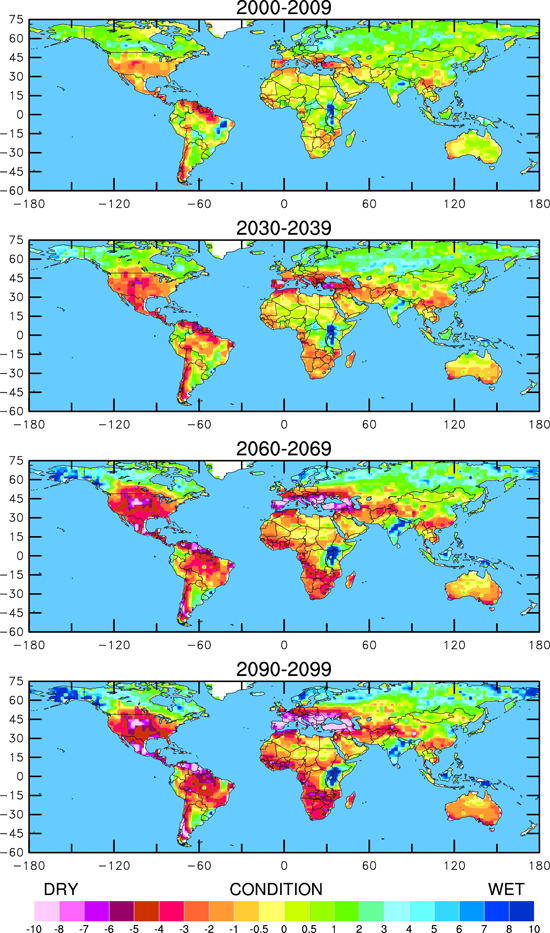
With the planet expected to continue warming due to increasing levels of greenhouse gases in the atmosphere, and with reports from IPCC and National Center for Atmospheric Research predicting increasingly frequent droughts in the decades ahead, the heat/drought feedback loop is still more bad news for a global agricultural sector already tasked with the formidable job of feeding a world population expected to reach nine billion by mid-century.
Research on the effects that heat and drought have on crop yields and food production is beginning to emerge. One recent paper conservatively estimated that U.S. farm production could drop 4 to 13 percent over the next two decades or so. Another study, which considered “worst-case scenarios,” projected that average U.S. crop yields could plummet 63 to 82 percent by the end of the century if global warming is particularly rapid.
Such an outcome would necessitate fundamental changes in how the world is fed, and would obviously make global food security an issue of paramount importance. Even in the present, however, it seems clear that climate change is already an integral part of the food security issue. This summer’s freakish weather, in the United States and elsewhere around the globe, has brought the world closer to another round of food riots and political instability.
Although there are reasons to be optimistic that such a crisis may yet be averted in the short term, it appears that maintaining and improving global food security will remain a major challenge into the foreseeable future.
Sources: Bloomberg, Chatham House, Climate Central, The Financial Times, The Guardian, The Huffington Post, National Oceanic & Atmospheric Association, Proceedings of the National Academy of Sciences, Resources for the Future, Reuters, USDA.
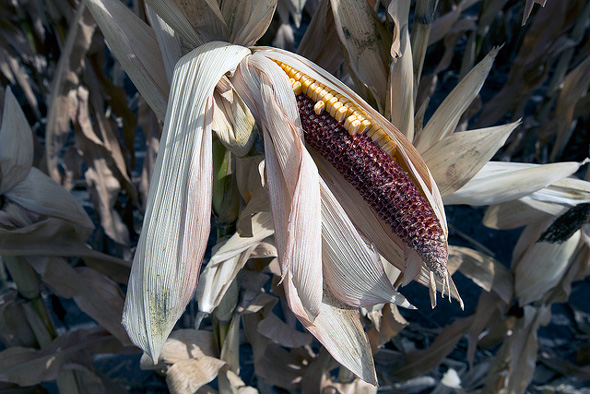
Map Credit: U.S. Drought Monitor, courtesy of Mark Svoboda/National Drought Mitigation Center. Drought stricken corn on a farm in Iowa, which President Barack Obama and Agriculture Secretary Tom Vilsack visited on Monday, courtesy of the USDA. Future drought conditions, courtesy of Aiguo Dai/Wiley Interdisciplinary Reviews.
Showing posts from category global health.