Showing posts from category family planning.
-
Day of 7 Billion Puts Future Generations in Spotlight
›This month, our small planet’s population will hit seven billion. Reproductive health and environmental groups worldwide are raising awareness about the exact day – the “Day of Seven Billion” – when we’re estimated to hit that number next week, calling for sustainability and women’s empowerment. But the future trajectory of the world’s population projections – and all that they entail for human and environmental wellbeing – depends on decisions we make now.
Let’s start with the more than 215 million women worldwide – including many in our home countries, the United States and Kenya – who do not want to get pregnant but are not using modern contraception. Our world looks very different in 2050 if these women’s needs are met.
Research from the Futures Group shows that meeting women’s needs results in a significantly slowed population trajectory, with world population topping out at eight billion in 2050. According to recently revised UN estimates, without this intervention population could rise to 10 or even 12 billion by century’s end. Meeting this need is also a smart investment: Our research estimates that access to modern contraception for all who want it would cost $3.7 billion per year. Others have estimated the savings in health care costs of providing contraception to all who want it at $5.1 billion per year. Family planning is cost-effective; it has been estimated that a dollar spent on family planning can save between $15 and $20 in education, health, housing, and other socio-economic support costs, making the achievement of the Millennium Development Goals cheaper for developing countries.
The health and environmental benefits are also enormous: a one-third reduction in maternal mortality; a one-fifth reduction in child mortality; a major reduction in the greenhouse gas emissions. Recent research shows that carbon emissions slow when we slow our population trajectory in an effect similar to increasing the world’s use of wind power forty-fold. In Nigeria it was recently estimated that providing universal access to family planning would result in a reduction of carbon emissions equivalent to eight years from current sources.
These investments also provide more than big numbers: By enabling couples and women to choose when and how many children they’ll have, women can continue their educations longer, participate more in the workforce, and contribute to household decisions that benefit the family.
Giving women what they want and need to plan their pregnancies is one of the most obvious, yet most overlooked solutions to many of the most pressing problems we face, from maternal and child mortality to climate change. International family planning funding has stagnated for over 10 years and the results have been predictable: In Kenya, and in many countries, unmet need – with all its human costs – has increased.
Today, the largest generation of young people ever is coming of age. The aspirations and health of the millennial generation – as well as all those in the future – are on the line.
Pamela Onduso, MPH, is a Kenyan reproductive health advocate and program adviser with Pathfinder International’s Kenya office based in Nairobi. Dr. Scott Moreland is a senior researcher at the Futures Group, and leads demographic work in countries around the world.
Sources: African Institute for Development Policy, Futures Group, Guttmacher Institute, Health Policy Initiative, PNAS, Population Services International, UN Population Division, World Health Organization.
Photo Credit: Adapted from “Tea picker and son,” courtesy of flickr user ROSS HONG KONG. -
Laurie Mazur, The Aspen Leaf
The Planet at 7 Billion: Lessons from Somalia
›October 28, 2011 // By Wilson Center StaffThe original version of this article, by Laurie Mazur, appeared on the Aspen Institute’s Aspen Leaf blog.
Listless, emaciated children wait for water to arrive by donkey. Their mothers rest nearby, too exhausted to speak. Tiny graves are chiseled out of bone-dry earth to hold the famine’s youngest victims. That is what Mary Robinson, then-president of Ireland, found when she visited Somalia 19 years ago. Images of suffering haunted her for years: “I never got Somalia out of my system,” she said.
Now, the Horn of Africa is again in the grip of famine. When Robinson returned to Somalia earlier this year, “Everything was even worse” than in 1992. At the National Press Club on Monday, October 17, Robinson issued an eloquent plea to address the crisis in Somalia, which has already claimed 40,000 lives. “How can we allow that to happen in the 21st century?” she asked. “It’s a black mark for all of us.” The event was part of a series of discussions organized by the Institute’s Aspen Global Health and Development program, titled “7 Billion: Conversations that Matter.”
Women, Reproductive Health, and Fertility.
It is not enough to respond to the current crisis, Robinson said. To prevent a recurrence, we must also address long-term health and development challenges. That means bolstering governance and security. And, perhaps most important, it means unleashing the power of women. Women are critical to the future of Somalia, said fellow speaker Walid Abdelkarim, principal officer and team leader for Somalia at the UN Department of Peacekeeping Operations. “The most important element is the ability of the household to grow,” he said, “and that’s about the woman who nourishes and runs the household.”
Continue reading on The Aspen Leaf.
Video Credit: Aspen Institute. -
How Did We Arrive at 7 Billion – and Where Do We Go From Here? [Part Two]
›October 26, 2011 // By Elizabeth Leahy MadsenThe world’s women will determine whether the global population in 2050 is as low as 8 billion or as high as 11 billion through their choices (or lack thereof) about the number and timing of their children. Women in developing regions of the world will have the greatest effect on these potential population trajectories. Even if fertility rates remain constant at current levels (which is unlikely), developing regions would grow from 5.7 billion in 2010 to 9.7 billion in 2050, but the total population of developed countries would remain essentially unchanged.The UN estimates that the seven billionth person alive today will be born on October 31. Demographer Elizabeth Leahy Madsen explains how we got to that number, its significance, and where our demographic path might take us from here. Read part one here.
The world’s women will determine whether the global population in 2050 is as low as 8 billion or as high as 11 billion through their choices (or lack thereof) about the number and timing of their children. Women in developing regions of the world will have the greatest effect on these potential population trajectories. Even if fertility rates remain constant at current levels (which is unlikely), developing regions would grow from 5.7 billion in 2010 to 9.7 billion in 2050, but the total population of developed countries would remain essentially unchanged.
The way that people decide the timing and number of their children is not easily distilled into a simple formula with a single solution. Still, some basic and important facts are known. In the developing world, where more than 80 percent of the world’s population lives, women in rural areas, those who have little or no education, and those who are poor, have larger families. As demographers have shown in modeling the determinants of fertility, women tend to seek contraception once they are confident that their children will survive to adulthood and when socioeconomic development increases the “costs” of having children, for example by motivating parents to send them to school rather than to work.
One of the most direct reasons for past declines in fertility rates was the rapid expansion of family planning and reproductive health programs, supported by country governments and international donors, that enabled women and men to more effectively choose the size of their families. But today, about 215 million women across the developing world would like to delay or avoid pregnancy but are using ineffective contraception or none at all. Funding programs to meet the family planning needs of these women, which would cost about $3.6 billion annually, would both empower them and help fertility rates continue to decline.
Beyond Access: Gender Inequality Inhibits Contraceptive Use
While increasing support for family planning programs tops the list of demographers’ recommended policies, ensuring that contraceptives are available and accessible will not alone achieve the fertility declines projected in most of the UN’s range of possibilities. Many women who are having or planning to have large families know about family planning and where to find it, but are choosing not to use contraception for cultural reasons that are often deeply engrained.
In sub-Saharan Africa, the region with the highest global fertility rate, only 16 percent of married/partnered women of reproductive age are using effective contraception. In comparison, between 62 and 75 percent of their peers in Ireland, the United States, and Uruguay – countries whose fertility rates are almost exactly at replacement level – are using it.
Logically, sub-Saharan Africa needs similar levels of contraceptive use to bring its average fertility rate towards replacement level as the UN projects, so the region’s average prevalence rate for modern contraception would need to rise by at least 10 percentage points in each of the next four decades. However, contraceptive use in the region has grown by only 0.5 percentage points or less over the past 30 years.
What is inhibiting the use of contraception? Demographic and health surveys find in Nigeria, for example, that 10 percent of married women are using an effective contraceptive method, while twice as many have an unmet need for family planning. This low use of family planning demonstrates high potential for change in the country’s demographic future, which, as the most populous in Africa, will greatly influence global and regional trends. Yet among women who do not intend to use contraception, 39 percent report that they or their family members are opposed to family planning, and another 16 percent fear side effects or have other health-related concerns. If Nigeria’s fertility rate remains unchanged, the country will be home to 500 million people by 2050.
In Pakistan, where 24 percent of births are unintended, surveys show similar barriers. Ninety-six percent of married women know about effective contraceptive methods, but only 22 percent are using one. More than one-quarter of women who do not plan to use contraceptives report that their fertility is “up to God” and 23 percent report that they or their family members are opposed to family planning. Pakistan’s population would more than double from 174 million to 379 million by 2050 if current fertility trends hold constant.
Peak Planet? Population Growth and Consumption Strain Environmental Resources
Because Nigeria, Pakistan, and other countries’ demographic trajectories may not follow the path laid out in population projections, we can’t take a world of nine billion for granted. While human ingenuity and technological advancements have improved standards of living in many countries, scientists caution that the combination of rising human numbers and growing consumption has serious environmental implications. Already, the quantity and quality of fresh water supplies are under strain, and forests in many developing countries are being rapidly depleted.
Population projections are much more than wonkish speculation – they foreshadow the serious problems that lie ahead if health, environment, and development policies aren’t strengthened. If the UN projections of our demographic future are to bear any semblance of reality, we must move beyond the status quo. While improving physical access to family planning should remain a top priority, meeting unmet need will also require addressing the deep-seated challenges of women’s education and empowerment.
Elizabeth Leahy Madsen is a consultant on political demography for the Wilson Center’s Environmental Change and Security Program and former senior research associate at Population Action International.
Sources: Bongaarts and Sinding (2009), Bongaarts (2006), Futures Institute, Guttmacher Institute and UN Population Fund, Measure DHS, O’Neill, Dalton, Fuchs, Jiang, Shonali Pachauri, and Katarina Zigova (2010), UN Population Division, Washington Post.
Photo Credit: “Afghan Internally Displaced Persons,” courtesy of flickr user United Nations Photo. -
How Did We Arrive at 7 Billion – and Where Do We Go From Here? [Part One]
›October 26, 2011 // By Elizabeth Leahy MadsenThe United Nations Population Division has estimated world population will reach seven billion on Monday. Which changes in demographic trends led us to this milestone? What do the past and present tell us about how human numbers will change in the future?
The “Day of Seven Billion” was announced this spring following the release of the latest revision of UN population projections. Although the seven billionth person will not be precisely identified, this estimate is based on careful demographic modeling. Every two years, the UN revises its projections to incorporate the latest trend data and modify its assumptions, as seemingly small changes can make a huge difference demographically.The UN estimates that the seven billionth person alive today will be born on October 31. Demographer Elizabeth Leahy Madsen explains how we got to that number, its significance, and where our demographic path might take us from here. Read part two here.
The United Nations Population Division has estimated world population will reach seven billion on Monday. Which changes in demographic trends led us to this milestone? What do the past and present tell us about how human numbers will change in the future?
The “Day of Seven Billion” was announced this spring following the release of the latest revision of UN population projections. Although the seven billionth person will not be precisely identified, this estimate is based on careful demographic modeling. Every two years, the UN revises its projections to incorporate the latest trend data and modify its assumptions, as seemingly small changes can make a huge difference demographically.
Demography Is Driven by Fertility and Population Momentum
Since world population reached three billion in 1959, the rate of growth has increased, peaked, and begun to slow. Each succeeding milestone was reached more quickly than the last: It took 15 years to reach four billion, 13 years to hit five billion, and only 11 years to get to six billion at the end of 1998. The interval leading to seven billion was slightly longer, at 13 years, as the global rate of population growth has slowed.
Although mortality and migration also affect population trends, the factor with the greatest influence by far is fertility – the average number of children born to each woman. The decline in the global fertility rate from an average of nearly 5 children per woman in the early 1960s to 2.5 children today has in turn slowed the pace of world population growth. However, demographic momentum from previous generations of high fertility can drive population growth for decades to come. Even if Nigeria reached replacement-level fertility today, its population would still grow by one-third by 2050 as the number of births continued to exceed the number of deaths.
Assumptions Matter
Population projections consider: 1) current data about fertility and 2) assumptions about the ways fertility will change in the future. These assumptions vary depending on the source, so how much of a difference do they make? As it turns out, quite a lot.
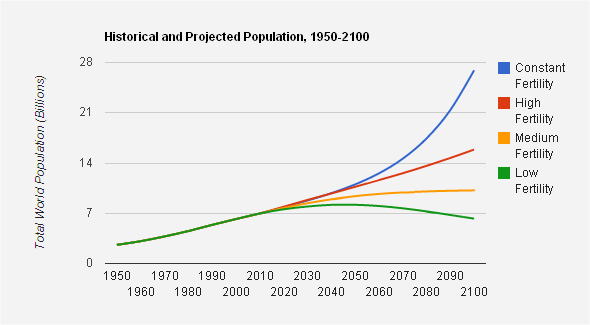
Projections of world population in 2050 range from 8.1 billion (if fertility rates fall to a global average of 1.7 children per woman) to 10.9 billion (if they remain unchanged). The gap of nearly three billion between those possibilities is greater than the combined populations of China and India today.
Estimates vary even more widely for the end of the century, with the UN projecting that by 2100 world population could total anywhere between 6 billion (if total fertility falls to an average of 1.55 children per woman) and 27 billion (if every country’s fertility rates remain constant at today’s levels).
While demographers parse the details of the projections, policymakers would like to know which of these scenarios is more likely. After all, the economic, environmental, and political consequences of a population of 8 or 11 billion two generations hence are not the same, and a world of 27 billion is difficult for anyone to fathom.
If we simply projected past trends into the future at a steady rate, the population estimates on the low end of the fertility spectrum seem more likely. The global fertility rate has fallen from 4.5 children per woman in the early 1970s to 2.5 today, a decline of 43 percent, so the 14 percent decline projected in the medium-fertility variant between now and 2050 seems reasonable at first glance, perhaps even conservative. The medium-fertility variant assumes that all countries’ fertility rates will begin moving towards replacement level, around 2.1 children per woman, regardless of whether they are currently above or below that number.
However, even a 14 percent decline in fertility assumes that areas where fertility rates remain stalled at high levels will soon begin rapid declines, paralleling the past experience of other regions. As Population Reference Bureau demographer Carl Haub writes, “the assumption that the developing world will necessarily follow the path of the industrialized world…is far from a sure bet.”
In the last 40 years, fertility rates in the Caribbean, northern and southern Africa, Latin America, and all of Asia declined by 50 percent or more. The pace of decline in sub-Saharan Africa, while still notable, was much slower, at 23 percent. In order to meet the UN medium-variant projections, the region’s fertility rate would need to fall by nearly 40 percent by mid-century.
Some of the largest, fastest-growing populations in the developing world would need to experience a major acceleration from recent trends. In Nigeria, fertility edged down by 15 percent between 1970 and 2010, but the medium variant projection depends on a decline of 37 percent over the next four decades; Ethiopia’s fertility rate will need to fall by half.
Gender Matters, Too
The great irony of fertility trends is that gender inequities play an important role at both ends of the scale. In countries with the highest fertility rates, women tend to have less education than men and less autonomy. Their fertility choices may be greatly affected by the preferences of their husbands or other family members. In Niger, which has the highest fertility rate in the world, married men would, on average, like three more children than married women. In Uganda, where women average more than six children each, 60 percent of men report that domestic violence is justified.
By contrast, in countries with the lowest fertility rates, women have achieved equal access to education and the labor market, with more autonomy about how to earn income and what to do with it. Yet cultural expectations that place the burden for child and elder care and housework almost entirely on women can make marriage an unappealing option. In Japan, which is among the 10 lowest fertility countries in the world, more women are choosing to stay single: The marriage rate has fallen by almost half since the 1970s. Japanese women who do marry are waiting until their late 20s and tend not to give birth until they are 30, both of which result in lower average family size.
Even at this end of the demographic spectrum, the assumptions embedded within population projections seem optimistic. Japan’s fertility rate was last above replacement level in the early 1970s; it has fallen steadily to 1.3 children per woman today. The UN projections assume that fertility will immediately reverse track and begin rising to over 1.8 children per woman in 2050, rebounding above two children per woman before the end of the century.
The stalled high fertility rates in much of sub-Saharan Africa and parts of the Middle East, together with unprecedented low fertility in Eastern Europe and parts of East Asia, indicate that we are currently in an era of remarkable demographic diversity, despite the UN’s projection of future convergence.
Continue reading part two here.
Elizabeth Leahy Madsen is a consultant on political demography for the Wilson Center’s Environmental Change and Security Program and former senior research associate at Population Action International.
Sources: Boling (2008), Haub (2011), Japan Statistics Bureau, Measure DHS, UN Population Division, UN Population Fund, Washington Post.
Image Credit: Chart data from UN Population Division, arranged by Elizabeth Leahy Madsen. -
Roger-Mark De Souza, RH Reality Check
Sex and Sustainability: Reflections For My Son Nick
›October 20, 2011 // By Wilson Center StaffThe original version of this article, by Roger-Mark De Souza, appeared on RH Reality Check.
“Are we going to talk about sex again?!” screamed my 12-year old son, Nick, as he ran down the stairs, away from me. That was five years ago and I had just sat down with him to have one of our father-son talks, this time about sex and sustainability.
Now Nick, a rising senior, is preparing for college at the same time as the global community is preparing for an important landmark of its own: the United Nations predicts that by October 31, world population will reach 7 billion.
The confluence of these two events gives me reason to think about the world Nick is inheriting from my generation, and makes me consider what I can say to him as he heads off to college.
This World of 7 Billion
I try to get my head around it. It’s a world of 7 billion people. With greater connectivity than I could have ever dreamed possible. A world of widening disparities and growing environmental degradation. A world with a changing climate. A world of crashing economic markets and changing debt ceilings.
It’s also a world of finite resources and growing demand.
Continue reading on RH Reality Check.
Photo Credit: David Hawxhurst/Wilson Center. -
Health and Harmony: Population, Health, and Environment in Indonesia
›Borneo’s Gunung Palung National Park is a microcosm of both the island’s ecological wealth and vulnerability. More than half of the park is undisturbed forest; the remainder, however, “is being torn down day after day” at an alarming rate, said Health in Harmony’s Nichol Simpson at an event on integrated approaches to population, health, and environment (PHE) programs in Indonesia. Alene Gelbard of the Public Health Institute’s Company-Community Partnerships for Health Indonesia (CCPHI) program joined Simpson on September 29 at the Wilson Center. Both speakers emphasized that no matter what issue a group works on, engaging local communities is essential for success.
The Destructive Cycle: Poor Health, Poor Environment
For Simpson, “the intersection between human and environmental health” is at the heart of Health in Harmony’s work. Health in Harmony opened Clinic ASRI in 2007, aiming to provide improved healthcare to villagers throughout Gunung Palung National Park while ending their dependence on illegal logging as a means of financial survival.
The area’s inhabitants were all too easily trapped in what Simpson called “the destructive cycle.” When faced by an unexpected medical emergency, families would go into debt to pay their medical bills. Health in Harmony found that of 232 local households surveyed, 13 percent had recently experienced a major medical emergency, at an average cost of $360. Most households in the area only hold around $260 in emergency savings, so to make up the difference, about a third turned to illegal logging to pay down their debt.
By deforesting the park, illegal logging worsens the health of nearby communities. For example, Simpson said that Clinic ASRI has seen a rise in cases of malaria and tuberculosis in the surrounding communities, in part because deforestation has increased the level of mosquito activity. The link between human and environmental health is clear, said Simpson: the people ASRI serves are “living it every day. They know the cause of this. And…they want it to stop.”
Protecting Natural Resources By Improving Health
The Health in Harmony clinic located in Sukadana, a small village sandwiched between Borneo’s coast and Gunung Palung Park, helps break the destructive cycle by treating patients regardless of their ability to pay. If patients do not have cash, they can barter for their care. In one case, a girl named Yani came to ASRI after her family incurred $500 over two months of visiting hospitals and traditional healers, none of whom could treat her condition. ASRI diagnosed and treated Yani for scabies. In exchange, her mother signed a pledge to protect Gunung Palung from logging and made the clinic a floor mat to cover the $1.50 bill.
By providing affordable, high-quality healthcare that is contingent upon pledging to protect the environment, Clinic ASRI improves human and environmental health in one fell swoop, said Simpson. “Because the infant mortality rate has decreased and you’re not overcompensating,” said Simpson, families can choose to have fewer children, using free birth control provided by ASRI.
“When you have fewer and healthier children, you’re investing in your education,” said Simpson. “When you’re investing in your education, you’re investing in your country and your community. This is the virtuous cycle. I didn’t invent it, but we are proving it in Sukadana.”
The communities around the clinic have embraced ASRI’s work, partnering with them to expand their services to address additional community needs, like training farmers in more productive organic methods and providing mated pairs of goats for widows, who pay ASRI back with kid goats and manure for fertilizer.
All but one of the 23 villages that ASRI services have been consistently free of illegal logging, according to monitors who visit them on a regular basis. “We’re proving the theory that we can protect natural resources by improving health,” Simpson said.
“Health Is Key to Sustainable Development”
Gelbard took a step back to talk about CCPHI’s experience establishing multi-sector partnerships among NGOs and corporations by building trust and enabling dialogue between the communities.
With corporate responsibility becoming more popular, “everyone’s talking about partnerships these days, and everybody’s partnering with everyone,” said Gelbard. “I don’t care what they call it – I care what they’re doing” and what results they achieve, she said. A successful partnership involves “all partners doing something more than just giving money.”
Gelbard said the 2004 tsunami reinforced the notion of corporate responsibility for a lot of companies operating in Indonesia. They saw that unless they branched out beyond their own walls and “did things to help strengthen communities,” efforts at corporate responsibility simply “would not benefit them in the long-run,” she said.
Through CCPHI, companies and NGOs have partnered on a wide range of efforts, including improving access to and funding for reproductive health services, improving sanitation by increasing access to water, and combating human trafficking by empowering girls and women.
Achieving the Millennium Development Goals will require increasing access to health care in a manner that reflects the needs of communities, she said. At its core, CCPHI’s work and the partnerships it facilitates are “based on the knowledge that health is key to sustainable development,” said Gelbard.
Event Resources
Sources: Alam Sehat Lestari, American Journal of Tropical Medicine and Hygiene, Company-Community Partnerships for Health Indonesia, ExxonMobil, The Guardian, Health in Harmony, National Geographic, PBS News Hour, Public Health Institute, Republic of Indonesia Ministry of Forestry, United Nations, World Wildlife Fund
Photo Credit: Used with permission courtesy of ASRI and Nikki See, Under-told Stories. -
Carl Haub, Behind the Numbers
Rwanda’s 2010 Demographic and Health Survey Shows Remarkable Drop in Fertility and Child Mortality
›October 18, 2011 // By Wilson Center StaffThe original version of this article, by Carl Haub, appeared on PRB’s Behind the Numbers blog.
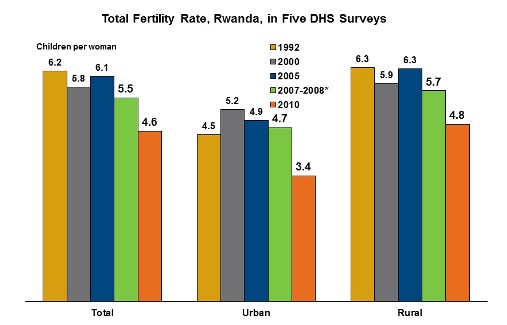
The Rwanda 2010 Demographic Health Survey is the latest in a regular series of DHS surveys that began in 1992, although hostilities had delayed the next survey until 2000. The 2010 survey interviewed 13,671 women ages 15 to 49 and 6,329 men ages 15 to 59 from September 2010 to March 2011. The total fertility rate (TFR – the average number of children would bear in her lifetime if the birth rate of a particular year were to remain constant) obtained in the survey was 4.6 for the three-year period preceding the survey. For urban women, the TFR was 3.4 and for rural women, who were 85 percent of the sample, 4.8.
Rwanda’s TFR saw its fastest decline in the 2010 DHS. From the 2007-08 Interim DHS to the 2010 survey, the TFR fell by 1.1 children nationwide – by 1.3 in urban areas and 0.9 in rural areas in a period of only four and a half years. This is sharpest drop in a sub-Saharan TFR I can ever remember seeing. As an indicator of future fertility plans, 56.2 percent of women with three living children said that they not wish to have any more children as did 76 percent of those with four living children. It is clear that the large family size of eight children per woman is truly a thing of the past.
In the survey, 51.5 percent of currently married women said that they were using some form of family planning, 45.1 percent a modern method. Injectables were by far the most frequently used, as such “spacing” methods are in much of Africa, with 23.1 percent of women saying that they used them. That method increased from 15.2 percent in the 2007-08 survey. The next two methods were implants (6.3 percent) and the pill (7.1 percent).
Continue reading on Behind the Numbers.
Image Credit: Arranged by Population Reference Bureau; data from the National Institute of Statistics of Rwanda, Ministry of Finance and Economic Planning, Ministry of Health Rwanda, MEASURE DHS, ICF Macro, Demographic and Health Survey 2010, Preliminary Report. -
PHE Is One Great Idea That Won’t Be On the Rio Agenda, Says Roger-Mark De Souza
›October 17, 2011 // By Sean Peoples“I am now serving as an example to other women in the community because I am not having any more children. I have received training in sustainable agricultural practices, I’m generating income, and I’m educating others,” said Berhane Ferkade, an Ethiopian farmer, to Population Action International’s Roger-Mark De Souza earlier this year. The 39-year-old mother of 11 become one of the community’s model farmers after working with LEM Ethiopia – a local population, health, and environment (PHE) development organization.