-
Watch: David Aylward on How Wireless Technology is Changing Global Health and Empowering Women
›“We have millions of young children, babies, dying unnecessarily, hundreds of thousands of women dying in childbirth – most of them unnecessarily – in large part for lack of access to health, lack of access to health information,” said David Aylward, executive director of the UN Foundation’s mHealth Alliance. “And while wireless doesn’t solve any of those problems by itself, it is a conduit, a pathway to solve those problems.”
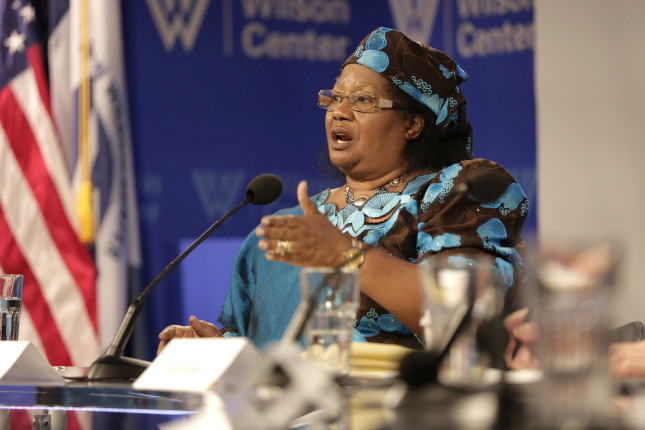
We spoke to Aylward before the Global Health Initiative (GHI) event “New Applications for Existing Technologies to Improve Maternal Health,” at the Wilson Center earlier this week.
“We’ve gone from a billion subscribers to five billion subscribers in the last six years, and 70 percent of those are in the developing world,” he said. “So almost everywhere you go a woman has a cellphone or has access to a cellphone.”
This access allows women in the developing world to do basic things those in the developed world take for granted, like call for help or set up reminders. The most important thing to think about in the future is to continue empowering women with the tools and knowledge to understand their own healthcare and supporting them with better care.
“All of which are possible in the very near term if we can get the different parties to get together and work on them together,” said Aylward, “and that’s what our mission is.”
Check out the the full event summary from GHI here. -
Improving Monitoring, Transparency, and Accountability for Maternal, Newborn, and Child Health
›“There is a knowledge gap between global targets and locally owned goals,” said Sallie Craig Huber, global lead for results management at Management Sciences for Health (MSH). The seventh meeting of the “Advancing Policy Dialogue on Maternal Health” series – cosponsored by the Global Health Council, MSH, and PATH – comes at a critical time as world leaders meet next week at the high-level, plenary UN Summit to review progress toward the Millennium Development Goals (MDGs).
Panelists Marge Koblinsky, senior technical advisor, John Snow Inc., Ellen Starbird, deputy director, U.S. Agency for International Development, and Monique Widyono, program officer of PATH, discussed strategies for improving maternal health evaluation methods while balancing the interests of donors and beneficiaries.
Maternal Health Indicators: Contact vs. Context
“Skilled birth attendants [have] become the strategy [for improving maternal mortality rates], but one size does not fit all,” said Koblinsky. The proportion of births attended by skilled birth attendants is a key maternal health indicator; however, it is not sufficient and says little about what the attendants actually did during the birth.
Koblinsky demonstrated how other indicators such as near-miss morbidity, rates of cesarean section, and contraceptive prevalence rates (CPR) are better aligned with maternal mortality outcomes. “CPR is much more closely linked with the outcome we desire as [contraception] reduces pregnancies for those at higher risk and reduces unwanted births and unsafe abortions,” said Koblinsky.
“Are the present benchmarks enough?” asked Koblinsky. “The answer is no….Indicators based on contact with skilled birth attendants focuses attention on contact, not on the quality of care or event context.”
Qualitative Data Is Necessary
“When we talk about monitoring and evaluation, transparency and accountability, it’s really critical to engage [in a discussion] on how we gauge progress,” said Widyono. In the field, “collection of data varies widely and depends on the capacity of those collecting, aggregating, and analyzing the information,” said Widyono. Such inconsistencies demand increased investment in local research capacity and qualitative analysis.
Such engagement also provides an opportunity for feedback. This “qualitative data helps to reinforce, illuminate, and deepen the understanding of what this quantitative data is showing on the ground,” said Widyono. Moving forward, policymakers, donors, and program managers will need to find a balance between these two sets of data and work together to galvanize action.
“There is a lack of attention paid to developing local, sustainable research capacity,” said Widyono. “We have an obligation to build local research capacity and disseminate findings in collaboration with the people who are going to be affected by this data,” she said.
Innovation and Research
“We really need to think about monitoring and evaluation and research and innovation as a continuum,” said Starbird. “They reinforce each other and play different roles in helping us understand what makes programs work or why they are not working.”
“We have a myriad of indicators that we expect people to monitor, collect data for, and report back to headquarters in a way that has not given countries and programs the freedom to be country-specific,” said Starbird. Therefore, “one of the goals is to minimize the reporting burden and better coordinate around indicator definition with other donors,” she said.
In order to strengthen “M&E;” for maternal health, Starbird called for new indicators as well as new ways of thinking about data analysis. “Having a results framework is really important to do good monitoring and evaluation,” she said. Evaluating the relationship between inputs, outputs, outcomes, and impacts requires a wide range of data resources so we can “get under the numbers” and determine what needs to be improved, she said.
“It’s really important to have realistic goals, otherwise it’s difficult to put programs into place and get where we want to go,” said Starbird. She said that MDG 5.B, which calls for universal access to reproductive health, “is great, but there’s never going to be universal access to reproductive health. If we really want to make progress we need to define something that is achievable and is something we can come together around.”
In conclusion, it is necessary to provide “countries with the room to do what needs to be done locally, so we can better understand these concepts rather than imposing indicators on everybody,” said Starbird. -
GMHC 2010: Lessons Learned & Recommendations
›Over the last three days, 700 technical experts have provided solutions to decrease maternal mortality. In the last year, governments have committed billions of dollars to implement such solutions. Yet, we’ve been here before, reminded Sigrun Mogedal of the Norwegian Ministry of Foreign Affairs during the final plenary session of the Global Maternal Health Conference. “Just look at ICPD, Beijing, and CEDAW. Obviously, there must be something wrong with accountability,” she said, since 15 years later women continue to die every minute giving birth.
Wrapping up the conference with a discussion of accountability makes sense – we need to learn from the past and close the gap between commitments made and real action on the ground. So what does today’s buzzword, “accountability,” mean, and how do we enforce the realization of commitments made…or lack thereof?
“Accountability is power, and includes transparency, answerability, and enforceability,” said Lynn Freedman of Columbia University. Through international law, budget transparency, and grassroots mobilization it is possible to ensure that policies make a difference to improve women’s lives.
A review of the Ministry of Finance’s allocation for health can tell us a lot about the government’s real commitment to eradicating maternal mortality. As the overarching instrument of policy the “budget is inextricably linked to development and exists for those who have less,” said Helena Hofbauer of the International Budget Project. “If there were greater transparency of government spending, we could have done more to push for change five years ago,” said Hofbauer. This is indeed true; however, it is also true that if governments simply followed through on the international agreements they are signatories to, women would be better protected.
Accountability through the legal system is possible and Nancy Northrup of the Center for Reproductive Rights demonstrated how international law has overhauled programs and sparked governments into action. For example, in India, the high court recently ruled that the government must execute audits and report back on the steps taken to align programs with policies that ensure a woman’s right to skilled birth attendance.
In order to bring about such judicial interventions a social movement must first be in place to build awareness and demand accountability. Building such a movement starts at the grassroots level and Aparajita Gogoi of CEDPA presented strategies for empowering local communities with a global voice. By providing a safe space for dialogue, communities are given the opportunity to share concerns and demand action from local health facilitators and government officials.
Increasing opportunities for dialogue allows for bottom up solutions and ensures that contextual variables are taken into consideration. “We need arenas for brokering diverse groups to compare notes and streamline synergies, ” said Mogedal. I am energized by the lessons learned today and eager to apply these key messages next week in Washington, DC during the seventh meeting of the Advancing Policy Dialogue for Maternal Health at the Woodrow Wilson International Center for Scholars that will further address “Monitoring, Transparency, and Accountability for Maternal Health.”
Originally posted on the Medscape blog Global Mamma, by Calyn Ostrowski of the Woodrow Wilson International Center for Scholars, Coordinator of the Maternal Health Dialogue Series in partnership with the Maternal Health Task Force and UNFPA.
Photo Credit: “Mothers and children waiting at the Bolemba healt centre” courtesy of flickr user hdptcar. -
GMHC 2010: Maternal Health Realities: Accountability and Behavior Change
›Four days ago a young woman died giving birth in a bustling marketplace in New Delhi. Just steps away from Parliament, this woman was left to die and no emergency care was sent to her – no midwives, nurses, or doctors; just people walking around her accepting the situation as normal and an uncontrollable way of life. But this is Delhi…not a remote tribal village where the nearest health clinic is hours away (on foot).
This juxtaposition lingers on in me as I sit in the plenary session of day two at the Global Maternal Health Conference and listen to Syeda Hameed, member of the Indian Parliament Planning Commission, discuss her recent visit to a remote village where every house has 10 children living in filth, flies, and emptiness.
Although I have been working on such development issues for the last five years I do not work in the field, nor do I visit the developing world on a regular basis. Hearing these stories, coupled with my firsthand experience of witnessing poverty here in Delhi reminds me of the daily reality of those 342,900 women who die every year. This is their way of life and I think it’s poignant that today’s sessions emphasize community based care, family planning, accountability, behavior change, and culture.
“Context, context, context,” said Wendy Graham of IMMPACT at yesterday’s plenary session. I agree, the context of social and cultural norms is an underlying factor that must be taken into consideration when implementing maternal and child health (MNCH) programs. With a background in psychology, I appreciated when Dr. Zulfiqar Bhutta, of Aga Khan University, recognized the toll of poverty on the imagination and the mentality of fatalism.
That is why it is so essential to “ask the people how they feel and bring their voices into the forums where policy decisions are made,” said Hameed. It is also important to hold key players accountable and include men in MNCH activities.
During the side session Male Involvement in Reproductive and Maternal and Newborn Health six field experts (in which half the panelists and audience members were men!) discussed effective methods for increasing male participation in family planning, vasectomies, gender equality, and hospital care.
The key findings from this discussion include:- Targeted interventions that educate men about danger signs and pregnancy complications correlates with behavior change and increased facility births.
- Many young married men feel pressured to prove their fertility. A sample of men was evaluated and those who had increased education and income were more likely to delay first pregnancy.
- Vasectomy is not something men want to talk about with family planning fieldworkers; however, official recognition of the vasectomy benefits by the government did increase referrals.
- Puppet and theater shows that demonstrate gender equity behaviors provide an opportunity for dialogue. Women in this study reported increased gender equity in family planning decision-making.
Originally posted at Maternal Health Task Force, by Calyn Ostrowski of the Woodrow Wilson International Center for Scholars, Coordinator of the Maternal Health Dialogue Series in partnership with the Maternal Health Task Force and UNFPA.
Photo Credit: “Parliament Street” courtesy of flickr user ~FreeBirD®~. -
GMHC 2010: Empowering the Next Generation
›“We do not need new legislation… we need affordable, effective, and scalable solutions,” said Shn Gulamnabi Azad, Minister of Health, India, at the opening ceremony of the first-ever Global Maternal Health Conference in New Delhi. Co-hosted by the Maternal Health Task Force and the Public Health Institute of India, this three-day technical meeting builds upon the momentum of Women Deliver and the G8 summit by bringing together 700 researchers, program managers, advocates, media, and young people to exchange ideas, share data, develop strategies, and identify solutions for reducing maternal mortality.
In order to reduce India’s maternal mortality rates, Azad called for the repositioning of family planning programs to include maternal and child health and not limit the scope of services to population control as historically executed. Improving family planning and maternal health services must also address the reproductive health needs of adolescent girls, and India is currently developing a new ministry that will target gender inequality, poverty, early child marriages, as well as other critical health issues important to young girls such as the dissemination of sanitary napkins.
“Although the legal age of marriage is 18, there are districts in India where 35 percent of the population is married between the ages of 15-18,” said Azad. During the side event “Adolescent Girls: Change Agents for Healthy Mother and Child,” technical experts such as Anil Paranjap of the Indian Institute of Health Management presented evidence that girls who marry between 15-18 are five times more likely to die during childbirth than women in their early 20’s.
“We still have deep-rooted subordination that makes it very difficult for young women to realize their sexual and reproductive health rights,” said Sanam Anwar with the Oman Medical College. Interventions such as the UDAAN project – a private-public partnership between the Center for Development and Population Activities (CEDPA) and the Government of India – demonstrate promising solutions for empowering young people through the use of existing infrastructure. In collaboration with teachers, parents, principals, and students, this project successfully increased leadership skills and improved youth knowledge on menstruation, health, friendship, peer pressure, early marriage, and reproductive health, said Sudipta Mukhopadhyay of CEDPA.
Empowering “young people” to improve maternal health also requires that the community support committed new thinkers and future leaders. The Young Champions of Maternal Health Program is a unique and refreshing group of young professionals from 13 countries dedicated to improving maternal health, and I look forward to learning how this new energy will further the maternal health agenda.
Originally posted at Maternal Health Task Force, by Calyn Ostrowski of the Woodrow Wilson International Center for Scholars, Coordinator of the Maternal Health Dialogue Series in partnership with the Maternal Health Task Force and UNFPA.
Photo Credit: “Indian Girl” courtesy of flickr user Jarek Jarosz. -
‘NSB’ Blogs from the 2010 Global Maternal Health Conference in New Delhi
›The 2010 Global Maternal Health Conference kicked off today, perhaps fittingly, in India – one of the world’s fastest growing nations but one that also faces serious reproductive health challenges. The Wilson Center’s Calyn Ostrowski is in New Delhi for the conference and will be providing updates to The New Security Beat throughout the week.
Those interested can also find a schedule of events and list of participants on the conference website as well as live webcasted events on the main page. Stay tuned!
Photo Credit: “Mumbai, India, November 2009” courtesy of flickr user travelmeasia. -
How Maternal Mortality and Morbidity Impact Economic Development
›“Investing in women and girls is the right thing to do,” says Mayra Buvinic, sector director of the World Bank’s gender and development group. “It is not only fair for gender equality, but it is smart economics.” But while it may be smart economics, many developing countries fail to address the underlying social causes that impact economic growth, such as poverty and gender inequality. Buvinic was joined by Dr. Nomonde Xundu, health attaché at the Embassy of South Africa in Washington, D.C., and Mary Ellen Stanton, senior maternal health advisor at the U.S. Agency for International Development (USAID), at the sixth meeting of the Advancing Policy Dialogue on Maternal Health Series, which addressed the economic impact of maternal mortality and provided evidence for the need for increased investment in maternal health.
-
Women Deliver in the Climate Change Debate
›One of the hottest topics at the “Women Deliver” conference earlier this month—where panels ran the gamut from HIV prevention and family planning to gender-based violence and maternal health—was the intersection of women’s reproductive health, global population growth, and climate change.
As panelists at three of the conference’s climate-focused events noted, women in poor, rural areas are especially vulnerable to the impacts of climate change. In many developing countries across Africa, Asia, and Latin America, women take on much of the burden of farming, gathering fuel, and supplying fresh water for their communities. As a result, they bear the brunt of hardships when climate change alters seasonal precipitation patterns, or increases scarcity of key natural resources.
In addition, “the more assets, the less vulnerable one person is,” said Lorena Aguilar of the International Union for Conservation of Nature. “Worldwide, compared to men, women tend to have more limited access to resources that would enhance their capacity to adapt to climate change—including land, credit, agricultural inputs, decision-making bodies, technology, and training services.”
Women’s hardship in the face of climate change can also have a negative effect on reproductive health. Aguilar remarked that during the dry season in parts of rural India and Africa, 30 percent or more of women’s daily caloric intake is spent on fetching water alone. The enormous physical strain placed on women’s bodies because of those tasks has resulted in higher miscarriage rates among those populations, she noted.
Educating Girls to Protect the Environment
Organizations like the United Nations and the Global Gender and Climate Alliance have been working in recent years to bridge the gap between women’s rights and climate change, and reframe climate change in terms of human development. But to date, women’s struggles with climate change have not translated into meaningful economic, educational, or healthcare support at the local government level, with women’s welfare “at the very bottom of the priority list” for most developing countries, according to Nickie Imanguli with Advocates for Youth.
The unmet need for family planning tools and services is perhaps the movement’s principal challenge going forward. With an estimated 200 million women having an unmet need for family planning, unintended pregnancies could be exacerbating environmental problems such as depletion of forests, water, and other finite resources. But most panelists expressed optimism that the growing recognition of a connection between climate change and women’s reproductive health might lead to a boost in funding for family planning initiatives in underserved areas of the world.
Speakers at Women Deliver emphasized that reproductive health can be bolstered by improving educational opportunities for girls in poor rural areas. Joy Nayiga with Uganda’s Ministry of Finance Planning Economic Development noted that “girls are more likely than boys to drop out of school to help their mothers gather fuel, wood, and water.” This trend, she said, robs females of an opportunity for educational advancement, and heightens the likelihood they will end up starting families of their own while very young.
Nayiga and other panelists asserted that empowering females through education leads them to take greater control over their own sexual health, making it easier for them to start their families later in life, or perhaps have a smaller number of children.
Encouraging women to take a more active role in family planning in this regard serves as “a win-win situation for women, their communities, and the nations of the world,” by “bending down the overall trajectory of population growth,” asserted the Worldwatch Institute’s Robert Engelman.
Some speakers also argued that enabling women to delay motherhood if they want could yield direct environmental benefits for nations of the Global South that are struggling to adapt to climate change. Since women are often responsible for overseeing agriculture and forest resource management practices in their communities, they help create localized carbon sinks across the developing world.
“Women pull carbon out of the atmosphere and bury it, in farm soils, in trees that they grow,” noted the Worldwatch Institute’s Engelman, who even suggested women’s aggregate impact removing carbon could be more effective than cap-and-trade plans.
Moving Slowly From Talk to Action
Given both their vulnerability to the effects of climate change—and their potential to help offset those same impacts—“women are critical stakeholders in climate change moving forward,” said Population Action International’s Kathleen Mogelgaard. So far, however, while there may be growing discussion about giving women a more prominent seat at the table when developing climate change adaptation and mitigation plans, that has not yet happened.
“We’re not seeing big government investment in empowering women on the issue of climate change,” remarked Leo Bryant, with Marie Stopes International, a U.K.-based NGO specializing in sexual and reproductive health. Instead, Bryant said, it has been NGOs that have been doing much of the heavy lifting of bringing women into the conversation.
But many panelists felt that, in time, governments will recognize it is in their enlightened self-interest to link issues of gender rights and climate change. “By upholding women’s rights,” concluded the IUCN’s Lorena Aguilar, “we are in fact making one of the most crucial preparations associated to climate change that any society can make.”
Click here for additional New Security Beat coverage of reproductive health talks at the Women Deliver conference, or here for more coverage of the interplay between traditional gender roles and family planning.
Sources: International Institute for Sustainable Development, International Union for the Conservation of Nature, Marie Stopes International, Population Action International, Population Reference Bureau, The Times (U.K.), United Nations Development Programme, Women Deliver, Worldwatch Institute.
Photo Credit: “Climate Change Canvas” courtesy of Amnesty International.
Showing posts from category Dot-Mom.