

-
ECSP Weekly Watch: March 25 – 29
›
A window into what we are reading at the Wilson Center’s Environmental Change and Security Program
UN Report Highlights Relationship Between Water and Peace (UN Water)
Freshwater consumption is growing at a steady rate, driven largely by agriculture, yet roughly 50% of the world’s population experiences severe water scarcity for at least part of the year. Poor water quality in low-income countries is attributable to low wastewater treatment, whereas in high-income countries, agricultural runoff does the damage. Extreme droughts or heavy rainfall, exacerbated by climate change, also have worsened in frequency and intensity, creating a deepening impact on global water security.
-
Water @ Wilson | MODSNOW: A New Tool for Water Security in Central and South Asia
›
Central and South Asia’s water resources are critical for the region’s water, energy, food and environmental security. Major rivers in the region originate from the Hindu-Kush-Himalaya, Pamir, and Tien Shan Mountain Ranges and flow across multiple countries. Unique geographical characteristics make water management a complex and challenging task that is further complicated by a changing climate and increasing demand affecting diminishing water resources.
-
Indigenous Partnerships Can Bring Progress in LAC Energy Projects
›Este ensayo se actualizó con una traducción al español, disponible después de la versión en inglés, a continuación.
Latin American and Caribbean (LAC) countries have committed to transitioning to a net zero economy by 2050. Will they be able to do so without leaving anyone behind? It is unlikely, if business models don’t change.
An annual investment of $700 billion will be needed to curb emissions from the energy sector and its end uses, as well as from agriculture, forestry and other land use. In the clean energy sector alone, investment must increase nearly fivefold from its 2022 level.
-
ECSP Weekly Watch | March 11 – 15
›A window into what we are reading at the Wilson Center’s Environmental Change and Security Program
China is Leading the World on Renewable Energy (Yale 360)
In November, Chinese and U.S. climate envoys pledged to triple global renewable energy by 2030, signaling renewed cooperation between the top two greenhouse gas emitters. However, the two countries are not quite on equal footing when it comes to renewable energy.
-
The Arc | Climate, Conflict, and Women’s Resilience: A Recent Women for Women International Report
›
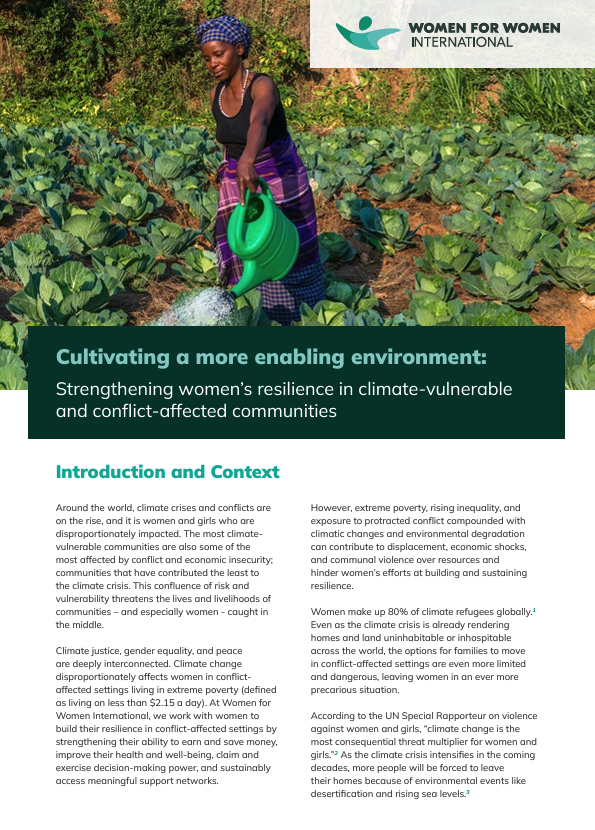
In today’s episode of The Arc, ECSP’s Angus Soderberg and Claire Doyle interview Nisha Singh and Kavin Mirteekhan from Women for Women International. We dive into the organization’s recent report, “Cultivating a more enabling environment: Strengthening women’s resilience in climate-vulnerable and conflict-affected communities,” to hear how women around the world are disproportionately impacted by conflict and climate shocks—and what we can learn from their solutions.
-
ECSP Weekly Watch: March 4 – 8
›A window into what we are reading at the Wilson Center’s Environmental Change and Security Program
Climate Change Disproportionately Impacts Rural Women (U.N. Food and Agriculture Organization)
A recent report by the U.N. Food and Agriculture Organization analyzed data from 24 low- and middle- income countries (LMICs) across five regions and over 100 thousand rural households to measure the impacts of climate change on rural women, youth, and people living in poverty. It found that climate change’s impacts disproportionately impact households headed by women, with income losses due to extreme heat (8% income loss) and flooding (3% income loss), relative to households led by men. The income gap between men and women was also widened as a result.
-
New Security Broadcast | Sarah Ladislaw on US Climate Security and “Mutually Assured Resilience”
›In today’s episode of New Security Broadcast, ECSP Program Director Lauren Risi speaks with Sarah Ladislaw, Special Assistant to the President and Senior Director for Climate and Energy at the National Security Council (NSC). In the conversation, Special Assistant Ladislaw describes her role at the NSC and the most pressing climate security challenges facing the US. She also reflects on her recent address at the Munich Security Conference, and her vision for achieving “mutually assured resilience.” -
ECSP Weekly Watch: February 19 – 23
›A window into what we are reading at the Wilson Center’s Environmental Change and Security ProgramProgress—and Room for Improvement—in UNEP’s Annual Report (United Nations Environment Programme)
How effective is the United Nations Environment Programme (UNEP)’s work on the fight against climate change? Its Annual Report analyzed the work it has done over the past year to do so. The UNEP supports key areas in which progress has been made, including waste reduction through the Global Framework on Chemicals and global instrument on plastic pollution, biodiversity protection efforts through various frameworks, and loss and damage mobilization through COP28.
Showing posts from category adaptation.
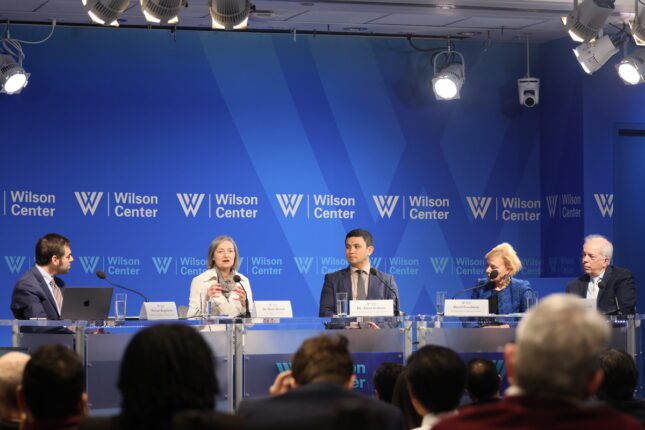
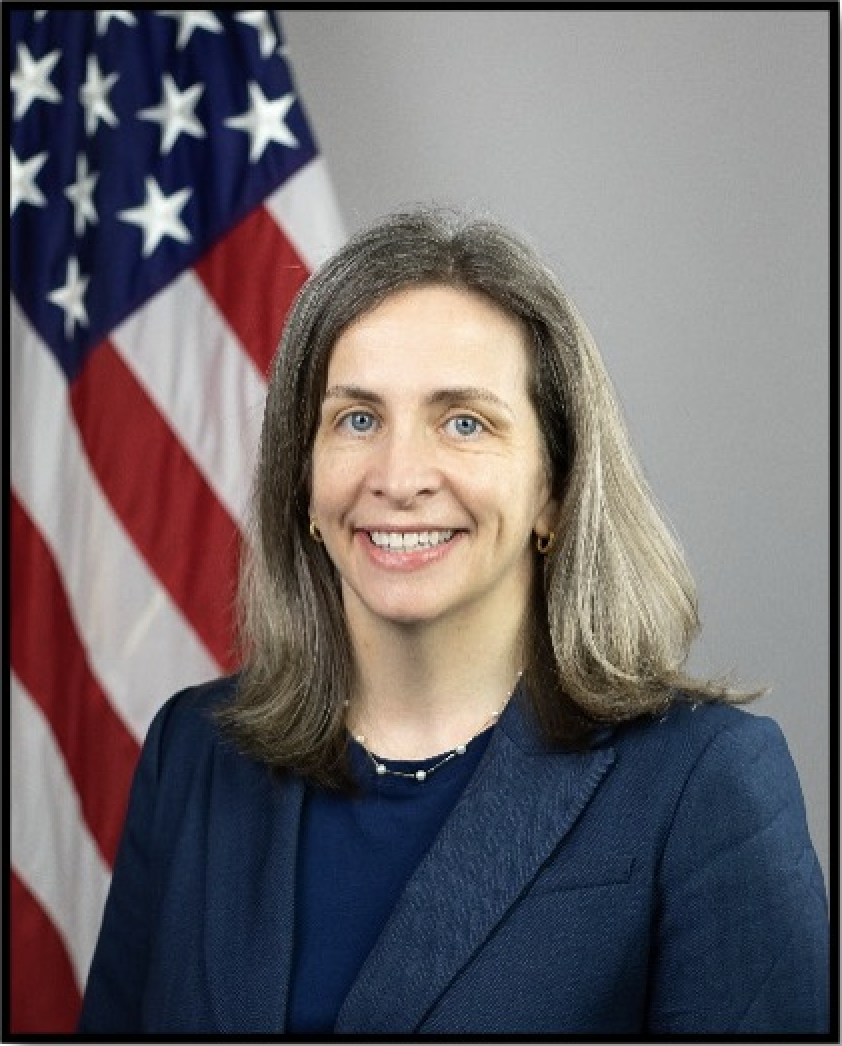 In today’s episode of New Security Broadcast, ECSP Program Director Lauren Risi speaks with Sarah Ladislaw, Special Assistant to the President and Senior Director for Climate and Energy at the National Security Council (NSC). In the conversation, Special Assistant Ladislaw describes her role at the NSC and the most pressing climate security challenges facing the US. She also reflects on her recent address at the Munich Security Conference, and her vision for achieving “mutually assured resilience.”

