-
Don’t Cry for Me, Argentina: Why a Melting Arctic Needs Stronger Governance
›May 11, 2010 // By Schuyler NullThe Arctic Council, which helps broker economic and environmental agreements between the Arctic nations, needs a larger role in developing joint international policy, says Norway’s ambassador to Canada. Accelerating ice melt is expected to open the Arctic Ocean to seasonal ship traffic sometime between 2013 and 2030 – which analysts worry will lead to disputes over newly accessible oil and gas reserves.
The Arctic Council was founded in 1996 to “provide a means for promoting cooperation, coordination and interaction among the Arctic States” – Canada, Greenland, Finland, Iceland, Norway, Sweden, Russia, the United States, as well as some Arctic indigenous communities are all members. According to the U.S. Geological Survey, the Arctic may contain up to 90 billion barrels of oil (more than the known reserves of Nigeria, Kazakhstan, and Mexico combined) and 27 percent of the world’s known natural gas reserves, most of which is located offshore.
While rhetorical flare-ups over access to resources and accusations of militarization have occurred, to date the Arctic Council has been an effective mitigating body. However, the Council currently lacks a permanent secretariat and reliable funding.
Currently, any territorial disputes are handled under the U.N. Convention on the Law of the Sea (UNCLOS), while the Arctic Council mainly facilitates communication. However the United States has not yet ratified the Law of the Sea, despite concerted high-level efforts to do so.
Referring to the Arctic, Secretary of State Hillary Clinton recently told Congress that “the Law of the Sea provides commercial rights to the mining of what is in the seabed of the territories that are claimable under sovereignty provisions in the treaty,” and if the United States does not ratify it, “we will lose out, in economic and resource rights, in terms of environmental interests, and national security.”
While the National Intelligence Council predicts that a major armed conflict over the Arctic is unlikely in the near future, it suggests that “serious near-term tension could result in small-scale confrontations over contested claims.” A comprehensive agreement brokered by Arctic Council leadership and agreed upon by all members – like the Convention on the Protection of the Mediterranean Sea Against Pollution, and Protocols, which helps regulate commerce and environmental protections – would guarantee third-party moderation and alleviate the risk of an outstanding dispute erupting into real conflict.
The value of such an agreement is illustrated by the growing tension between Britain and Argentina over offshore oil rights around the Falkland Islands. Recent British drilling efforts, which have yielded a pocket of oil worth potentially an estimated $25 billion, provoked a furious response from Argentinean officials who have long disputed Britain’s claims to sovereignty, not only of the islands themselves, but of the seas around them.
Under UNCLOS, a nation is entitled to “explore and exploit” any natural resources within 200 nautical miles of their shores and in certain circumstances can apply for an extension to 350 nautical miles. By these definitions, there is considerable overlap in British and Argentinean claims, which the Law of the Sea alone is unable to resolve.
In a statement reported by the Times Online last week, Foreign Minister Jorge Taiana said that “Argentina energetically refutes what is an illegal attempt to confiscate non-renewable natural resources that are the property of the Argentine people.”
In an earlier bid to slow development, Argentinean President Cristina Fernandez de Kirchner announced in February that any ship coming to or from the disputed islands would have to be granted a permit in order to pass through Argentinean waters, effectively threatening blockade.
The sovereignty of the Falkland Islands has remained a disputed topic for Argentina since the loss of the Falkland Islands War in 1982, made worse by recent financial woes at home and the country’s lack of domestic oil reserves.
Although tensions in the Arctic region are low now, a changing environment and increased competition for energy resources may lead to similar disputes in the polar region – a strong argument for strengthening multilateral institutions like the Arctic Council and UNCLOS sooner rather than later.
Video Credit: “2008 Arctic Sea Ice Minimum w/overlay” courtesy of Flickr user NASA Goddard Photo and Video. -
DOD Measures Up On Climate Change, Energy
›May 5, 2010 // By Schuyler Null“As Congress deliberates its role, DOD is moving ahead steadily on a broad range of energy and climate initiatives,” says former Senator John Warner in a recent Pew report, Reenergizing America’s Defense: How the Armed Forces Are Stepping Forward to Combat Climate Change and Improve the U.S. Energy Posture.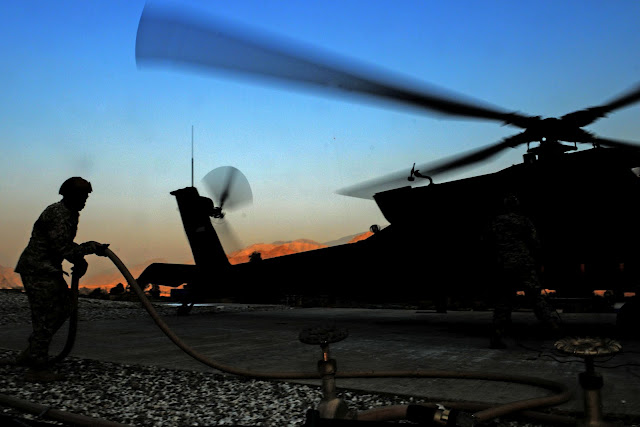
The military as a leader and catalyst for renewable energy was a key focus of the recently released Quadrennial Defense Review (QDR), which for the first time included consideration of the effects of climate change and excessive energy consumption on military planning:Assessments conducted by the intelligence community indicate that climate change could have significant geopolitical impacts around the world, contributing to poverty, environmental degradation, and the further weakening of fragile governments. Climate change will contribute to food and water scarcity, will increase the spread of disease and may spur or exacerbate mass migration.
According to the Pew report, the Department of Defense has set a goal of producing or procuring at least 25 percent of its non-tactical electric energy needs from renewable sources by 2025. Highlights of the service’s efforts include:
The Pew report offers a generally favorable appraisal of the military’s response to the “twin threats of energy dependence and climate change” and the progress made towards reaching federal energy mandates. However, the authors let slide that the overwhelming amount of DOD energy usage is tied to tactical consumption, which has been given inadequate attention thus far (consider that the senior Pentagon official overseeing tactical energy planning was only just appointed, although the position has existed since October 2008).- The U.S. Navy’s “Great Green Fleet” carrier strike group, which will run entirely on alternative fuels and nuclear power by 2016;
- The construction of a 500-megawatt solar facility in Fort Irwin, California by the U.S. Army which will help the base reach ‘net-zero plus’ status;
- The goal of acquiring 50 percent of the U.S. Air Force’s aviation fuels from biofuel blends by 2016;
- The U.S. Marine Corps’ 10×10 campaign to develop a comprehensive energy strategy and meet ten goals aimed at reducing energy and water intensity and increasing the use of renewable electric energy by the end of 2010.
Interest in this field has grown quickly, as evidenced by the more than 400 people gathered at the launch of the latest report from the Center for New American Security (CNAS), Broadening Horizons: Climate Change and the U.S. Armed Forces – a big increase from the 50 or so at CNAS’ first natural security event in June 2008.
The CNAS study, much like the Pew report, breaks down the military’s efforts by service, but the study’s authors – including U.S. Navy Commander Herbert E. Carmen – thankfully provide more specific recommendations for what could be done better.
Based on research, interviews, and site visits, the study offers geographically specific recommendations for each of the Unified Commands, as well as seven broad recommendations for DOD as a whole:
“While we believe there is still much work ahead, there is a growing commitment to addressing energy and climate change within the DOD,” said USN Commander Carmen in the report:- In light of its implications for the global commons, ensure that DOD is included in the emerging debate over geoengineering.
- Urge U.S. ratification of the UN Convention on the Law of the Sea in order to provide global leadership and protect U.S. and DOD interests, especially in the context of an opening Arctic sea.
- Eliminate the divided command over the Arctic and assign U.S. Northern Command (NORTHCOM) as the supported commander.
- The U.S. government should make an informed decision about constructing nuclear reactors on military bases and provide clear policy guidelines to DOD.
- Congress and DOD should move away from the “cost avoidance” structure of current renewable energy, conservation, and efficiency practices in order to reward proactive commanders and encourage further investment.
- All of the services should improve their understanding of how climate change will effect their missions and capabilities; e.g. migration and water issues may impact Army missions, a melting Arctic, the Navy.
- The Air Force should fully integrate planning for both energy security and climate change into a single effort.
Indeed, in our conversation with officials in the Office of the Secretary of Defense for Policy, it was clear that, in developing the climate change and energy section of the 2010 QDR, the Department of Defense has developed a nascent, intellectual infrastructure of civilian and military professionals who will continue to study the national security implications of climate change, and, we hope, will continue to reevaluate climate change risks and opportunities as the science continues to evolve.
A holistic view of national security that includes energy and environment, as well as demographic and development inputs, continues to gain traction as an important driver in DOD policy and planning.
Photo Credit: “Refueling at FOB Wright” courtesy of Flickr user The U.S. Army. -
Book Review: ‘Global Warring: How Environmental, Economic, and Political Crises Will Redraw the World Map’ by Cleo Paskal
›April 9, 2010 // By Rachel Posner As record-breaking snowstorms blanketed Washington, D.C. this winter, I took advantage of the citywide freeze to read Cleo Paskal’s new book, Global Warring: How Environmental, Economic, and Political Crises Will Redraw the World Map. In it, Paskal makes a compelling case for why the West should care about the geopolitical shifts—already underway—that will be exacerbated by climate change.
Paskal eloquently explains the science behind climate change in layman’s terms, breaking down incredibly complex issues and drawing connections across seemingly disparate challenges, such as rising food prices, degrading energy infrastructure, and growing water scarcity. She is a skilled storyteller, using memorable vignettes (and at times even humor) to effectively illustrate these climate-related complexities.
But what truly sets Paskal’s book apart from a number of recent works on this topic is her ability to elucidate the major power shifts that are directly related to today’s climate and resource stresses. “Environmental change is the wild card in the current high-stakes game of geopolitics,” she writes (p. 249). Such natural resource stresses will only become more pronounced in the future.
Global Warring highlights a number of key challenges and opportunities that could take the United States and other Western nations by surprise if they don’t change policies now to secure their positions as major global powers.
Impacts of Environmental Change: Like the developing world, the United States and other Western nations will suffer from extreme weather events and the broader effects of environmental change. However, the United States has “institutional, regulatory, political, and social” weaknesses that affect its “ability to absorb the stress of repeated, costly, and traumatic crises,” including its expensive, aging infrastructure, writes Paskal (p. 40). For example, while the country will face more Hurricane Katrinas, the U.S. military is still not adequately prepared to address such domestic environmental disasters.
Transportation Routes and Trade: The Northwest Passage—the sea route that connects the Atlantic and Pacific Oceans through North American waterways—is a highly coveted trade route that will become all the more valuable as Arctic ice continues to melt in the years ahead. Already the United States, Canada, Russia, China, and even the European Union are engaged in a geopolitical chess game for control of the Arctic. Each is staking a claim to the natural resources below the surface, new shipping routes, and strategic chokepoints. According to Paskal, if the West wants to remain “a major force in the twenty-first century,” the United States and the EU should help Canada secure its claim to the Northwest Passage. This way, Canada could protect its borders and “talk to other countries, including Russia, on a more equal basis about creating and jointly using facilities like search, rescue, and toll stations, and on methods of speeding legitimate, safe shipping and exploration in the northern waters,” she writes (p. 125).
New Power Dynamics and Partnerships for China, India, and the West: China and India are two of the world’s fastest growing economies and each are taking on new roles in Asia and beyond. But could climate change and environmental challenges stem their growth, or will these “powerhouse” countries prove resilient? As the global power balance begins to shift toward Asia, Paskal sees India as the “swing vote” that might shape the future of geopolitics for the next long while” by aligning itself with Russia and China and potentially marginalizing the West (p. 185). Alternatively, the West could finally acknowledge India as an equal partner—for example, by strengthening civilian nuclear cooperation—and thus help foster stability over the long term. Stresses on natural resources, now and in the future, will only increase the importance of strong alliances and geopolitical partnerships.
Rising Sea Levels in the Pacific Ocean: Most Americans and other Westerners are not terribly concerned about the welfare of the small-island nations in the Pacific whose entire existence is threatened by sea-level rise. Paskal rightfully draws our attention to the ambiguous state of the international law of the sea, which leaves much of this region up for grabs when sea levels rise and coastlines change. “At stake is access to fisheries, sea-lanes in relatively calm waters, control over regional security, unknown underwater resources, geostrategic advantage, and geopolitical political leverage,” she writes (p. 214). China has already gone to great lengths to secure its control over the Pacific, and if it continues to be successful, the United States will risk losing influence in the region.
Throughout all of these cases, Paskal weaves in a discussion of the growing and strategically significant practice of “nationalistic capitalism.” For example, she describes how China’s state-owned companies work with their government to “advance national strategic interests,” often signing bilateral deals that “cut out the open market and overtly link much-needed resources to wide-ranging agreements on other goods and services, including military equipment” (p. 94-5). As China and other nationalistic capitalist countries expand their reach into the resource-rich regions of Africa and Latin America, fewer resources (like food and fuel) will be available in the open market. For the United States and other “free market” nations, this practice could lead to higher prices and increased competition for business and political alliances.
Overall, Global Warring is an excellent read that I would recommend to friends and colleagues, especially those tracking long-range global trends and promoting farsighted policies. I appreciated Paskal’s recurring call for abandoning short-term expediency in U.S. decision-making in favor of a longer-term approach. Paskal shows how over time the United States’ short-term interests are creating major vulnerabilities that will be worsened by environmental stresses in the future.
The book’s only notable shortcoming is its skewed geographic scope. Paskal focuses heavily on North America and Asia, particularly China and India, and only briefly mentions Africa, Latin America, the Middle East, and Australia. Obviously, a book about the shift of major world powers would concentrate on the most influential players, but these other regions are worthy of greater consideration given their critical natural resources, demographic trends, and ongoing climate adaptation efforts.
Regardless of how the climate changes, the environmental trends described in Global Warring are already manifesting as geopolitical realities that will dramatically affect the United States. As Paskal says, “Countries that want internal stability, influence over allies, control over sea-lanes, and access to critically important resources better start planning now (p. 235).
Rachel Posner is a fellow in the Energy and National Security Program at the Center for Strategic and International Studies (CSIS). Previously, she has served as the assistant director of the CSIS Global Water Futures Project; research associate with the CSIS Global Strategy Institute; and Brent Scowcroft Award Fellow with the Aspen Strategy Group. -
Is the Melting Arctic a Security Challenge or Crisis? The View From Russia and Washington
›March 24, 2010 // By Geoffrey D. DabelkoIn his opening remarks at the Security Council of the Russian Federation’s meeting on climate change last week, Russian President Dmitry Medvedev framed climate change as a force for increased competition and “disputes between countries.” Unsurprisingly, he focused on the Arctic region and what he called the “inadmissible” and “unfair” threats to Russia’s access to the region’s resources:
We must not forget either that climate change can give rise not only to physical change, change in the nature around us, but can also see the emergence of disputes between countries over energy exploration and extraction, the use of marine transport routes, bioresources, and shortages of water and food resources. The countries bordering the Arctic region are already actively engaged in expanding their research, economic, and even military presence in the Arctic. Unfortunately, in this situation, we are seeing attempts to limit Russia’s access to exploring and developing Arctic energy deposits, which is inadmissible from a legal point of view and unfair in terms of our country’s geographical location and very history.
His reference to “shortages of water and food resources” fits squarely within the increasingly common view of climate change’s potential as a “conflict accelerant” (see, e.g., the U.S. Department of Defense’s 2010 Quadrennial Defense Review) or “threat multiplier” (as in CNA’s National Security and the Threat of Climate Change and statements from representatives of the UK and EU foreign offices).
But his Arctic comments sounded different than what I’ve been hearing in Washington. The Arctic rightfully gets a lot of attention for alarming rates of physical change, newly accessible resources, and potential new shipping routes. Yet remarks at a recent spate of Arctic climate and security discussions suggest officials in Washington view the geopolitical and trade issues more as “challenges” than “crises.”
For example, last month at the Stimson Center, and just yesterday at the Johns Hopkins University Applied Physics Lab, the U.S. Navy’s director of Task Force Climate Change and oceanographer, Rear Admiral David Titley, used “challenge” rather than “crisis” to depict the security situation in the far North. At numerous panels, officials and experts expressed confidence that the Arctic Council and related institutions are forums robust enough to manage current and future disputes.
Ironically, one of those key institutions is UNCLOS, the Law of the Sea treaty, which has been ratified by 157 countries, but not the United States. U.S. military and civilian officials alike see ratification as a key step for the United States to represent its interests in these critical multilateral settings. Nevertheless, we can anticipate some knee-jerk demagoguery about the treaty ceding U.S. sovereignty to the United Nations, so the Senate is unlikely to take up the issue until after the fall 2010 elections.
I want to thank friend and colleague Alexander Carius, co-director of Adelphi Research, for calling President Medvedev’s speech to my attention.
Photo: Russian President Dmitry Medvedev, courtesy Flick user World Economic Forum -
Weekly Reading
›Climate change is “the biggest global health threat of the 21st century,” says the final report of a year-long commission held by The Lancet and University College London. A Lancet editorial, “Sexual and reproductive health and climate change,” says that rapid population growth “increases the scale of vulnerability to the consequences of climate change” and that meeting the unmet need for contraception “could slow high rates of population growth, thereby reducing demographic pressure on the environment.”
Following the escalation of hostilities in Gaza, the UN Environment Programme’s environmental assessment found that Gaza’s underground water supplies are “in danger of collapse as a result of years of over-use and contamination that have been exacerbated by the recent conflict.” IRIN reports that climate change has led to lower rainfall and “slowed the recharge rate of the aquifer” under Gaza, while “rapid population growth and suburban sprawl” have left “little space for rainwater catchment.”
In “Arctic Climate Feedbacks: Global Implications,” the World Wildlife Fund says that “warming in the Arctic will likely have far-reaching impacts throughout the world, resulting in a sharp increase in harmful greenhouse gases and significant shifts in global weather patterns that could disrupt the lives and livelihoods of hundreds of millions of people.”
The Obama Administration’s Interagency Ocean Policy Task Force Interim Report—now open for a 30-day review and comment period—“proposes a new National Policy that recognizes that America’s stewardship of the ocean, our coasts, and the Great Lakes is intrinsically and intimately linked to environmental sustainability, human health and well-being, national prosperity, adaptation to climate and other environmental change, social justice, foreign policy, and national and homeland security.”
The Economics of Climate Adaptation Working Group estimates that climate risks “could cost nations up to 19 percent of their GDP by 2030, with developing countries most vulnerable,” and warns that the “historic pace of population and GDP growth could put ever more people and value at risk.” However, the group also contends that “between 40 and 68 percent of the loss expected to 2030 in the case locations – under severe climate change scenarios – could be averted through adaptation measures whose economic benefits outweigh their costs.” -
Weekly Reading
›A study published in Conservation Letters finds that emphasizing the ways the environment benefits the world’s poor “is a substantial improvement over dollar-based, ecosystem-service valuations that undervalue the requirements of the world’s poor” and “offers great hope for reconciling conservation and human development goals.”
NATO offers seven one-minute videos on environmental-security topics.
In Foreign Policy, Stephen Faris argues that melting Himalayan glaciers could make security problems in South and Central Asia even worse.
The Financial Times offers an extended look at environmental migration in Ghana.
The Arctic Climate Change and Security Policy Conference: Final Report and Findings, a report from the Carnegie Endowment for International Peace, maintains that a multilateral process is the best way to minimize tensions over the Arctic. -
Weekly Reading
›In the June 2009 edition of The Atlantic, 2008 International Reporting Fellow Delphine Shrank explains how conflict in DRC is harming the local ecosystem and livelihoods.
Oxfam International has released a study (Spanish) arguing that rapidly shrinking glaciers in the Andes are disrupting water supplies and leading to conflict in Peru, Bolivia, and Ecuador.
A shortage of clean water is leading to domestic violence in Uganda, report The New Vision and Circle of Blue.
The June 2009 edition of National Geographic includes a special report on food security, agriculture, and population.
“Two decades after its fall, the border between East and West Germany has already become Europe’s biggest nature reserve: an 858-mile ‘ecological treasure trove,’ no longer the Iron Curtain but the Green Belt, and home to more than 600 rare and endangered species of birds, mammals, plants and insects,” reports Tony Paterson for The Independent.
Worldfocus.org’s latest radio show explores the geopolitics of the melting Arctic. -
Weekly Reading
›“The Arctic could slide into a new era featuring jurisdictional conflicts, increasingly severe clashes over the extraction of natural resources, and the emergence of a new ‘great game’ among the global powers,” argue Paul Berkman and Oran Young, two researchers at the University of California, Santa Barbara, in Science. “However, the environment provides a physical and a conceptual framework to link government interests in the Arctic Ocean, as well as a template for addressing transboundary security risks cooperatively.” In the Washington Times, Paula Dobriansky, former U.S. undersecretary of state for democracy and global affairs, argues that the Antarctic Treaty offers lessons for dealing with competing territorial claims in the Arctic.
An article by Fred Pearce in Yale Environment 360, “Consumption Dwarfs Population As Main Environmental Threat,” has re-energized the debate over population’s contribution to climate change. For more, see Suzanne Petroni’s article “An Ethical Approach to Population and Climate Change” in ECSP Report 13.
Time interviews Laurel Neme, author of Animal Investigators: How the World’s First Wildlife Forensics Lab Is Solving Crimes and Saving Endangered Species, about the illegal wildlife trade. Neme will speak at the Wilson Center on May 20.
Slate’s William Saletan discusses the skewed sex ratio in China. For more on this topic, see Richard Cincotta’s review of Bare Branches: The Security Implications of Asia’s Surplus Male Population.
According to Rose George, author of The Big Necessity: The Unmentionable World of Human Waste and Why It Matters, “If you invest a dollar in sanitation, you save seven dollars in health-care costs.” Audio is available of a recent talk featuring George and ECSP Director Geoff Dabelko.
Time reports on Mexico’s water crisis. (See “Water Stories” for more on water and sanitation in Mexico.) It also features photo slideshows on the politics of water in Central Asia and the global water crisis.
In a paper published in Ecology (subscription required), Kevin Lafferty, a research ecologist for the United States Geological Survey at the University of California Santa Barbara, argues that climate change may not necessarily expand the range of disease vectors, as many scientists have argued.
Showing posts from category Arctic.