-
What “Lost” Cultures Can Contribute to Management of Our Planet
›
“Climate change is not a technical problem for indigenous people – it’s a psychological and spiritual problem,” said Wade Davis, explorer-in-residence at National Geographic, at a recent Wilson Center event, the third in a series co-sponsored by George Mason University and the Environmental Change and Security Program. Indigenous people are “being driven out of existence,” as climate change alters landscapes and weather patterns that they have carefully adapted to over centuries, he said. These people are not “failed attempts at being modern…they are unique answers to the fundamental question, ‘what does it mean to be human and alive?’” he said. “It behooves us to pay attention to how they choose to live upon the earth.” [Video Below]
-
The Impact of Environmental Change and Geography on Conflict
›“Environmental Change, Strategic Foresight, and Impacts on Military Power,” published in Parameters by Chad M. Briggs, the Minerva Chair of Energy and Environmental Security at the Air University, USAF, tackles the changing definition of “environmental security” and how the concept can help planners better prepare for the effects of climate change and an elevated focus on energy security. New potentially destabilizing issues like glacial melt, sea-level rise, and Arctic ice melt are on the horizon, writes Briggs. China and others are already planning for these events, and it’s important that the United States does the same, starting with a greater appreciation for the impact of environmental security on vulnerability and risk. “Due to past practices and bureaucratic stovepipes, implementation is limited more by initiative and imagination than actual resources,” he writes.Clionadh Raleigh of Trinity College Dublin and the International Peace Research Institute finds in “Seeing the Forest for the Trees: Does Physical Geography Affect a State’s Conflict Risk?” that a region’s geography does not have a uniform effect on its likelihood of experiencing conflict. Raleigh’s conclusions, published in International Interactions, run counter to traditional histories which often emphasize the importance of physical geography, specifically with regard to civil war and insurgencies. Focusing on the Great Lakes region of Africa, Raleigh finds that other factors – like how populated an area is and its proximity to valuable natural resources – correlate higher with an area’s propensity for violence than any other factor. -
Governing the Far North: Assessing Cooperation Between Arctic and Non-Arctic Nations
›November 12, 2010 // By Ken CristDespite fears of an unregulated race for Arctic territory and resources, there is currently considerable international cooperation occurring to address key issues in the Far North, said Betsy Baker of the Vermont Law School at an event hosted by the Canada Institute in collaboration with the Friedrich Ebert Foundation, the Kennan Institute, and the Environmental Change and Security Program. The program provided a timely forum to discuss efforts by Arctic and non-Arctic nations to cooperate on key environmental, security, and economic issues, and foster discussion on pressing Arctic governance questions. The event’s first panel was moderated by Don Newman, former senior parliamentary editor, CBC News.
Assessing Cooperation Among Arctic Nations
The United States, said Baker, is currently engaged in international cooperation in a number of areas including, shipping, emergency response and rescue, science, seabed mapping, and joint military exercises. The majority of U.S. Arctic initiatives are conducted via the Arctic Council, an institution that Secretary of State Hillary Clinton favors strengthening. Baker maintained that the most effective form of Arctic governance would be a “bottom up” approach. Governing structures closest to the end users, she explained, are the most effective means of ensuring economic development and environmental security.
Baker noted that the lack of infrastructure and search and rescue capabilities represent the most pressing security concerns in the Arctic. Until this occurs, the international community will not be able to adequately respond to a potential oil spill or grounded vessel in the region. While some analysts have expressed concern over the militarization of the Arctic, Baker and other panelists downplayed the possibility of military conflict in the Far North as a significant concern. She suggested that science-based diplomacy would be the best means to peacefully resolve disputes in the region.
Danila Bochkarev of the EastWest Institute in Brussels said that the development of sea routes (particularly the Northern Sea Route), border protection, and infrastructure development are among Russia’s top Arctic priorities. Bochkarev noted that the Arctic region has increased in economic importance to Russia and currently represents 11 percent of its GDP and 80 percent of the country’s discovered industrial gas. Aside from economic opportunities, melting Arctic ice has also allowed increased access to Russian territory, which is also viewed as a security concern by Russian officials. Other looming Russian concerns, noted Bochkarev, include the increasing internationalization of Arctic governance, competing claims for the Arctic continental shelf, and challenges to Russia’s sovereignty claim over the Northern Sea Route. He maintained that Russia has committed to following the principles of the UN Convention on the Law of the Sea to peacefully resolve any territorial disputes.
Joël Plouffe of the Université du Québec à Montreal noted that Canada’s recently published “Statement on Canada’s Arctic Foreign Policy” highlights the Harper government’s desire to bolster economic development, protect the environment, strengthen its sovereignty claim, and improve governance in the Far North. Plouffe said that the Arctic policy document also shows Canada’s commitment to foster bilateral relationships among Arctic nations, particularly the United States. He noted that Canada has always promoted international cooperation in the Arctic and was one of the founding members of the Arctic Council. Canada’s Arctic policy, said Plouffe, also serves to fill a security gap in the Far North, an area of particular concern to the United States.
While Canada has demonstrated a willingness to engage coastal Arctic states on key environmental, security, and economic issues in the Far North, the Canadian government’s willingness to work with non-Arctic states is less clear, said Plouffe. Canada, he remarked, has yet to decide whether it would like to create an exclusive neighborhood of Arctic states to resolve governance issues, or if it is willing to include non-Arctic nations in international meetings and Arctic forums.
The Perspective of Non-Arctic Nations
“[W]e cannot be indifferent to a region whose melting ice sheet, volumes of water, and temperatures have a direct impact on Germany and Europe,” said Franz Thönnes, SPD Member of the German Bundestag. He explained that Germany and the European Union’s interest in the Arctic stem in part from the importance the EU places on the principles of stability and sustainability. EU interests in the Arctic also extend to the economic realm. Of particular interest, said Thönnes, are untapped Arctic oil and gas reserves and potential new shipping routes. He noted that the shipping route from Hamburg to Shanghai would be cut from 25,200 km to 17,000 km should the Northwest Passage become accessible. Given that Germany operates the world’s largest container fleet, access to such routes would be of major importance to Germany and other European maritime countries.
Ted McDorman of the University of Victoria stated that from an international law perspective, the Arctic Ocean is legally no different than any other ocean. Like other oceans, noted McDorman, there are significant gaps in governance that will require international cooperation to address. These include setting standards for shipping vessels passing through Arctic water and waterways, collaboration on marine science, and how to manage the Arctic marine ecosystem sustainably. According to McDorman, while some aspects of Arctic oil and gas development, such as drilling, will fall under domestic jurisdictions, international standards will still need to be negotiated to address potential oil spills or other environmental repercussions that may affect other countries. McDorman questioned whether an international treaty modeled after the Antarctic treaty would make sense for the Arctic region and he echoed comments by others that the idea is not supported by key Arctic players and is unlikely to move forward.
The Scandanavian countries vary in their level of Arctic engagement, said Timo Koivurova of Finland’s University of Lapland. Finland is currently developing a new Arctic strategy, and Iceland remains adamantly opposed to an exclusive Arctic Five governance structure while supporting active EU involvement in Arctic affairs. On the other hand, Sweden remains relatively inactive on the Arctic policy front. Koivurova noted that there are a growing number of non-Arctic nations – including China, South Korea, and Japan – that are seeking to become a part of the Arctic Council.
Koivurova closed by asking whether the Arctic Council could be reformed in a manner that allowed Arctic nations to retain their status while allowing greater representation for non-Arctic nations. Such reform, said Koivurova, may be necessary given the increasing desire and number of countries vying for a voice on Arctic governance.
Ken Crist is program associate with the Canada Institute at the Woodrow Wilson Center.
Photo Credit: “Arctic Sunrise,” courtesy of flickr user drurydrama (Len Radin). -
Admiral Mullen and the “Strategic Imperative” of Energy Security
›October 13, 2010 // By Geoffrey D. DabelkoTop American military brass weighed in this morning on energy security with an emphasis on conservation, efficiency, and alternatives. A little climate change even crept into the discussion as well.
The occasion was a Department of Defense conference titled “Empowering Defense Through Energy Security” sponsored by the Office of the Under Secretary of Defense for Acquisition, Technology & Logistics and the United States Air Force, Army, Navy and Marine Corps leadership. The new Office of Operational Energy Plans and Programs was on point.
Starting at the top, Chairman of the Joint Chiefs of Staff Admiral Mike Mullen set the tone:My friend and columnist Tom Friedman has spoken eloquently of the growing need – and awareness – to rethink our views on energy – and minimize our dependence on overseas energy sources that fuel regimes that do not always share our interests and values, while not further damaging a world that is already becoming overheated, overpolluted, and overstretched.
The wider context of climate change and its security implications also found a place in Admiral Mullen’s remarks:
We in the Defense Department have a role to play here – not solely because we should be good stewards of our environment and our scarce resources but also because there is a strategic imperative for us to reduce risk, improve efficiencies, and preserve our freedom of action whenever we can. …
So, to start with, let’s agree that our concept of energy must change. Rather than look at energy as a commodity or a means to an end, we need to see it as an integral part of a system … a system that recognizes the linkages between consumption and our ability to pursue enduring interests.
When we find reliable and renewable sources of energy, we will see benefit to our infrastructure, our environment, our bottom line … and I believe most of all … our people. And the benefits from “sustainability” won’t just apply to the military.Beyond these immediate benefits, we may even be able to help stem the tide of strategic security issues related to climate change.
Admiral Mullen then gave way to General Norton A. Schwartz, chief of staff of the U.S. Air Force; General Peter W. Chiarelli, vice chief of the U.S. Army; Aneesh Chopra, the federal chief technology officer; and Secretary of the Navy Ray Mabus, with Sharon Burke, director of operational energy plans and programs, running the show.
This is no small matter. In addition to the newly developing waterways near the polar icecaps, in 2008, the National Intelligence Council identified twenty of our bases that are physically at risk as a result of the rising level of the ocean.
And regardless of what the cause of these changes is – the impacts around the world could be sobering – and far-reaching.
As glaciers melt and shrink at a faster rate, water supplies have been diminishing in parts of Asia.
Rising sea levels could lead to mass migration and displacement similar to what we have seen in Pakistan’s flood … and climate shifts could drastically reduce the arable land needed to feed a burgeoning population as we have seen in Africa.
This scarcity of – and potential competition for – resources like water, food, and space – compounded by an influx of refugees if coastal lands are lost … could not only create a humanitarian crisis, but create conditions of hopelessness that could lead to failed states … and make populations vulnerable to radicalization.
These challenges highlight the systemic implications – and multiple-order effects – inherent in energy security and climate change.
And while the brass met inside, clean energy companies exhibited their wares in the Pentagon’s inside courtyard.
Photo Credit: “the Pentagon from above,” courtesy of flickr user susansimon. -
Chad Briggs: Dealing With Risk and Uncertainty in Climate-Security Issues
›July 21, 2010 // By Wilson Center StaffWe must do more than simply take our current understanding of climate-change risk and extrapolate it into the future, asserted Chad Briggs of the Berlin-based Adelphi Research in a video interview with the Wilson Center’s Environmental Change and Security Program.
-
U.S. Navy Task Force on Implications of Climate Change
›What about climate change will impact us? That’s the question the Navy’s Task Force Climate Change is trying to answer. Rear Admiral David Titley explains the task force’s objectives in this interview by the American Geophysical Union (AGU) at their recent “Climate Change and National Security” event on the Hill.
The task force is part of the military’s recent efforts to try to better understand what climate change will mean for the armed forces, from rising sea levels and ocean acidification to changing precipitation patterns. In the interview, Admiral Titley points out that for the Navy in particular, it is important to understand and anticipate what changes may occur since so many affect the maritime environment.
The Navy’s biggest near-term concern is the Arctic, where Admiral Titley says they expect to face significant periods of almost completely open ocean during the next two to three decades. “That has huge implications,” says Titley, “since as we all know the Arctic is in fact an ocean and we are the United States Navy. So that will be an ocean that we will be called upon to be present in that right now we’re not.”
Longer term, the admiral points to resource scarcity and access issues and sea level rise (potentially 1-2 meters) as the most important contributing factors to instability, particularly in places like Asia, where even small changes can have huge impacts on the stability of certain countries. The sum of these parts plus population growth, an intersection we examine here at The New Security Beat, is something that deserves more attention, according to Titley. “The combination of climate, water, demographics, natural resources – the interplay of all those – I think needs to be looked at,” he says.
Check out the AGU site for more information, including an interview with Jeffrey Mazo – whose book Climate Conflict we recently reviewed – discussing climate change winners and losers and the developing world (hint: the developing world are the losers).
Sources: American Geophysical Union, New York Times.
Video Credit: “What does Climate Change mean for the US Navy?” courtesy of YouTube user AGUvideos. -
Natural Resource Frontiers at Sea
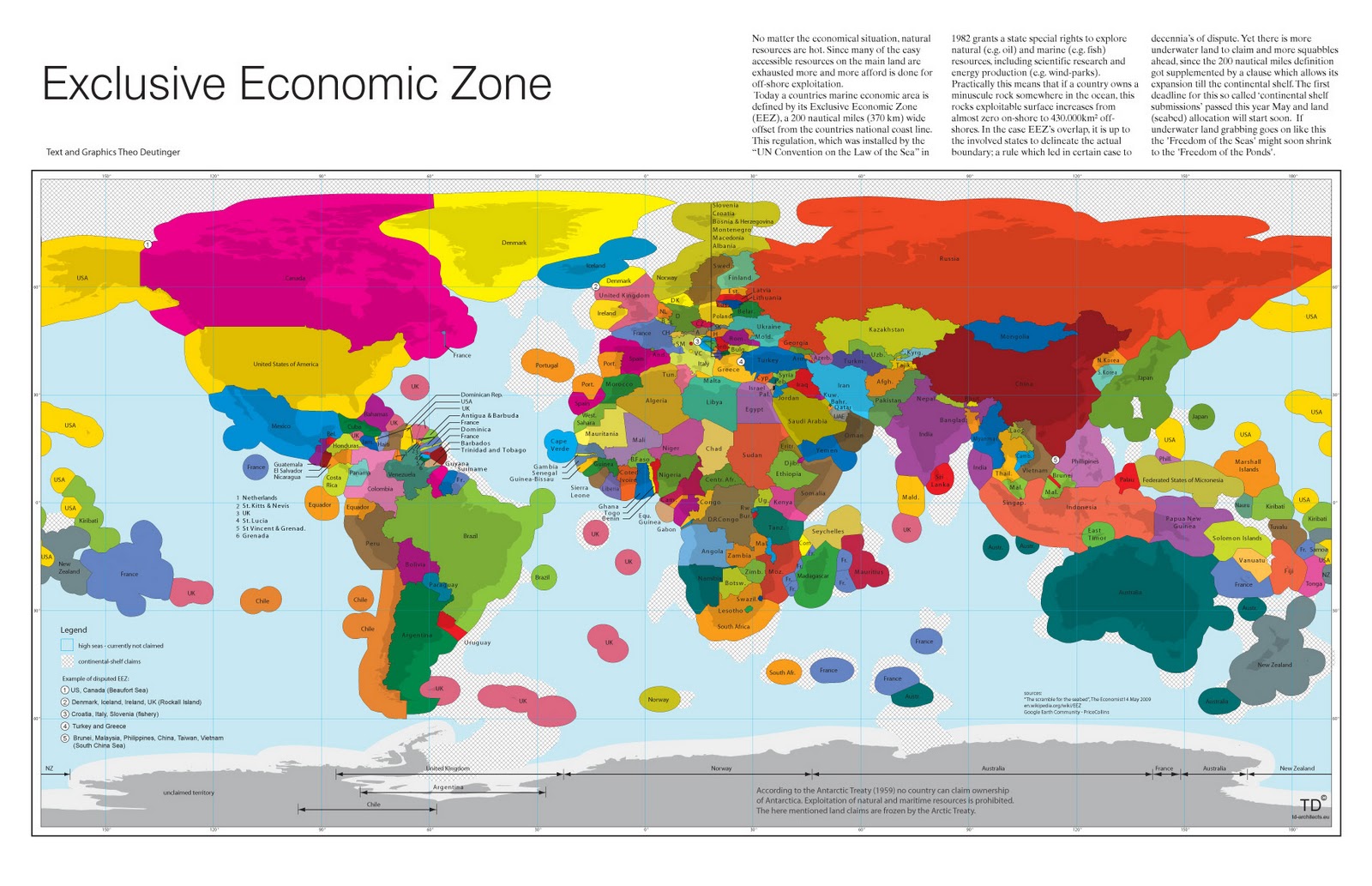
›As burgeoning populations and growing economies strain natural resource stocks around the world, countries have begun looking to more remote and difficult-to-access resources, including deep-sea oil, gas, and minerals. The UN Convention on the Law of the Sea (UNCLOS) guarantees exclusive access to these resources within 200 nautical miles of a nation’s sovereign territory – called an exclusive economic zone (EEZ). TD Architects’ “Exclusive Economic Zone” illustrates this invisible global chessboard and highlights some examples of disputed areas, such as the South China Sea, the Mediterranean, the Falkland/Malvina Islands, and the Arctic.
-
‘NATO 2020’ Recommendations Avoid “New Security” Challenges
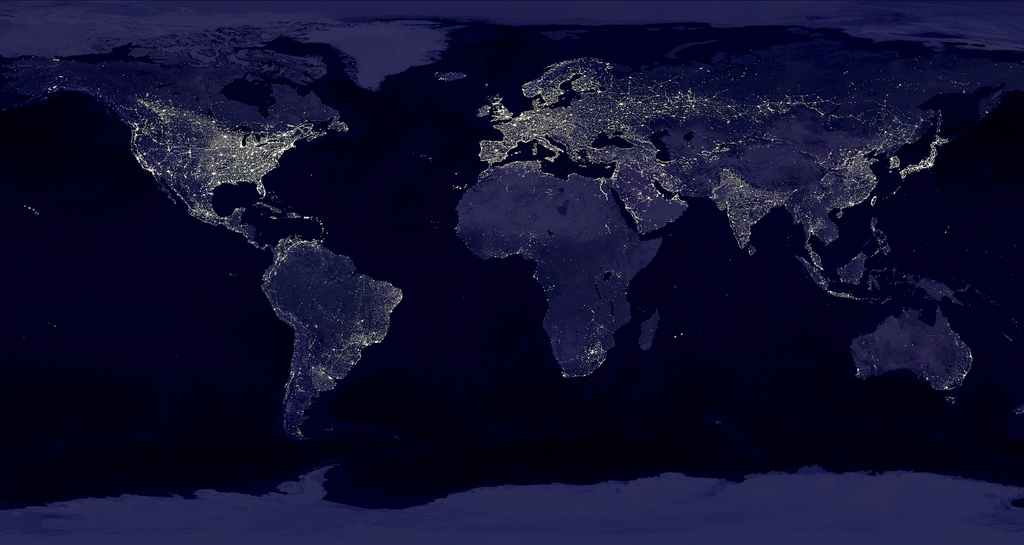
›May 25, 2010 // By Schuyler NullA recently released report, NATO 2020, outlines expert recommendations for the alliance’s new strategic concept. However, while pointing to a nighttime satellite image of the globe at a Wilson Center conference last week, Professor Peter Liotta of Salve Regina University said the report focuses too much on conventional self-defense, when most of the new security challenges of the 21st century will come from areas of the world “where the lights are out.”
In an interview with New Security Beat, Liotta criticized NATO 2020’s emphasis on what he sees as a reactive, rather than a proactive, stance. By ignoring “new security” vulnerabilities such as environmental and demographic challenges, NATO may end up creating more threats for itself down the line, he said.
The report briefly acknowledges that demographic change and environmental degradation represent sources of uncertainty in forecasting global trends. However, neither are included as major threats to the alliance. Instead, the authors say the most probable threats are nuclear or non-nuclear armed ballistic missiles, terror attacks, and cyber intrusion.
Discussions about non-traditional security vulnerabilities often produce contentious and conflicting viewpoints, which makes it easier to ignore them, said Liotta. However, it is important for NATO to realize that security threats – even more conventional ones – do not exist in isolation.
Liotta said the continued focus on NATO’s Article 5, the invocation of collective self-defense, overshadows other important foundations of the alliance. For example, Article 2, which encourages “promoting conditions of stability,” could be invoked to help the alliance address non-traditional security threats.
In his presentation, Liotta, formerly of the U.S. Naval War College, cited mass migration, water scarcity, and low probability, high-risk events, such as rapid sea-level rise from Arctic ice melt, as examples of challenges that NATO should be preparing to meet. He also drew attention to the security challenges of a burgeoning global population, saying that rapid growth and urbanization will produce 600 cities with more than one million people by 2025.
Such extreme events as the 2008 earthquake in Sichuan, China, which killed about 90,000 people and left five million homeless, might be a symptom of the strain our growing population has placed on the Earth’s natural systems, said Liotta. Scientists point out that an earthquake of such magnitude has never been seen in Sichuan and that large construction projects – particularly a large dam and reservoir that lie within 550 yards of the fault line – have likely had a considerable effect on local geology.
In Europe’s current deployment-adverse, difficult fiscal environment, it is perhaps understandable that NATO planners would focus on concrete threats rather than emerging vulnerabilities. But, as Liotta argues, the consequences for ignoring these new security challenges could be no less dire.
Sources: Daily Mail, Foreign Policy, NATO, Telegraph.
Photo Credit: “The Night Lights of Planet Earth” courtesy of flickr user woodleywonderworks.
Showing posts from category Arctic.