

-
PODCAST – A Discussion on Climate Change and Security: Arctic Links and U.S. Intelligence Community Responses
›February 24, 2009 // By Wilson Center Staff“The climate issue also very clearly illustrates the whole complexity of the security issue,” says Henrik Selin. “Arctic melting is a national security issue in the traditional national security kind of way.” In this podcast from the Environmental Change and Security Program, Selin, assistant professor of international relations at Boston University, and Stacy VanDeveer, associate professor of political science at the University of New Hampshire, sat down with ECSP Director Geoff Dabelko to discuss the resonance of climate change in the U.S. security community.
VanDeveer and Selin were in Washington to speak at a January 12 event, “Governing the Climate: Lessons From the National Conference on Climate Governance.” VanDeveer has frequently coauthored articles with Dabelko, including “It’s Capacity, Stupid: International Assistance and National Implementation” in Global Governance, “European Insecurities: Can’t Live With ’Em, Can’t Shoot ‘Em” in Security Dialogue, and “Environmental Cooperation and Regional Peace: Baltic Politics, Programs, and Prospects” in Environmental Peacemaking. -
Weekly Reading
›Conflicts among pastoralists over water and land have increased in drought-stricken northeastern Kenya, reports IRIN News.
Country for Sale, a report by Global Witness, alleges that Cambodia’s oil, gas, and mineral industries are highly corrupt.
Foreign Policy features an interview with General William “Kip” Ward, the commander of the new U.S. Africa Command. The New Security Beat covered General Ward’s recent comments on civilian-military cooperation.
Healthy Familes, Healthy Forests: Improving Human Health and Biodiversity Conservation details Conservation International’s integrated population-health-environment projects in Cambodia, Madagascar, and the Philippines.
Double Jeopardy: What the Climate Crisis Means for the Poor, a new report on climate change and poverty alleviation, synthesizes insights from an August 2008 roundtable convened by Richard C. Blum and the Brookings Institution’s Global Economy and Development Program at the Aspen Institute.
“Although the long-term implications of climate change and the retreating ice cap in the Arctic are still unclear, what is very clear is that the High North is going to require even more of the Alliance’s attention in the coming years,” said NATO Secretary General Jaap de Hoop Scheffer at a seminar on security prospects in the High North hosted by the Icelandic government in Reykjavik.
“I think we will work our way towards a position that says that having more than two children is irresponsible. It is the ghost at the table. We have all these big issues that everybody is looking at and then you don’t really hear anyone say the “p” word,” says UK Sustainable Development Commission Chair Jonathon Porrit, speaking about population’s impact on the environment. Porrit has drawn criticism for his remarks.
A local priest has warned that a Norwegian company’s proposed nickel mines will threaten food security on the Philippine island of Mindoro. -
United States Elevates Arctic to National Security Prerogative
›January 16, 2009 // By Will Rogers “The United States has broad and fundamental national security interests in the Arctic region and is prepared to operate either independently or in conjunction with other states to safeguard these interests,” states National Security Presidential Directive 66 (NSPD-66), issued by President Bush on Monday. NSPD-66 does pay some attention to “softer” Arctic issues, such as environmental protection, international scientific cooperation, and the involvement of the Arctic’s indigenous communities in decisions that affect them. But it still takes a tough stance on access to natural resources, boundary issues, and freedom of the seas/maritime transportation. With the rapid shrinking of Arctic ice caps making the region more accessible, the world is likely to see increased competition between the eight Arctic states—the United States, Canada, Denmark, Finland, Norway, Russia, and Sweden—over territorial claims and natural resources like oil and natural gas.
The opportunity to gain control over nearly a quarter of the world’s untapped oil and natural gas reserves will cause “a recalibration of geo-strategic power,” writes Scott Borgerson, visiting fellow for ocean governance at the Council on Foreign Relations, in the November 2008 issue of the Atlantic. With the world economic crisis slowing the development of alternative energy technologies, energy consumers will continue to be held hostage by volatile oil and natural gas markets, making those with control over these resources strong geopolitical players. Europe receives one-fifth of its natural gas from Russia, which has abundant reserves. And Russia has leveraged these reserves in an effort to slow the pace of former Soviet states’ accession into NATO and the EU.
Sweden and Norway recently forged a new defense relationship to address the rise of Russian power, and Finland, “also spooked by an increasingly assertive Russia,” will likely join the new Nordic defense pact. Among the pressing concerns for the Nordic alliance is to “make plans for what they call the ‘high north’, the energy-rich area that lies between Europe and the North Pole,” writes Edward Lucas in the Economist’s The World in 2009.
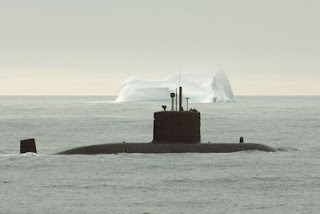
If the Nordic states gain significant control of Arctic oil and natural gas reserves, the European balance of power could shift further toward the West, a situation Russia is eager to prevent. Meanwhile, Canada, “alarmed by Russian adventurism in the Arctic,” has also strongly asserted its claims to Arctic sovereignty. “Canada has taken its sovereignty too lightly for too long,” said then-Prime Minister Stephen Harper in 2007. “This government has put a big emphasis on reinforcing, on strengthening our sovereignty in the Arctic.” Denmark, Great Britain, and Iceland, also mindful of the importance of Arctic resources, will likely stake claims to newly discovered resources. With the United States prepared to operate independently—at least according to the outgoing Bush administration—and its Arctic neighbors not likely to back away from their own interests, this once-frozen region could become a political hotspot.Photo: A Canadian naval submarine, the HMCS Corner Brook, patrols in Arctic waters as part of a Canada Command sovereignty operation in the Hudson Strait in August 2007. Courtesy of MCpl Blake Rodgers, Formation Imaging Services, Halifax, Nova Scotia, and flickr user lafrancevi.
-
Weekly Reading
›The U.S. Army’s first annual sustainability report details its environmental “bootprint.” It reveals that the Army reduced its facility energy intensity use by 8.4 percent from FY04-FY07, but increased its hazardous waste generation by 35 percent from 2003-2006. The New York Times’ Green, Inc. blog weighs in.
The Economist’s “The World in 2009” features a special section on the environment. UN Under-Secretary-General Sir John Holmes discusses the urgency of preparing for and responding to climate change-related disasters, while Peter Brabeck-Letmathe, chairman of Nestle, highlights the links between water scarcity, agriculture, and biofuels.
The Year of the Gorilla 2009, a project of the United Nations, will promote low-volume wood-burning stoves, ecotourism, anti-poaching projects, and human health care in an effort to save endangered gorillas. Gladys Kalema-Zikusoka, founder of Ugandan NGO Conservation Through Public Health (CTPH), describes CTPH’s efforts to protect mountain gorillas through human health care and family planning, community outreach and education, and support for alternative livelihoods.
“While policymakers, wedded to an outmoded worldview, fret about what Arctic climate change might do to national power directly in the basin, human wellbeing could be devastated around the world by cascading consequences of shifts in the Arctic’s energy balance,” writes Thomas Homer-Dixon in “Climate Change, the Arctic, and Canada: Avoiding Yesterday’s Analysis of Tomorrow’s Crisis.” “Ironically, these changes could – in the end – do far more damage to state-centric world order and even to states’ narrowly defined interests than any interstate conflicts we might see happen in the newly blue waters of the Arctic.”
A new paper from the Stockholm International Peace Research Institute explores the links between mining and conflict in the Democratic Republic of the Congo (DRC) and Sierra Leone.
Diamonds and Human Security: Annual Review 2008 examines the socio-political impacts of diamond extraction in 13 countries, including the DRC, Sierra Leone, Angola, and Cote d’Ivoire.
Former ECSPer and current freelance writer Ali Gharib dissects “greenocons,” arguing that “the apparent convergence of the right-wing with environmentalism, typically a politics of the left, is complex and conflicted.” -
Energizing Investors and Innovators to Think Outside the Grid
›October 2, 2008 // By Will Rogers“The issue of our time is the combination of energy security and climate change,” said former Congressman Sherwood Boehlert at “Thinking Outside the Grid: An Aggressive Approach to Climate and Energy,” a September 23, 2008, forum co-sponsored by Wilson Center On the Hill and the Environmental Change and Security Program. Boehlert noted that the energy security-climate change nexus has received more attention lately, due to record gas prices; successful advertisement campaigns like that of Texas oil magnate-turned-wind farm entrepreneur T. Boone Pickens; and bestselling books like Thomas Friedman’s Hot, Flat, and Crowded: Why We Need a Green Revolution—and How It Can Renew America.The Ice Thins and the Plot Thickens: Climate Change Impacts
Lester Brown, founder of the Earth Policy Institute, pointed to the faster-than-expected melting of Arctic ice as an indicator of the severity of the climate crisis. Last year, an ice sheet the size of the
Investing in Technology to Create a Sustainable Future
We may be able cut carbon emissions enough to prevent the Tibetan glaciers and
Brown believes we can create a sustainable energy future by increasing our investments in existing alternative technologies, including wind, solar, and geothermal projects. One of the leading generators of wind energy, Texas currently has more than 4,000 megawatts of installed wind energy capacity, enough to meet the energy needs of` more than 1 million households.
While skeptics claim it would take decades to restructure
Industry and Government: Each Must Play a Role
Melanie Kenderdine, associate director of MIT’s Energy Initiative, noted that energy companies such as BP and Shell are gradually investing more money in cleaner technologies, and that venture capitalists have also put funds into renewable alternatives. Still, Kenderdine emphasized that “the enemies of urgency are many,” so governments must exercise leadership on energy innovation. Ninety percent of the U.S. Department of Energy’s budget “is not for energy, has nothing to do with energy,” decried Kenderdine. “And if we don’t fix that, we’re not going to be able to rapidly develop the technologies and do it in the right way with the right incentives, right sequencing of investments that we need in order to deal with the climate issue—we won’t be able to accomplish it.”
-
The More Things Change…Russia Embraces Free Trade (in Nuclear Waste)
›September 29, 2008 // By Geoffrey D. DabelkoI was disappointed but not surprised to receive a recent e-mail from Wilson Center Senior Scholar Murray Feshbach, warning me off visiting
The beginning of a September 26 St. Petersburg Times article gives us a glimpse of this selective Russian embrace of free trade:Up to 10,000 tons of depleted uranium hexafluoride are expected to travel through St. Petersburg in the next six months, according to the local branch of the international environmental pressure group Bellona….According to official sources, cargos containing depleted uranium hexafluoride arrive in the city on average ten times a month…radioactivity levels near the trains have significantly exceeded the norm on several occasions over the past year.
Environmental and health issues in Russia have not always looked so dire. In the early 1990s, in the wake of the fall of the Soviet Union, two exciting developments came out of northwest Russia from two unlikely sources: the military and civil society. In one of the most militarized regions of the world, the Russian military cooperated with the Norwegian military and eventually the
Health concerns connected to nuclear waste also formed the basis of a blossoming civil society movement in early-1990s
But even by the mid-1990s, the tide was beginning to turn back to a secretive and securitized approach to environmental data. The celebrated treason case of former Russian submarine captain Aleksandr Nikitin was merely the most visible example of the recriminalization of sharing environmental data. Nikitin’s “crime” was co-authoring the 1996 Bellona Foundation report The Russian Northern Fleet: Sources of Radioactive Contamination. Following a year of imprisonment and the achievement of Amnesty International prisoner status, Nikitin was released, but his celebrated case was succeeded by the Russian government’s broad-stroke efforts to dial back environmental openness and the rights that came with it. We may be seeing the effects of this return to environmental secrecy in the current row over nuclear waste transportation through St. Petersburg.
Photo courtesy of Woodrow Wilson Center. -
Weekly Reading
›In a speech last week, National Intelligence Council Chairman Thomas Fingar hinted at the contents of Global Trends 2025, the intelligence report being prepared for the next U.S. president on future global threats. It predicts that U.S. global dominance will decline over the next several decades, as the world is buffeted by climate change and shortages of energy, water, and food. The intermediate draft of the report was reviewed this summer at a Wilson Center meeting hosted by ECSP.
U.S. Population, Energy and Climate Change, a new report by the Center for Environment & Population, explores how various aspects of U.S. population—including size and growth rate, density, per capita resource use, and composition—affect greenhouse gas emissions.
An extensive Congressional Research Service report compares U.S. and Chinese approaches to diplomacy, foreign aid, trade, and investment in developing countries. “China’s influence and image have been bolstered through its increasingly open and sophisticated diplomatic corps as well as through prominent PRC-funded infrastructure, public works, and economic investment projects in many developing countries,” write the authors.
ICLEI-Europe has released a set of reports designed to help local governments reap the benefits of integrated water resources management. Available in English, Portuguese, and French, the reports are geared toward southern African countries.
“The potential is there with undetermined boundaries and great wealth for conflict, or competition” in the Arctic, says Rear Admiral Gene Brooks, who is in charge of the U.S. Coast Guard’s Alaska region.
Negussie Teffera, former head of Ethiopia’s Office of Population, and Bill Ryerson of the Population Media Center (PMC) discussed PMC’s extraordinarily successful radio soap operas last week on the Canadian Broadcasting Corporation’s program “The Current.” -
Changes Wrought By Melting Arctic Demand U.S. Leadership, Argues Expert
›April 8, 2008 // By Sonia Schmanski“Washington must awaken to the broader economic and security implications of climate change,” writes Scott G. Borgerson, an international affairs fellow at the Council on Foreign Relations and a former lieutenant commander in the U.S. Coast Guard, in an article in the latest issue of Foreign Affairs that explores the consequences of a melting Arctic. “Being green,” emphasizes Borgerson, “is no longer a slogan just for Greenpeace supporters and campus activists; foreign policy hawks must also view the environment as part of the national security calculus.”
Borgerson outlines a mixed bag of sometimes-dramatic changes with important environmental and security implications for the United States. There will be damaging consequences for the fragile Arctic ecosystem, where polar bears are becoming increasingly endangered and fish have been appearing much farther north than ever before. Conversely, the huge new swaths of water now open to shipping and naval vessels will cut the distance between Rotterdam and Yokohama by 40 percent, and between Rotterdam and Seattle by 20 percent, significantly reducing ships’ fuel needs. Ships will also find it easier to avoid potentially unstable waters around the South China Sea and the Middle East (recall the Strait of Hormuz confrontation in January of this year).
During the last 23 years, 41 percent of the Artic’s multi-year ice has melted, and the American Geophysical Union predicts the first ice-free Arctic summer will occur in 2013. Russia’s behavior last summer indicates that it is keenly aware of the new ocean territory being uncovered; there could be as much as 586 billion barrels of oil in the territory it will seek to claim under the UN Convention on the Law of the Sea (UNCLOS). And Russia is not the only country poised to lay claim to the newly available Arctic sea; Norway, Denmark, and Canada have also petitioned the UN Commission on the Limits of the Continental Shelf for additional Arctic territory. Additionally, because Greenland’s recent farming boom could only be helped by a warming climate, Borgerson believes the country might be emboldened to petition Denmark for independence.
The United States has remained largely on the periphery of these issues, last issuing an executive statement in 1994. Borgerson writes that “the combination of new shipping routes, trillions of dollars in possible oil and gas resources, and a poorly defined picture of state ownership makes for a toxic brew.” The situation is especially unstable because it is not progressing within a single, clearly defined international legal framework. UNCLOS cannot be easily applied to the Arctic because of the region’s unique geography and a host of other complexities—the world’s longest and most geographically complicated continental shelf, legally defining the “Northwest Passage,” competing claims to the territory—working to confuse the situation. In addition, it deals exclusively with territory and does not address the many other ramifications of a warming Arctic. Furthermore, the United States prohibited the 1996 Arctic Council from addressing security concerns, so it is unavailable to deal with many of the burgeoning questions.
Borgerson calls for more robust U.S. involvement in shaping the future of this important territory, recalling the successful 1817 Rush-Bagot Agreement between Canada and the United States that demilitarized the Great Lakes and eventually formed the St. Lawrence Seaway Development Corporation to manage the area. He also argues that because the United States and Canada jointly administer the North American Aerospace Defense Council (NORAD), they should be “perfectly capable of doing the same on the Arctic frontier.” Eventually, they could include other states in this management, especially Russia. “Self-preservation in the face of massive climate change,” writes Borgerson, “requires an enlightened, humble, and strategic response.”
Showing posts from category Arctic.
 “The United States has broad and fundamental national security interests in the Arctic region and is prepared to operate either independently or in conjunction with other states to safeguard these interests,” states
  I was disappointed but not surprised to receive a recent e-mail from Wilson Center Senior Scholar

