-
Can China Help Indonesia Shift Gears on Electric Two-wheelers?
January 29, 2026 By Nayan Seth
Indonesia produces more than half of the world’s nickel output – a critical component in batteries for four- and two-wheel electric vehicles (EVs). Mostly Chinese-owned smelters work around the clock in Sulawesi to process the nickel ore and ship it across the globe. Indonesia’s resource nationalism – the government policy banning ore exports and forcing domestic processing appears to have worked well – but only in the upstream segment of the supply chains.
As Indonesia powers a cleaner future abroad, the benefits of a two-wheeled EV revolution have yet to materialize in the nickel-processing heartland.
While four-wheeler EVs continue to make impressive gains, the electric adoption in Indonesia’s two-wheeler market, the backbone of the country’s passenger transport, continues to struggle.
The government’s ambitious push to electrify two-wheelers provided a crucial early boost has not been matched by consistent long-term policy support. Repeated shifts in subsidies have created uncertainty, weakening investor and manufacturer confidence for EV motorcycles and scooters.
Sustaining policy incentives, along with promoting local partnerships with innovative Chinese and other foreign manufacturers, could unlock the full potential of electric two-wheeler manufacturing in Indonesia.
Two-wheelers Own the Roads
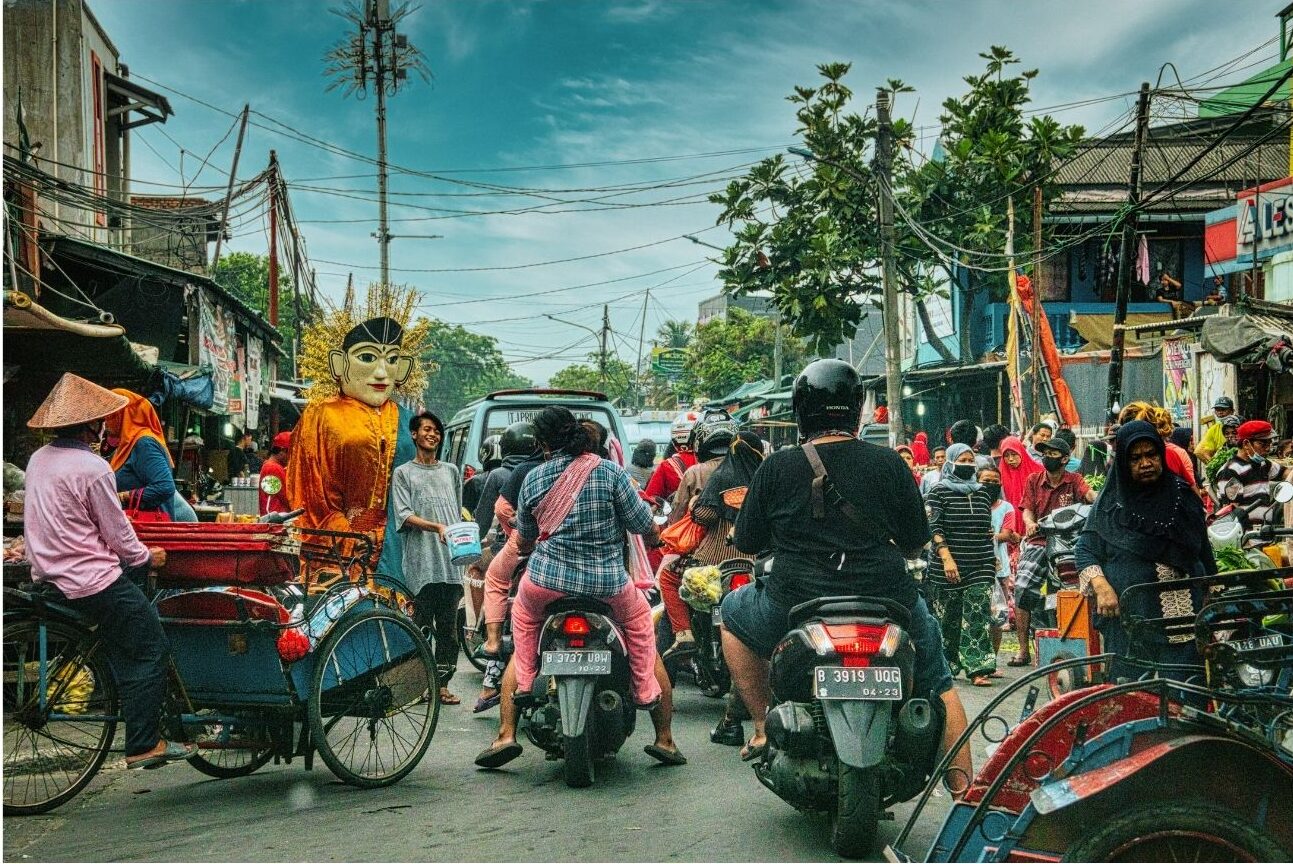
After China and India, Indonesia is the world’s third-largest two-wheeler market. With a population of 280 million, there are over 126 million motorcycles and scooters, making up more than 80% of all vehicles on the country’s roads.
In 2024, six million internal combustion engine (ICE) two-wheelers were sold in the Southeast Asian country, with electric motorcycles surpassing 100,000 units for the first time but only making up 1 percent of total annual sales.
Japanese companies like Yamaha, Honda and Suzuki dominate Indonesia’s ICE motorcycle market, while multiple local, Chinese and Taiwanese firms compete fiercely in the crowded electric two-wheeler space.
According to data by the International Council on Clean Transportation (ICCT), in 2024, there were 59 factories churning out over 65 electric two-wheeler models in Indonesia, with total production capacity exceeding sales volume by more than tenfold. These factories notably rely on mostly Chinese suppliers to import many components and batteries for electric two-wheelers.
Start. Stop. Restart Two-Wheeler Policies
The fortunes of Indonesia’s electric two-wheelers faced a bumpy path with unpredictable government support.
In 2022, under the leadership of President Joko Widodo, the government announced a series of subsidies, tax breaks and infrastructure investments to both convert existing ICE two-wheelers into electric and promote the sale of new electric motorcycles.
The government set a lofty goal: 13 million units by 2030 while promising to spend $430 million to usher in a cleaner transportation future. It laid out a target of 60% domestic production for electric two-wheelers by 2026 and 80% by 2029. The government also formed partnerships with Chinese and Korean companies to build local motorcycle battery supply chains.
Starting from close to zero in 2020, the electric two-wheeler market grew exponentially, tripling sales in 2023 to over 60,000 units and nearly doubling again in 2024. Ride-hailing service providers like Gojek and Grab have played a significant role in electric two-wheeler expansion.
It seemed that nothing could stop the electric two-wheeler dream run. But after the new President’s decision in 2024 to pull the plug on two-wheeler subsidies, “the share of the sales literally dropped. The new administration has a different agenda. They are not as eager as the previous administration,” said Tenny Kristiana from the ICCT in Indonesia.
Only 12,000 units of electric motorcycles were sold in the first half of 2025, a 50% drop from the previous year. Sales of e-scooters also plunged by 28%.
Despite repeated pleas by a once-booming two-wheeler industry, Indonesian authorities have remained noncommittal on resuming state support due to sweeping budget cuts.
However, government inaction is only part of the picture. The market also faces structural challenges, including lack of common standards for batteries, an oversupply of low-quality motorcycles, absence of after-sales maintenance services, and long-standing consumer preferences for fuel-powered vehicles.
Chinese two-wheeler manufacturers, already making inroads in the Indonesian market, could leverage their global leadership and experience to support local capacity building efforts and help resolve persistent bottlenecks to position Indonesia as a key hub for production and regional market expansion.
Chinese Two-wheeler Manufacturers in Indonesia
China continues to lead the world in the global electric two-wheeler market, accounting for around 73% of the total sales.
Technologically superior Chinese firms also enjoy highly integrated supply chains spanning components, battery systems, and final assembly. That industrial depth gives them a competitive edge as they continue to expand abroad through direct exports and localized production centers.
Leading them is Yadea, the world’s largest electric two-wheeler manufacturer by volume, selling over 6 million units in more than 80 countries in 2024. The company has invested in setting up overseas factories in Mexico, Brazil, Vietnam and Indonesia.
Yadea is betting big on Southeast Asia as it expects the region to be the company’s biggest export market.
In 2024, the company began constructing a $150 million R&D facility in Karawang, Indonesia, which is expected to open in 2026. It will become Yadea’s largest facility in Southeast Asia with a projected capacity of 3 million units. According to the firm, the factory “will not only cater to the domestic market but also export products to neighboring countries.”
Before Yadea, China-based Sunra Group also announced plans to open an electric motorcycle factory with an investment of $120 million, aiming to produce one million units every year.
Apart from creating localized supply chains in midstream battery and component manufacturing, Chinese firms could also help ease one of the pressing challenges in Indonesia’s two-wheeler market – battery swapping.
Local firms dominate the space but operate independently with no common battery standards.
Tenny Kristiana of the ICCT explained the problem. “Battery swapping is only tied to a brand. So, if you have a brand, you need to go to that company’s battery swapping outlet. You cannot just swap any battery because it’s tied to the brand,” she emphasised.
Kristiana added while the government has attempted to build a consensus, it has faced pushback from the private sector focused on protecting their “own exclusive brand.”
Chinese firms’ expertise in creating local battery swapping infrastructure and experience navigating technical standard regulations could be leveraged to support Indonesia’s still-nascent market.
As a nickel powerhouse with a vast domestic two-wheeler market, Indonesia is uniquely positioned to ride the clean-tech wave through strategic local and international collaboration. To get there, policymakers must ensure the road ahead is smooth, predictable, and free of avoidable bumps.
Nayan Seth is a Washington, D.C.-based policy research analyst and a multimedia journalist with previous professional experience in China and India. He has worked as a reporter for Voice of America and as Washington correspondent for Indo-Asian News Service, covering the Asia-Pacific region.
Source: ICCT, JICA, McD, Nikkei Asia, Rest of World, Reuters, Transportation Research Interdisciplinary Perspectives, Tycorun, Xinhua, Yadea
Photo Credits: Traffic jam on a side street in Jakarta, photo courtesy of Tom Fisk, modified from Canva Pro.
 A Publication of the Stimson Center.