
-
Sandra Ruckstuhl on Capturing Practical Lessons on Water, Conflict, and Cooperation
 We realized “there was a need for a toolkit on water,” says Sandra Ruckstuhl in this week’s Water Stories podcast, “with a focus of conflict and conflict mitigation, but also peacebuilding.” Ruckstuhl, a consultant for the World Bank who has researched water programs in Yemen and the Middle East, helped the Wilson Center produce USAID’s Water and Conflict toolkit, which documents examples of successful development interventions focused on water and peacebuilding.
We realized “there was a need for a toolkit on water,” says Sandra Ruckstuhl in this week’s Water Stories podcast, “with a focus of conflict and conflict mitigation, but also peacebuilding.” Ruckstuhl, a consultant for the World Bank who has researched water programs in Yemen and the Middle East, helped the Wilson Center produce USAID’s Water and Conflict toolkit, which documents examples of successful development interventions focused on water and peacebuilding.
“We have lots of assumed peaceful outcomes from projects, but very little of it has been measured and documented,” says Ruckstuhl. “We would do a real service to the field if we really started documenting and measuring this kind of information so we can inform better and better practice in this area.”
Ruskstuhl and her team worked to ensure that the toolkit could be used by practitioners without professional training or formal education in conflict studies. “When we are talking about peacebuilding,” Ruckstuhl says, “we are boiling it down to collaborative governance—and that also is transferrable to different sectors.”
“When we are designing and implementing some development investment, we’re injecting ourselves into a system,” in which water management, health, food, and other public services are interconnected. Ruckstuhl calls for more incentives that would push practitioners to foster cross-sector connections, which would allow different sectors to work together more collaboratively.
Project designers must consider all the stakeholders involved, including governance institutions, which in many circumstances are dominated by men. “The constructive role women can play in the household, in these governance institutions, in the decision-making for things like water allocation…that knowledge and that capacity of women can be missed,” says Ruckstuhl. Integrating gender concerns more effectively would contribute to more equitable water management, so she proposes educating communities on the value of including women in projects focused on water and conflict.
The interview was originally recorded in October 2016.
Sources: US Agency for International Development
Friday Podcasts are also available for download on iTunes and Google Podcasts.
 A Publication of the Stimson Center.
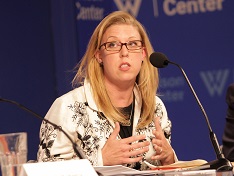 We realized “there was a need for a toolkit on water,” says Sandra Ruckstuhl in this week’s Water Stories podcast, “with a focus of conflict and conflict mitigation, but also peacebuilding.” Ruckstuhl, a consultant for the World Bank who has researched water programs in

