• woodrow wilson center
  • ecsp

New Security Beat

Subscribe:
  • rss
  • mail-to
  • Who We Are
  • Topics
    • Population
    • Environment
    • Security
    • Health
    • Development
  • Columns
    • China Environment Forum
    • Choke Point
    • Dot-Mom
    • Friday Podcasts
    • Navigating the Poles
    • Reading Radar
  • Multimedia
    • Water Stories (Podcast Series)
    • Backdraft (Podcast Series)
    • Tracking the Energy Titans (Interactive)
  • Films
    • Water, Conflict, and Peacebuilding (Animated Short)
    • Paving the Way (Ethiopia)
    • Broken Landscape (India)
    • Scaling the Mountain (Nepal)
    • Healthy People, Healthy Environment (Tanzania)
  • Publications
  • Events
  • Contact Us

NewSecurityBeat

The blog of the Wilson Center's Environmental Change and Security Program
  • Lisa Palmer, Yale Environment 360

    Will Indonesian Fires Spark Reform of Rogue Forest Sector?

    November 11, 2015 By Wilson Center Staff
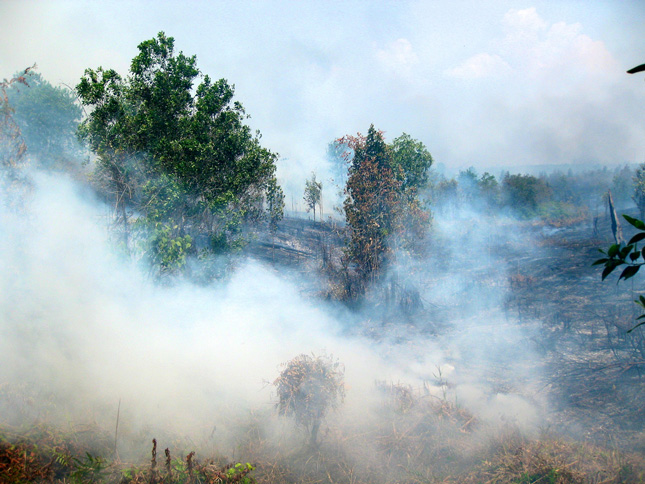
    Indonesia-fires

    The original version of this article, by Lisa Palmer, appeared on Yale Environment 360.

    The fires that blazed in Indonesia’s rainforests in 1982 and 1983 came as a shock. The logging industry had embarked on a decades-long pillaging of the country’s woodlands, opening up the canopy and drying out the carbon-rich peat soils. Preceded by an unusually long El Niño-related dry season, the forest fires lasted for months, sending vast clouds of smoke across Southeast Asia.

    Fifteen years later, in 1997 and 1998, a record El Niño year coincided with continued massive land-use changes in Indonesia, including the wholesale draining of peatlands to plant oil palm and wood pulp plantations. Large areas of Borneo and Sumatra burned, and again Southeast Asians choked on Indonesian smoke.

    In the ensuing years, Indonesia’s peat and forest fires have become an annual summer occurrence. But this summer and fall, a huge number of conflagrations have broken out as a strong El Niño has led to dry conditions, and deforestation has continued to soar in Indonesia. Over the past several months, roughly 120,000 fires have burned, eliciting sharp protests from Singapore and other nations fed up with breathing the noxious haze from Indonesian blazes.

    The pall of smoke still drifting over Southeast Asia is the most visible manifestation of decades of disastrous policies in Indonesia’s corrupt forestry and palm oil sectors. Indonesia’s runaway deforestation and draining of peatlands has become a matter of serious concern not only to its neighbors, but also to the global community. In recent years, the country’s land-use changes have made Indonesia the world’s sixth-largest emitter of greenhouse gases, and this year’s fires are likely to propel the country into the top five, behind China, the United States, the European Union, and India. On some days last month, carbon emissions from Indonesia’s peat and forest fires equaled the daily emissions of the entire U.S. economy.

    Continue reading on Yale Environment 360.

    Sources: Yale Environment 360.

    Photo Credit: Forest fire in Central Kalimantan, Indonesia, September 2011, courtesy of Rini Sulaiman/Center for International Forestry Research.

    Topics: Brazil, climate change, conservation, democracy and governance, development, economics, environment, environmental health, forests, Indonesia, international environmental governance, mitigation, natural resources, Singapore, South Asia

Join the Conversation

  • RSS
  • subscribe
  • facebook
  • G+
  • twitter
  • iTunes
  • podomatic
  • youtube
Tweets by NewSecurityBeat

Trending Stories

  • unfccclogo1
  • Pop at COP: Population and Family Planning at the UN Climate Negotiations

Featured Media

Backdraft Podcast

play Backdraft
Podcasts

More »

What You're Saying

  • Volunteers,At,The,Lagos,Food,Bank,Initiative,Outreach,To,Ikotun, Pan-African Response to COVID-19: New Forms of Environmental Peacebuilding Emerge
    Rashida Salifu: Great piece 👍🏾 Africa as a continent has suffered this unfortunate pandemic.But it has also...
  • A desert road near Kuqa An Unholy Trinity: Xinjiang’s Unhealthy Relationship With Coal, Water, and the Quest for Development
    Ismail: It is more historically accurate to refer to Xinjiang as East Turkistan.
  • shutterstock_1779654803 Leverage COVID-19 Data Collection Networks for Environmental Peacebuilding
    Carsten Pran: Thanks for reading! It will be interesting to see how society adapts to droves of new information in...

Related Stories

No related stories.

  • woodrow
  • ecsp
  • RSS Feed
  • YouTube
  • Twitter
  • Facebook
  • Home
  • Who We Are
  • Publications
  • Events
  • Wilson Center
  • Contact Us
  • Print Friendly Page

© Copyright 2007-2021. Environmental Change and Security Program.

Woodrow Wilson International Center for Scholars. All rights reserved.

Developed by Vico Rock Media

Environmental Change and Security Program

Woodrow Wilson International Center for Scholars

Ronald Reagan Building and International Trade Center

  • One Woodrow Wilson Plaza
  • 1300 Pennsylvania Ave., NW
  • Washington, DC 20004-3027

T 202-691-4000
