• woodrow wilson center
  • ecsp

New Security Beat

Subscribe:
  • rss
  • mail-to
  • Who We Are
  • Topics
    • Population
    • Environment
    • Security
    • Health
    • Development
  • Columns
    • China Environment Forum
    • Choke Point
    • Dot-Mom
    • Friday Podcasts
    • Navigating the Poles
    • Reading Radar
  • Multimedia
    • Water Stories (Podcast Series)
    • Backdraft (Podcast Series)
    • Tracking the Energy Titans (Interactive)
  • Films
    • Water, Conflict, and Peacebuilding (Animated Short)
    • Paving the Way (Ethiopia)
    • Broken Landscape (India)
    • Scaling the Mountain (Nepal)
    • Healthy People, Healthy Environment (Tanzania)
  • Publications
  • Events
  • Contact Us

NewSecurityBeat

The blog of the Wilson Center's Environmental Change and Security Program
  • Mike Ives, Yale Environment 360

    Vietnam’s Rice Boom Has Steep Environmental Costs for Mekong Delta

    July 17, 2013 By Wilson Center Staff
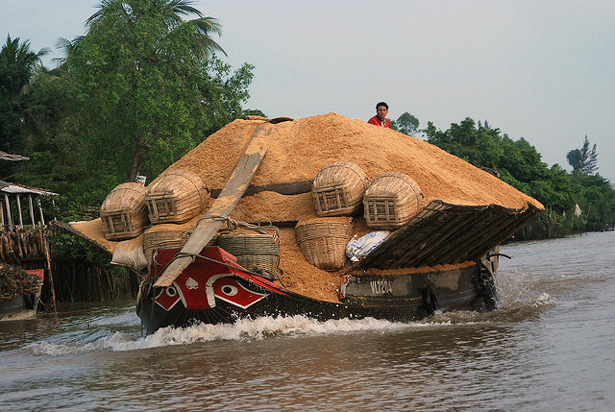
    Rice husks on the Mekong River, Vietnam

    The original version of this article, by Mike Ives, appeared on Yale Environment 360.

    Phan Dinh Duc leans against yellow sacks of freshly harvested rice. It’s a warm spring evening in Vietnam’s Mekong Delta, and Duc, a local farmer, is waiting for traders to arrive by truck to purchase his produce and sell it on commodities markets. Beyond him lies a vast checkerboard of rice paddies, each filled with water and bordered by a network of canals and roughly 10-foot-high earthen dikes. They enable year-round rice cultivation in an area where, a half century ago, vast floodplains typically lay fallow for half the year and farmers planted one annual rice crop that grew in tandem with seasonal floods.

    Here in the southern province of An Giang, a stronghold of Vietnam’s booming rice industry, yields have increased fourfold in the last four decades. The initial surge occurred thanks to the development of high-yielding rice varieties and the construction of so-called “August dikes,” which extended the end of the rice-growing season from June to August and enabled farmers to plant a second annual crop. Larger dikes built in the 1990s and early 2000s allowed farmers like Duc to plant a third crop on the same acreage. Within a generation, Vietnam has gone from a poor country where the government rationed rice and other staples, to a lower middle-income one that is now among the world’s top rice producers.

    But scientists say that the ongoing construction of dikes and irrigation infrastructure across the Mekong Delta and along the country’s South China Sea coastline has disrupted the river delta’s complex ecological systems. In upstream areas, for example, high dikes block the natural flood pulse and deprive downstream floodplain farms and fisheries of key nutrients. Agricultural chemicals also pollute irrigation canals and cause water and soil to acidify, which scientists say has contributed to a decline in fish populations and a general loss of biodiversity.

    Continue reading on Yale Environment 360.

    Sources: World Delta Dialogues.

    Photo Credit: Rice fluff on the Mekong, courtesy of flickr user Mor.

    Topics: agriculture, Asia, biodiversity, climate change, development, economics, environment, environmental health, flooding, food security, natural resources, population, Vietnam, water

Join the Conversation

  • RSS
  • subscribe
  • facebook
  • G+
  • twitter
  • iTunes
  • podomatic
  • youtube
Tweets by NewSecurityBeat

Trending Stories

  • unfccclogo1
  • Pop at COP: Population and Family Planning at the UN Climate Negotiations

Featured Media

Backdraft Podcast

play Backdraft
Podcasts

More »

What You're Saying

  • Volunteers,At,The,Lagos,Food,Bank,Initiative,Outreach,To,Ikotun, Pan-African Response to COVID-19: New Forms of Environmental Peacebuilding Emerge
    Rashida Salifu: Great piece 👍🏾 Africa as a continent has suffered this unfortunate pandemic.But it has also...
  • A desert road near Kuqa An Unholy Trinity: Xinjiang’s Unhealthy Relationship With Coal, Water, and the Quest for Development
    Ismail: It is more historically accurate to refer to Xinjiang as East Turkistan.
  • shutterstock_1779654803 Leverage COVID-19 Data Collection Networks for Environmental Peacebuilding
    Carsten Pran: Thanks for reading! It will be interesting to see how society adapts to droves of new information in...

Related Stories

No related stories.

  • woodrow
  • ecsp
  • RSS Feed
  • YouTube
  • Twitter
  • Facebook
  • Home
  • Who We Are
  • Publications
  • Events
  • Wilson Center
  • Contact Us
  • Print Friendly Page

© Copyright 2007-2021. Environmental Change and Security Program.

Woodrow Wilson International Center for Scholars. All rights reserved.

Developed by Vico Rock Media

Environmental Change and Security Program

Woodrow Wilson International Center for Scholars

Ronald Reagan Building and International Trade Center

  • One Woodrow Wilson Plaza
  • 1300 Pennsylvania Ave., NW
  • Washington, DC 20004-3027

T 202-691-4000
