• woodrow wilson center
  • ecsp

New Security Beat

Subscribe:
  • rss
  • mail-to
  • Who We Are
  • Topics
    • Population
    • Environment
    • Security
    • Health
    • Development
  • Columns
    • China Environment Forum
    • Choke Point
    • Dot-Mom
    • Friday Podcasts
    • Navigating the Poles
    • Reading Radar
  • Multimedia
    • Water Stories (Podcast Series)
    • Backdraft (Podcast Series)
    • Tracking the Energy Titans (Interactive)
  • Films
    • Water, Conflict, and Peacebuilding (Animated Short)
    • Paving the Way (Ethiopia)
    • Broken Landscape (India)
    • Scaling the Mountain (Nepal)
    • Healthy People, Healthy Environment (Tanzania)
  • Publications
  • Events
  • Contact Us

NewSecurityBeat

The blog of the Wilson Center's Environmental Change and Security Program
  • Choke Point

    Keith Schneider, Circle of Blue

    Double Choke Point: Demand for Energy Tests Water Supply and Economic Stability in China and the U.S.

    July 7, 2011 By Wilson Center Staff
    The original version of this article, by Keith Schneider, appeared on Circle of Blue.

    The coal mines of Inner Mongolia, China, and the oil and gas fields of the northern Great Plains in the United States are separated by 11,200 kilometers (7,000 miles) of ocean and 5,600 kilometers (3,500 miles) of land.

    But, in form and function, the two fossil fuel development zones – the newest and largest in both nations – are illustrations of the escalating clash between energy demand and freshwater supplies that confront the stability of the world’s two biggest economies. How each nation responds will profoundly influence energy prices, food production, and economic security not only in their domestic markets, but also across the globe.

    Both energy zones require enormous quantities of water – to mine, process, and use coal; to drill, fracture, and release oil and natural gas from deep layers of shale. Both zones also occur in some of the driest regions in China and the United States. And both zones reflect national priorities on fossil fuel production that are causing prodigious damage to the environment and putting enormous upward pressure on energy prices and inflation in China and the United States, say economists and scholars.

    “To what degree is China taking into account the rising cost of energy as a factor in rising overall prices in their economy?” David Fridley said in an interview with Circle of Blue. Fridley is a staff scientist in the China Energy Group at Lawrence Berkeley National Laboratory in California. “What level of aggregate energy cost increases can China sustain before they tip over?”

    “That’s where China’s next decade is heading – accommodating rising energy costs,” he added. “We’re already there in the United States. In 13 months, we’ll be fully in recession in this country; 9 percent of our GDP is energy costs. That’s higher than it’s been. When energy costs reach eight to nine percent of GDP, as they have in 2011, the economy is pushed into recession within a year.”

    Continue reading on Circle of Blue.

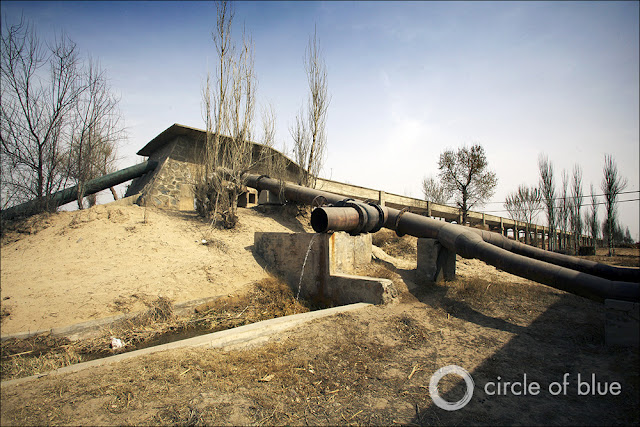
    Photo Credit: Used with permission, courtesy of J. Carl Ganter/Circle of Blue. In Ningxia Province, one of China’s largest coal producers, supplies of water to farmers have been cut 30 percent since 2008.
    Topics: China, Choke Point, coal, economics, energy, environment, environmental health, natural resources, U.S., water

Join the Conversation

  • RSS
  • subscribe
  • facebook
  • G+
  • twitter
  • iTunes
  • podomatic
  • youtube
Tweets by NewSecurityBeat

Trending Stories

  • unfccclogo1
  • Pop at COP: Population and Family Planning at the UN Climate Negotiations

Featured Media

Backdraft Podcast

play Backdraft
Podcasts

More »

What You're Saying

  • Volunteers,At,The,Lagos,Food,Bank,Initiative,Outreach,To,Ikotun, Pan-African Response to COVID-19: New Forms of Environmental Peacebuilding Emerge
    Rashida Salifu: Great piece 👍🏾 Africa as a continent has suffered this unfortunate pandemic.But it has also...
  • A desert road near Kuqa An Unholy Trinity: Xinjiang’s Unhealthy Relationship With Coal, Water, and the Quest for Development
    Ismail: It is more historically accurate to refer to Xinjiang as East Turkistan.
  • shutterstock_1779654803 Leverage COVID-19 Data Collection Networks for Environmental Peacebuilding
    Carsten Pran: Thanks for reading! It will be interesting to see how society adapts to droves of new information in...

Related Stories

No related stories.

  • woodrow
  • ecsp
  • RSS Feed
  • YouTube
  • Twitter
  • Facebook
  • Home
  • Who We Are
  • Publications
  • Events
  • Wilson Center
  • Contact Us
  • Print Friendly Page

© Copyright 2007-2021. Environmental Change and Security Program.

Woodrow Wilson International Center for Scholars. All rights reserved.

Developed by Vico Rock Media

Environmental Change and Security Program

Woodrow Wilson International Center for Scholars

Ronald Reagan Building and International Trade Center

  • One Woodrow Wilson Plaza
  • 1300 Pennsylvania Ave., NW
  • Washington, DC 20004-3027

T 202-691-4000