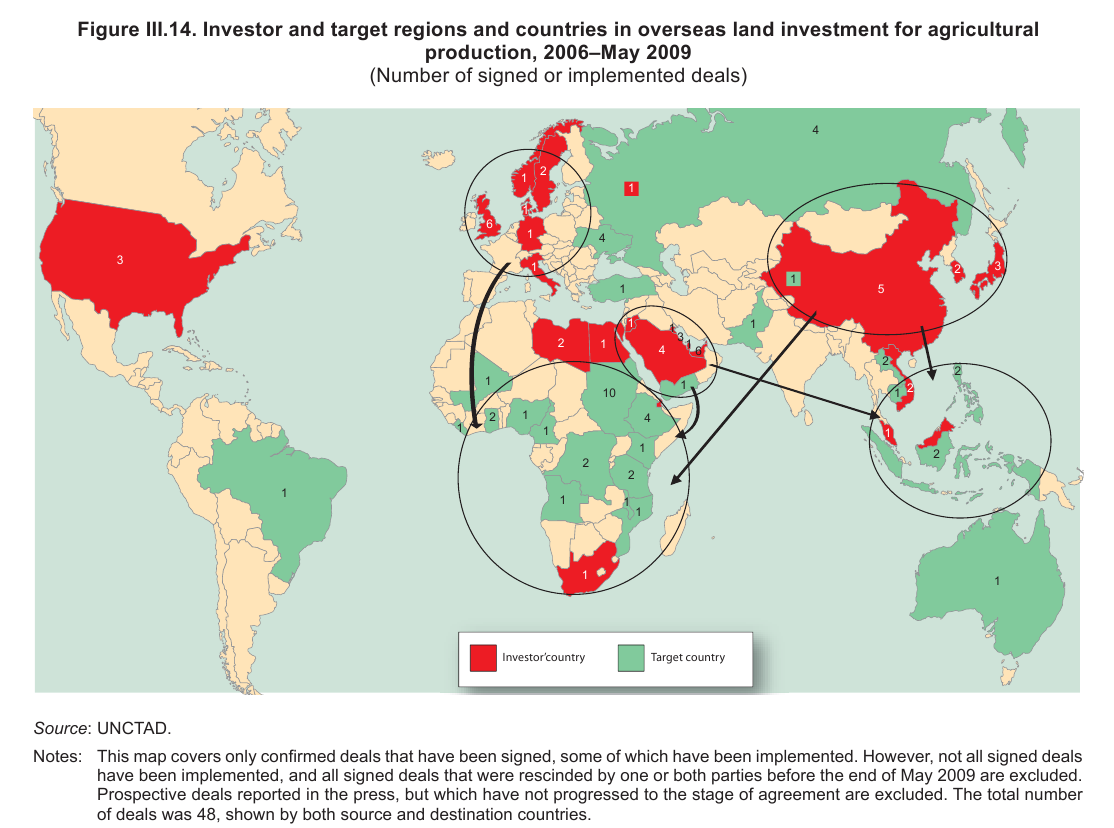
Over the past few years, wealthy countries with shrinking stores of natural resources and relatively large populations (such as China, India, South Korea, and the Gulf states) have quietly purchased huge parcels of fertile farmland in Africa, South America, and South Asia to grow food for export to the parent country. With staple food prices
shooting up and food security projected to
worsen in the decades ahead, it is little wonder that countries are looking abroad to secure future resources. But the question arises: Are these “land grabs” really about the food — or, more accurately, are they “water grabs”?
The Great Water Grab
With growing urban populations, an expanding middle class, and increasingly scarce arable land resources, some governments and investors are snapping up the world’s farmland. Some observers, however, have pointed out that these dealmakers might be more interested in the water than the land.
In an article from The Economist in 2009, Peter Brabeck-Letmathe, the chairman of Nestlé, claimed that “the purchases weren’t about land, but water. For with the land comes the right to withdraw the water linked to it, in most countries essentially a freebie that increasingly could be the most valuable part of the deal.”
Consider some of the largest investors in foreign land: China has a history of severe droughts (and recently, increasingly poor water quality); the Gulf nations of Saudi Arabia, Kuwait, Qatar, and Bahrain are among the world’s most water-stressed countries; and India’s groundwater stocks are rapidly depleting.
A recent report from the World Bank on global land deals highlighted the effect water scarcity is having on food production in China, South Asia, the Middle East, and North Africa, stating that “in contrast, Sub-Saharan Africa and Latin America have large untapped water resources for agriculture.”
Keeping Engaged and Informed
“The water impacts of any investment in any land deal should be made explicit,” said Phil Woodhouse of the University of Manchester during the recent International Conference on Global Land Grabbing, as reported by the New Agriculturist. “Some kind of mechanism is needed to bring existing water users into an engagement on any deals done on water use.”
At the same conference, Shalmali Guttal of Focus on the Global South cautioned, “Those who are taking the land will also take the water resources, the forests, wetlands, all the wild indigenous plants and biodiversity. Many communities want investments but none of them sign up for losing their ecosystems.”
With demand for water expected to outstrip supply by 40 percent within the next 20 years, water as the primary motivation behind the rush for foreign farmland is a factor worth further exploration.
Global Farming
According to a report from the Oakland Institute, nearly 60 million hectares (ha) of African farmland – roughly the size of France – were purchased or leased in 2009. With these massive land deals come promises of jobs, technology, infrastructure, and increased tax revenue.
In 2008 South Korean industrial giant Daewoo Logistics negotiated one of the biggest African farmland deals with a 99-year lease on 1.3 million ha of farmland in Madagascar for palm oil and corn production. The deal amounted to nearly half of Madagascar’s arable land – an especially staggering figure given that nearly a third of Madagascar’s GDP comes from agriculture and more than 70 percent of its population lives below the poverty line. When details of the deal came to light, massive protests ensued and it was eventually scrapped after president Marc Ravalomanana was ousted from power in a 2009 coup.
While perhaps an extreme example, the Daewoo/Madagascar deal nonetheless demonstrates the conflict potential of these massive land deals, which are taking place in some of the poorest and hungriest countries in the world. In 2009, while Saudi Arabia was receiving its first shipment of rice grown on farmland it owned in Ethiopia, the World Food Program provided food aid to five million Ethiopians.
Other notable deals include China’s recent acquisition of 320,000 ha in Argentina for soybean and corn cultivation – a project which is expected to bring in $20 million in irrigation infrastructure, the Guardian reports – and a Saudi Arabian company which has plans to invest $2.5 billion and employ 10,000 people in Ethiopia by 2020, according to Gambella Star News.
But governments in search of cheap food aren’t the only ones interested in obtaining a piece of the world’s breadbasket: Individual investors are also heavily involved, and the Guardian reports that U.S. universities and European pension funds are buying and leasing land in Africa as well.
The Future of Land and Water
Whatever the benefits or pitfalls, large-scale land deals around the world look set to continue. The world is projected to have 7 billion mouths to feed by the end of this year and possibly 10 billion plus by the end of the century.
Currently, agriculture uses 11 percent of the world’s land surface and 70 percent of the world’s freshwater resources, according to UNESCO. If and when the going gets tough, how will the global agricultural system respond? Whose needs come first – the host countries’ or the investing nations’?
Christina Daggett is a program associate with the Population Institute and a former ECSP intern.
Photo Credit: Number of signed or implemented overseas land investment deals for agricultural production 2006-May 2009, courtesy of GRAIN and the UN Conference on Trade and Development (UNCTAD).
Sources: BBC News, Canadian Water Network, Christian Science Monitor, Circle of Blue, The Economist, Gambella Star News, Guardian, Maplecroft, New Agriculturalist, Oakland Institute, State Department, Time, UNFPA, UNESCO, World Bank, World Food Program.

 A Publication of the Stimson Center.