
-
Advancing One Health: Protecting People, Gorillas, and the Land on Which They Live
› In 2003, a scabies skin disease outbreak affecting mountain gorillas in Bwindi Impenetrable National Park was traced to people living around the national park—people with limited access to basic health and social services. To protect the people and wildlife of this special park, we launched Conservation Through Public Health (CTPH), an NGO that promotes biodiversity conservation by enabling people, gorillas, and other wildlife to coexist harmoniously through improved health and wellbeing.
 -
Common Climate Impact Assessments Underestimate Future Vulnerability
›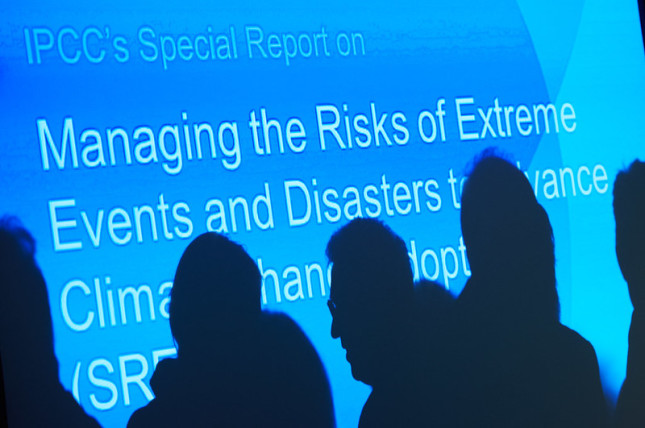
Climate-related disasters are a major source of human and material losses. Poverty and low level of economic development are important determinants of environmental vulnerability. Achieving stable and sustainable development thus represents an important strategy to reduce adverse impacts of climate change. However, present efforts to evaluate possible consequences of climate change in the future suffer from too optimistic assumptions about economic growth in poor countries, as we document in a new article just published in the journal Global Environmental Politics.
-
Dr. Mishkat Al-Moumin on the Importance of Women & the Environment to Sustainable Peace
›“I believe if you acknowledge women as primary users of environmental resources, if you draft the policy with women [at] the table, offering you their unique perspective and unique feedback, you’re going to have a more stable policy. A policy that gets implemented,” says Mishkat Al-Moumin, scholar in residence at the Environmental Law Institute, in this week’s Friday Podcast, and second in a series of interviews recorded at the First International Conference on Environmental Peacebuilding. -
Black Coal to White Trash
›Coal has long been China’s “black gold,” supplying over half of the nation’s electricity. Yet as coal’s energy share decreases due to domestic action to reduce air pollution and greenhouse gas emissions, a new coal industry is emerging. In China’s arid northwest, eight plants are pulverizing coal chunks and “cooking” coal powder into something more valuable than power—or maybe even gold. These coal conversion plants, soon numbering over 20, churn out chemicals to produce plastic.
-
To Envision a More Sustainable Future Tell the Story of Conservation Technology
›Last summer, I stood on a cliff 100 feet above the Madre De Dios River, in Southern Peru near the Bolivian border, to watch the rosy gift of an Amazon sunset. It was quiet, in a tropical rainforest way, with the light clamor of parrots, macaws, and cicadas. Then, a peke-peke motorized canoe broke through the soft din. It arrived from the east, carrying a new supply of diesel fuel for the gold miners who were prepping the generator that would operate a suction-pump and dredge for gold across the river and around the bend. Before nightfall, the fuel ignited the baritone of a diesel generator. It moaned all night and all day, barely stopping. In subsequent days, instead of a light clamor of birds and primates, the thrum of a gold mining operation seemed like all I could hear. -
The Top 5 Posts of January 2020
›The world’s largest greenhouse gas emitter, China, is projected to fulfill its Paris commitment to reduce the proportion of coal in its energy mix ten years ahead of schedule. However, the country remains the world’s largest producer and consumer of coal, and coal conversion practices are steadily on the rise. In this month’s top post, China Environment Forum’s Richard Liu, Zhou Yang, and Xinzhou Qian track China’s risky gamble on coal conversion.
-
Fisheries Management: A Possible Venue for Navigating Fisheries Conflicts in the Indian Ocean
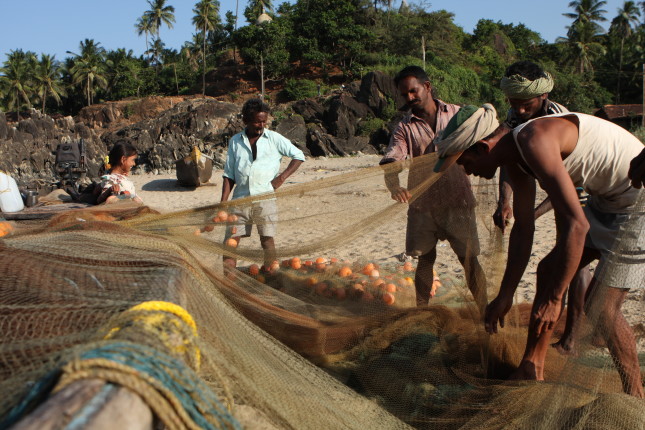
›A significant increase in fisheries-related conflicts in the Indian Ocean since 2000 is heightening regional tensions. These conflicts have ranged from purely verbal and diplomatic disputes to armed attacks on fishing vessels by coast guards and navies. These disputes are most often low-intensity, but constitute true “wild card” scenarios in which competing powers’ navies reach the brink of engagement due to the actions of third parties that they neither command nor control.
-
Geoff Dabelko and Sharon Burke on Environmental Peacebuilding in an Era of Great Power Competition
› United States and China are on the road to war, said Senior Advisor of New America’s Resource Security Program, Sharon Burke in this week’s Friday Podcast. “And if you’re an environmental peacebuilder and you’re not thinking about that, you might want to,” she added. She spoke with Geoffrey Dabelko, Professor at Ohio University and Senior Advisor to ECSP, at the first ever International Conference on Environmental Peacebuilding in October 2019 at the University of California, Irvine. It’s a war we can’t afford, said Burke. “But we’re not doing anything to avoid it at the moment, in my opinion, other than deterrence.”
 A Publication of the Stimson Center.
 In 2003, a scabies skin disease outbreak affecting mountain gorillas in Bwindi Impenetrable National Park was traced to people living around the national park—people with limited access to basic health and social services. To protect the people and wildlife of this special park, we launched
  “I believe if you acknowledge women as primary users of environmental resources, if you draft the policy with women [at] the table, offering you their unique perspective and unique feedback, you’re going to have a more stable policy. A policy that gets implemented,” says Mishkat Al-Moumin, scholar in residence at the Environmental Law Institute, in this week’s Friday Podcast, and second in a series of interviews recorded at the First International Conference on Environmental Peacebuilding.
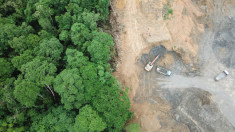 Last summer, I stood on a cliff 100 feet above the Madre De Dios River, in Southern Peru near the Bolivian border, to watch the rosy gift of an Amazon sunset. It was quiet, in a tropical rainforest way, with the light clamor of parrots, macaws, and cicadas. Then, a peke-peke motorized canoe broke through the soft din. It arrived from the east, carrying a new supply of diesel fuel for the gold miners who were prepping the generator that would operate a suction-pump and dredge for gold across the river and around the bend. Before nightfall, the fuel ignited the baritone of a diesel generator. It moaned all night and all day, barely stopping. In subsequent days, instead of a light clamor of birds and primates, the thrum of a gold mining operation seemed like all I could hear.
 United States and China are on the road to war, said Senior Advisor of New America’s

