Showing posts from category USAID.
-
Development or Security: Which Comes First?
› “Let’s take an area of conflict of great concern to us: Afghanistan. One of the very concrete questions is, do you invest your development efforts predominantly in the relatively secure parts of Afghanistan, which gives you more security gains in terms of holding them, or in the relatively insecure parts, where you’re most concerned with winning against the Taliban and the battle seems most in the balance?” With that question, Richard Danzig, the chairman of the board for the Center for a New American Security (CNAS), got to the heart of the issues being debated at a recent panel on development assistance and national security.
The discussion, hosted on September 5 by the Aspen Institute in conjunction with the Brookings Blum Roundtable on Global Poverty, brought together Rajiv Shah, the administrator of the U.S. Agency for International Development; Susan Schwab, professor at the University of Maryland and former U.S. trade representative; Sylvia Mathews Burwell, president of the Bill and Melinda Gates Foundation’s Global Development Program; and CNAS’ Danzig. Most of the hour-long discussion was spent debating whether assistance could be successful in insecure situations (like Afghanistan), or if a place has to have some kind of stability before assistance can really take root and successfully spur development.
Short vs. Long term
Administrator Shah, not surprisingly, made the argument that development assistance is valuable in either instance. That said, he also strongly cautioned against overpromising what aid in a place like Afghanistan can accomplish, saying that “one big mistake we’ve made is to oversell what any civilian agency can do in an environment where there’s an active military campaign.” He pointed out that “it not only raises the cost of doing the work…but it also puts people at real risk.”
Danzig took a more aggressive tone, saying that “in the great majority of cases I think it is misleading and distortive to argue for development on the grounds that it will predominantly enhance security.” He argued that more often than not, security should be a prerequisite for development: “You need to distinguish cart and horse here…in most instances…the security needs to precede the development.”
Shah and Danzig, who dominated the panel, were more in sync about what development assistance can accomplish in longer-term scenarios, when security and stability are assured. Shah in particular spoke forcefully about development assistance over time, stressing that “in the long view, in the medium term, the development priorities are national security priorities.”
Enabling Success
However, Shah did warn that aid could fall short of our goals if it not carried out in a reliable way. “Stability and predictability of finance is the single thing that’s most highly correlated with good outcomes,” he said. When our aid to a country comes and goes unreliably, flowing one year and stopping abruptly the next, it’s much harder to have the kind of positive impact we want it to have, he explained.
“Through the years, where these questions have been debated back and forth, there has been one constant,” said moderator Jessica Tuchman Mathews, president of the Carnegie Endowment for International Peace. “We have always multiplied the objectives vastly beyond the resources – always.”
Video Credit: Aspen Institute. -
Debts, Deficits, and Development
›The debates surrounding the U.S. national debt and deficit bring with them implications for both overall U.S. development policy and the budgets of USAID and the Department of State. These implications were the focus of the Wilson Center on the Hill event that took place on August 2, “Debts, Deficits, and Development,” moderated by Wilson Center Senior Scholar John Sewell. Sewell said that Congressional action on deficit reduction could potentially reduce funding for development-related initiatives just as the U.S. government “for the first time…is taking development and the notion of development very seriously.”
After an introduction from Sewell, Gordon Adams, distinguished fellow at the Henry L. Stimson Center, began by talking about the lack of attention that international affairs and the civilian side of U.S. international engagement usually receive in the government budget. He noted the growth in personnel and funding at USAID and the Department of State over the past ten years as a success, adding that a fair amount of this growth was related to the conflicts in Iraq and Afghanistan and the global effort against terrorist organizations.
“Foreign policy, development, foreign assistance, [and] diplomacy have increasingly been viewed as a key part of a broadly defined security budget,” said Adams. The first Quadrennial Diplomacy and Development Review had the potential to restructure the Department of State and USAID in line with these goals, he said, but lacked the force to prioritize programs and allocate funds effectively.
In post-conflict environments, Adams emphasized the need to build the capacity to govern effectively, efficiently, and accountably first. “Where we fall down,” added George Ingram, co-chair of the Modernizing Foreign Assistance Network, “is in rushing too much money in right as the conflict ends for two or three years and then getting distracted by other crises from year five to ten; when the country’s built up a capacity and probably could use the assistance, our interest falls off.” In his opinion, that sequencing should be reversed.
Focus on Priorities
Adams continued to emphasize the need for goals and priorities when he addressed the topic of belt-tightening at USAID or the Department of State. According to Adams, the four categories to consider in allocating resources are: security assistance; the individual priorities of foreign assistance and development funds; conflict prevention and resolution; and better preparation and training of personnel. He lauded the military’s commitment to training its servicemen and women throughout their careers and suggested a similar program for members of the Foreign Service. To coordinate these priorities, however, a coherent U.S. development strategy (currently lacking) is essential, said Ingram.
Focusing on how the current budget environment is impacting development, Ingram said that the decade of growth in the international affairs budget for development may have just hit a brick wall. He described the FY 2012 budget as “skewed heavily toward reducing the development accounts and protecting the security accounts,” resulting in an 11 percent overall cut from 2011 levels and some development accounts being reduced by 20 or 30 percent.
Ingram noted that USAID’s overall operating expenses were cut by 27 percent from FY 2011 levels. This operating expense reduction will likely halt planned increases in USAID staff and may ultimately lead to staff cuts. The failure to build up staff at USAID will reduce its ability to manage key development programs and slow the Department of Defense’s efforts to shift responsibilities for development work to civilian hands.
Adams added that in light of shrinking resources, legislators will probably ask supporters of development about the tangible outcomes of investment in development and about the link between development and American interests, so they should be prepared with answers. Ingram cited the successes of U.S. aid over the last decades – such as the Green Revolution and oral rehydration – and noted how they benefited from a long-term perspective rather than approaching development on a project-by-project basis.
Given the tumult in the Middle East since the start of the Arab Spring, the need for expertise in governance is high, said Adams. “The problem of governance in failing, fragile, weak, brittle authoritarian states,” he said, “is a great risk to stability.”
Event Resources:Erica Pincus is an intern at the Wilson Center’s Program on America and the Global Economy.
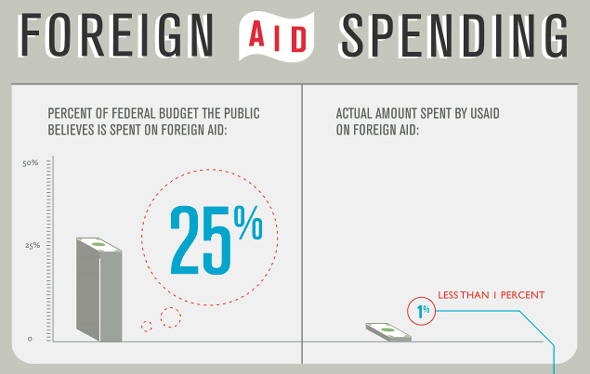
Image Credit: “Foreign Aid Spending,” courtesy of visual.ly user maggie, published by USAID. -
John Donnelly, Global Post
Family Planning and Seven Billion at the Aspen Institute
›September 9, 2011 // By Wilson Center Staff
The original version of this article, by John Donnelly, appeared on Global Post.
Sometime this fall, the world’s population will reach 7 billion people. Experts now forecast that by 2050, the population could be 10 billion.
Those numbers, said the former presidents of Chile and Latvia at an event in Washington D.C., Wednesday night, should force policy makers to focus more intently on making family planning much more widely available in the developing world.
“When we are 9, 10 billion people, what are we going to do? Go to Mars? Go to the moon?” said Michelle Bachelet, the former president of Chile and now the Under Secretary-General and Executive Director of UN Women, the latest agency created by the United Nations. “We are really going to have huge problems. Family planning is a huge issue.”
Her comments came during a series of discussions organized by Aspen Global Health and Development called “7 Billion: Conversations that Matter.” The talks, funded in part by the U.S. Agency for International Development, have often centered on global health issues, and Wednesday’s event was no different.
Continue reading on Global Post.
Video Credit: The Aspen Institute. -
What’s in a Name? Watch Don Lauro on PHE, HELP, and HELPS
›Population, health, and environment (PHE) expert Don Lauro has worked on integrated projects for decades as a scholar, an implementer, a donor, and an evaluator. He recently visited the USAID-funded BALANCED Project in Tanzania as part of a wider look at this integrated approach. In an interview with ECSP, Lauro said the effort “made me think more broadly…about this area that we call population, health, and environment and what’s really in a name like that.”
“We commonly say PHE, and we all know what we’re talking about,” Lauro said of the population and development community, “but when you look deeply into these projects – or even not so deeply – you see that there’s other things going on as well.”
For example, Lauro pointed to the focus on livelihoods that many PHE programs have: “In the project I saw in Tanzania, there were many microcredit groups on the ground – mostly women – taking small loans for developing little enterprises that they had, like baking bread, raising bees, buying a cow…little enterprises to make their lives a little bit better.”
“Some people don’t use the term ‘PHE’…maybe it’s a ‘HELP’ project; that is health, environment, livelihoods, and population,” Lauro said. “Other people would say it’s maybe something even longer, ‘HELPS’ – health environment, livelihoods, population, and sustainability (or ‘security’ – Ed.).” When he was at the Wilson Center, Gib Clarke coined the “HELP” term in ECSP’s FOCUS Issue 20, arguing that livelihoods is such a critical component that it ought to be more formally recognized.
But, said Lauro, “on the ground they don’t use these terms – they say things like, ‘this is a healthy community program’ or ‘this is a green community program.’”
“I think it’s very important for us to realize what happens on the ground is lot different, and maybe more real, than how we talk about it.” -
Zo Zatovonirina, PHE Champion
Improving Human Health and Conservation in Madagascar’s Forest Communities
›This PHE Champion profile was produced by the BALANCED Project.
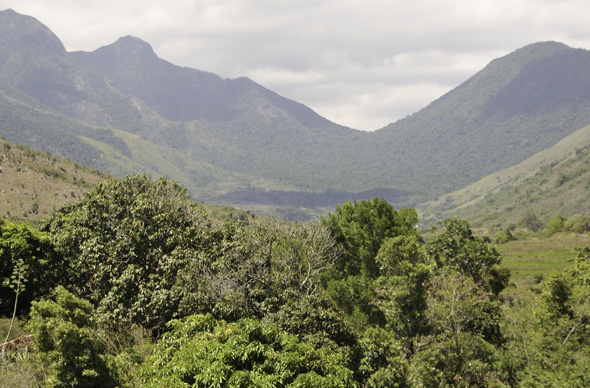
Madagascar is one of the world’s most unique ecosystems, with a total of eight plant families, five bird families, and five primate families that live nowhere else on Earth. Madagascar’s tropical forests and marine environments are home to endemic species of flora and fauna, although tragically 15 species are now extinct. At the same time, Madagascar is rich in freshwater resources, yet more than 60 percent of the island’s 19.7 million people do not have access to safe drinking water.Since 2003, Zo Zatovonirina has worked for Conservation International (CI) in Madagascar, and he has seen up-close the challenges of reaching remote forest communities, often requiring one- or two-day hikes over treacherous roads. As coordinator for USAID’s Healthy Families, Healthy Forests Program, Zo worked with two Malagasy nongovernmental organizations (NGOs), MATEZA, and the Association for Health Action and Security, to implement integrated population, health, and environment (PHE) approaches in response to community needs in the Ankeniheny Zahamena forest corridor in eastern Madagascar.
From 2003-2008, CI and partners reached more than 25,000 village residents with PHE messages; increased contraceptive prevalence in target zones from 17 percent in 2005 to 30 percent in 2008; constructed 3,000 latrines; and improved environmental health in all priority sites.
Today, biodiversity in Madagascar is under increased pressure, in light of political instability since 2009 and continued population pressures. Recognizing CI and partner experience and investments in conservation efforts to improve human well-being, USAID Madagascar and World Learning recently awarded a new 15-month grant to CI Madagascar and two Malagasy NGO partners – Voahary Salama and Ny Tanintsika – to implement an integrated PHE project in the southeastern Ambositra Vondrozo forest corridor. All three organizations have implemented PHE projects in Madagascar, and they have established trusting relationships with the people living in these fragile ecosystems.
Madagascar has a rich history of implementing successful PHE projects, and this project represents a new PHE pilot phase in the midst of political uncertainty. According to Zo, PHE approaches remain constant – simultaneously addressing several complex and linked problems such as poverty, child survival, and unsustainable dependency on natural resources. In Zo’s experience, CI’s PHE approach touches on all these aspects and delivers a pragmatic, integrated package of interventions designed to increase community capacity to better manage their health and environment. Utilizing PHE approaches, CI, Voahary Salama, and Ny Tanintsika will strive to reach communities for the first time ever with family planning, water, sanitation, and hygiene services while helping them conserve their biological heritage.
This PHE Champion profile was produced by the BALANCED Project. A PDF version can be downloaded from the PHE Toolkit. PHE Champion profiles highlight people working on the ground to improve health and conservation in areas where biodiversity is critically endangered.
Photo Credit: The forests of Madagascar, courtesy of Conservation International/Russ Mittermeier, and Zo Zatovonirina, courtesy of Conservation International. -
Cynthia Brady, USAID
The Specter of “Climate Wars”
›July 29, 2011 // By Wilson Center StaffThe original version of this article, by Cynthia Brady, appeared in the June/July 2011 edition of USAID’s Frontlines.
In 2007, many in the advocacy community rushed to categorize the conflict in the Darfur region of Sudan as a “climate war” in the wake of a compelling United Nations report that emphasized the ways climate change and environmental degradation can drive conflict.
In 2009, international media focused significant attention on an academic study that analyzed historical linkages between civil war and temperatures in sub-Saharan Africa and suggested there would be a 54-percent increase in armed conflicts by 2030. [Video Below]
In both cases, subsequent research and analyses conducted by prominent scholars countered those original claims of such direct climate and conflict connections, at least based on existing evidence. Those studies are two examples of the recent spate of analyses on the subject and serve as cautionary tales against alarmism and overly simplistic assumptions about specific connections between climate change and stability.
The reality is far more complicated.
The science and practice of analyzing the interaction of climate change risk and conflict risk is new and still evolving. As a result, there is little certainty over exactly how climatic change will manifest in specific locations and what the consequences will be for economic development, political stability, and peace and security.
Around the world, climate change likely will create both risks and opportunities, making it critical that development and relief organizations like USAID consider climate change not as a monolithic threat but rather as an important influence within a complex web of environmental and social factors.
Responding to climate change effectively means taking action to reduce the threats. It also means harnessing opportunities by helping people and institutions to effectively cope with and adapt to change – environmental or otherwise. Climate-focused interventions, if conducted strategically and with sensitivity to local context, can produce outcomes for conflict prevention and sustainable development as well.
For example, recent USAID-funded research in the conflict-prone Karamoja region of northeastern Uganda found that engaging local communities in the design and implementation of climate change adaptation activities – for example, promoting shared grazing areas and creating small-scale irrigation systems – holds considerable potential to reduce conflict by building social cohesion and addressing feelings of marginalization and disempowerment among local community members.
Since 2008, USAID has invested in research to better understand how specific climate factors contribute to the risk of conflict and affect the resilience of social structures and institutions. The goal is to build a deeper understanding that will enable the agency and its partners to respond most effectively to climate-related stress, reduce the risk of violent outcomes, and maximize the potential for U.S. foreign assistance to prevent conflict and promote stability.
This knowledge also will help USAID make wise investments as part of meeting U.S. Government commitments under the Global Climate Change Initiative as described in President Barack Obama’s September 2010 Presidential Policy Directive on Global Development.
Climate Change and Conflict Prevention
The research thus far points to climate change as an exacerbating factor in situations where political, economic, and social stresses already exist. The risk of conflict is greatest where there is poor governance and low institutional capacity.
The agency, through its Office of Conflict Management and Mitigation (CMM), has identified two basic scenarios under which climate change could combine with other variables and potentially lead to conflict.
First, climate change could intensify existing environmental or resource problems. For example, a series of droughts could reduce the available local water supply, aggravating competition between farmers and pastoralists in already arid regions. Second, climate change could create new environmental or resource problems that contribute to instability. Changing rainfall patterns, for instance, could damage agricultural production in formerly fertile areas, decimating local livelihoods and causing food insecurity.
There is a third area of potential risk for USAID and other donors as well: namely, that climate-related financing, policies, and programs which have not adequately considered local conflict dynamics and context could produce serious unintended negative consequences.
Climate change-related interventions such as incentive payments to stop deforestation – particularly in fragile states and conflict-affected areas – must recognize that both the money and the power to allocate benefits may inadvertently reinforce the social status quo, shift local power balances, or expose governance failures.
In her field work in Nepal, Janani Vivekananda, a researcher with USAID partner International Alert, recently illustrated how certain types of assistance might inadvertently do harm. She explained how a now-defunct village water tap installed in an effort to mitigate the effects of climate variability, did not appropriately consider the local social, political, and conflict context or even basic environmental parameters. In the end, it contributed to local grievance.
The community had requested the tap to be installed during a period of water stress and three consecutive years of drought. The Government of Nepal sponsored the project just before the elections.
Vivekananda explained: “These people are hand-to-mouth farmers. They didn’t know and they wouldn’t know that ground water levels were falling. They wouldn’t know the negative impacts of uncontrolled surface water extraction and so they chased about this tap, and within three months it ran dry. That was the only cash that was injected into the community for development purposes, and it had no impact whatsoever apart from being a stark reminder that the government itself isn’t doing what it ought to.”
This story highlights the reality that local context will define the outcome of peace or conflict and, thus, as CMM’s discussion paper “Climate Change, Adaptation, and Conflict: A Preliminary Review of the Issues” noted, there remains a pressing need for a more robust, fine-grained understanding of the interaction between climate change and the political, social, and economic realities of conflict-prone areas.
To help fill this information gap, USAID is supporting field-based climate change and conflict research in Peru, Uganda, Ethiopia, and the Niger River Basin in West Africa. At the global level, the agency is improving its ability to integrate climate change considerations into conflict early warning models. It is also establishing academic and practitioner partnerships that explore a wide range of environment and security issues.
Today, close to 60 percent of the State Department’s and USAID’s foreign assistance goes to 50 countries that are in the midst of, recovering from, or trying to prevent conflict or state failure. A significant amount of that assistance is slated for Global Climate Change mitigation and adaptation programming. Yet, as CMM’s conflict early warning specialist, Kirby Reiling, observed, “much of that money could be a lost investment if those countries fall into armed conflict.”
With conflict-sensitive development assistance and with smart climate change policies and programs, vulnerable countries will have enhanced opportunities to build stronger societies and more resilient institutions for sustainable development, peace, and security.
Cynthia Brady is a senior conflict advisor in USAID’s Office of Conflict Management and Mitigation.
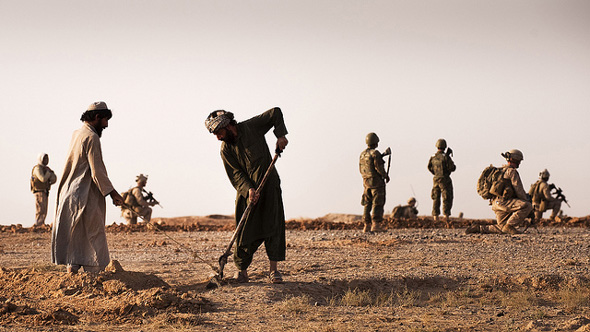
Photo Credit: Afghan farmers plow a field guarded by U.S. Marines, courtesy of flickr user isafmedia. -
Nepal to East Africa: Population, Health, and Environment Programs Compared
›“Practice, Harvest and Exchange: Exploring and Mapping the Global, Health, Environment (PHE) Network of Practice,” by the University of Rhode Island’s Coastal Resources Institute and the USAID-supported BALANCED Project, explores the successes and challenges of their global population, health, and environment (PHE) network (with a heavy presence in East Africa). In order to increase support of the nascent PHE approach, the network seeks to shorten the “collaborative distance” between “PHE champions,” so they can develop a stronger body of evidence for the links between population, health, and the environment. In their analysis, the authors write that the network has facilitated the development of independent, information-sharing relationships between “champions.” However, they also observed shortfalls in the network, such as its limited reach into less technologically advanced yet more biodiverse regions, its bias toward BALANCED meet-up event participants, and its exclusion of those experts unlikely to be included in published works.In “Linking Population, Health, and the Environment: An Overview of Integrated Programs and a Case Study in Nepal” from the Mount Sinai Journal of Medicine, Sigrid Hahn, Natasha Anandaraja, and Leona D’Agnes provide both a broad survey of the structure and content of programs using the PHE method and an in-depth case study of a successful initiative in Nepal. Hahn et al. praise the Nepalese program for simultaneously addressing deforestation from fuel-wood harvesting, indoor air pollution from wood fires, acute respiratory infections related to smoke inhalation, as well as family planning in Nepal’s densely populated forest corridors. “The population, health, and environment approach can be an effective method for achieving sustainable development and meeting both conservation and health objectives,” the authors conclude. In particular, one benefit of cross-sectoral natural resource and development programs is the inclusion of men and adolescent boys typically overlooked by strictly family planning programs. -
Tate Watkins, Short Sentences
Why Fund Both Farm Subsidies and Foreign Aid?
›June 27, 2011 // By Wilson Center StaffThe original version of this article, by Tate Watkins, appeared on the blog Short Sentences.
The USDA routinely disburses $10 billion to $30 billion a year in farm subsidies. President Obama has allocated $47 billion for the State Department and USAID for the next fiscal year (not including proposed expenditures for Afghanistan, Iraq, and Pakistan).*
Why does the U.S. simultaneously fund domestic agricultural subsidies and foreign aid? The policies oppose each other. When it comes to promoting development opportunities for farmers around the globe, one of USAID’s ostensible goals, the left hand of the U.S. binds its right.
The origin of agricultural subsidies goes back at least to the first Agricultural Adjustment Act, enacted in 1933 as an attempt to help Depression farmers cope. Today farm interests justify subsidies in name of food security or, since 9/11, national security. But it’s widely acknowledged that the pastoral American family farmer, the image that farm interests present to the American people when the merits of subsidies are debated, do not benefit most from agricultural subsidies. Large corporate farmers do.
Continue reading on Short Sentences.
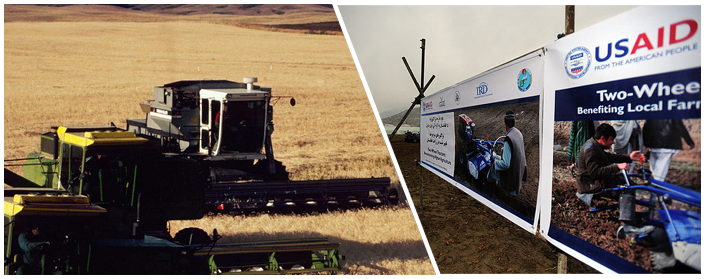
Photo Credit: Adapted from “YM009180,” courtesy of flickr user tpmartins, and “Badam Bagh Farm,” courtesy of flickr user U.S. Embassy Kabul Afghanistan.