Showing posts from category zz Organizations.
-
World Population Day 2011: The Year of Seven Billion
›July 11, 2011 // By Schuyler NullThe UN Population Fund established World Population Day as a day of awareness about global population in 1987. As we approach seven billion just 24 years later, the UN is kicking off their 7 Billion Actions campaign, designed to raise awareness about the resource, health, and environmental challenges raised by our numbers. Population and its more detailed cousin-indicator, demography, impact the world in a great many ways – from contributing to resource scarcity and environmental destruction to creating social imbalances that can lead to civil instability.
Check out a few of New Security Beat’s most recent stories on population to get a sense of why it’s such an important but oft-simplified and misunderstood indicator and where it matters most.
Photo Credit: “World population,” courtesy of flickr user Arenamontanus.- One in Three People Will Live in Sub-Saharan Africa in 2100, Says UN
- Ten Billion: UN Updates Population Projections, Assumptions on Peak Growth Shattered
- Tunisia Predicted: Demography and the Probability of Liberal Democracy in the Greater Middle East
- Watch: Demographic Security 101 With Elizabeth Leahy Madsen
- Yemen Beyond the Headlines: Population, Health, Natural Resources, and Institutions
- Guest Contributor Michael Kugelman: Pakistan’s Population Bomb Defused?
- Dot-Mom: USAID Egypt’s Health and Population Legacy Review
- Watch: Eric Kaufmann on How Demography Is Enhancing Religious Fundamentalism
- Consumption and Global Growth: How Much Does Population Contribute to Carbon Emissions?
-
Robert Jenkins, OpenDemocracy.net
Women, Food Security, and Peacebuilding: From Gender Essentialism To Market Fundamentalism
›July 5, 2011 // By Wilson Center Staff
That women’s engagement in resolving and recovering from conflict is crucial to sustainable peace has been an article of faith, and an element of international law, since the UN Security Council passed Resolution 1325 in 2000. It took a decade of missed opportunities, however, for the UN to develop a systematic action plan for redeeming the promise of 1325. The September 2010 Report of the Secretary-General on women’s participation in peacebuilding contains a concrete set of commitments for UN actors working in post-conflict settings.
-
Nepal to East Africa: Population, Health, and Environment Programs Compared
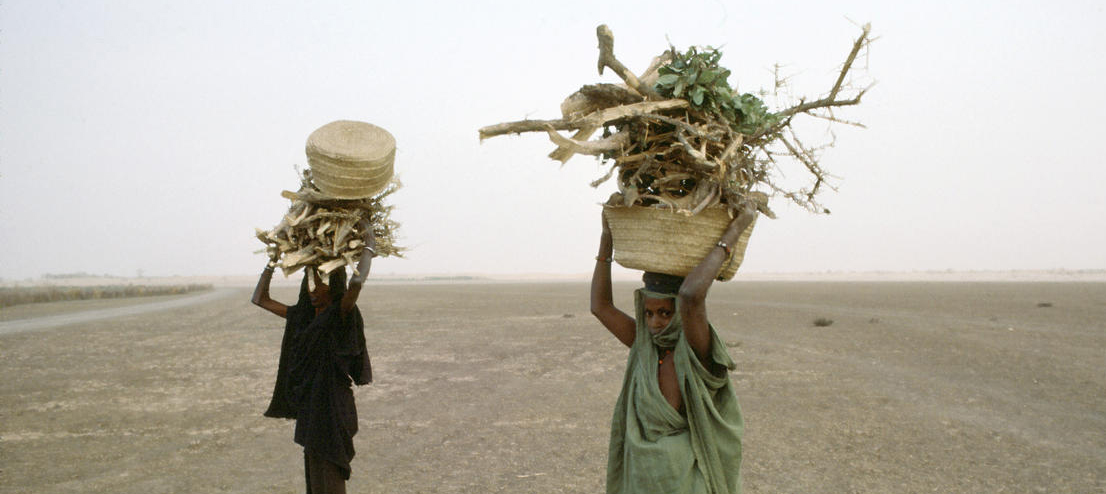
›“Practice, Harvest and Exchange: Exploring and Mapping the Global, Health, Environment (PHE) Network of Practice,” by the University of Rhode Island’s Coastal Resources Institute and the USAID-supported BALANCED Project, explores the successes and challenges of their global population, health, and environment (PHE) network (with a heavy presence in East Africa). In order to increase support of the nascent PHE approach, the network seeks to shorten the “collaborative distance” between “PHE champions,” so they can develop a stronger body of evidence for the links between population, health, and the environment. In their analysis, the authors write that the network has facilitated the development of independent, information-sharing relationships between “champions.” However, they also observed shortfalls in the network, such as its limited reach into less technologically advanced yet more biodiverse regions, its bias toward BALANCED meet-up event participants, and its exclusion of those experts unlikely to be included in published works.In “Linking Population, Health, and the Environment: An Overview of Integrated Programs and a Case Study in Nepal” from the Mount Sinai Journal of Medicine, Sigrid Hahn, Natasha Anandaraja, and Leona D’Agnes provide both a broad survey of the structure and content of programs using the PHE method and an in-depth case study of a successful initiative in Nepal. Hahn et al. praise the Nepalese program for simultaneously addressing deforestation from fuel-wood harvesting, indoor air pollution from wood fires, acute respiratory infections related to smoke inhalation, as well as family planning in Nepal’s densely populated forest corridors. “The population, health, and environment approach can be an effective method for achieving sustainable development and meeting both conservation and health objectives,” the authors conclude. In particular, one benefit of cross-sectoral natural resource and development programs is the inclusion of men and adolescent boys typically overlooked by strictly family planning programs. -
Tate Watkins, Short Sentences
Why Fund Both Farm Subsidies and Foreign Aid?
›June 27, 2011 // By Wilson Center StaffThe original version of this article, by Tate Watkins, appeared on the blog Short Sentences.
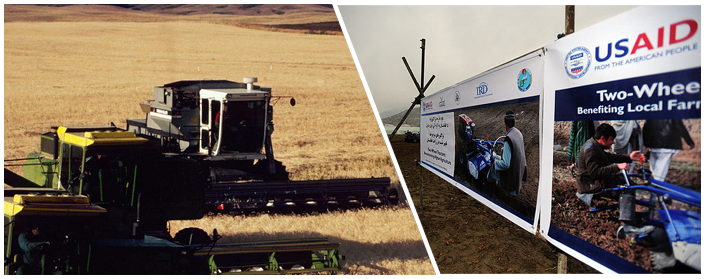
The USDA routinely disburses $10 billion to $30 billion a year in farm subsidies. President Obama has allocated $47 billion for the State Department and USAID for the next fiscal year (not including proposed expenditures for Afghanistan, Iraq, and Pakistan).*
Why does the U.S. simultaneously fund domestic agricultural subsidies and foreign aid? The policies oppose each other. When it comes to promoting development opportunities for farmers around the globe, one of USAID’s ostensible goals, the left hand of the U.S. binds its right.
The origin of agricultural subsidies goes back at least to the first Agricultural Adjustment Act, enacted in 1933 as an attempt to help Depression farmers cope. Today farm interests justify subsidies in name of food security or, since 9/11, national security. But it’s widely acknowledged that the pastoral American family farmer, the image that farm interests present to the American people when the merits of subsidies are debated, do not benefit most from agricultural subsidies. Large corporate farmers do.
Continue reading on Short Sentences.
Photo Credit: Adapted from “YM009180,” courtesy of flickr user tpmartins, and “Badam Bagh Farm,” courtesy of flickr user U.S. Embassy Kabul Afghanistan. -
Women in Agriculture: Closing the Gender Gap for Development and World Hunger
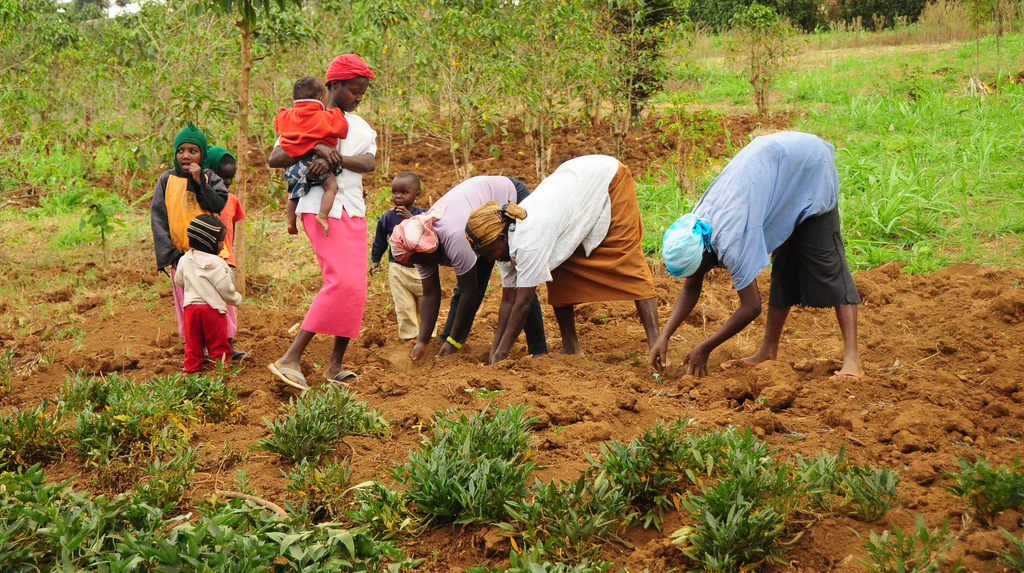
›June 22, 2011 // By Kellie FurrProviding women with equal access to productive resources and opportunities may be the key to bolstering the struggling global agricultural sector and feeding communities living in extreme hunger, according to the UN Food and Agriculture Organization’s (FAO) latest State of Food and Agriculture report, which this year is sub-titled, “Women in Agriculture: Closing the Gender Gap for Development.”
“Women are farmers, workers, and entrepreneurs, but almost everywhere they face more severe constraints than men in accessing productive resources, markets, and services,” write the authors. “This ‘gender gap’ hinders their productivity and reduces their contributions to the agriculture sector and to the achievement of broader economic and social development goals.”
Barriers to Productivity
Globally, women comprise 43 percent of the agricultural labor force, ranging from 20 percent in Latin America to 50 percent in southeastern and eastern Asia and sub-Saharan Africa, according to the report. But despite their significant global presence, female farmers face gender-specific constraints that hinder access to productive resources, financial support, information, and services required to be viable and competitive. “The yield gap between men and women averages around 20 to 30 percent, and most research finds that the gap is due to differences in resource use,” write the authors.
Generally, women are more likely than men to hold lower-wage, part-time, or seasonal positions and tend to get paid less even when they are more qualified. Furthermore, domestic and occupational lines are blurred for women, who are often not compensated for work that is closely related to domestic food preparation. Most significantly for agricultural productivity, women across the developing world often lack access to quality land, sometimes being barred from land ownership. This ban precludes female farmers from exercising managerial discretion over farming activities, such as entering contract farming agreements. Women also generally own less livestock and contract for less labor – two crucial assets for marketable agricultural production in many developing countries. Moreover, because of insufficient land and resources, women farmers are also more vulnerable to climate shocks.
Resource barriers for female farmers extend to education, finance, and technology as well. The authors observe that “female household heads in rural areas are disadvantaged with respect to human capital accumulation in most developing countries, regardless of region or level of economic development,” which represents a historical bias against females in education. Despite notable success observed in finance projects involving female farmers, gender bias exists in the financial system, which prevents women from bearing initial financial risk in order to increase long-term productivity gains. Sources of gender bias in the financial sector include legal barriers, cultural norms, lack of collateral, and institutional discrimination by public and private lenders. Due to the aforementioned lack of credit, labor, and education, women farmers are deficient in all aspects of technology, such as the acquisition of new equipment, information about new seed varietals and animal breeds, pest control measures, and management techniques.
Global Implications
Closing the gender gap could have profound implications for easing world hunger. According to the FAO, approximately 925 million people are currently undernourished, most of whom live in developing countries. If women were given all the inputs and support as men, agricultural output could increase by 2.5 to 4 percent in developing countries, potentially reducing the world’s hungry by 100 to 150 million people. “This report clearly confirms that the Millennium Development Goals on gender equality (MDG 3) and poverty and food security (MDG 1) are mutually reinforcing,” FAO Director-General Jacques Diouf argues in his introductory remarks.
Increasing the economic viability of women farmers may also translate into better infant and child health indicators – when women control additional income, they tend to allocate more of their earnings toward the health and well-being of their children. Closing the agricultural gap is “a proven strategy for enhancing the food security, nutrition, education, and health of children,” Diouf asserted. “Better fed, healthier children learn better and become more productive citizens. The benefits would span generations and pay large dividends in the future.”
Finally, the FAO notes that in addition to reducing child mortality rates, increasing female education and economic prosperity helps lower fertility rates, which over time increases human capital and can help drive a demographic transition towards lower dependency rates and higher per capita growth.
Closing the Gender Gap
“The conclusions are clear,” write the authors:1) Gender equality is good for agriculture, food security, and society; and
Though they note that “no simple ‘blueprint’ exists for achieving gender equality in agriculture,” the authors do recommend some basic principles to the development community, including working towards eliminating discrimination against women under the law, strengthening rural institutions and making them gender-aware, freeing women for more rewarding and productive activities, building the human capital of women and girls, bundling interventions, improving the collection and analysis of sex-disaggregated data, and making gender-aware agricultural policy decisions.
2) Governments, civil society, the private sector and individuals, working together, can support gender equality in agriculture and rural areas
Recognizing that “women will be a pivotal force behind achieving a food secure world,” the U.S. Agency for International Development (USAID) has actually launched initiatives aimed directly at closing the gender gap. The Feed the Future initiative, announced last spring, includes a heavy focus on gender equity and integration with small-scale farming initiatives. For example, the Office of Women in Development is supporting a three-year project in Liberia, “Integrated Agriculture for Women’s Empowerment,” that aims to train and support 1,500 small farmers in Lofa county, two-thirds of whom are women. And in Rwanda, USAID helped the Ministry of Agriculture and Animal Resources – headed by Dr. Agnes Kalibata – develop a national investment plan, which has been successful in bringing in donor support.
However, the FAO report does not offer specific feedback on programs like Feed the Future, which is arguably a crucial component of a truly comprehensive assessment on the current state of agriculture. Though they write that the State of Food Agriculture series is intended to simply be “science-based assessments of important issues,” the infancy of these food security efforts and the immediacy of the problems examined (see recent food price instability) creates an excellent opportunity for critical input. “Women in Agriculture” offers perhaps the most comprehensive report on the gender gap and development to date, but more specific critiques on the current efforts of USAID and others might make more of an impact in a field where the issues at play have been fairly clearly enumerated many times before.
Sources: Food and Agriculture Organization, The Hunger Project, International Fund for Agricultural Development, Population Action International, USAID.
Photo Credit: Adapted from “Ngurumo Village-Ntakira (Kenya),” courtesy of flickr user CGIAR Climate. -
Jacob Park, Our World 2.0
Will Expanding “Human Security” Really Improve People’s Lives?
›June 16, 2011 // By Wilson Center StaffThe original version of this article, by Jacob Park, appeared on the UN University’s Our World 2.0.
To those working in the financial markets, the term “securitization” refers to the financial practice of pooling various types of debt, such as residential mortgages, and repackaging them as products like bonds, etc. And you can bet that most of the 2.5 million pages one gets if one searches for this term on the web probably relate to complex financial markets.
Yet the use of the term “security” is not limited to the financial markets and it appears that the United Nations system and the international community seem to be caught up in its own securitization trend. At the April 2011 65th General Assembly of the United Nations, the General Assembly held an informal debate on the human security concept and why it is important to the UN and the international community.
At this meeting, UN Deputy Secretary General Asha-Rose Migiro argued that “in a world where threats could be as sudden and unpredictable as a tsunami or as protracted and unyielding as an oppressive dictatorship, an expanded paradigm of security was needed to encompass the broad range of conditions threatening people’s survival, livelihoods, and dignity.”
In light of the recent triple disaster in Japan and this year’s uprisings in the Arab World, Migiro stated that from “natural disasters and entrenched poverty to outbreaks of conflict and the spread of disease, the dramatic events of recent weeks had underscored the vulnerability of developed and developing countries alike.”
Her views reflect a trend since the 2005 World Summit, where leaders agreed that human security concerned both “freedom from fear” and “freedom from want,” and the definition of human security expanded beyond the traditional military-political paradigm of security to be inclusive of social, energy, and environmental issues.
In fact, a wide range of UN institutions have been active promoting their respective security work; the United Nations Environment Programme (UNEP) in relation to environmental security; the Food and Agricultural Organization in relation to food security; and the United Nations Development Programme/UN Trust Fund for Human Security, among others. (Similarly, the International Energy Agency, founded in response to the 1973/74 oil shocks, today plays an increasingly important role in advising its member countries on energy security.)
Real Solutions or Good Metaphors?
It’s hard to disagree with the expanded definition of security to include a wide range of social, environmental, and human development issues. But toward what ends? What will this diverse focus ultimately lead to?
Perhaps I am being overly pessimistic and need to be more patient for these various security issues to develop as possible policy solutions. However, experience with the term “sustainable development” offers a good illustration of what happens when vague concepts rather than real solutions starts the drive the institutional machinery of global governance.
It seems like at times we’re replacing solutions with metaphors or frames to discuss social, environmental, and human development global concerns. The emerging security narrative feels as if we’re waiting for some military quick fixes; as if there is some special forces unit that can be called upon to get rid of the climate-induced migration problem in the same manner as a special U.S. Navy SEAL team was dispatched to deal with Osama Bin Laden.
Unfortunately, there is a real possibility that these UN programs and initiatives (however worthwhile they may be) on energy security, food security, environmental security, climate security, and human security will attempt to deal with all of these issues at the same time and at the end, risk dealing with none. One thing is certain: more international conferences will be planned on security issues even if it is unclear what real benefits this will provide to the most vulnerable members of the international community, whom this securitization trend is designed to help.
What do you think? Will the securitization of all threats to human life make a difference to “at risk” communities across the globe? Or are we just getting caught up in language and not solutions?
Thoughts? Be sure to follow-up on Our World 2.0 as well.
Jacob Park is an associate professor of business strategy and sustainability at Green Mountain College in Vermont specializing in global environment and business strategy, corporate social responsibility, community-based entrepreneurship, and social innovation.
Photo Credit: “UN Peacekeepers Rescue School Collapse Victims,” courtesy of flickr user United Nations Photo. -
Pakistan’s Population Bomb Defused?
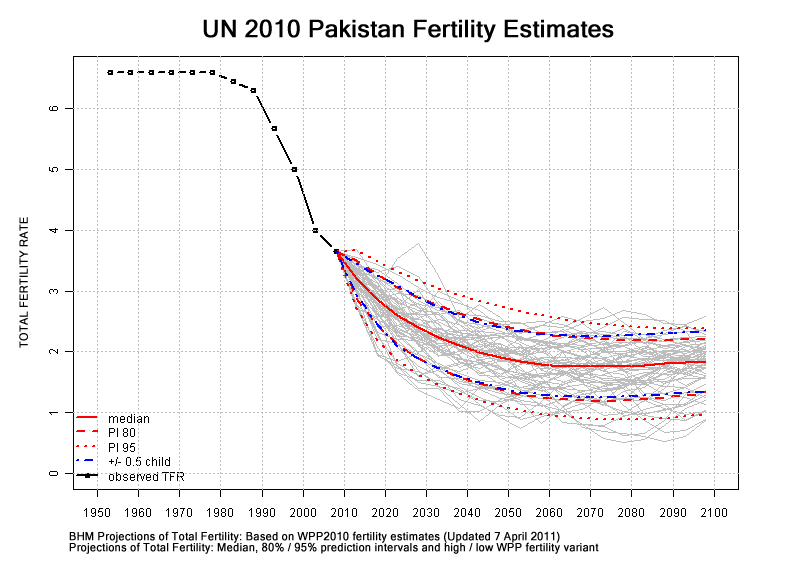
›What is going on over at the UN Population Division? In response to The New Security Beat’s post on the UN’s sub-Saharan projections, Ed Carr of USAID recently highlighted what appears to be gross overestimations in the 2010 population revision for Ghana. Yet in the case of Pakistan, the opposite is seemingly at play – the projections appear to wildly (and unrealistically) underestimate population numbers for the coming decades.
The 2008 revision’s mid-variant estimate for Pakistan in 2050 was 335 million people. The new revision projects only about 275 million by that year. Even the new high-variant estimate (314 million) falls below the earlier mid-variant projection. Furthermore, the constant-fertility variant estimate for 2050 has fallen from 450 million to under 380 million.
What gives? Thanks to some helpful staff at the Population Division and Population Action International’s Elizabeth Leahy Madsen (who helped translate the UN’s demographic-ese for this non-specialist), I can only conclude that the UN has decided to hedge its bets that Pakistan’s fertility rates will fall, simply because its South Asian neighbors (and other nations) have followed this trajectory.
If so, I believe this assumption is spurious. As reported in the Wilson Center’s recent book on Pakistan’s population challenges, though Pakistan’s fertility rate is in decline, it is falling at a considerably slower pace than that of its neighbors, and the rate of decrease has slowed considerably over the last decade. The country’s total fertility rate (TFR) today is just under four, considerably above the replacement level rate (2.1).
By many indications, Pakistan’s TFR does not figure to fall quickly anytime soon. Pakistan’s maternal and reproductive health sector is deeply troubled, with family planning services either of poor quality or nonexistent – particularly in rural areas. Many rural women are obliged to travel on average 50 to 100 kilometers to obtain such services. Meanwhile, the status of Pakistani women is dreadful; female literacy is estimated to stand at only 44 percent (some places it as low as 35 percent), while women’s labor participation rates barely approach 20 percent. Not surprisingly, Pakistan’s contraceptive prevalence rate is quite low (30 percent), while its rate of unmet need for family planning is high (25 percent).
With all of Pakistan’s problems, improving access to family planning is simply not a front-burner issue for Islamabad (in fact, as our book notes, demography on the whole is largely neglected in Pakistan), which makes the 2010 revision’s projections all the more questionable.
The UN is expected to release details on the methodology behind its basic assumptions in the coming weeks; here’s hoping for some clarity. (Editor’s note: As Liz Madsen points out, there’s also a white paper on the new probabilistic model to sift through, if you’re prepared for some heavy reading.)
Michael Kugelman is a program associate for the Asia Program at the Woodrow Wilson Center.
Chart Credit: Modification of projections of total fertility based on Bayesian hierarchical model, courtesy of the UN Population Division. -
Helping Hands: An Integrated Approach to Development
›Originally featured in the Wilson Center’s Centerpoint, June 2011.
“At the moment, the agendas of the growing population of people and the environment are too separate. People are thinking about one or the other,” said Sir John Sulston, Nobel laureate and chair of the Institute for Science, Ethics, and Innovation at the University of Manchester, in an interview with the Environmental Change and Security Program (ECSP).
“People argue about, ‘Should we consume less or should we have fewer people?’ The point is it’s both. We need to draw it together. It’s people and their activities.”
Many who research and work on population, health, and environment (PHE) issues are increasingly advocating integrated solutions. Such issues as population growth, natural resource management, and food security, are interrelated challenges that, if addressed concurrently, likely will yield better results and community trust.
With this notion in mind, ECSP launched the five-year HELPS (health, environment, livelihoods, population, and security) project in October 2010. The project focuses on integrated PHE programs and demographic security linkages. HELPS also looks at population’s links to global environmental priorities, media coverage of population, and related issues like gender, youth, and equity.
Funded by USAID’s Office of Population and Reproductive Health through its IDEA (Informing Decision-makers to Act) grant, the HELPS project builds on ECSP’s 14-year history of exploring nontraditional security issues.
Population-Environment Connection
A February event in the HELPS series featured Sir John Sulston, who said dialogue between population and environmental communities has received renewed attention and is reappearing on national agendas.
The Royal Society’s People and the Planet study, which will be completed by early 2012, will “provide policy guidance to decision-makers as far as possible” and aims to facilitate dialogue, he said. The HELPS Project is helping the working group gather evidence of population-environment connections and to identify solutions.
“What we should be aiming to do is to ensure that every individual on the planet can come to enjoy the same high quality of life whilst living within the Earth’s natural limits,” said Sulston. People are happier, healthier, and wealthier than ever before, according to human development indexes. But, Sulston said, 200 million women worldwide have an unmet need for family planning, ecosystems are degraded, biodiversity has decreased, and there are widespread shortages of food and water.
“Many times we tackle different development challenges through single sector programs: health programs, agriculture programs, water programs. Those single sector approaches can make sense,” said ECSP Director Geoff Dabelko on the Wilson Center’s Dialogue television program. “But, of course, poor people are facing all those life and death challenges at once. We have to find ways to help them meet those challenges together in an integrated fashion.”
On the same program, Roger-Mark De Souza, vice president for research and director of the Climate Program for Population Action International, said the drive for integrated development stems from the communities being served, not necessarily from outside aid groups. “We’ve seen that there’s a greater impact because there’s longer sustainability for those efforts that have an integrated approach,” he said. “There’s a greater understanding and a greater appreciation of the value that [PHE] projects bring.”
At an April 7 ECSP event, De Souza said rural communities in developing countries understand that high population growth rates, poor health, and environmental degradation are connected. An integrated approach to development, he said, is a “cost-effective intervention that we can do very easily, that responds to community needs that will have a huge impact that’s felt within a short period of time.”
Proponents of integrated development face significant barriers, but the tide may be turning. To fully harness this momentum, former ECSP Senior Program Associate Gib Clarke argues in his FOCUS brief, “Helping Hands: A Livelihood Approach to Population, Health, and Environment Programs,” that the PHE community must solidify its research base, reach out to new partners, and push for flexible funding and programming. He suggested changing the name PHE to HELP – health, environment, livelihoods, and population. By adding livelihoods, the glue that binds population, health, and the environment, he said, the HELP moniker might broaden its appeal to new donors and practitioners.
Case Study: Madagascar
In Madagascar, a key country for integrated PHE programs, “today’s challenges are even greater than those faced 25 years ago,” said Lisa Gaylord, director of program development at the Wildlife Conservation Society, at a March 28 Wilson Center event. As the country’s political situation has deteriorated since 2009, the United States and other donors pulled most funding, and some PHE programs were forced to discontinue environmental efforts.
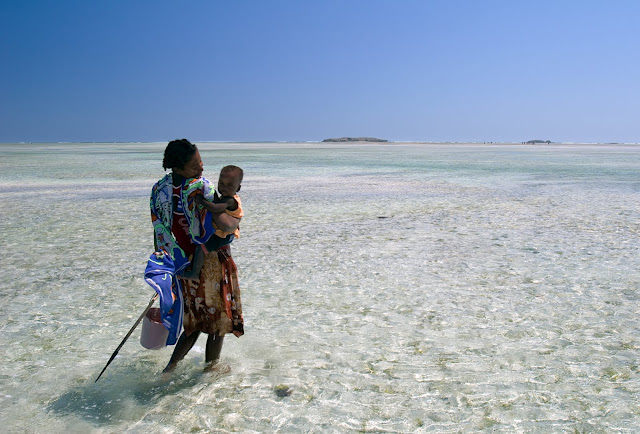
But other PHE programs are expanding: Based in southwestern Madagascar, the Blue Ventures program began as an ecotourism outfit, said Program Coordinator Matt Erdman, but has since grown to incorporate marine conservation, family planning, and alternative livelihoods. A major challenge is its rapidly growing population, which threatens the residents’ health and food security, as well as the natural resources on which they depend. More than half the island’s population is younger than 15, and the infant and maternal mortality rates are high, Erdman said.
In response, Blue Ventures set up a family planning program. The program uses a combination of clinics, peer educators, theater presentations, and sporting events, such as soccer tournaments, to spread information about health and family planning. The HELPS project will soon publish a Focus brief on Blue Ventures’ family planning efforts, titled: “To Live with the Sea.”
Erdman said, “If you have good health, and family size is based on quality, families can be smaller and [there will be] less demand for natural resources, leading to a healthier environment.”
Demographic Security
A country’s age structure can pose a challenge, said Jennifer Dabbs Sciubba, the Mellon Environmental Fellow with the Department of International Studies at Rhodes College, at a March 14 Wilson Center event. Countries with a large percentage of people younger than 30 “are [much] more likely to experience civil conflict than states with more mature age structures.”
Tunisia’s recent revolution, Sciubba said, could be understood as a “story about demography.” Countries with transitional age structures, such as India, Brazil, and South Africa, face different security challenges. With a majority of their populations between 15 and 60 years old, more people are contributing to the economy than are taking away, which could bolster these countries economically and politically. Global institutions will have to reform and include these countries, she advised, “or else become irrelevant.”
“Understanding population is critical to our success in being able to prevent conflict, and also managing conflict and crises once we’re involved,” said Kathleen Hicks, Deputy Undersecretary at the Department of Defense (DOD). However, the DOD does not “treat demographics as destiny,” she said, but instead as “one of several key trends, the complex interplay of which may spark or exacerbate future conflicts.”
Demography can also help predict political trends. In 2008, demographer Richard Cincotta predicted that between 2010 and 2020 the states along the northern rim of Africa – Morocco, Algeria, Tunisia, Libya, and Egypt – would each reach a demographically measurable point where the presence of at least one liberal democracy among the five would be probable. Recent months have brought possible first steps to validate that prediction.
Mathew Burrows, counselor at the National Intelligence Council, said Cincotta’s work demonstrates that “the demographic tool is essential” to analysts and policymakers. “There is a real appetite among policymakers” for understanding demography, he said, because it gives them more structure than political science narratives.
Yemen is another example of this trend. In March, tens of thousands of youth-led demonstrators demanded that their president resign. While numerous factors have sparked the “Arab Spring,” one driving force is Yemen’s dire demographic and environmental situation. Some experts say Yemen may be the first country to run out of groundwater. The average Yemeni woman has more than five children, and 45 percent of its population is below age 15. On May 18, Yemeni and international experts discussed these issues at the Wilson Center. Upcoming HELPS events include daylong conferences on Afghanistan and Nigeria.
There are solutions that can break the links between “youth bulges” and insecurity. In a recent video interview discussing the connection between demography and civil conflict, Elizabeth Leahy Madsen, a senior research associate at Population Action International, said, “Policies that have a major impact over time are ensuring education, especially for girls, and providing employment opportunities to the large and growing numbers of young people today.”
Dana Steinberg is the editor of the Wilson Center’s Centerpoint.
Photo Credit: Blue Ventures in Madagascar, courtesy of Garth Cripps.