Showing posts from category urbanization.
-
Meeting the Health Challenges of the Urban Poor
›November 2, 2010 // By Joshua NickellFifty percent of the world’s population now lives in cities, a figure that is predicted to rise to 60 percent by 2030, and 70 percent by mid-century, according to UN figures. The majority of this growth will occur in the Global South, where most of the world’s slums are found.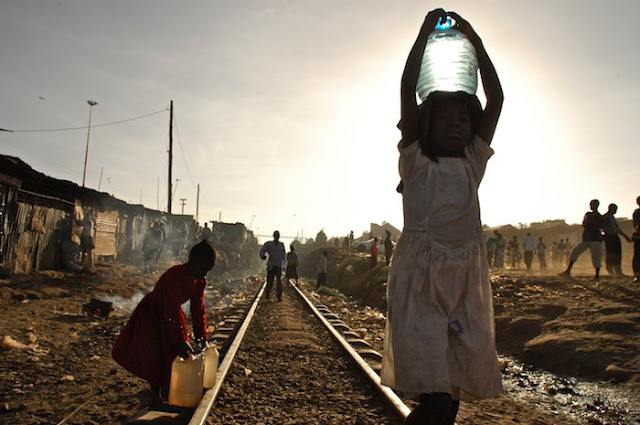
Why the rampant urban migration? Prospects for better health care, education, and employment are drawing the world’s poor out of rural areas into cities. But as the number of impoverished city-dwellers and slums grows, it is becoming increasingly important for society to consider how it will address the problems associated with this unprecedented degree of global urbanization.
At a recent event, “Meeting the Health Challenge of Urban Poverty and Slums,” co-hosted by the Wilson Center on the Hill program and the Comparative Urban Studies Project, Jacob Kumaresan, director of WHO Center for Health Development in Kobe, Japan, and Richard B. Lamporte, director of new program development, Jhpiego, discussed poverty and health challenges in rapidly growing urban slums.
The chances that the world’s rapidly growing number of city-dwellers will live a healthy and prosperous life depend on the services and opportunities cities can offer. As Kumaresan pointed out, there is currently no shortage of problems. Among other ills, he stated that 170 million urban residents currently do not have access to a latrine, while more than 1.2 million people will die from urban air pollution this year alone. As more individuals migrate to cities, these problems will be compounded.
Kumaresan also noted that cities have the “worst and the most unimaginable disparities when it comes to health.” While urban centers have more hospitals and attract many of the best doctors, the hospitals are often not managed or governed well. As a result, many poor urbanites suffer worse health care than their rural neighbors.
For instance, Kumaresan noted that tuberculosis rates in rural parts of India are half those of urban settings. Kumaresan also emphasized that these disparities are certainly not limited to the Global South: developed cities like New York and Los Angeles contend with similar inequities.
To address these issues, Kumaresan encouraged policymakers to examine the unique circumstances and conditions of their cities. “You’ve got to do analytical work to see what the problems are in each city, and to look not at the averages, but to unmask the differentials,” he said.
In Osaka, Japan, tuberculosis rates are 12 times higher than the rest of the country, said Kumaresan, primarily because of high affliction rates among its homeless population. As such, it is important for Osaka’s policymakers to address its tuberculosis problem by considering related socio-economic factors and following through with concrete policy actions.
Lamporte emphasized the importance of giving aid and development organizations flexible funding in order to allow them to better address unique local urban problems and inequities. He advised international donors to devote a certain percentage of their funding to integrated initiatives. “Certainly the goalposts could be set, but having some element of complementary funding … would be extremely useful,” he said.
As both Lamporte and Kumaresan pointed out, the future of the city is increasingly becoming the future of the world. As such, it is crucial to have “an urban optic going into the future,” according to Lamporte. If not, he argued, it will be at our own peril, as disease and unrest find increasingly sturdy footholds in urban slums. As the transformation from a rural to an urban planet continues, it will be essential for emerging and growing cities must use successful urban development techniques from both the Global North and the South.
Joshua Nickell is an intern with the Program on America and the Global Economy.
Sources: IRIN, Osaka University Graduate School of Medicine, UN, World Health Organization.
Photo Credit: “kibera_photoshow08,” courtesy of flickr user newbeatphoto. -
Assessing Our Impact on the World’s Rivers
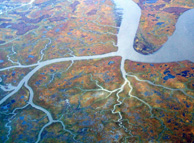
› In a special “Rivers in Crisis” issue of Nature, the lead article, “Global Threats to Human Water Security and River Biodiversity,” presents damning evidence that manipulation of river systems — through the construction of canals, levees, hydroelectric projects, and other infrastructure — has caused serious and lasting biological damage to watersheds throughout both the developing and developed worlds. The authors (all 11 of them!) report that key rivers have become shadows of their former selves in terms of the amount of aquatic life they can support. Without drastically improved stewardship of waterways, “we are pushing these river systems toward catastrophe,” warns Peter McIntyre, an article co-author.The human impact on the world’s river systems will be hard to reverse, says Margaret Palmer, author of a second Nature article on freshwater biodiversity loss, “Beyond Infrastructure.” Human-induced changes to watersheds affect local hydrology at a fundamental level, she contends, weakening rivers’ ability to deliver crucial “ecological goods and services” — such as clean water and nutrient-rich sediment loads — that help maintain the health of local environments and the human populations that depend on them. To fully understand the scope of the problem, Palmer says more research is needed to explore the linkages between biodiversity levels and “ecosystem services” that healthy rivers provide.
 -
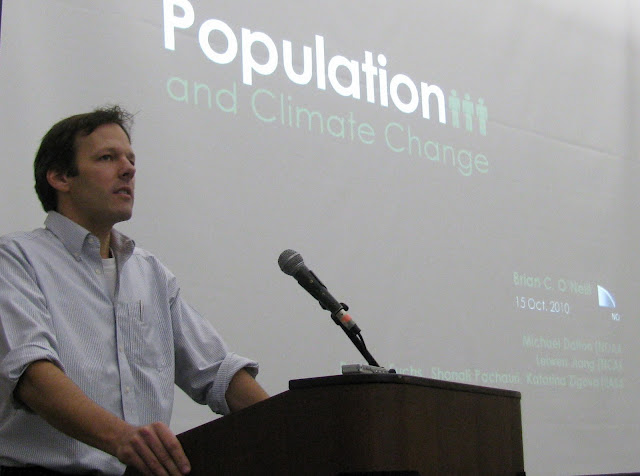
Brian O’Neill: Population is Neither a Silver Bullet nor a Red Herring in Climate Problem
›October 16, 2010 // By Meaghan Parker“Slower population growth would not solve the climate problem, but it could make a contribution. It is neither a silver bullet nor a red herring,” said Brian O’Neill of the National Center for Atmospheric Research at the annual Society of Environmental Journalists’ conference in Missoula, MT. On Friday, he presented the results of a new demographic study as part of a panel, “Population, Climate, and Consumption,” moderated by Ken Weiss of the Los Angeles Times.
-
New Study Finds Lower Population Growth Could Cut Carbon Emissions
›A new study, “Global Demographic Trends and Future Carbon Emissions,” finds that slowing population growth by 2050 would meet 16-29 percent of the reductions in carbon emissions necessary to avoid dangerous climate change — roughly equivalent to 1-1.5 “stabilization wedges.” Published in PNAS this week, the article reports the results of a comprehensive assessment, led by Brian O’Neill of the National Center for Atmospheric Research (NCAR), of the impact of demographic changes, including urbanization and aging, on global carbon emissions.
The authors conclude that policies designed to meet the substantial unmet need for family planning and reproductive health services, particularly in the United States and developing countries, would lead to emission reductions that amount to about one-half of a wedge. These results suggest that “family planning policies would have a substantial environmental cobenefit,” they write.
O’Neill will discuss the study’s results and recommendations on Friday morning at the annual Society of Environmental Journalists’ conference in Missoula, MT. The panel, “Population, Climate, and Consumption,” which I helped organize, will be moderated by Ken Weiss of the Los Angeles Times. Weiss wrote on the Times’ Greenspace blog that “the study offers a novel way to quantify how changes in human population influence the buildup of greenhouse gases in the atmosphere.”
To tease out the complex connections between climate, population, and consumption, O’Neill and his coauthors looked beyond population size to delve into household location and composition. They found that urbanization and aging trends will have differential–and potentially offsetting–impacts on carbon emissions.
Aging, particularly in industrialized countries, will reduce carbon emissions by up to 20 percent in the long term. On the other hand, urbanization, particularly in developing countries could increase emissions by 25 percent.
The Taboo Against Mixing Condoms and Climate
Most coverage to date, including the widely distributed press release from the National Science Foundation, overlooked the study’s recommendations to increase access to family planning and meet unmet need for contraception as a climate mitigation strategy.
Unfortunately, that’s the case in many venues: “You don’t see policymakers talking about in the climate negotiations,” climate scientist Richard Somerville told Weiss. Family planning has long been off the table–Mother Jones recently called it “The Last Taboo” – especially at the big climate conferences. At Copenhagen, it was only discussed at side events; NYT’s Andrew Revkin called it the “missing ‘P’ word.“
One of this year’s panelists, Laurie Mazur, who last year published, A Pivotal Moment: Population, Justice and the Environmental Challenge, will likely explore the environmental cobenefits of improving women’s reproductive health. In addition to mitigation, some developing countries have identified family planning as a strategy in their national climate adaptation plans.
Growth Story: Population at SEJ
Friday’s panel is the only one to consider population’s role in environmental issues at this year’s SEJ conference, the premier event for U.S. environmental journalists. Given the issue’s historic marginalization within environmental community, that’s not necessarily surprising.
But there appears to be a growing interest among reporters: last year’s SEJ panel on population moderated by Tim Wheeler of The Baltimore Sun drew a standing-room-only crowd, following a popular 2008 SEJ panel on the topic moderated by Steve Curwood of Living on Earth.
More surprisingly, Friday’s panel is one of less than a handful at this year’s conference to address international environmental issues. I hope next year’s conference in Miami will draw on that city’s vibrant immigrant community and short flights to Latin America and the Caribbean to bring in more international flavor.
Sources: DotEarth, Greenspace, National Science Foundation, Population Action International, UNFPA. -
Meeting the Needs of Latin America’s Rural and Urban Populations
›October 14, 2010 // By Kayly OberThere are two Latin Americas according to demographers. In one of the most urbanized regions of the world, the population of some countries remains highly rural. While countries like Chile, Argentina, and Uruguay are close to 90 percent urbanized, much of Central America, as well as Ecuador, Paraguay, and Bolivia, are only about 50-60 percent urban.
Across the continent, Latin America’s total fertility rate has fallen from almost six children per woman in the 1960s to 2.2 children in 2005. Population growth rates are projected to continue to decline from 1.5 percent in 2010 to roughly 0.75 percent by 2020. But less-urbanized countries continue to experience high population growth in their rural areas, particularly among their large indigenous populations, who are not experiencing the same shifts from high to low fertility.
For example, since 1990, communities surrounding Guatemala’s Sierra de Lacandon National Park have grown by 10 percent each year, with birthrates averaging eight children per woman. These larger communities and households have led to agricultural expansion into the park, which has lost 10 percent of its forest canopy since 1990.
Rural-to-rural migration is also a key, but often overlooked, dynamic as migrants move to other rural areas in search of new land to farm. Between 1961 and 2001, Central America’s rural population increased by 59 percent. This increased population was accompanied by a 15 percent increase in deforestation, totaling some 13 million hectares.
Although many rural areas of Latin America have high fertility rates and expanding populations, they also have a high unmet demand for contraception. Indigenous populations are particularly underserved by health providers for many reasons, including cultural barriers, language, and accessibility. According to the Population Reference Bureau, an estimated 50 percent of indigenous women in the Ecuadorian Amazon do not want another child, yet 98 percent of them do not have access to a modern contraceptive method.
While reaching historically disadvantaged populations in rural communities is not easy, some programs have had considerable success—and saved money—by combining environmental and health efforts. For example, the Guatemalan NGO ProPeten trained more than 80 midwives and health promoters and developed a radio soap opera in both Spanish and Q’eqchi’ to deliver health services and environmental education to the communities living near the Maya Biosphere Reserve.
Given links between rural population growth and agricultural expansion, expanding access to family planning may not only be a cost-effective way to help women reach their desired family size, but also a smart investment in forest conservation and climate mitigation—and perhaps a down-payment on a more secure future for all. -
The Tenth Parallel: Dispatches From the Fault Line Between Christianity and Islam
›The latitudinal tenth parallel — located 700 miles above the equator — constitutes a “faith-based fault line” between Islam and Christianity, said Eliza Griswold at the launch of her latest book, The Tenth Parallel: Dispatches from the Fault Line Between Christianity and Islam at the Wilson Center on September 16, 2010. The former Wilson Center public policy scholar traveled more than 9,000 miles to six countries along the line. One quarter of the world’s Muslim population lives north of the line, while one-fourth of the world’s Christian population lives south of it.
Religious Conflict and Environmental Peacemaking
The tenth parallel is vulnerable to intense religious conflicts, exacerbated by the imposition of colonial-era national borders. Griswold collected stories from tribal leaders, presidents, and missionaries that reveal subtle linkages between religious conflict, politics, and environmental change. “Every single religious conflict I saw had a worldly trigger, whether land, oil, or water,” she said, because these groups tend to self-identify along lines of religion, “even over any kind of ethnicity.”
In the town of Abiay, Sudan, Griswold described a fight “over who’s going to get that oil, and how they’re going to divide themselves. Religion comes in as an overlay, because the north pushes the people of the south farther south by saying, ‘Guess what? We need that land, and why? Because our Muslim people need that land for their cattle,’ but underneath that land runs a river of oil.”
But in these origins of conflict Griswold finds an avenue to peace: “Environmental challenges seem to work well in areas of religious conflict” as a neutral meeting ground, she said.
For example, in the Nigerian city Kaduna, where Christians and Muslims have clashed violently, two former mortal enemies and self-avowed fundamentalists work together to deprogram the youth they trained to protect their faith through violence. At the Interfaith Reconciliation Center, Pastor James (who lost an arm to a group of Muslims) and Imam Muhammed Nurayn Ashafa use practical aspects of living to encourage interfaith dialogue. During Griswold’s visit, it was fuel-efficient cookstoves, “because that’s one of the things Christians and Muslims fight about…whether land, water, oil.”
Such concrete examples of environmental peacemaking offer future policy options for mitigating conflicts in other areas. “The tenth parallel is one of the most sensitive environmental zones in the world…so do I think it’s replicable? Absolutely,” said Griswold.
The Changing Demographics of Religion
Today, “four out of five of the world’s one billion Muslims don’t live in the Middle East; they live in Africa and they live in Asia. More than half of them live along the tenth parallel, and about half of the world’s two billion Christians also live along the tenth parallel,” sais Griswold.
She explained that the migration of Islam to Africa stopped along the tenth parallel because of the tsetse flies and the devastating sleeping sickness they carried.
Later, colonial-era European missionaries arrived, many with “the express purpose of stopping Islam from winning Africa, from spreading south of the tenth parallel,” she said. For example, Britain’s division of Sudan restricted Muslims to the north and Christians to the south, where missionaries developed and constructed the southern Sudanese state.
“Many of these places are failed states…and religion has come in largely to fill the gaps,” said Griswold. “The world is breaking down on tribal lines and religion is the largest tribe there is, more so than ethnicity, more so than other global markers.”
Based on population projections, Griswold pointed out that “the center of Christianity, in 2050 will be on the tenth parallel…in Muslim Nigeria.”
Historical Echoes
Historically, aid and development work along the tenth parallel “was not a secular enterprise,” Griswold said, since most of the aid workers were Christian missionaries. “So there is a very long history and a very strong association between the West and Christianity in many, many places,” she pointed out.
This history has long affected American foreign policy and perceptions of the United States abroad. According to Griswold, “foreign policy [has] come to reflect the interests of selective groups of Americans.” For that reason, “we really need to call for caution in how we allow ourselves to be represented and in the diversity of voices that get out there,” she advised.
For example, the evangelical preacher Franklin Graham met with Bashir in 2003 to ask for the right to proselytize in northern Sudan. In exchange, Bashir hoped to avoid being added to “the American ‘hit list’ after Afghanistan and Iraq,” reported Griswold. Graham told her that in response he took out a George W. Bush re-election pin and said, “Mr. President, I understand you’ll be talking to my president later today. Why don’t you tell him you’re his first voter here in the Sudan?”
In the same vein, Griswold cautioned against perpetuating American ignorance of Muslim culture:We, especially in America, are extremely aware of this fight over who speaks for God. Because I think, when we see what’s happening on the steps of the Lincoln Memorial or at Ground Zero, we’re looking at a struggle inside of a broader Christian context between Franklin Graham and Barack Obama over who a true Christian is. And Islam becomes the easiest bogeyman. The quickest way to whip up fear in followers is to create a shared enemy.
“The single most important finding of the book,” Griswold concluded, “was that the clashes within religions, the clashes between Christians and Christians, Muslims and Muslims, over who has the right to speak for God, are the most important and most overlooked religious conflicts going on today.”
Shawna Cuan is an intern with the Environmental Change and Security Program. Edited by Meaghan Parker.
Photo Credit: “Farmer Harvests Sorghum Seeds in Sudan,” courtesy of flickr user United Nations Photo. -
“All Consuming:” U of M’s ‘Momentum’ on Population, Health, Environment, and More
›August 23, 2010 // By Schuyler NullMinnesota’s Institute on the Environment is only in its third year of operation but has already established itself as an emerging forum for population, health, and, environment issues, due in no small part to its excellent thrice-a-year publication, Momentum. The journal is not only chock-full of high production values and impressively nuanced stories on today’s global problems, but is also, amazingly, available for free.
Momentum has so far covered issues ranging from food security, gender equity, demographic change, geoengineering, climate change, life without oil, and sustainable development.
Highlights from the latest issue include: “Girl Empower,” by Emily Sohn; “Bomb Squad,” with Paul Ehrlich, Bjørn Lomborg, and Hans Rosling; and “Population Hero,” on the fiscal realities of stabilizing growth rates.
The lead story featured below, “All Consuming,” by David Biello, focuses on the debate over whether consumption or population growth poses a bigger threat to global sustainability.Two German Shepherds kept as pets in Europe or the U.S. use more resources in a year than the average person living in Bangladesh. The world’s richest 500 million people produce half of global carbon dioxide emissions, while the poorest 3 billion emit just 7 percent. Industrial tree-cutting is now responsible for the majority of the 13 million hectares of forest lost to fire or the blade each year — surpassing the smaller-scale footprints of subsistence farmers who leave behind long, narrow swaths of cleared land, so-called “fish bones.”
Continue reading on Momentum.
In fact, urban population growth and agricultural exports drive deforestation more than overall population growth, according to new research from geographer Ruth DeFries of Columbia University and her colleagues. In other words, the increasing urbanization of the developing world — as well as an ongoing increase in consumption in the developed world for products that have an impact on forests, whether furniture, shoe leather, or chicken fed on soy meal — is driving deforestation, rather than containing it as populations leave rural areas to concentrate in booming megalopolises.
So are the world’s environmental ills really a result of the burgeoning number of humans on the planet — growing by more than 150 people a minute and predicted by the United Nations to reach at least 9 billion people by 2050? Or are they more due to the fact that, while human population doubled in the past 50 years, we increased our use of resources fourfold?
Photo Credit: “All Consuming” courtesy of Momentum. -
‘UK Royal Society: Call for Submissions’ “People and the Planet” Study To Examine Population, Environment, Development Links
›August 12, 2010 // By Wilson Center StaffBy Marie Rumsby of the Royal Society’s In Verba blog.
In the years that followed the Iranian revolution, when Ayatollah Khomeini returned from exile to Tehran and the country went to war against Iraq, the women of Iran were called upon to provide the next generation of soldiers. Following the war the country’s fertility rate fell from an average of over seven children per woman to around 1.7 children per woman – one of the fastest falls in fertility rates recorded over the last 25 years.
Iran is an interesting example but every country has its own story to tell when it comes to population levels and rates of change. The global population is rising and is set to hit 9 billion by 2050. And whilst fertility rates in Ethiopia are on the decline, its total population is projected to double from around 80 million today, to 160 million in 2050.
Earlier this month, the Royal Society announced it is undertaking a new study which will look at the role of global population in sustainable development. “People and the Planet” will investigate how population variables – such as fertility, mortality, ageing, urbanization, and migration – will be affected by economies, environments, societies, and cultures, over the next 40 years and beyond.
The group informing the study is chaired by Nobel Laureate Sir John Sulston FRS, and includes experts from a range of disciplines, from all over the world. With names on the group such as Professor Demissie Habte (President of the Ethiopian Academy of Sciences), Professor Alastair Fitter FRS (Professor Environmental Sciences, University of York) and Professor John Cleland FBA (Professor of Medical Demography, London School of Hygiene and Tropical Medicine), there’s bound to be some lively discussions.
Linked to the announcement of the study, the Society held a PolicyLab with Fred Pearce, environmental journalist, and Jonathon Porritt, co-founder of Forum for the Future, to discuss the significance of population in sustainable development.
Both speakers have been campaigning against over-consumption for many years. Jonathon Porritt has been a keen advocate for fully funded, fully engaged voluntary family planning in every country in the world that wants it.
“In my opinion, that would allow us to stabilize global population at closer to 8 billion, rather than 9 billion. And if we did it seriously for forty years, that is an achievable goal.” Porritt thinks that stabilizing global population at 8 billion rather than 9 billion would save a large number of women’s lives, and suggests “you cannot ignore the gap between 8 billion and 9 billion if you are thinking seriously about climate change.”
Fred Pearce acknowledges that population matters, but stresses that it is consumption (and how we produce what we produce) that we need to focus on. He feels it is too convenient for us to focus on population.
According to Fred, the global average is now 2.6 children per woman – that’s getting close to the global replacement level of 2.3 children per woman.
“It is no longer human numbers that are the main threat……It’s the world’s consumption patterns that we need to fix, not its reproductive habits,” said Pearce.
The Society will be taking a long look at some of these issues, assessing the latest scientific evidence and uncertainty around population levels and rates of change. The “People and the Planet” study is due for publication in early 2012, ahead of the Rio+20 UN Earth Summit. The Society is currently seeking evidence to inform this study from a wide-range of stakeholders.
The deadline for submissions is October 1, 2010. For more information on submissions, please see the Royal Society’s full call for evidence announcement.
Image Credit: “In Verba” courtesy of the Royal Society.