-
Indonesia: Pioneering Community Outreach Creates Success Story
›January 31, 2012 // By Elizabeth Leahy MadsenThis is the third post in a series profiling the process of building political commitment in countries whose governments have made strong investments in family planning. Previous posts have profiled Rwanda and Iran.
While the two other countries profiled in this series, Rwanda and Iran, have only reinvigorated their family planning programs within the past 20 years, Indonesia’s story begins in the 1960s. In this respect, the world’s fourth most populous country is classified among the pioneers of family planning in the developing world and has been described as a “world leader” and “one of the developing world’s best.” An extensive community outreach program combined with a centralized government that made family planning a priority were key to Indonesia’s success story.
Jakarta Pilot and Religious Support Motivates National Scale-up
For a decade and a half after the struggle for independence from the Dutch ended in 1949, the government of President Sukarno ruled out any government support for family planning. According to a Demographic and Health Survey (DHS) report, the rate of contraceptive use among married women at the time was essentially zero. Fertility rose slightly during this period, from an average of 5.5 in the early 1950s to 5.6 children per woman a decade later. However, in 1965, Sukarno was overthrown, and the next year, a military general named Suharto assumed power in an uprising that left as many as half a million people dead.
Suharto’s regime would last until 1998. Though he operated with a “heavy hand” amidst personal corruption, Suharto also aggressively pursued economic development and brought about a policy shift towards promoting family planning. Despite initial reservations – Suharto believed that the people would oppose family planning on religious grounds – various domestic and international advisers convinced him otherwise.
General Ali Sadikin, the governor of Jakarta – a city of three million even then – was particularly influential in convincing Suharto. According to Australian demographer Terence H. Hull, who has written extensively about population issues in Indonesia, Sadikin was “quickly learning demographic lessons in his attempts to renovate a city with poor housing, schooling, transport, and basic services,” and he began to regularly speak out about the challenges that rapid population growth posed to his goals of urban development.Sadikin decided to support the Indonesian Planned Parenthood Association, which had a network of clinics offering family planning, but lacked the funding to meet more than a small amount of demand. With the public support of Sadikin, a Jakarta-wide pilot program was operational in 1967.
Hull reports that a second integral event in the early years was a 1967 meeting between government officials and Muslim, Protestant, Catholic, and Hindu leaders representing four of the country’s major religions. Following the meeting, a pamphlet called “Views of Religions on Family Planning” was published, representing “a tipping point when national consensus around the morality of birth control was turning from strongly negative to strongly positive.”
A Strong Coordinating Board Reaches out to Communities
By late 1968, efforts were in place to scale up the family planning program in Jakarta to the national level. The National Family Planning Coordinating Board (BKKBN in Indonesian) was created and quickly became entrenched throughout the country thanks to generous funding, including from international donors.
The BKKBN’s emphasis on the community level, which ensured that family planning services and awareness-generating activities were reaching people around the country through multiple channels, was a key factor in the program’s achievements. The organizations involved in promoting family planning messages at the community level included youth, women’s and religious groups, employers, and schools, with high-level support reiterated regularly by the president. Hull described the BKKBN’s efforts as “a true collaboration because the program emphasized institutions not normally associated with family planning, but did so in a way that was both socially acceptable and socially invigorating.”
In the program’s first two decades, the contraceptive prevalence rate for modern methods rose from almost nonexistent to 44 percent, and fertility subsequently fell from 5.5 to 3.3 children per woman. These changes are widely attributed to robust government sponsorship from the highest levels, together with effective grassroots implementation that fostered support from nearly all sectors of society.
In subsequent years, Indonesia experienced rapid economic and social development. Per capita income increased more than 20 times over between 1966 and 1996, with initial growth largely due to oil revenues. Other development indicators also improved dramatically. The literacy rate is now over 90 percent, nearly all girls attend school, and half of women are members of the labor force. However, Hull cautions against proclaiming the family planning program the primary causal factor in these successes. Family planning and other development programs would not have been as effective, he says, without changes in the political structure, which steadily became more centralized and stable in its oversight of a very heterogeneous society.
A Recent PlateauAs Indonesia continued to develop and its political system evolved, the family planning program has faced some challenges in the past 15 years. Suharto resigned in the face of widespread opposition in 1998, after more than 30 years in power. While this brought positive movement towards democracy, the ensuring political uncertainty shifted the government’s energies away from reproductive health and other aspects of social development.
In the early 2000s, the family planning program was decentralized to district and municipal levels, in line with political reforms aimed at diminishing the role of central hierarchy nationwide. District leaders were charged with planning, budgeting, and implementing family planning and other primary health services. In accordance, BKKBN modified its strategies to become even more community-oriented. Still, observers judge the family planning program to have “weakened” following decentralization.
With strong logistics, popular support, and donor assistance, contraceptive use continued rising during the years of political transition. By 2002-2003, 57 percent of married women were using a modern contraceptive method and the fertility rate had reached 2.6 children per woman. However, these indicators remained unchanged in the next national survey, conducted in 2007. Fertility in Indonesia is at the median for Southeast Asia – higher than Thailand and Vietnam and lower than Cambodia and the Philippines.
The Program Moves Forward
As democracy became more secure in the early 2000s, the country’s next generation of leaders kept sight of demographic issues. In 2005, President Susilo Bambang Yudhoyono stated, “High population growth without rapid economic growth will result in poverty and setbacks … Large numbers of children and high populations will only bring advantages if they are skilled.” BKKBN and the Ministry of Health worked with USAID, public health researchers, NGOs and others to develop national family planning standards for quality of care, which were devised and implemented in the early 2000s.
Judging the program’s achievements to have been substantial and its momentum sustainable, USAID graduated Indonesia from population assistance in 2006, after 35 years. Though gaps remain, women’s fertility preferences are largely being met.
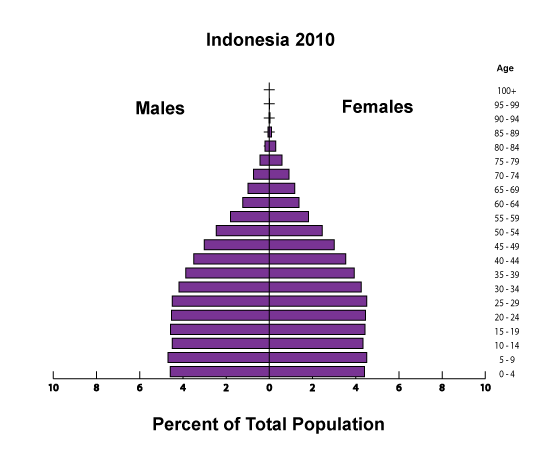
Today, 80 percent of all births are intended, and unmet need for family planning – the share of married women who wish to delay or prevent pregnancy but are not using contraception – stands at nine percent, two percentage points below the average for Southeast Asia and all developing countries. Meanwhile, Indonesia’s demographic profile looks much different than it might have. At the time of graduation, USAID reported that without its long-standing and well administered family planning program, Indonesia’s 2006 population would have been larger by 80 million people, or 35 percent.
Elizabeth Leahy Madsen is a consultant on political demography for the Wilson Center’s Environmental Change and Security Program and senior technical advisor at Futures Group.
Sources: Demographic and Health Surveys; Hull (2007); Management Sciences for Health; New York Times; UN Population Division; USAID.
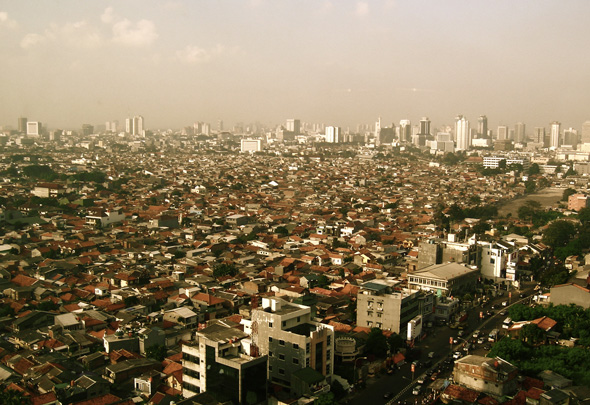
Photo Credit: “Jakarta,” courtesy of flickr user frostnova. -
Richard Black: Future Climate-Migration Interactions Will Stress Cities, “Trap” Vulnerable Populations
›“In a 50-year time span, climate change, in particular, is likely to have a quite a strong impact on the drivers of migration,” said Richard Black, professor of human geography at University of Sussex and lead author of Migration and Global Environmental Change: Future Challenges and Opportunities. “But in a way that is different to what has been understood until now.”
-
Call for Papers: Reducing Urban Poverty
›The Woodrow Wilson Center’s Comparative Urban Studies Project, USAID, the International Housing Coalition, the World Bank, and Cities Alliance are teaming up a third time to co-sponsor an academic paper competition for graduate- and PhD-level students focused on challenges facing urban centers in the developing world.
The themes of this year’s competition are land markets, global climate change, and youth.
Land Markets: The absence of efficient land and housing markets and lack of secure tenure for both renters and owners are impediments to urban and economic development in developing cities. Papers on this topic should explore strategies and approaches that would enable property markets to function better and would provide increased security of tenure and strengthened property ownership rights.
Global Climate Change: Papers should examine how urban populations, especially the poor, are coping with the impacts of climate change, and provide strategic policy analysis to better understand how cities can become more resilient to climate change impacts.
Youth: Most of the youth of the developing world are now or will soon be living in urban areas. Unfortunately, they are often growing up in the poorest urban areas – informal settlements and slum communities where their opportunities for advancement are limited by a variety of negative factors. Papers focused on youth should explore ways to build capacity so that you can develop knowledge and skills, find gainful employment, and participate more fully in society to advance economic growth and social development.
Winning papers from each category will be published and the authors invited to Washington, D.C. in the fall of 2012 for a policy workshop with subject matter experts. Additionally, one grand prize winner will be asked to present his or her work at the World Urban Forum (WUF). WUF was established by the United Nations to examine rapid urbanization and its impact on communities, cities, economies, climate change, and policies. The sixth WUF will be held from September 1-7, 2012 in Naples, Italy and will be focused on “The Urban Future.” In addition to the Washington conference and publication of his or her paper, the grand-prize winner will be invited to present his or her winning paper on a panel at the World Urban Youth Assembly at WUF on September 1st and 2nd.
The deadline for the submission of abstracts is February 20, 2012.
For detailed competition guidelines and requirements, and further information on the sub-topics, please see the full call for papers.
Image Credit: “Split by yelowcap,” courtesy of flickr user yelowcap (Vladimir Kaštier). -
George Washington University’s PISA Helps Share Rural Vietnamese Climate Adaptation Strategies
›“Climate change is not a topic of debate in Vietnam, it’s a real challenge to future prosperity and security,” says George Washington University’s Partnerships for International Strategies in Asia (PISA) program in this video about their climate adaptation and mitigation work in Nam Dinh province. “[Vietnam’s] population density (265 people/square kilometer), its long coastline (3,444 km), its two major rivers (the Red and Mekong) – all help make it one of the 10 countries considered most vulnerable to climate change,” the narrator says.
-
Reducing Urban Poverty: A New Generation of Ideas
›Download Reducing Urban Poverty: A New Generation of Ideas from the Wilson Center.
In 2008 the global population reached a remarkable turning point; for the first time in history, more than half of the world’s people were living in cities. Moving forward into the 21st century, the world faces an unprecedented urban expansion with projections for the global urban population to reach nearly five billion by the year 2030. Virtually all of this growth will occur in the developing world where cities gain an average of five million residents every month, overwhelming ecosystems and placing tremendous pressure on the capacity of local governments to provide necessary infrastructure and services. Failure to incorporate urban priorities into the global development agenda carries serious implications for human security, global security, and environmental sustainability.
Recognizing a need to develop and strengthen urban-focused practitioner and policymaking ties with academia, and disseminate evidence-based development programming, the Wilson Center’s Comparative Urban Studies Project, USAID’s Urban Programs Team, the International Housing Coalition, the World Bank, and Cities Alliance teamed up to co-sponsor an academic paper competition for graduate students studying urban issues. The first competition took place in the months leading up to the 5th World Urban Forum, held in Rio de Janeiro in March 2010.
This publication, Reducing Urban Poverty: A New Generation of Ideas, marks the second annual academic paper competition. “Reducing urban poverty” was chosen as the theme with each author focusing on one of three topics: land markets and security of tenure; health; and, livelihoods. A panel of urban experts representing the sponsoring institutions reviewed 70 submitted abstracts, from which 16 were invited to write full length papers. Of these, six were selected for this publication. We congratulate the graduate students who participated in this competition for their contribution to our understanding of the complex relationship between urbanization and poverty.
These papers highlight the new research and innovative thinking of the next generation of urban planners, practitioners, and policymakers. It is our hope that by infusing the dialogue on these issues between the academic and policy worlds with fresh perspectives, we will foster new and innovative strategies to reduce global urban poverty.
Sources: UNFPA, UN-HABITAT. -
Emily Puckart, MHTF blog
Maternal Health in Kenya: New Research Unnecessary, Time to Address Existing Gaps
›The original version of this article, by Emily Puckart, appeared on the Maternal Health Task Force blog.
During the recent Wilson Center/African Population and Health Research Center meeting in Nairobi on improving health systems through a maternal health framework, participants focused on knowledge gaps in the Kenyan health system that can negatively affect maternal healthcare. This focus on gaps sparked discussion around research needed (or not needed) in the maternal health field, supply gaps, and gaps between addressing technical, medical issues of maternal health (like preeclampsia or postpartum hemorrhage), and larger society-wide gaps like gender equity. The gaps highlighted by participants at the Nairobi dialogue included:- Gaps in knowledge: During the dialogue, members of the Kenyan maternal health community discussed the possibility of strengthening community health workers as an information delivery platform. Participants wondered about the possibility of using community health workers to distribute information both downward to the end user (patients), and then again to gather information from end users and distribute it upwards through the system to reflect the opinions of the direct users of the healthcare system.
- Supply gaps: Participants argued that while there is a large body of information in terms of maternal health supplies at the national level in Kenya, there is not as much data on supplies at the actual health facility level, where it is much needed and would be very helpful to successfully treat patients.
- Gaps in healthcare delivery: There is a strong need to address inequality in the distribution of health services as there are unequal services in rural and urban areas. Within those broad areas there may be further inequalities, as even in urban areas, slum areas or neighborhoods on the edges of cities may have less access to quality healthcare than populations that live in wealthier areas of the city or closer to the city center. Further there are broader questions of gender and access to care. Where women are not able to control household finances, they may be unable to access and pay for lifesaving care. Participants framed the question in a rights framework, “Do we value the lives of women less than men?”
- Health workforce gaps: There is a mismatch between the supply of health workers and the absorption of those trained health workers in Kenya. Many of them are not incentivized professionally or financially to stay in the system where they are trained. These health workers may leave for other countries or prefer to stay in urban areas depriving rural areas of a surplus of trained health workers.
- Gaps between words and actions: Several of the small working groups pointed to accountability as a serious issue, as there are gaps between the words of politicians on health issues and actual actions. The gap between the government promised funding for health and the actual lower amount of spending was consistently highlighted during the Nairobi dialogue as a serious gap in holding governments accountable for their promises.
The lively conversation provoked by a broad discussion of gaps in the Kenyan health system provided fertile ground to develop action points on maternal healthcare that participants then presented on the second day of the meeting to several Kenyan members of parliament. Ideally, this will be the first discussion of many as maternal health advocates, field workers, and researchers coalesce around ways to address the gaps in maternal healthcare in Nairobi and elsewhere.
Emily Puckart is a senior program assistant at the Maternal Health Task Force (MHTF).
Photo Credit: Jonathan Odhong, African Population and Health Research Center. -
Twin Challenges: Population and Climate Change in 2050
›With global population reaching 7 billion, a lot of attention has been paid to the question of how to sustainably support so many people, much less the 9 billion expected by 2050, or the 10 billion possible by 2100. Add in the environmental variability projected from climate change and the outlook for supporting bigger and bigger populations gets even more problematic. Two new maps – one by the Population Reference Bureau (PRB), the other by McGill University PhD candidate Jason Samson – show how the world might change over the next 40 years in the face of these twin challenges.
Nine Billion in 2050
PRB’s map, built using their DataFinder tool, shows the world in 2050 in terms individual country growth rates between now and then. Japan, Russia, and countries in Eastern Europe are set to grow more slowly than anywhere else, and some of that group will actually shrink by 10 to 20 percent of their current size. Western, Central, and Eastern Africa will be home to the highest increases. Niger’s 2050 population is expected to be 340 percent its 2011 size – the largest growth of any country.
The map is based on country-level data pulled from a number of sources: the UN Population Division’s latest “World Population Prospects,” the UN Statistics Division’s “Demographic Yearbook 2008,” the U.S. Census Bureau’s International Database, and PRB’s own estimates. It’s unclear what numbers come from which sources, though it is clear that PRB’s 2050 estimates span the UN’s range of medium, high, and constant-fertility variants. In spite of these variations, none of PRB’s estimates come anywhere near the UN Population Division’s low variant estimates.
PRB’s map, echoing its 2011 World Population Data Sheet, shows a world where sub-Saharan Africa will bear the brunt of population growth. The average country in Africa in 2050 is projected to be slightly more than twice its 2011 size; the average European country is expected to barely break even. Africa is home to more countries whose populations are estimated to least double (34) or triple (4) than any other continent. Europe, meanwhile, is home to more countries whose populations will stagnate (8), or even shrink (19), than anywhere else. Interestingly, the Caribbean is a close second in terms of countries whose populations are projected to stay the same (seven to Europe’s eight), and Asia is second to Europe in terms of countries whose populations are projected to shrink (Georgia, Japan, Armenia, South Korea, and Taiwan).
More People, More Climate Change, More Vulnerability
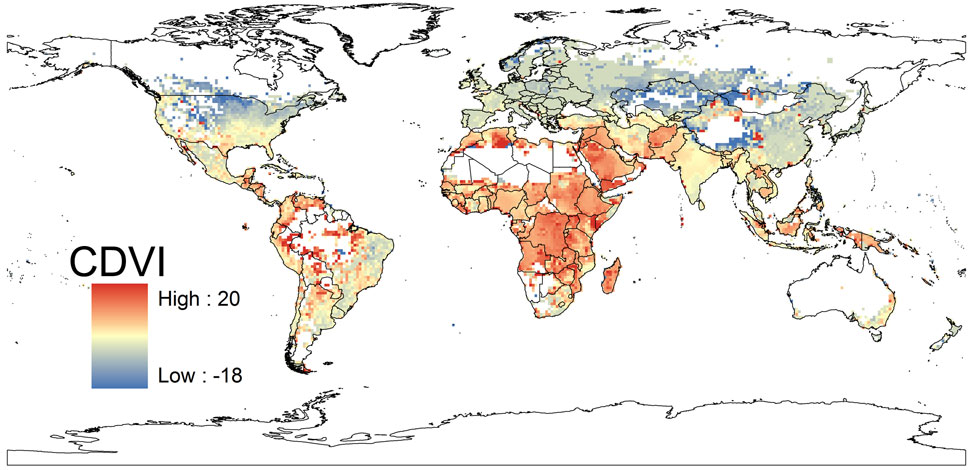
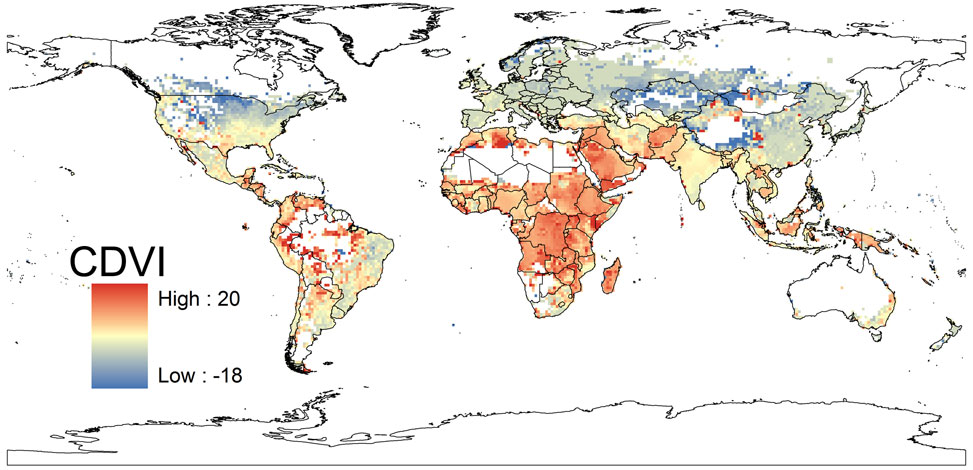
Samson’s map takes on the same time period but projects where people will be most vulnerable to the effects of climate change. Since his map takes into account population growth (measuring where people are most vulnerable, remember), unsurprisingly, Africa, the Middle East, Southeast Asia, and central South America are covered in bright red dots, indicating high vulnerability. Conversely, North America, Europe, and much of Central Asia are in shades of blue.Samson built his index using four environmental predictors – annual mean temperature, mean temperature diurnal range, total annual precipitation, and precipitation seasonality – taken from WorldClim’s 2050 forecasts, and 2005 sub-national population data from Columbia’s Center for International Earth Science Information Network. In spite of the sub-national population data, Samson makes a point to justify his use of supranational climate data in order to best reflect “the scale at which climate conditions vary.” He writes that localized issues like urbanization and coastal flooding “are probably best investigated with targeted regional models rather than by attempting to modify global models to include all factors of potential regional importance.”
Samson’s research shows that, generally, people living in places that are already hot will be more vulnerable to climate change over time, while people in more temperate climates will feel a negligible impact. Though he projects the largest real temperature changes will happen in temperate climates like North America and Europe, the comparatively smaller changes in Africa, the Middle East, Southeast Asia, and central South America are expected to have a greater impact because those regions are already very hot, their natural resources are stressed, and they are expected to bear the brunt of population growth over the next few decades.
These findings reflect a disparity between those responsible for climate change and those bearing the brunt of it, which, although not surprising, “has important implications for climate adaptation and mitigation policies,” said Sampson, discussing the map in a McGill press release.
Sub-National Data “Present a Very Different Picture”
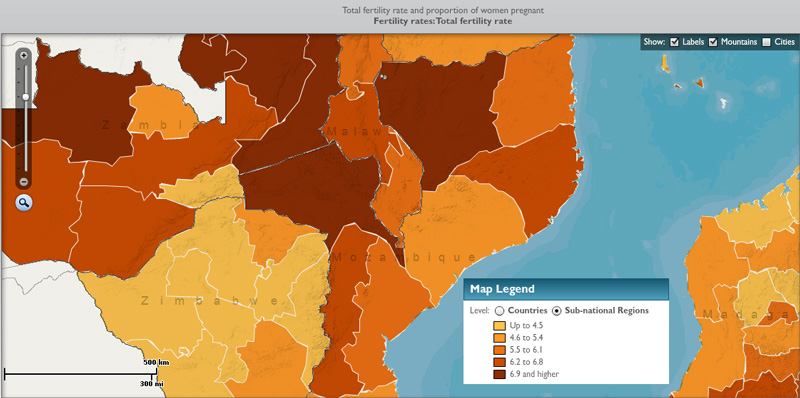
Though they offer a useful approximate glimpse at what the world might look at in 2050, both of these maps fall prey to over-aggregation. By looking at national rather than sub-national data, we miss how nuanced population growth rates can be within a country. Stimson Center Demographer-in-Residence Richard Cincotta wrote in a recent New Security Beat post that “national level comparisons of total fertility rates tend to communicate the false impression of a world with demographically homogeneous states.” Sub-national data, including differences between urban and rural areas and minority-majority fertility rates, “present a very different picture.”
And that difference matters. When it comes to looking at how population interacts with other issues, like the environment, poverty, and conflict, the importance of a sub-national approach becomes evident. In its 2011 data sheet, PRB writes that “poverty has emerged as a serious global issue, particularly because the most rapid population growth is occurring in the world’s poorest countries and, within many countries, in the poorest states and provinces.”Edward Carr, an assistant geography professor at the University of South Carolina currently serving as a AAAS science fellow with USAID, argues that national-level data obscures our ability to understand food insecurity as well. The factors that drive insecurity “tend to be determined locally,” writes Carr in a post on his blog, and “you cannot aggregate [those factors] at the national level and get a meaningful understanding of food insecurity – and certainly not actionable information.”
The same is true when it comes to climate vulnerability. In a report from The Robert S. Strauss Center’s Climate Change and African Political Stability Program, authors Joshua Busby, Todd Smith, and Kaiba White write that “research announcing that ‘Africa is vulnerable to climate change,’ or even ‘Ethiopia is vulnerable,’ without explaining which parts of Ethiopia are particularly vulnerable and why, is of limited value to the international policy community.”
“It is of even less use to Africans themselves, in helping them prioritize scarce resources,” add Busby et al.
Understanding the joint problems of climate change and population growth on a global level helps frame the challenges facing the world as it moves toward 8, 9, and possibly 10 billion. But knowing the ins and outs of how these issues interact on a local level will be a necessary step before policymakers and others can hope to craft meaningful responses that minimize our vulnerability to these challenges over the coming decades.
Sources: Center for International Earth Science Information Network at Columbia University, Climate Change and African Political Stability Program at the Robert S. Strauss Center, McGill University, Population Reference Bureau, UN Population Division, UN Statistics Division, U.S. Census Bureau, University of South Carolina, WorldClim.
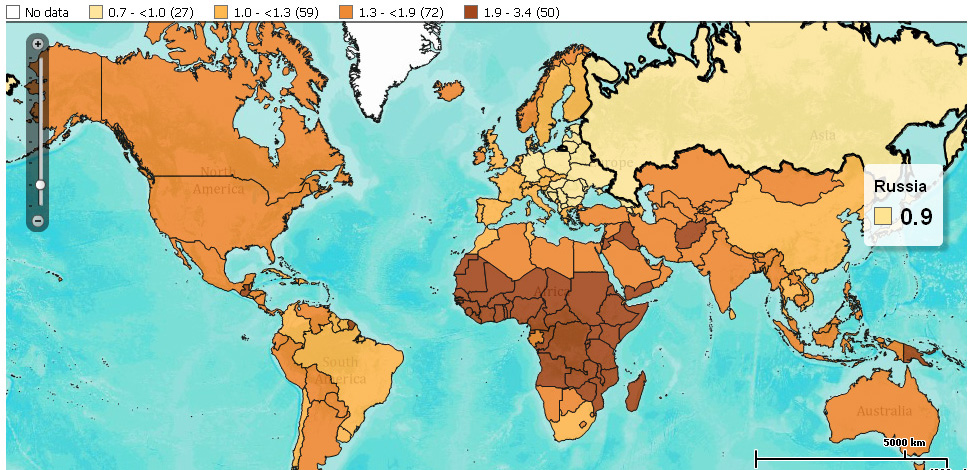
Image Credit: “2050 Population As a Multiple of 2011,” courtesy of PRB; CDVI map used with permission, courtesy of McGill University; Sub-national total fertility rates in Southern Africa, courtesy of MEASURE DHS, arranged by Schuyler Null. -
Broadening Development’s Impact: From Sustainability to Governance and Security
›John Drexhage and Deborah Murphy’s UN background paper, “Sustainable Development: From Brundtland to Rio 2012,” looks at how “sustainable development” has evolved since the 1987 Brundtland Report first brought the concept to the forefront of the international community’s attention. Drexage and Murphy write that climate change has become a “de facto proxy” for sustainable development and they offer various recommendations for how policymakers and institutions can better integrate social and economic issues into a sustainable development framework. Considering that “increasing consumption, combined with population growth, mean that humanity’s demands on the planet have more than doubled over the past 45 years,” the authors conclude that “the opportunity is ripe” to bring “real systemic change” to how the world thinks about – and acts on – sustainable development.The World Bank’s World Development Report 2011 makes an argument for “bringing security and development together to put down roots deep enough to break the cycles of fragility and conflict.” The report gives an overview of the “interconnections among security, governance, and development” and offers recommendations on how understanding and addressing them can end cycles of violence. Just as Drexhage and Murphy point to population changes as a challenge for sustainable development, the World Bank notes that growing urbanization has “increased the potential for crime, social tension, communal violence, and political instability” locally while a threefold increase in refugees and internally displaced persons over the past 30 years has put strains on regional relations around the world. Though the report acknowledges that there’s no quick fix to any of these problems, the conclusion underlining the report’s findings is that “strengthening legitimate institutions and governance to provide citizen security, justice, and jobs is crucial to break cycles of violence.”
Showing posts from category urbanization.