-
Sex and Sustainability on the Road to Rio+20
›When it comes to the public conversation about sustainable development, we can’t tell the story with only half the world’s population. Women’s voices are key – and women must have a seat at the table. Earlier this week I was honored to join Musimbi Kanyoro of the Global Fund for Women and Carmen Barroso of International Planned Parenthood Federation to brief bloggers and reporters about the linkages between sex and sustainability. The three of us are heading down to the landmark Rio+20 conference to track the inclusion of reproductive health and rights in the sustainable development agenda.
Some highlights from our call:- Musimbi noted that though the linkages between the environment – particularly climate change – and reproductive health issues can be contentious, we must remember that we are talking about real people with real needs – not abstract ideas.
- Carmen argued that women’s health and rights should be included in the upcoming Sustainable Development Goals, because health is intrinsic to sustainability, and reproductive rights are intrinsic to health.
- Musimbi remarked that climate change, urbanization, energy, and food security are all connected to population, our planet, and reproductive health. She highlighted the need for an open discussion about these linkages, especially for the 200 million women who want access to family planning.
- I pointed out that development projects that address population, health, and environmental issues are making a difference in remote communities around the world.
Follow me to Rio+20 here on the blog and the New Security Beat Twitter feed.
Image Credit: Adapted from UNSCD 2012 official logo. -
Comparing Urban Governance and Citizen Rights in China and India
›Today, according to Xuefei Ren, 129 cities in China and 45 in India have populations of over a million people. Such large-scale urbanization has created major governance challenges. Speaking at a May 23 Asia Program event co-sponsored with the Kissinger Institute on China, United States Studies, and the Comparative Urban Studies Project, Ren, a Wilson Center Fellow, examined two case studies of urbanization-driven governance in China and India and their effect on citizen rights.
Her first case study involved housing demolitions and urban re-development in Shanghai and Mumbai. In Shanghai, nearly a million households were relocated between 1995 and 2008 to make way for hotels, airports, and luxury apartments. City regulations in 1991 and 2001 legalized forced demolitions, and no prior consent from residents was needed.
However, Ren noted that displaced residents “are not quite powerless.” She highlighted the case of a woman who sued the city government after being relocated and was eventually granted the compensation she had requested. In 2003, China’s central government ordered a freeze on large-scale demolitions. Several years later, it passed a “landmark” property rights law.
Meanwhile, in Mumbai, local officials in the early 2000s had their own re-development plans. The Indian city is rife with overcrowded, low-income housing; slums are populated by seven million citizens (40 percent of the city’s total population), and comprise up to 10 percent of Mumbai’s total land area.
In 2004, aware that most of the slums were located in desirable areas – near airports or in central business districts – city planners recognized a major development opportunity. Over the next two years, officials launched a demolition campaign that left 400,000 people homeless. According to Ren, certain categories of residents were theoretically entitled to compensation, but with “legal protections carrying little weight,” most of them received nothing.
Yet, as in Shanghai, Mumbai’s city dwellers successfully fought back. Housing activists staged acts of “direct agitation,” including a series of street protests and road blockages. Such tactics, said Ren, were “disruptive but effective.” The Mumbai courts sided against the activists in 2006, but India’s Supreme Court later issued a ruling in their favor.
Fighting Land Acquisitions: A Comparison
Ren’s second case study compared land acquisition efforts outside the slums.
Last year, residents in Wukan, a village along China’s southeast coast in the province of Guangdong, launched a protest movement against land seizures. They alleged that government officials had sold their land to developers and failed to provide residents with appropriate compensation. The protestors made two demands: the return of their land and the holding of local elections.
Notably, Ren said, protestors in Wukan affirmed their support for the Communist Party, and never framed their movement as an anti-government effort. In March 2012, local elections were in fact held, with two leaders of the protest movement voted into office (one as village chief, the other as his deputy).
Ren also discussed an attempt by India’s Tata Motors corporation to acquire land in Singur, a village about 100 miles from Calcutta in the state of West Bengal. The company wanted to use this land to construct a factory for the Nano, a small, cheap car marketed to India’s urban middle class. In 2005, the West Bengal government, which had been controlled by the Communist Party of India-Marxist (CPI-M) for nearly 30 years, actively wooed the firm. State authorities “went overboard” in offering Tata Motors subsidies and highly fertile land, said Ren. Small landowners were obliged to surrender their plots at low prices, and in 2006 the corporation formally took over the land (nearly 1,000 acres altogether), despite heavy opposition from peasants.
However, violent protests continued and after several months, Tata Motors was forced to pull out of West Bengal. Then, in a state election in May 2011, the Trinomool Congress Party, led by the populist leader Mamata Banerjee, swept the CPI-M from power. Banerjee had run her campaign on a promise to restore the land to Singur’s farmers.
Just weeks after the new government assumed power, West Bengal passed a law that would allow for about 400 acres from the Tata Motors project to be returned to farmers who had refused government compensation for their land.
Ren acknowledged that in both countries, citizenship rights are not enjoyed by all and tend to be unevenly distributed across social groups. Still, she concluded, Chinese and Indian cities “have become strategic sites for reassembling citizen rights.” By asserting their land and housing rights, city denizens “are becoming active citizens.”
Michael Kugelman is a program associate with the Wilson Center’s Asia Program. He can be reached at michael.kugelman@wilsoncenter.org and on Twitter @michaelkugelman.
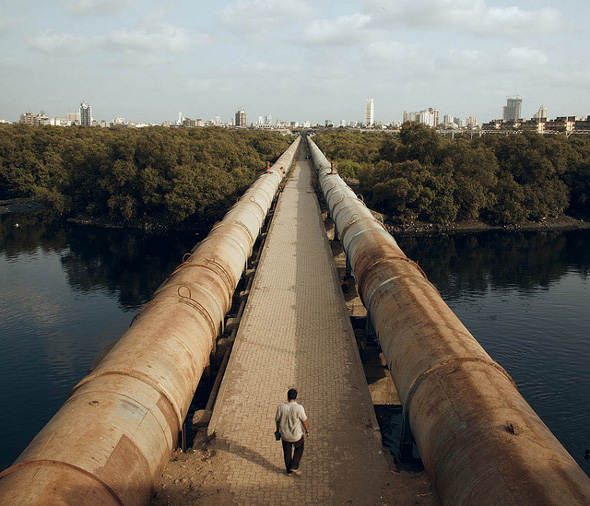
Photo Credit: Mumbai pipes, courtesy of flickr user lenskap. -
Roger-Mark De Souza, Climate and Development Knowledge Network
Population-Climate Dynamics: From Planet Under Pressure to Rio
›May 11, 2012 // By Wilson Center StaffThe original version of this article, by Roger-Mark De Souza, appeared on the Climate and Development Knowledge Network (CDKN).
In late May, I presented research on population and climate dynamics in hotspots at the Planet Under Pressure conference in London, in a session organized by the Climate and Development Knowledge Network. As we prepare for the Rio+20 Earth Summit in June, I reflect on the roles of population dynamics and climate-compatible development for ensuring a future where we can increase the resilience of the most vulnerable to the impacts of climate change.- Improving our well-being and the future we can have is within our reach: We can take action to improve well-being through specific actions that can produce short term results. This is a key message encapsulated in the concept of climate-compatible development, reflected in many presentations and discussions that I heard at Planet Under Pressure. Even though others were not calling it “climate-compatible development,” the essence and the meaning behind the research was the same – small concrete discrete steps are possible, and taking action on population dynamics is one of them.
- Population is on the agenda: Population issues – growth, density, distribution, aging, gender – were a constant at Planet Under Pressure – and in more ways than just looking at population as a driver. It is clear that there is interest, and a need, to address population as a key component of climate-compatible development.
- But those concerns and issues must be location specific, and must be contextualized for the policy and programmatic environment: Population issues must be framed in the appropriate context – and must move beyond academic exploration. I attended one session where a paper presented an academic supposition of whether we should invest in consumption versus fertility reduction to produce short-term returns for climate, but the analysis was completely devoid of any political, policy, or programmatic truth-testing. We must factor in those considerations when making recommendations, if ultimately we are really looking to make the difference that we can.
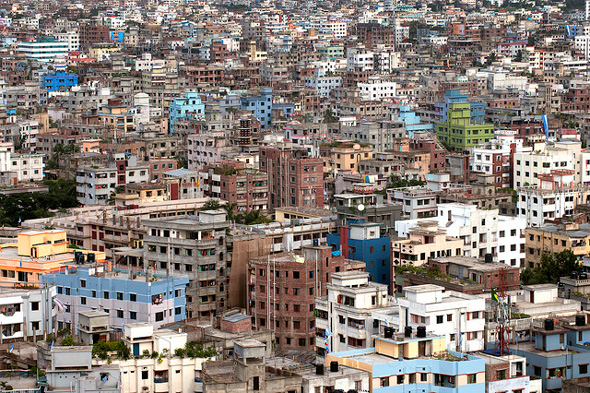
Photo Credit: “Urbanization in Asia,” courtesy of United Nations Photo. -
Michael Kugelman, AfPak Channel
Pakistan’s Climate Change Challenge
›May 11, 2012 // By Wilson Center StaffLast month, an avalanche on the Siachen glacier in Kashmir killed 124 Pakistani soldiers and 11 civilians. The tragedy has intensified debate about the logic of stationing Pakistani and Indian troops on such inhospitable terrain. And it has also brought attention to Pakistan’s environmental insecurity.
Siachen is rife with glacial melt; one study concludes the icy peak has retreated nearly two kilometers in less than 20 years. It has also been described as “the world’s highest waste dump.” Much of this waste-generated from soldiers’ food, fuel, and equipment-eventually finds its way to the Indus River Basin, Pakistan’s chief water source.
Siachen, in fact, serves as a microcosm of Pakistan’s environmental troubles. The nation experiences record-breaking temperatures, torrential rains (nearly 60 percent of Pakistan’s annual rainfall comes from monsoons), drought, and glacial melt (Pakistan’s United Nations representative, Hussain Haroon, contends that glacial recession on Pakistani mountains has increased by 23 percent over the past decade). Experts estimate that about a quarter of Pakistan’s land area and half of its population are vulnerable to climate change-related disasters, and several weeks ago Sindh’s environment minister said that millions of people across the province face “acute environmental threats.”
Continue reading on the AfPak Channel.
Sources: Daily Times, Dawn.com, Environment News Service, The Express Tribune, The New York Times, Remote Sensing Technology Center of Japan.
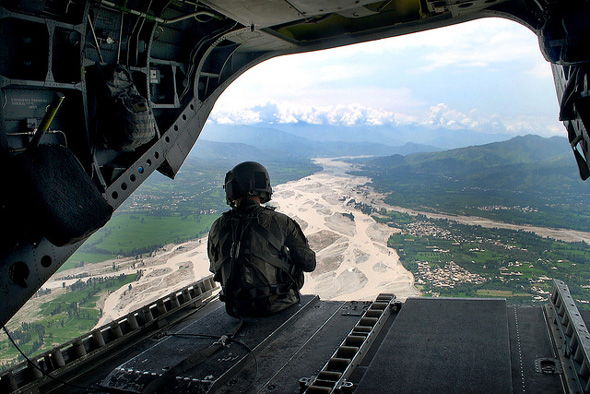
Photo Credit: “Surveying damage in Pakistan,” courtesy of the U.S. Army.
-
Updates to African Conflict Database Give Researchers Access to Comprehensive, Near Real-Time Information
›Despite the end of Cold War-era civil wars, political violence rates in Africa remain remarkably high. However, this broad statement hides an important qualification: the types of violence that have persisted in recent years have changed significantly, shifting from rebel and government activity towards violence against civilians, riots, protests, and battles by armed groups other than rebels.
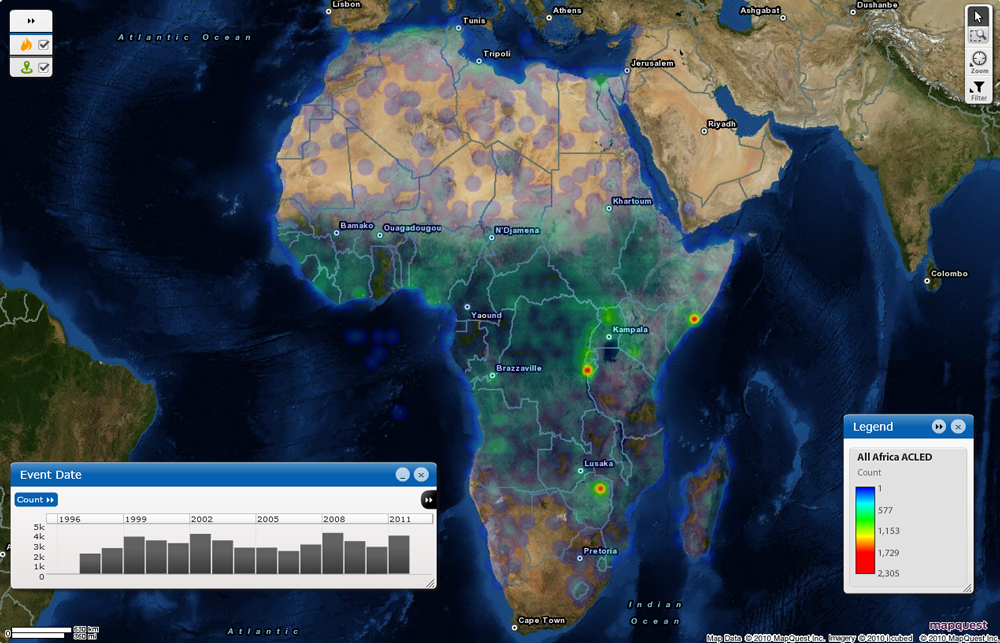
The only way researchers can track this activity is through political violence data disaggregated by type, location, and time. The Armed Conflict Location and Event Dataset (ACLED) project aims to provide that service. We recently released updated information on political violence across Africa from January 1997 to December 2011 (see above for a hotspot map and timeline of violence over this period).
New to the ACLED project are real time data and trend reports on monthly conflict patterns throughout the continent. It is now perhaps the comprehensive and representative depiction of political violence as it occurs throughout Africa.
The data captures an array of actions including battles, looting, rioting, protesting, violence against civilians, and non-violent activity (such as arrests, recruitment drives, troop movements) by a variety of actors such as governments, rebels, militias, rioters and protestors.
Each event is geo-referenced by location and time-stamped by day. In our recently released version, we also included fatalities by event; distinguished conflict groups by their type (government, rebel, political militia, communal militia, rioters, protesters, civilians etc.); and specified the type of interaction between actors (e.g. government-rebel battle; rebel-civilian attack). These changes make ACLED data flexible for multiple uses.
Several new findings on conflict patterns are found using ACLED data:- Violence against civilians accounts for approximately half of all conflict events.
- Generally, where they occur, civil wars intensely affect 19 percent of a state’s territory, yet rebel actions have drastically decreased since 2005.
- Militia activity has significantly increased since 2005 and is especially high during election periods in new democracies.
- Communal violence patterns are more widespread but affect fewer people than civil war violence.
- Civil war patterns are not strongly affected by climate changes, but communal conflict decreases during periods of local scarcity and increases on the cusp of rainy seasons.
- Political violence increases in the period from peace talk announcements to negotiations. This violence is directed towards overtaking territory and civilians are frequently the main victims.
Fine-grained data on the range of political violence in the developing world is important as it provides the opportunity to ask and potentially answer certain questions about a range of issues related to governance, economic development, and conflict dynamics themselves.
For example, ACLED data shows that violence is increasingly occurring in villages, towns, and cities across Africa. In other words, political violence may be “urbanizing.” This has important implications for how we understand the practice of politics, the geography of marginalization, and the role of trigger patterns in explaining conflict. But there are many competing theories that could explain this trend.
Using data that disaggregates by violence type allows us to probe deeper: If the environmental security framework is correct, political violence in towns may be a response to high in-migration from rural areas to cities. Violence therefore is due to competition between urban people and migrant populations.
An alternative explanation is that the poor conditions of African urban life, high rates of informal employment, and under-representation of urban communities in government might explain an increase in violence. In this case, violence is a populist response, in that civilians riot and protest in favor of government reform.
Finally, the advantages of densely populated urban areas – easier access to resources, recruits, infrastructure, and power – may attract more organized groups to contest these spaces. If this explanation were correct, we would expect higher rates of rebel activity against government forces in cities, with a clear drive to overtaking the capital.
We have not been able to address these questions before with credible and comprehensive data, but now we can. Indeed, such data is crucial for interrogating the climate-security debate.
For example, Clionadh recently co-authored an article in the Journal of Peace Research’s special issue on climate and conflict, which used ACLED data for East Africa. In that piece, she and her co-author argued that different conflict groups use their environment in accordance with their overall goals. While much of the conflict activity studied had an environmental signal, the climate signal was much weaker.
We hope that these studies and other work with disaggregated data spur more theories and explanations of conflict patterns in developing states, and that the breadth and form of the data allows for new directions within conflict research.
Clionadh Raleigh is an assistant professor in the Department of Geography at Trinity College, Dublin, external researcher at the Peace Research Institute Oslo (PRIO), and director of the ACLED project. Caitriona Dowd of Trinity College and Andrew Linke of the University of Colorado are senior researchers for ACLED.
Image Credit: ACLED. -
Karen Newman: Population and Sustainable Development Links Are Complex, Controversial, and Critical
›April 23, 2012 // By Kate Diamond“The one child family norm in China has fixed the global imagination around population to be around doing something which constricts people’s and women’s choices, rather than expands women’s possibilities to take control of their lives,” said Karen Newman, the coordinator for the UK-based Population and Sustainability Network. But contemporary population programs are about educating people on and providing access to voluntary reproductive, sexual, and maternal health services.
Newman spoke to ECSP, during the Planet Under Pressure conference this year, about family planning efforts and the connection between population dynamics and the environment.
“You have what I would describe as a sort of kaleidoscope of complexity” between climate change and population dynamics – not just growth, said Newman, but urbanization and migration.
For example, China recently overtook the United States as the world’s largest emitter of carbon, and although China has 1.3 billion people compared to the United States’ 310 million, population can hardly be credited as the most important driver for the country’s emissions. “How fair is it [to credit population growth] without in the same nanosecond saying, ‘but most of the carbon that was emitted in China was to manufacture the goods that will of course be consumed in the West?” said Newman.
“It makes it more difficult to say in a sound bite that ‘OK, population and sustainable development, it’s the same conversation,’ which I believe it to be.”
The Population and Sustainability Network, working through the Population and Climate Change Alliance, collaborates with international organizations from North America, Europe, Ethiopia, and Madagascar to support on-the-ground groups working on integrated population, health, and environment programming. These programs address environmental issues, like marine conservation and deforestation, while also providing reproductive health services, including different methods of contraception, diagnosis and treatment of sexually-transmitted diseases, antenatal and postnatal care, and emergency obstetric care.
“As a result of people wanting to place a distance between those coercive family planning programs in the ‘60s and the way that we do reproductive health now…because it’s such a large package, there is a sense that…this reproductive health thing is too much, we can’t really get ahold of this,” said Newman.
“What I think we need to do is keep people focused on the fact that these are women’s rights,” she said. “But we at the same time have to say ‘this is relevant if you care about sustainable development and the world’s non-renewable resources.’”
Sources: United Nations Population Division. -
Megacities, Global Security, and the Map of the Future
›“We’re in an urban century, there is no doubt,” said Peter H. Liotta, visiting scholar at the U.S. Military Academy West Point and co-author of The Real Population Bomb: Megacities, Global Security, and the Map of the Future, during a March 20 event at the Wilson Center. Liotta’s book focuses on the geopolitical impacts of poorly managed urbanization on the most vulnerable as well as the security issues such urbanization might create. He was joined by Jaana Remes of the McKinsey Global Institute, who painted a more promising picture of a globally rising, economically prosperous urban middle class, and Stimson Center visiting fellow Peter Engelke, who grappled with the contradictions between these alternative urban realities. [Video Below]
“Urbanization is key to economic development, but it has been, is now, and will continue to be into the future beset by a very large shadow side, wherein the marginalized face grinding poverty, squalor, and despair,” explained Engelke.
Although Liotta and Remes laid out very different “maps of the future,” Engelke suggested three commonalities. First, they both highlight the “unprecedented scale and speed of global change.” Second, they acknowledge that “a global demographic shift is well underway, and has been for some time.” And third, they accept that we have yet to fully integrate cities into the physical and mental maps by which we navigate the world, he said. Despite the economic dynamism of cities, “we live in a world that, I submit, has not yet grasped this reality even in conceptual terms, much less political and policy ones.”
The City as a Source of Vulnerability
People come to megacities “because there’s a chance,” said Liotta. “It looks like a nightmare to us, but people come because they’re waiting for a future.” This chance, however, is often slim, according to Liotta.
The sheer scale of modern urbanization (approximately 200,000 people move every day from rural to urban areas) produces myriad sources of vulnerability for the poorest and most marginalized, said Liotta. “World population growth will occur in the poorest, youngest, and often heavily Muslim states, which lack education, capital, and employment. And for the first time in history the world will be primarily urbanized, with most megacities in the poor states where you don’t have policing, sanitation, and health care.”
This urban shift concentrates young populations presumed to be unstable, exacerbates the risk of disease and climate change, and increases the threat of declining resource availability and food production, Liotta said. In states where “the lights are out” – that is, where urbanization is not met with sufficient economic development – our new urban century may feature significant security challenges, he argued. “Every single security problem we have today, and in the future – whether it’s human security, environmental security, or national security – is [in] the places where the lights are out.”
In The Real Population Bomb, Liotta links these sorts of security issues to what he terms “entangled vulnerability scenarios,” such as scarcity of water for drinking and irrigation, outbreak and rapid spread of disease, or lack of sufficient warning systems for natural disasters or environmental impacts. These scenarios, he argues, deserve a greater showing next to the traditional focus on hard security “threats.”
Fertility rates are generally declining, which will eventually dissipate the youth bulges being experienced by many countries, but the challenge is how to “manage that glide path,” said Liotta. It is about “doing it well collectively, because we are not thinking collectively well about how to do this and places in the world are in serious trouble.”
The City as a Center of Growth
Jaana Remes presented both a broader scale of analysis and a more positive outlook. Urbanization is “the most powerful positive economic force in today’s environment,” she asserted, drawing on the McKinsey Global Institute report, Urban World: Mapping the Economic Power of Cities.
Compared to the historical experiences of the Western world, change in the most rapidly urbanizing of today’s developing states is occurring at “100 times the scale, in one tenth of the time,” said Remes. This change is fundamentally shifting the economic profiles of states such as India and China, which are projected to account for approximately one third of global GDP by 2050.
This growth in economic prominence can be accounted for by the rise of urban populations of middle class consumers not just in megacities, but also in the rapidly growing “middleweight” cities (from 200,000 to 10 million people) explained Remes. The path that these cities take will be “very significant for…how our world is going to look like in the next few decades,” she said. They are where “the lion’s share of global investment is going to be made.”
Engaging Global Urbanization
“That we are seeing cities rise in their profile is nothing new in history,” said Remes, “in fact you can argue that cities are actually some of the longest-lasting assets in the world.” Today, 600 urban centers generate more than 60 percent of global GDP; 400 of these are in emerging markets. So, “even though the scale of the change we expect to see is very dramatic, from the cities perspective, it is probably going to be more evolution than revolution.”
Taking advantage of this growth will require some significant global re-posturing. In terms of commercial diplomacy for instance, most nations continue to distribute their people more according to the “geopolitical power of the 20th century than the economic opportunity of the 21st,” said Remes. She points out, for example, that the city of Wuhan in China is expected to generate 10 times the GDP growth of Auckland, New Zealand, yet the number of foreign service officials stationed in each city is in the opposite proportion.
Policymakers looking to adapt should also look more closely at opportunities to re-develop existing, or “brownfield,” infrastructure. The challenge of accommodating the tremendous pace of urbanization may be great, she said, but “we have not yet seen one piece of infrastructure where you can’t make substantial improvements.”
Summing up the need to work on what he argued has been a shortfall in policy engagement, Engelke concluded that, “we are indeed quite a ways from acknowledging the enormous challenges, but also the opportunities, that global urbanization presents to us.”
Event ResourcesSources: UN Population Division.
Photo Credit: David Hawxhurst/Wilson Center. -
Mia Foreman, Behind the Numbers
Serving the Reproductive Health Needs of Urban Communities in Nairobi
›The original version of this article, by Mia Foreman, appeared on the Population Reference Bureau’s Behind the Numbers blog.
Kenya’s population is growing rapidly, more than tripling from 10.9 million people in 1969 to 38.6 million in 2009. According to the United Nations, the annual population growth rate between 2010 and 2015 is 2.7 percent with 22.5 percent of the population residing in urban areas in 2011.
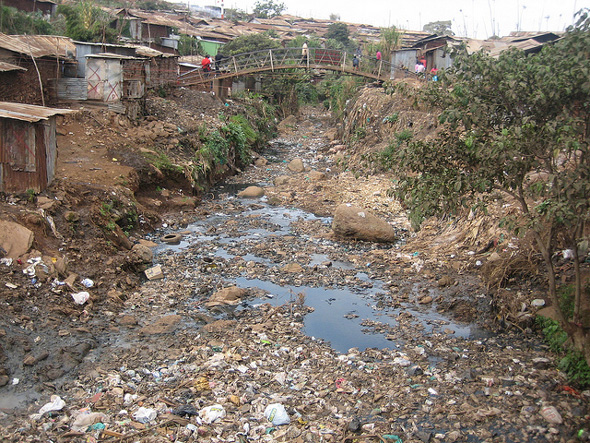
One area that has seen tremendous growth is Nairobi’s largest slum, Kibera. While experts have given estimates ranging from 270,000 to 2,000,000 residents, Kibera is a large area of informal settlements plagued by challenges such as the lack of electricity, job opportunities, and high levels of violence.
While it may be easier to focus on what is lacking in Kibera, there are also many services being provided in the community including affordable and quality reproductive health care by organizations such as Marie Stopes Kenya.
Marie Stopes Kenya was established in Kenya in 1985 as a locally registered nongovernmental organization. It is Kenya’s largest and most specialized sexual reproductive health and family planning organization and is known for providing a wide range of high-quality, affordable, and client-centered services to men, women, and youth throughout Kenya. In 1997, Marie Stopes Kenya opened its first clinic in Kibera and began offering reproductive health services at an affordable rate for residents.
Continue reading on Behind the Numbers.
Sources: UN Population Division.
Photo Credit: “The Kibera ‘river’,” courtesy of Dara Lipton and flickr user The Advocacy Project.
Showing posts from category urbanization.