

-
The Arc | Dr. Renata Giannini on Women Environmental Defenders in the Amazon and Climate Mitigation
› In today’s episode of The Arc, ECSP’s Angus Soderberg and Claire Doyle interview Wilson Center Fellow Dr. Renata Giannini about her work with women environmental defenders in the Amazon and their role at COP30 in Brazil. Select quotes from the interview are featured below.
 -
Money Can Grow on Trees: Forestry Rights Reform for Decarbonization in China
›
High in the remote mountains of western Fujian Province, Changkou—part of Sanming Prefectural City—became the first village to launch a new forestry carbon ticket system in May 2021. Changkou farmers have long received little benefit in managing forests because of fragmented forest land, high investment risks, and limited ownership rights. To solve those problems, the Sanming Forestry Bureau issued tickets to forestry farmers, granting them the right to receive stocks on their plots of forests by cooperating with farms in a certain period. Meanwhile, the carbon tickets grant farmers the right to earn carbon emission credits for their land and trees.
-
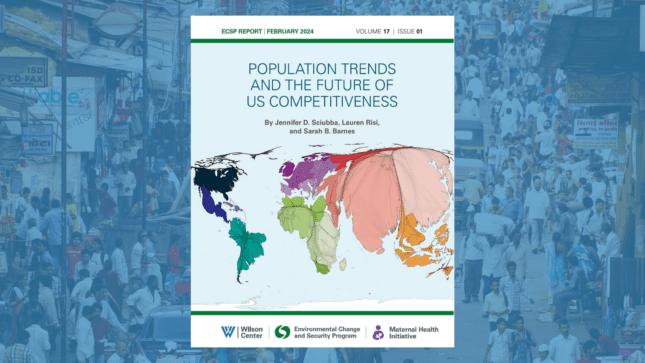
REPORT LAUNCH | Population Trends and the Future of US Competitiveness
›From the Wilson Center // February 5, 2024 // By Jennifer Dabbs Sciubba, Lauren Herzer Risi & Sarah B. BarnesThis article is adapted from “Population Trends and the Future of US Competitiveness”
Demographic issues intersect with a number of policy priorities on the congressional agenda, including the economy, immigration, health care and foreign policy, but how population trends influence policy outcomes is often overlooked or misunderstood. In a new report, we explore how population dynamics have changed dramatically over the last few decades, and what these changes mean for the economic and security interests of the United States.
-
Environment and Security | Q&A with Editor in Chief, Ashok Swain
›From Afghanistan, Nepal, and Libya to the Arctic, the new issue of Environment and Security takes a fresh look at emerging issues at the intersection of environment and security. Ashok Swain, Editor in Chief of Environment and Security, spotlights some of the new research and insights in this Q&A with ECSP staff.
Q: The new issue of Environment and Security features an article on Arctic governance, including a close examination of the International Code for Ships Operating in Polar Waters (Polar Code). How do the authors assess this regulatory instrument as it enters its 10th year since adoption?
-
ECSP Weekly Watch | December 11 – 15
›A window into what we are reading at the Wilson Center’s Environmental Change and Security Program
COP28 Extension Produces a New Agreement
In the closing moments of COP28, the almost 200 countries in attendance settled on a deal for a roadmap that would include a reference to “phasing out fossil fuels.” This language was a step toward highlighting the inevitability of this transition in order to address climate change.
-
Green Corruption: Dissecting a Recent Wilson Center Event
›In today’s episode of New Security Broadcast, ECSP’s Angus Soderberg breaks down a recent Wilson Center event against the backdrop of the 10th annual Conference of State Parties (COSP) to the UN Convention on Corruption, which is under way in Atlanta this week. On September 19, ECSP and the Wilson Center’s Global Europe Program, in partnership with the U.S. Department of State, the Embassy of the Principality of Liechtenstein, and the Basel Institute on Governance, hosted Combating Green Corruption: Fighting Financial Crime as a Driver of Environmental Degradation. The speakers discuss how corruption fuels wildlife trafficking and other environmental crimes, which finance illicit activities, hamper development, and erode efforts to combat biodiversity loss and climate change across the globe.
-
Relief, Recovery, and Peace: Peter Schwartzstein on COP28’s New Theme
›
In today’s “Relief, Recovery, and Peace” episode on New Security Broadcast, we’re featuring an interview recorded by the Wilson Center’s Middle East Program (MEP) with Peter Schwartzstein, a Wilson Center Global Fellow and environmental journalist.
In a conversation with MEP director, Merissa Khurma, Schwartzstein discusses the impact of the war in Gaza on COP28 and environmental peacebuilding efforts more broadly in the region. He also talks about how to advance the new theme of peace in COP discussions and what his hopes are for a best-case scenario coming out of the upcoming summit. -
Ecological Threat Report 2023: Same Hotspots, More Risk
›Future projections of social disturbance due to climate change and ecological pressures provide little optimism for peace in conflict-affected areas over the coming decades. Yet, can we identify current hotspots and future areas of conflict risk? The fourth Ecological Threat Report (ETR), produced by the Institute for Economics & Peace, attempts to do so by taking on the monumental task of evaluating the relationship between ecological threats and peace.
The new report documents a world of growing ecological threats and declining social resilience in the states and territories most vulnerable to a changing climate. And by assessing ecological threats, societal resilience, and levels of peacefulness at the state, territorial, subnational, and city levels, the report also finds a strong correlation between ecological threats and levels of peacefulness.
Showing posts from category natural resources.


 In today’s “Relief, Recovery, and Peace” episode on New Security Broadcast, we’re featuring an interview recorded by the Wilson Center’s Middle East Program (MEP) with Peter Schwartzstein, a Wilson Center Global Fellow and environmental journalist.
In a conversation with MEP director, Merissa Khurma, Schwartzstein discusses the impact of the war in Gaza on COP28 and environmental peacebuilding efforts more broadly in the region. He also talks about how to advance the new theme of peace in COP discussions and what his hopes are for a best-case scenario coming out of the upcoming summit.
In today’s “Relief, Recovery, and Peace” episode on New Security Broadcast, we’re featuring an interview recorded by the Wilson Center’s Middle East Program (MEP) with Peter Schwartzstein, a Wilson Center Global Fellow and environmental journalist.
In a conversation with MEP director, Merissa Khurma, Schwartzstein discusses the impact of the war in Gaza on COP28 and environmental peacebuilding efforts more broadly in the region. He also talks about how to advance the new theme of peace in COP discussions and what his hopes are for a best-case scenario coming out of the upcoming summit.


