

-
Weekly Reading
›The Population Reference Bureau’s 2009 World Population Data Sheet shows that global population numbers will reach 7 billion in 2011. Among its key findings, PRB notes that “population growth is one root cause of increases in global greenhouse gas emissions. But the complexity of the mechanisms through which demographic factors affect emissions is not fully taken into consideration in many analyses that influence governments’ climate change mitigation efforts.”
The Guardian reports that U.S. marines have launched an energy audit of American military operations in Afghanistan, the first such assessment to take place in a war zone. “Some 80% of US military casualties in Afghanistan are due to improvised explosive devices (IEDS),” the article elaborates, “and many of those placed in the path of supply convoys.” DoD’s Alan Shaffer recently told ClimateWire, “nearly three-quarters of what convoys move in Afghanistan’s treacherous terrain is fuel or water.”
The Department of State released an inspection of the operations of the Bureau of African Affairs that identifies a rift between U.S. diplomats and the U.S. military’s recently established African Command (AFRICOM). As the Wilson Center’s Steve McDonald told Bloomberg.com, “It got off to a hugely bad start…Part of it was tied up with policies of the Bush era, where our own security concerns far overrode any sensitivities to local considerations.”
T. Paul Shultz of Yale University’s Economic Growth Center evaluates population and health policies, looking specifically at “the causal relationships between economic development, health outcomes, and reproductive behavior.”
Oxfam’s “The Future is Here: Climate Change in the Pacific” includes recommendations for adapting and mitigating climate change in Australia, New Zealand, and the Pacific island nations—a region “where half the population lives within 1.5 kilometers of the sea.” -
Budgeting for Climate
› Update: Read a response by Miriam Pemberton
“The Obama administration…has identified the task of substantially reducing greenhouse gas emissions as one of its top priorities,” writes Miriam Pemberton in a new report from the Institute for Policy Studies, “Military vs. Climate Security: Mapping the Shift from the Bush Years to the Obama Era.”
-
Senate, Pentagon Focus on Climate-Security Challenges
›July 31, 2009 // By Brian Klein“Climate change may well be a predominant national security challenge of the 21st century, posing a range of threats to U.S. and international security,” said Sharon Burke, vice president for Natural Security at the Center for a New American Security (CNAS). Her remarks at a July 21 Senate Foreign Relations Committee hearing on climate change and security—along with those of two retired vice admirals and former Senator John Warner—amplified the growing chorus of national security experts and military personnel urging Congress to act promptly to address the security implications of climate change.
Vice Admiral Lee Gunn, USN (Ret.), called climate change “a clear and present danger to the United States of America,” while Burke cited a 2007 report from the Center for Naval Analysis that defined climate change as a “threat multiplier.”
Security Link Could Push Senate Climate Bill
Senator John Kerry, chair of the Senate Foreign Relations Committee, scheduled last week’s hearing on climate’s security links in a bid to bolster support for congressional action on climate change, which is currently stalled in the Senate. “Just as 9/11 taught us the painful lesson that oceans could not protect us from terror, today we are deluding ourselves if we believe that climate change will stop at our borders,” he said.
Former Senator John Warner echoed this sentiment, noting that the hearing was an opportunity to “educate the American public on these potential risks to our national security posed by global climate change.”
“Leading military, intelligence, and security experts have publically spoken out that if left unchecked, global warming could increase instability and lead to conflict in already fragile regions of the world. If we ignore these facts, we do so at the peril of our national security and increase the risk to those in uniform who serve our nation,” stated Warner, who recently launched the Pew Project on National Security, Energy, and Climate with the Pew Environment Group.
Pentagon Looks to Reduce Reliance on Oil and Drive Innovation
Burke explained that the phenomenon will not only pose “direct threats to the lives and property of Americans” from wildfires, droughts, flooding, severe storms, the spread of diseases, and mass migrations, but will also have “direct effects on the military,” including problems with infrastructure and the supply chain.
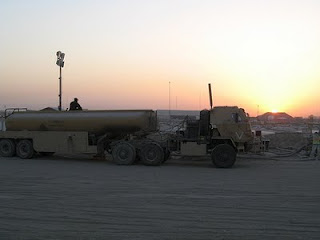
As a massive consumer of energy—110 million barrels of oil and 3.8 billion kilowatts of electricity in 2006 alone—the Pentagon has recognized its vulnerability to disruptions in fossil fuel supplies, as well as its potential to develop alternative technologies. As ClimateWire’s Jessica Leber writes in the New York Times: “The long logistics ‘tail’ that follows troops into the war zone—moving fuel, water and supplies in and waste out—risks lives and diverts major resources from fighting.”
According to Leber, two-thirds of the tonnage in Iraq convoys was fuel and water. To mitigate such vulnerability in the future—not to mention in arid, mountainous Afghanistan—DoD has begun testing ways to turn waste into energy, distribute power through “microgrids,” develop jet fuel from algae, desalinate water using little energy, and purify wastewater on a small scale.
“While the military by itself won’t make a market for plug-in vehicles or algae-based jet fuel,” notes Leber in an earlier ClimateWire article, “its investment power can bump emerging climate-friendly technologies onto a larger commercial stage.”
At the hearing, Burke warned against the possible knock-on effects of switching dependence from fossil fuel to other resources like lithium for lithium-ion batteries in electric cars.
The Military Must Manage Uncertainty
Vice Admiral Dennis McGinn, USN (Ret.), a member of the CNA’s Military Advisory Board, dismissed the argument that climate data and projections are too uncertain to form a solid basis for action. “As military professionals,” he told the Senate committee, “we were trained to make decisions in situations defined by ambiguous information and little concrete knowledge of the enemy intent. We based our decisions on trends, experience, and judgment, because waiting for 100% certainty during a crisis can be disastrous, especially one with the huge national security consequences of climate change.”
“The future has a way of humbling those who try to predict it too precisely,” Kerry said at the hearing. “But we do know, from scientists and security experts, that the threat is very real. If we fail to connect the dots—if we fail to take action—the simple, indisputable reality is that we will find ourselves living not only in a ravaged environment, but also in a more dangerous world.”
Photo: A convoy of the U.S. Army’s 515th Transportation Division moves fuel around Baghdad, Iraq. Courtesy Flickr user heraldpost. -
Who Does Development? Civil-Military Relations (Part I)
›USAID convened a study group to determine the future civil-military relationship between USAID and the Department of Defense. Two members of the study group, Dr. Frederick Burkle and Dr. Gene Bonventre, offer their thoughts.In the first decade of the new millennium, the relationship between the Department of Defense and civilian governmental agencies and NGOs has been a rollercoaster ride. At the high point of civil-military cooperation—the response to the Kurdish refugee crisis after the first Iraq war—the U.S. military provided security, access, and logistics, while USAID and NGOs provided direct assistance and expert advice to the 800-pound uniformed gorilla.
-
Who Does Development? Civil-Military Relations (Part II)
›USAID convened a study group to determine the future civil-military relationship between USAID and the Department of Defense. Two members of the study group, Dr. Frederick Burkle, Jr., and Dr. Eugene Bonventre, offer their thoughts.
The success of all interventions and relief efforts in conflict and post-conflict situations is dependent on politics and political action. For the United States, political action translates into military action. During my career, I’ve been involved in five conflict situations with the U.S. military, and each one made a different claim and set different restrictions for intervening with “aid.”
In the 1990s, after several frustrating years of failures, many in government believed that humanitarian assistance without political solutions achieved nothing. In good Wilsonian fashion, they saw political action—and the military interventions that followed—as a means to project, influence, and spread U.S. values. As such, the military became the security and protection tool of political humanitarianism, especially among those who considered that the convergence of humanitarian actors with the military ensured that the duty to provide assistance and the right to receive it was guaranteed.
The Kurdish crisis after the Persian Gulf War was instrumental for many reasons. One, it was the first time the Security Council did not veto a resolution to protect vulnerable populations within a sovereign state. Two, it was considered in most circles to be a success, because the coalition led by the U.S. military was considered by the humanitarian community to have been an ally in the struggle to provide security and assistance. The military presence allowed the humanitarians to work in an austere environment and to save lives.
What happened afterwards is a different story. Influenced by the post-9/11 global war on terrorism, increasingly insecure conflict environments, and the unilateral approach to conflict management, the military began to provide direct assistance to the population themselves. Liberties were taken: NGOs were recruited as “force multipliers,” “a second front,” or “part of our combat team.” The traditional leaders of humanitarian assistance and disaster relief, the Red Cross and the UN’s Office for Coordination of Humanitarian Affairs, were ignored. A “partnership” of the U.S. military-political command, the World Bank, corporate contractors, and like-minded NGOs dominated the scene.
In the last four months I’ve been confronted by two retired generals. One strongly insisted that the military must “stay within their lane” or risk destroying the military and supporting the perception of a U.S. politico-military “empire.” The other strongly insisted that the only entity in the world that could do humanitarian assistance and disaster relief is the U.S. military
So who should be leading these efforts for the United States? USAID, which was decimated in the 1980s, has never come back. The more than 12,000 USAID professionals during the 1960s-70s now number only 2,000. Reestablishing USAID’s place in development and relief will take much money, time, and expertise.
In the meantime, the only show in town, DoD, grows even larger and stronger. Gates’ statement that more civilians are needed in Afghanistan and Pakistan was actually a request for more “civilians” to be coordinated by the military.
It is not unusual to find those who think that the politico-military “relief and reconstruction complex” is impossible to change, especially when they are favored by Congress over USAID and State to solve these problems. But if “outcome indicators” rather that the current DoD-dominated “achievement indicators” were used to measure success, they would tell a totally different story.
In the last few years, the argument that such efforts are essential to “winning the hearts and minds” of a population has come out of nowhere. This claim is not grounded in accepted measures that monitor and evaluate such success. Yet the defense budgets that are heavily supported by Congress are based on achievement indicators alone.
President Obama does not come to the table with a strong and substantive knowledge or experience with the nuances of foreign assistance and the critical importance of the traditional humanitarian community. He is currently hearing only voices from the military and industry on this issue. We owe it to both the humanitarian community and the military to ensure that evaluation of their effectiveness is transparent, accountable, and evidence-based.
Current USAID leadership, short of a named Administrator, must speak up. The opportunity to reestablish USAID’s role in development and humanitarian assistance may never come this way again.
Dr. Frederick M. Burkle, Jr., is a professor and senior fellow with the Harvard Humanitarian Initiative, Harvard University; a senior public policy scholar at the Woodrow Wilson Center; and a retired Navy Reserve Captain and combat decorated for service with the U.S. Marines. -
Retired Generals, Admirals Warn of Energy’s Security Risks
›June 18, 2009 // By Rachel Weisshaar“Some, I think, probably are surprised to hear former generals and admirals talk about energy efficiency and renewable energy, but they shouldn’t be,” said General Charles Wald, USAF (Ret.), chairman of the CNA Military Advisory Board (MAB), a group of 12 retired three- and four-star admirals and generals. “Force protection isn’t just about protecting weak spots; it’s about reducing vulnerabilities before you get into harm’s way.”
Wald was joined by fellow MAB member Vice Admiral Dennis McGinn, USN (Ret.), and CNA General Counsel Sherri Goodman for a discussion of MAB’s latest report, Powering America’s Defense: Energy and the Risks to National Security, at a meeting on May 28, 2009. Two years ago, Wald, Goodman, and two other members of the MAB spoke at another Environmental Change and Security Program-hosted event on the MAB’s first report, National Security and the Threat of Climate Change.
Energy, Climate, and the Military“Our over-dependence on fossil fuels” and “our dependence on a vulnerable electric grid…present an urgent and serious risk to our national security,” said Goodman, who served as deputy under secretary of defense for environmental security from 1993-2000.
Powering America’s Defense argues that U.S. dependence on foreign oil “tethers America to unstable and hostile regimes, subverts foreign policy goals, and requires the U.S. to stretch its military presence across the globe.”
The U.S. military’s energy use presents unique risks. “Our inefficient use of oil adds to the already-great risk assumed by our troops. It reduced combat effectiveness. It puts our troops more directly and more often in harm’s way,” said Wald. “Many of our casualties—and you’ve all heard of the IEDs and EIDs that have done so much harm to so many of our young people—many of those people are in convoys carrying fuel to the battlefield” in Iraq and Afghanistan.
A major U.S. blackout in August 2003—which shut down water and sewage plants, gas stations, telecommunications outlets, and some elements of border check systems—emphasized the vulnerability of the nation’s electrical grid. “The situation can be exploited as a threat by those to wish to do us harm,” said Wald.
Innovative Solutions, With DoD in the Lead
The report recommends that:- Energy-security and climate-change goals should be integrated into national-security and military planning processes;
- The Department of Defense (DoD) should design and deploy energy-efficient systems on the battlefield;
- DoD should monitor its energy use at all levels of operations;
- DoD should improve the energy efficiency of its installations;
- DoD should increase renewable-energy generating capacity; and
- DoD should invest in the development of low-carbon liquid fuels—such as those produced by algae—that can replace oil.
A Direct Appeal
Recalling the sacrifices Americans made on the home front during World War II—saving scrap metal, conserving fuel, planting victory gardens—McGinn urged Americans today to take a similar approach to meeting the nation’s energy and climate challenges.
“There are individual steps that every American can take: using less energy, being more efficient with the energy that we do use, supporting new policies to help our country take a new energy path,” he said. “They may cost money, yes, but if we don’t spend the money now, primarily thinking of that as an investment, we’ll still pay, and we’ll pay much more later. In fact, very likely, we’ll pay in American lives lost,” he said. -
At Heavy-Hitting Conference, CNAS Launches Natural Security Program, Blog
›June 11, 2009 // By Rachel WeisshaarToday’s Center for a New American Security (CNAS) annual conference was replete with heavy hitters like General David Petraeus discussing the world’s top security challenges, including Iraq, Afghanistan, Pakistan, and North Korea. But at an afternoon panel, CNAS’s Sharon Burke argued that although environmental and natural-resource issues may not get their own section in the Presidential Daily Briefing, they are intimately intertwined with many of the high-profile security issues that do.
President Obama recently called for a stronger focus on agricultural development in Afghanistan, said Burke, as part of a broader approach to increasing stability and improving Afghans’ quality of life. But decades of war have contributed to severe deforestation and land degradation, and farmers “can’t plant their seeds if the land is barren, and that’s where we are right now,” she said.
The panel also served as the launch for CNAS’s new Natural Security program (see working paper) and blog, which aim to study the “national-security implications of natural resources use,” said Burke. The program grows out of CNAS’s investigation of the security impacts of climate change and energy over the past several years. Burke explained that it was difficult to discuss energy and climate change without also talking about water, land, biodiversity, and a host of other related issues, so CNAS decided to create a program that would not attempt to separate these interconnected issues.
Burke was joined by former U.S. Senator John Warner, Peter Gleick of the Pacific Institute, Roderick Eggert of the Colorado School of Mines, and Commander E. J. McClure of the Office of the Secretary of Defense. -
AFRICOM Steps Into the Spotlight
›May 26, 2009 // By Rachel WeisshaarDid you notice the rash of AFRICOM coverage last week? The Washington Post and the Washington Times (as well as the military’s own Stars and Stripes) published articles on the U.S. military’s newest combatant command and its attempts at military-to-military cooperation and hearts-and-minds diplomacy in Africa.
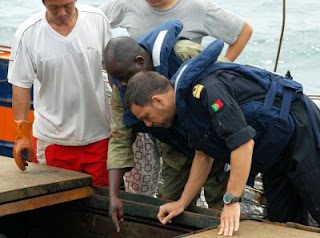
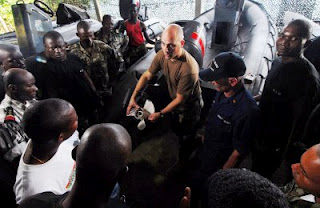
As part of a seven-month operation the military is calling the Africa Partnership Station, the USS Nashville is attempting to help stabilize the waters off of West Africa, which are plagued by illegal fishing, drug trafficking, and illegal migration, as well as robberies and kidnappings in the Niger Delta. According to the International Maritime Bureau, these waters are now the second-most dangerous in the world, after Somalia’s.
The Post aptly noted that the Nashville’s “mission appears to be as much about wooing Africa as about teaching maritime security.” Each time the Nashville docks, military doctors offer free checkups, and sailors repair local buildings and train host-country soldiers. This low-profile approach seems designed to allay Africans’ earlier fears of U.S. colonialism, which forced the U.S. military to headquarter AFRICOM in Germany instead of Africa.Why the sudden surge in publicity for AFRICOM, when it’s been doing these kinds of outreach and confidence-building activities for more than a year? Perhaps President Obama, Secretary of State Hilary Clinton, and others in the new administration see AFRICOM as an example of a foreign policy that places as much emphasis on diplomacy and development as on defense. Indeed, even Secretary of Defense Bob Gates, who was appointed by former President Bush, has called for a rebalancing of the instruments of U.S. power; in 2007, he said, “We must focus our energies beyond the guns and steel of the military, beyond just our brave soldiers, sailors, Marines, and airmen. We must also focus our energies on the other elements of national power that will be so crucial in the coming years.”
Photos: Top—Portugal Navy Lieutenant Commander Antonio Mourinha and a Gabonese Sailor inspect a holding bay for fish after boarding an illegal fishing vessel during Africa Partnership Station (
Showing posts from category military.

 “Climate change may well be a predominant national security challenge of the 21st century, posing a range of threats to U.S. and international security,” said
  USAID convened
  USAID convened
  “Some, I think, probably are surprised to hear former generals and admirals talk about energy efficiency and renewable energy, but they shouldn’t be,” said General Charles Wald, USAF (Ret.), chairman of the CNA
  “Our over-dependence on fossil fuels” and “our dependence on a vulnerable electric grid…present an urgent and serious risk to our national security,” said Goodman, who served as deputy under secretary of defense for environmental security from 1993-2000.
 Did you notice the rash of
  Why the sudden surge in publicity for AFRICOM, when it’s been doing these kinds of outreach and confidence-building activities for more than a year? Perhaps President Obama, Secretary of State Hilary Clinton, and others in the new administration see AFRICOM as an example of a foreign policy that places as much emphasis on diplomacy and development as on defense. Indeed, even

