-
The UN Water Conference and Latin American Transboundary Waters: A Case for Better Governance
›
In recent decades, the international system has undergone profound changes—especially in terms of the types of threats that destabilize international peace and security. As new threats emerge, a focus on new dimensions of the concept of security is now reaching the top of the international agenda. In this context, the global freshwater crisis is beginning to be perceived as an existential threat to states requiring extraordinary measures to alleviate or solve the problem.
-
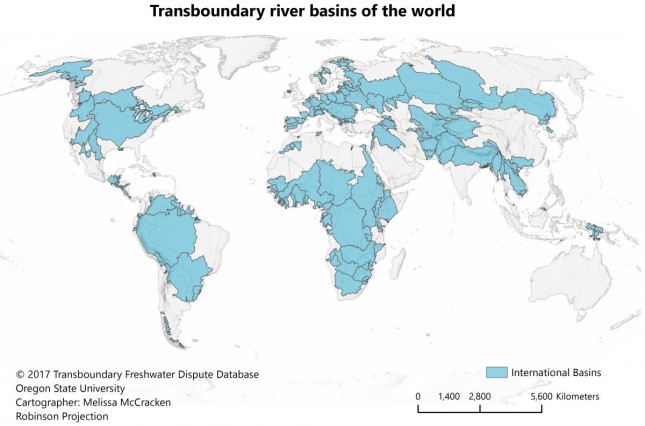
Tracking Conflict and Cooperation Over the World’s International Freshwater Resources
›Guest Contributor // March 20, 2023 // By Alexandra Caplan, Melissa McCracken, Susanne Schmeier, Zoe Rosenblum & Aaron Wolf
Waters that cross international political borders can drive the countries that share them to conflict—or encourage cooperation between them. Indeed, since the 1940s, overall trends point to a tendency for countries to cooperate over shared water resources, which stands in stark contrast to media portrayals of “water wars.”
Yet instances of conflict over water have increased slightly since 2000. Why? Most of them are fueled by water quantity disputes or the unilateral development of dams or other infrastructure. Institutions often play a key role in facilitating cooperation (and reducing conflict) over shared waters, but their growth and adoption have slowed over the last two to three decades.
-
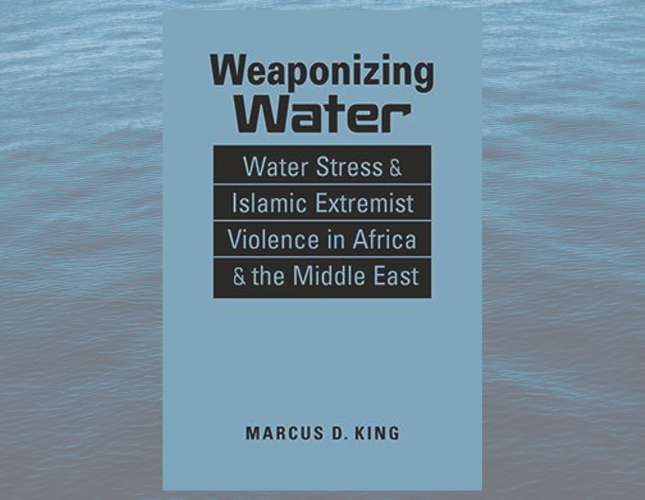
Book Preview: “Weaponizing Water” by Marcus D. King
›By 2050, two-thirds of the population will face some form of water stress. As a fundamental part of life, water—or a lack of it—influences other parts of life, including conflict. In fact, as author Marcus King notes in his new book, Weaponizing Water: Water Stress and Islamic Extremist Violence in Africa and the Middle East, there is a “correlation between the spheres of influence of violent extremist organizations (VEOs) and the driest lands or areas of sparse vegetation in some of the most arid regions on earth.”
-
Gravity and Hope in Environmental Peacebuilding: Two Young Leaders Share Their Stories
›In today’s episode of the New Security Broadcast, ECSP’s Claire Doyle partnered with Elsa Barron at the Center for Climate and Security for a conversation with two young leaders who are working to tackle climate change and build peace: Christianne Zakour and Hassan Mowlid Yasin. Christianne is a volunteer with UNEP’s Major Group for Children and Youth and Hassan is co-founder of the Somali Greenpeace Association. On the episode, Christianne and Hassan share about the climate, equity, and conflict issues that motivate their work and describe how they think we can make progress towards a livable future for all. -
Climate Security and Critical Minerals Mining in Latin America: How Can Business Help?
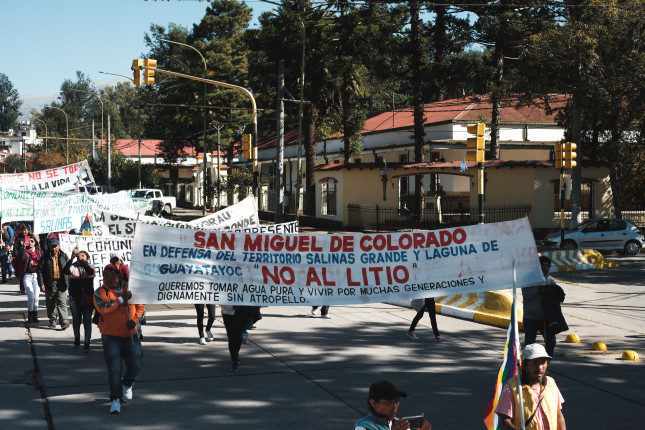
›Guest Contributor // March 7, 2023 // By Héctor Camilo Morales Muñoz, Johanna Dieffenbacher, Raquel Munayer & Beatrice MoselloThe amount of critical minerals required to develop low-carbon energy technologies is predicted to be six times higher than what is needed today. Yet meeting this demand is necessary to enable a global transition that will address climate change and comply with agreements such as the European Green New Deal.
-
Water and Conflict: Updates from the Russia-Ukraine War
›The first anniversary of Russia’s invasion of Ukraine is also a reminder of the long-term challenges faced by that embattled country, including one of the most important resources for human survival: water.
“For Ukrainians, water has been under fire for nearly a decade,” observed Erika Weinthal, Professor of Environmental Policy and Public Policy at Duke University, at a recent Water @ Wilson Series event: “Water and Conflict: Updates from the Russia-Ukraine War,” co-hosted by the U.S. Water Partnership.
-
Arms Are Not Enough: Solutions for the Sahel Must Consider Climate
›On February 25, Nigeria will begin voting for its new president in one of the most tightly fought elections in decades. And the most likely winner has already set down a marker in his campaign. “You can’t be talking about climate change when people are taking cover from bombs,” observed Nigerian presidential hopeful Peter Obi.
-
Environmental Management: A Critical Tool for Environmental Peacebuilding
›On July 28, 2022 the United Nations General Assembly (UNGA) voted—by a count of 161 in favor, with 8 abstentions — that living in a clean, healthy, and sustainable environment is a human right. Building on the similar declaration by the UN Human Rights Council in October 2021, the UNGA has now reinforced the notion that the growing assaults on human health through environmental hazards are transgressions against the basic rights and freedoms of people.
Showing posts from category security.