-
Family Planning Saves Lives, Can Help Mitigate Effects of Climate Change
›
Contraceptives prevented an estimated 272,040 maternal deaths in 2008, reducing worldwide maternal mortality by 44 percent, according to a recent paper by Saifuddin Ahmed, Qingfeng Li, Li Liu, and Amy O. Tsui, published in The Lancet. But the prevention of maternal deaths could have been even higher. The study, “Maternal Deaths Averted by Contraceptive Use: An Analysis of 172 Countries,” estimates that an additional 104,000 maternal deaths – many occurring in developing parts of Africa and South Asia – could have been averted simply by satisfying existing unmet need for contraception. In sub-Saharan Africa, for example, only 22 percent of women who are married or sexually active use contraception – a far cry from the 65 percent which the study suggests is the point at which maternal deaths avoided by contraceptive use begin to plateau. Not surprisingly, this has also yielded some of the highest regional fertility rates in the world.
Such high fertility rates are driving growing concerns about scarcity and capacity in the region, and how climate change might exacerbate already-difficult development hurdles. This nexus of issues was the subject of a recent policy brief by Population Action International and the African Institute for Development Policy, titled Population, Climate Change, and Sustainable Development in Africa. The brief points out that “a large share of Africa’s population lives in areas susceptible to climate variation and extreme weather events,” and that there is an inherent tension the continent faces as it seeks to balance high population growth with climate change-induced reductions in the availability of natural resources, like water and arable land. The authors urge policymakers, rather than focusing on environment, population, and health individually, to “connect population dynamics and climate change” to address their interlinked challenges together.
-
Population and Sustainability in an Unequal World
›August 13, 2012 // By Laurie Mazur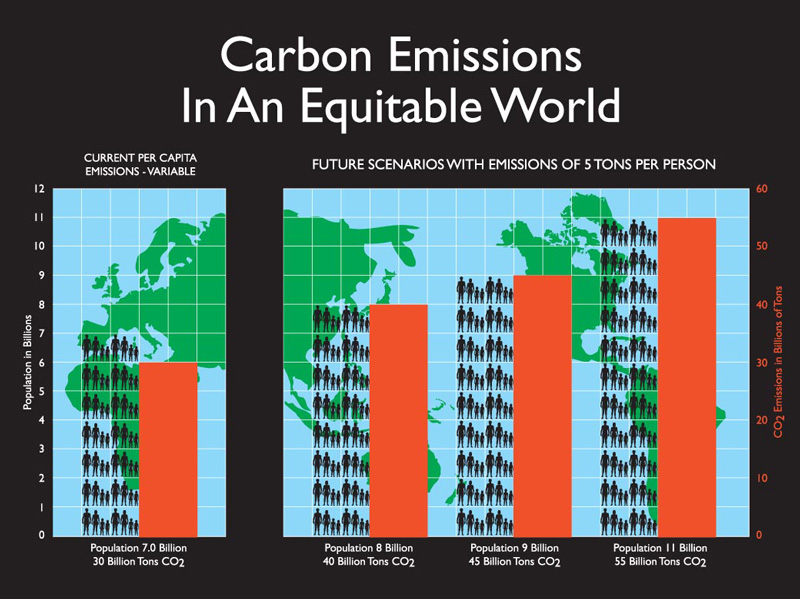
June’s Rio + 20 Conference on Sustainable Development left environmentalists little to cheer about. Kumi Naidoo, executive director of Greenpeace International, called the meeting “a failure of epic proportions.” And Washington Post reporter Juliet Eilperin said the conference “may produce one lasting legacy: convincing people it’s not worth holding global summits.”
-
PRB’s 2012 World Population Data Sheet
›“The most rapid population growth in many ways [occurs in] the countries that can least afford it,” said Carl Haub in a webinar on July 19 to launch the Population Reference Bureau’s (PRB) 50th annual World Population Data Sheet. This year, the report explores aging populations in more developed countries, rapid population growth in less developed countries, and the increased global prevalence of non-communicable diseases in an interactive map, which concisely illustrates global trends. PRB estimates that the world’s population is 7,057,075,000 as of mid-2012; the global population crossed the seven billion threshold in October 2011.
 “The most rapid population growth in many ways [occurs in] the countries that can least afford it,” said Carl Haub in a webinar on July 19 to launch the Population Reference Bureau’s (PRB) 50th annual World Population Data Sheet. This year, the report explores aging populations in more developed countries, rapid population growth in less developed countries, and the increased global prevalence of non-communicable diseases in an interactive map, which concisely illustrates global trends. PRB estimates that the world’s population is 7,057,075,000 as of mid-2012; the global population crossed the seven billion threshold in October 2011.
Aging Europe and East Asia
Haub explained that population growth in Europe has been declining since the 1970s and is more or less a “pre-programmed destiny” for these countries. People of child-bearing ages make up a smaller percent of the population in many more developed countries, so unless there is an “enormous increase” in total fertility rates, these populations will continue to decline for the foreseeable future.
Haub noted that these aging populations are unprecedented. In Germany and Italy, for example, 21 percent are over the age of 65; many other European countries have similar figures, as do other developed countries like Japan and South Korea. PRB expects these percentages to increase throughout the next century and for European countries to struggle to support greater numbers of retirees.
Many such states have already found it difficult to raise the retirement age, even though medical advances allow people to work until later ages. PRB projects that in Japan, 42 percent of their population will be over the age of 60 in 2050; if such a large percentage of the population is no longer in the labor force, it will be difficult for to find the resources to support them.
The report shows that the United States, on the other hand, is still experiencing modest population growth. The higher birthrate is in part due to immigration, as recent immigrants to the United States tend to have more children. Haub noted that European states have been reluctant to accept greater numbers of migrants to try to reverse their declining population.
Youthful Developing Countries
While the demographic destiny of aging countries is somewhat determined, the future for less developed countries is more uncertain. Many countries in sub-Saharan Africa, the Middle East, and South Asia have large and growing youth populations, and how many children these “future parents” will have is uncertain. That uncertainty is underscored by the variety of scenarios for future population growth. The UN has four variants – high, medium, low, and constant fertility – which vary considerably in their projections for future populations, and PRB’s global projections for 2050 are some 600 million people more than the commonly-used medium variant UN projection.
Rapid growth in the least developed countries is hardly a new phenomenon, but PRB breaks down the numbers to an impressive degree. The 2012 Data Sheet provides updated net migration rates, projected population as a multiple of today’s, infant mortality rates, rate of natural increase, and other basic statistics. PRB also provides population pyramids from the wealthiest and poorest quintiles of the population of Malawi, as an example of the utility of desegregating data to better allocate resources to the underserved. They found that while birthrates have begun to decline for the wealthiest one-fifth of Malawians, the poorest citizens still have a total fertility rate of over seven children per woman.
Measuring Health Systems
Devastating infectious diseases – malaria, tuberculosis, and HIV/AIDS – have long been entrenched in some of the least developed and most rapidly growing parts of the world. But this year, PRB began to assess health on a broader level by tracking deaths attributed to non-communicable diseases as well. Diseases like cardiovascular disease, diabetes, respiratory illness, and cancer are leading causes of death in developed countries, but they have also increased in prevalence in developing countries at an alarming rate.
PRB is not the only organization to take note of the change in disease predominance. The World Health Organization has issued guidelines targeting four factors which increase the risk of these illnesses: tobacco use, alcohol abuse, poor diet/obesity, and physical inactivity. The UN also called a special session last September to discuss non-communicable diseases. President of PRB Wendy Baldwin noted that the last such discussion on a health issue was 10 years ago about HIV/AIDS.
Baldwin also pointed out that non-communicable diseases can increase the burden on the health systems of developing countries even more so than in developed states. She reported that in south Asia, for example, people have heart attacks on average six years earlier than people in developed countries, meaning more families lose their primary breadwinners.
The risk factors for these non-communicable diseases are difficult to target, especially with increasing urbanization in developing countries. But in a video accompanying the report, Baldwin mentioned that raising the price of cigarettes is an effective way to reduce tobacco consumption, especially for youth. Some countries have also made progress in increasing physical activity through sports programs and making urban areas safer for pedestrians. “The low and middle income countries have a real opportunity to take really positive steps to confront that rise in non-communicable diseases and to address the risk factors that drive them,” she said.
The Data Sheet Over Time
The World Population Data Sheet has long been a vital resource for those in the population, health, and environment fields and has grown to include far more data than its first iteration in 1962. At first, the sheet had only four indicators: a population estimate for the year, annual rate of increase, crude birth rate, and crude death rate. Over time, PRB began measuring a greater number of key figures like infant mortality and life expectancy at birth. Population projections, a staple of the current version, were not added until 1978, perhaps in response to the inception of the United Nations World Population Projections in 1974.
Over the past five decades, the data sheet has been witness to some major shifts in global population trends. While PRB discourages researchers from comparing past data to current figures because the measures and methods of gathering information have likely changed over time, it is still possible to see the rise of importance in several trends based on the indicators PRB chose to focus on each year. For example, extremely young populations have been found to have profound effects on a country’s stability and prosperity, as have aging populations. The 1966 data sheet was the first to measure the percentage of the population under the age of 15, and it didn’t become a consistent data point until 1977.
The number of people living in cities in the developing world surpassed those in the developed in 1970, according to the UN, and in 1972, PRB began tracking the percentage of populations living in urban areas. HIV/AIDS indicators were added in 2000, as global awareness and a commitment to fighting the disease was rising.
PRB’s demonstrated commitment to continually adding more data and refining existing projections makes the data sheet is a valuable resource to those studying the problems of today and the future. Fifty years on, the amount of information collected is staggering. The data sheet provides a glimpse at not just how many people there are in the world, but also where and how they live.
For more information, take a look at the full data sheet!
Sources: Population Reference Bureau, UN Population Division.
Image Credit: PRB; Video: Noncommunicable Diseases and Youth in Developing Countries. -
Iran’s Surprising and Shortsighted Shift on Family Planning
›August 8, 2012 // By Elizabeth Leahy MadsenIn late July, Iran’s government announced that it would no longer fund family planning programs, a dramatic reversal following 20 years of support. The change is especially abrupt for a country that has been lauded as a family planning success story, with thorough rural health services and an educated female population contributing to one of the swiftest demographic transitions in history.
-
Three UN Millennium Development Targets Reached and a Review of the Human Drivers of Climate Change
›“It is plausible that key transitions in human evolutionary history have been driven in large part by climate change,” write Eugene A. Rosa and Thomas Dietz in “Human Drivers of National Greenhouse-Gas Emissions,” a literature review published by Nature Climate Change. “Changes in climate will doubtless be a key force in the future evolution of social systems, including all aspects of social, economic, and political life, while impinging on the health and well-being of the individuals who populate them.” Rosa and Dietz cite numerous studies to argue that nearly every facet of society will be affected by climate change. “The critical point,” they write, “is that population, affluence, technology, and all other drivers act not alone or additively but in a multiplicative fashion.” For example, rapid population growth can lead to an increase in urbanization, which generates “substantial demand for goods and services that can induce emissions in distant places.” They conclude that huge changes must be made in technology and consumption in order to combat the effects of climate change that are being caused by a growing population and an increasingly affluent world.The United Nations’ 2012 Millennium Development Goals Report, released last month in New York City, announces that three of the eight major human development goals have been reached ahead of their 2015 targets. The Millennium Development Goals, set at a conference in 2000, were established to “uphold the principles of human dignity, equality, and equity at a global level.” The 2012 report indicates that the number of people living in extreme poverty has been halved since 1990; the proportion of people in the world without sustainable access to safe drinking water has also been halved; and more than 200 million slum dwellers have “gained access to either improved water sources, improved sanitation facilities, or durable or less crowded housing.” At the report launch, UN Secretary-General Ban Ki-moon noted that “these results represent a tremendous reduction in human suffering and are a clear validation of the approach embodied in the MDGs, but they are not a reason to relax.” Goals that have yet to be achieved include universal primary education; gender equality; reduced child mortality and improved maternal health; reducing rates of diseases such as HIV and malaria; and creating a global partnership for development.
Keenan Dillard is a cadet at the United States Military Academy at West Point and an intern with the Woodrow Wilson Center’s Environmental Change and Security Program. -
A Roundup of the ‘Global Trends 2030’ Series on Population Aging
›The National Intelligence Council is trying something new for this year’s Global Trends report: keeping a blog. So far, there have been postings from analysts and contributors on everything from migration and urbanization to international banking and precision strike capabilities, but over the past week, one of the most extensive series yet went up on demography. Though youth bulge theories have often dominated population-related security discussions, 11 posts highlight the newest and least understood of all demographic conditions: advanced population aging.
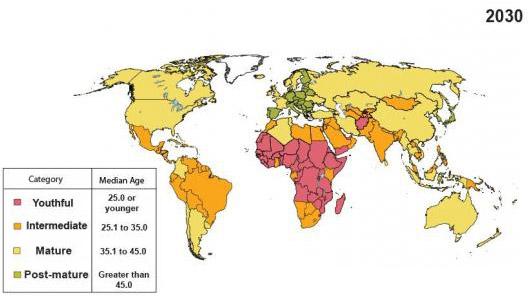
In parts of the world, mainly Europe and several countries in East Asia, populations are set to become “extremely mature” because of sustained declines in average fertility to very low levels and steady increases in lifespan. Demographers measure maturity by a population’s median age – the age of the person for whom precisely half of the population is younger and half older. Japan and Germany currently have the most mature populations; both are reported to have a median age slightly over 45 years. By 2030, UN Population Division and U.S. Census Bureau projections suggest that there may be between 19 and 29 countries that pass this benchmark. In Japan, the median age is projected to be 51.
If 5 out of 10 people in a country over 50 years old sounds unprecedented, that’s because it is. In this series, titled “Population Aging to 2030,” a group of political demographers, economic demographers, political scientists, and historians discuss the implications of this never-before-experienced set of age structures.
In his introductory essay, “Population Aging: A Demographic and Geographic Overview” (cross-posted here on New Security Beat), Richard Cincotta outlines the upcoming demographic trend, identifying the particulars of these novel age structures and indicating the regions that are expected to mature into economically and politically advantageous and disadvantageous demographic profiles.
In “Population Aging – More Security or Less?,” Jack Goldstone examines the effects on the U.S. military of a maturing developed world. With the United States and their traditional allies having proportionally fewer young people, will this impact limit their ability to put “boots on the ground?” Can new partnerships be developed in order to make up for this shortfall in man power?
In “China: the Problem of Premature Aging,” Richard Jackson focuses on China’s unique set of aging issues. Due to strict immigration laws and the one-child policy, China is experiencing the most rapid aging of the major powers. The favorable age structure which has enabled huge economic growth will soon shift to being a major burden on a relatively smaller working-age population, having potential political and societal consequences beyond that.
“The Sun Has Yet to Set on China” provides a different interpretation of the challenges China faces. Jennifer Dabbs Sciubba argues that although there will be changes in age structure, the problems may be overstated and the United States may still face a challenge to its status as sole global superpower.
In “Population Aging and the Welfare State in Europe,” Ronald Lee and Andrew Mason emphasize the stresses aging will exert on the extensive social welfare programs of many European states. The combination of longer life expectancy and declining fertility rates has led to a large and increasing funding gap in the welfare system, leaving questions as to the future viability of these programs.
In “Population Aging and the Future of NATO,” Mark Haas foresees that the welfare funding gap could have far-reaching international security consequences. With European governments diverting more and more resources away from military spending to fund welfare programs, the current U.S. irritation with NATO is likely to continue, as European allies “free ride” on the back of U.S. military supremacy in order to cut their defense budgets.
In “The Beginning of History: Advanced Aging and the Liberalness of Democracies,” Richard Cincotta examines the future of the liberal democratic political systems across aging countries. With increasing pressure on resources and a large disparity likely between the native born and migrant populations, it may become challenging for these states to remain liberal and democratic.
For Toshi Yoshihara, author of “The Strategic Implications of Japan’s Demographic Decline,” the aging process will pose a question of priorities for the leaders of Japan. The decreasing number of personnel available to the military, the effects of which were highlighted by the recent tsunami, will force a strategic decision between a defense force that is prepared primarily to address immediate and local security threats or one that is trained primarily for broader humanitarian interests.
“A Demographic Sketch of a Reunified Korea” provides interesting insights into the hypothetical demography of a single, unified Korea. Putting aside the two very distinct social paths that evolved during the past 60 year, Elizabeth Hervey Stephen uses demographic projections to envisage the challenges and opportunities that could arise from reunification.
David Coleman points to immigration as a possibly-mitigating force to aging in the developed world. In “The Impact of Immigration on the Populations of the Developed World and Their Ethnic Composition,” Coleman concludes that the developed world is likely to become “super diverse” by 2030. But this trend can be volatile. International migration is subject to many political and economic factors, bringing into question whether the developed world can rely on migration to supplement their native growth rates.
In “The Ethnic Future of Western Europe to 2030,” which wraps up the series, Eric Kaufmann examines the ethnic make-up of Western Europe in the coming decades. While the size of ethnic minority populations may be smaller than in the United States, the speed of growth in these minorities is likely to be much more rapid in Western Europe. This unprecedented increase in migrant populations could exacerbate ethnic social tensions, particularly in urban areas.
The broad nature of these essays suggests that advanced population aging will emerge within the context of many types of policy debates in the coming decades. While these 11 brief essays only scratch the surface of their respective areas of research, they provide a broad introduction to the politics of advanced population aging.
Jonathan Potton is a student at the University of Aberdeen and currently interning at the Stimson Center for demographer Richard Cincotta.
Sources: UN Population Division, U.S. Census Bureau.
Image Credit: Courtesy of Richard Cincotta. Data from U.S. Census Bureau’s international database. -
From Youth Bulge to Food and Family Planning, Los Angeles Times’ ‘Beyond 7 Billion’ Series Synthesizes Population Challenges
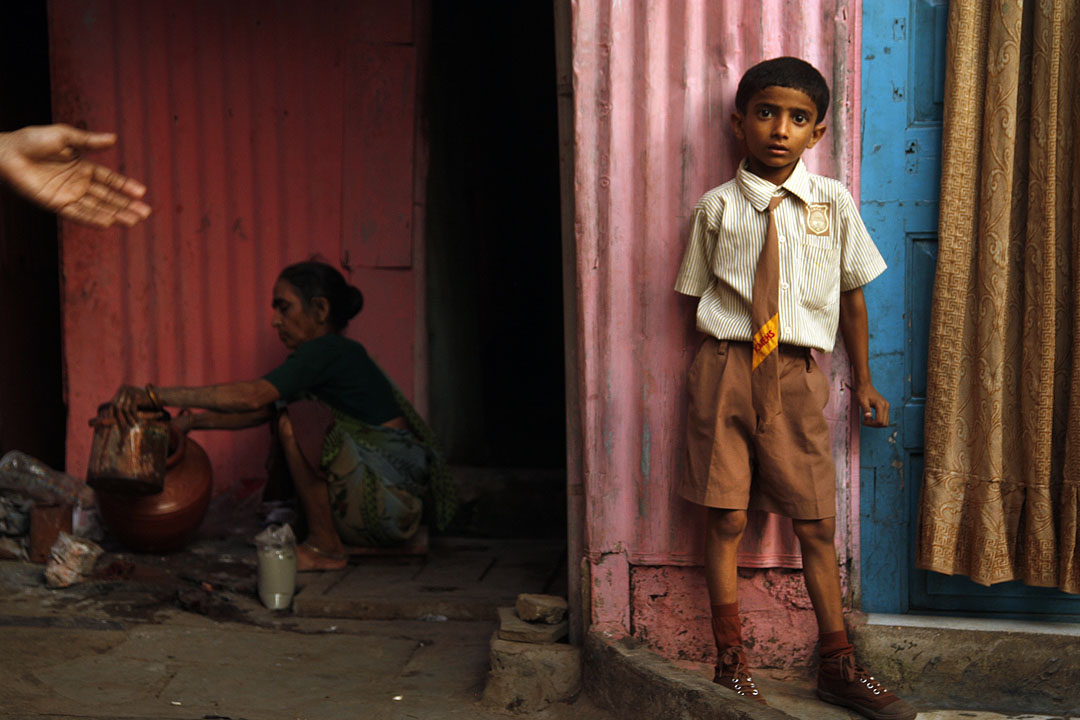
›Over the next 40 years, the world is set to add 2.3 billion people. Millions more will join the middle class, pushing consumption upwards and further straining the world’s natural resources. Variables like climate change and political instability will exacerbate that strain and complicate efforts to bolster peaceful and stable development. Los Angeles Times correspondent Kenneth Weiss and photographer Rick Loomis examine these numerous and interconnected challenges in a five-part series on population growth and consumption dynamics.
Speaking to demographic and health experts (including a number of New Security Beat regulars, like Richard Cincotta, Jon Foley, and Dr. Joan Castro), Weiss provides a thorough, astute, and compelling assessment of population dynamics in a rapidly changing world. The series starts with a basic introduction to population, climate, and consumption dynamics and progresses through to discuss political demography, global food security, and detailed looks at two important case studies, China and the Philippines.
Part One: A Population Primer
Population growth alone poses a number of challenges as cities become more crowded and demand for basic resources like water and food outpaces supply. Climate change and the unpredictable and sometimes extreme weather that is its hallmark “will make all of these challenges more daunting,” writes Weiss. And “population will rise most rapidly in places least able to handle it.” Africa, the Middle East, and South Asia, already expected to bear the brunt of climate change with rising sea levels, shorter growing seasons, and increasingly variable weather patterns, will also have to support the bulk of the world’s population growth by mid-century. Populations in Europe, North America, and East Asia are expected to stay stable or decline in numbers.
The magnitude of growth in Africa, the Middle East, and South Asia, however, is uncertain. What happens from here “hinges on the cumulative decisions of hundreds of millions of young people around the globe,” Weiss writes. And yet, “population growth has all but vanished from public discourse.” Family planning in particular remains hamstrung by “erratic funding and unpredictable crosscurrents.” The result, he writes, is that even “under the best conditions, it’s hard to get contraceptives into the hands of impoverished women who want them.”
Part Two: The Arc of Instability
Drawing on work from demographer Richard Cincotta, George Mason University’s Jack Goldstone, Population Action International, and others, part two of Weiss’ series examines youth bulges and the so-called “arc of instability,” stretching across the disproportionately youthful countries of Africa, the Middle East, and South Asia.
When a large youth population is mixed with other societal conditions, like “religious and ethnic friction, political rivalries, economic disparities, or food shortages,” youth can be “the kindling” for a spark that ignites simmering tensions, writes Weiss. Afghanistan is a case in point, where unemployed young men are often turning to the Taliban not out of extremist fervor, but out of a desperate need to support themselves and their families. “It’s too hard to employ this many people and too easy to recruit them into violence,” Cincotta told Weiss.
And Afghanistan is just the beginning, according to Goldstone. “We are literally going to see one billion young people come into the populations in the arc of instability over the next two decades,” he said. “We can’t fight them. We have to figure a better way to help them.”
Part Three: Feeding a Growing Population
As the world’s population continues to grow, and as more families join the middle class, world food production will have to double by mid-century in order to meet future demand. “What that actually means,” says World Wildlife Fund’s Jason Clay, an agriculture specialist, “is that in the next 40 years we need to produce as much food as we have in the last 8,000.”Jon Foley on how to feed nine billion and keep the planet
Weiss presents the Horn of Africa and Punjab as microcosms of the problems facing global food production in the 21st century. Desertification and urbanization are eating away at potential cropland, while harmful farming techniques leech essential nutrients from soil, rendering it useless for future use. Insufficient infrastructure means that food spoils as it’s shipped from where it’s produced to where it’s needed, while extreme and widespread poverty means that those most in need can’t afford enough to feed their families.
Stuck between growing demand and restricted supply, the University of Minnesota’s Jonathan Foley said the challenge of the century is straightforward: “How will we feed nine billion people without destroying the planet?”
Part Four: Population and Consumption in China
China has “a greater collective appetite – and a greater ecological impact – than any other country,” writes Weiss, making it a prime example of “how rising consumption and even modest rates of population growth magnify each other’s impact on the planet.”
The country’s one-child policy slowed population growth rapidly, cutting fertility almost in half in less than a decade. Over time, a large working-age cohort with few dependents emerged, and helped China reap a demographic dividend. The resulting economic prosperity has come at a cost, however, as rising incomes and increasing consumption, spread across 1.3 billion people, have wreaked havoc on the country’s environment on a scale not seen anywhere else in the world.
Because of that scale, what happens in China will have global repercussions. Climate scientists “say that in order to avoid a potentially catastrophic rise in global temperatures, worldwide carbon dioxide emissions must be cut in half by 2050,” Weiss writes. “For that to happen, China’s emissions would have to peak by 2020” – 15 years earlier than official government projections. The government remains opposed to further limits on emissions, arguing that such limits would “cripple” economic growth – an unfair impediment considering that developed countries were able to “pollute their way to prosperity, their argument goes.”
Part Five: Family Planning in the Philippines
Weiss ends the series with an in-depth look at family planning in the Philippines – a country at the forefront of the global debate over access to contraception. Lawmakers in the 80-percent-Catholic country have steadfastly refused to fund family planning services, while support from the international community all but vanished when USAID, “the major donor of contraceptives to the Philippines,” said in 2008 that it would end its contraceptive program.
Today, half of all pregnancies in the Philippines are unintended. Lawmakers are considering a “reproductive health bill…call[ing] for public education about contraceptives and government subsidies to make them available to everyone,” but a powerful opposition, including Church leadership, has stalled the bill for 14 years, Weiss writes.Joan Castro on population-environment programing in the Philippines
Public officials, including the former Manila mayor who ended the city’s contraceptive program 12 years ago, portray unbridled population growth as an economic asset, saying that “when you have more people, you have a bigger labor force.” For the millions of Filipinos who live in poverty, however, the lack of affordable family planning services leaves them with little control over family size and puts the Philippines on track to grow from 96.4 million people today to 154.9 million by mid-century. At that rate, the Philippines would be Asia’s third fastest growing country, behind Timor Leste and Afghanistan.
Not everything in the series is dire – there are side columns highlighting population, health, and environment programming in Uganda, Iran’s successful family planning program, and Dr. Joan Castro’s family planning and marine conservation work in the Philippines. But Weiss is not naïve about the challenges ahead. Under any of the United Nation’s population projections, “living conditions are likely to be bleak for much of humanity,” he writes. “Water, food, and arable land will be more scarce, cities more crowded, and hunger more widespread.”
“Even under optimistic assumptions, the toll on people and the planet will be severe.”
But while the population challenges facing the world are many, Weiss, like many before him, makes one argument clear: providing family planning services to the 222 million women who want to control the number of children they have but cannot would go a long way towards minimizing future strain.
Be sure to check out the photo and video features accompanying the “Beyond 7 Billion” series on the feature site.
Note: The sentence beginning with “When a large youth population…” was corrected.
Sources: Los Angeles Times, UN Population Division.
Video Credit: “The Challenge Ahead,” used with permission courtesy of the Los Angeles Times; Photo: “Dharavi,” used with permission courtesy of Rick Loomis/Los Angeles Times; Jon Foley video: TEDx. -
Population Aging: A Demographic and Geographic Overview
›The original version of this article, by Richard Cincotta, appeared on the National Intelligence Council’s Global Trends 2030 Blog. It is the first post in a series on population aging, featuring Jack Goldstone, Richard Jackson, Jennifer Dabbs Sciubba, Ronald Lee, Andrew Mason, Toshi Yoshihara, Elizabeth H Stephen, David Coleman, and Eric Kaufmann.
This series, Population Aging to 2030, begins with an introductory essay aimed at familiarizing readers with some of the demographic and geographic particulars of this phenomenon, and with several key demographic terms. The term most in need of definition is, of course, “population aging.”
Showing posts from category population.


 “The most rapid population growth in many ways [occurs in] the countries that can least afford it,” said Carl Haub in a webinar on July 19 to launch the Population Reference Bureau’s (PRB) 50th annual