-
Transforming Africa: Women and Young People Will Drive Progress
›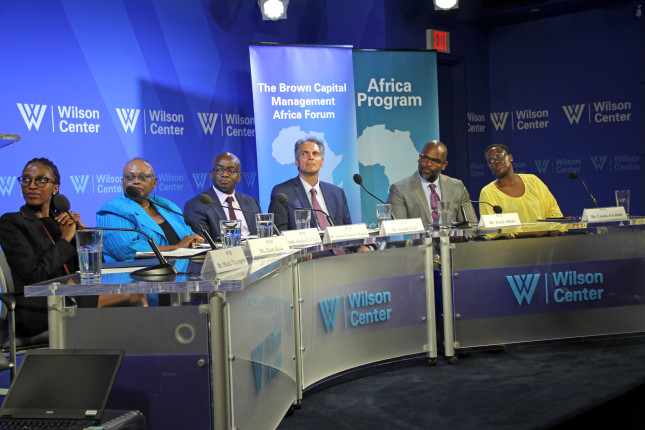
“Too often in the United States, the narrative that we hear about Africa is one of poverty, war, and ineffective or failed states. It is a crisis, a place best engaged through aid packages and humanitarian assistance,” said Keith Lee, President and Chief Operating Officer of Brown Capital Management at a recent Wilson Center event hosted by the Africa Program. “This has never been the entire story, and today more than ever, Africa is undergoing enormous transformations that challenge this narrative,” Lee said.
-
Africa in Transition: Highlights from a Conversation on Investing in Youth for Economic Prosperity
›
Africa in Transition, a new series hosted by the Wilson Center and the Population Institute, explores the role of population trends—migration, urbanization, fertility, maternal mortality—in shaping sub-Saharan Africa’s chances for prosperity, health, and security. In this podcast, we share highlights from the first Africa in Transition event. Parfait Eloundou-Enyegue, Professor at Cornell University, starts the conversation by reminding us that “African countries are in the middle of multiple transitions that have the potential to create opportunities for prosperity, growth, and increased human capital, but also to create greater inequality. The challenge, therefore, is to build prosperity, but to do it for all.”
-
Africa’s Future Workforce: Investing in Youth for Economic Prosperity and Equity
›“African countries are not in the middle of one transition, they are in the midst of several transitions,” said Parfait Eloundou-Enyegue, Professor and Chair of the Department of Development Sociology at Cornell University, at a recent Wilson Center event on demographic trends on the continent, and investing in youth to ensure economic prosperity. “All of these transitions are an opportunity for prosperity, an opportunity for growth, an opportunity to build human capital,” said Eloundou-Enyegue. However, demographic, cultural, political, and economic changes can also exacerbate existing inequalities between and within countries. The challenge is not only to build prosperity, but to do it for all, said Eloundou-Enyegue.
-
More Countries Want to Invest in Caring. Here’s How They Should Do It
›At long last, my husband and I are empty-nesters. We have always worked in high-pressure jobs, and while the children were young, I put in plenty of non-work hours to care for them and for the household. My husband was unfailingly helpful, but now that our children are grown, I’m ready to renegotiate our “to do” list.
-
New Security Beat’s Biggest Stories of 2018
›In 2018, our readers came to New Security Beat to understand how individuals and communities cope in the face of environmental uncertainty, particularly when the rule of law, natural resource management, and social services are lacking.
-
The Tetherball Effect: How Efforts to Stop Migration Backfire
›Fears of Central American caravans and Saharan smugglers keep European and U.S. leaders up at night. Desperate to manage migration, they turn to short-term fixes, which include blocking borders and supporting authoritarian leaders to contain people—their own citizens and others—before they get close to Europe or the United States. This bit of political theater appeals to some, but has limited effects in overall numbers. The long game consists of addressing root causes so people no longer feel compelled to move at all. But this too will do little to prevent migration north. If anything, it will encourage more people to move.
-
Innovative Approaches Empower Adolescent Girls to Live HIV-free Lives
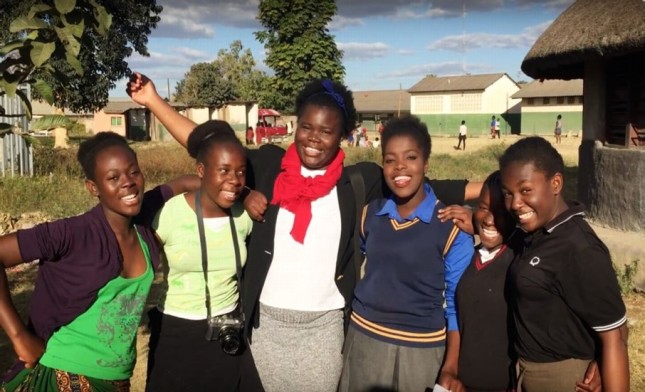
›“Everyone in the community knew that I was the next [to get pregnant], but I was so determined that until I achieve my dream of becoming an accountant, I will not drop out of school, and I will not get pregnant,” said Rebecca Acio, a 19-year-old Ambassador for the Strengthening School-Community Accountability for Girls’ Education (SAGE) DREAMS Project, Uganda. She spoke at a recent Wilson Center event on emerging lessons from the DREAMS Innovation Challenge. As a peer educator at her school in Lira, Uganda, and a temporary dropout herself, Acio “knew what it cost to be a dropout” and worked to identify other at-risk girls to encourage them to stay in school.
-
The Care Gap: How Can Government Get Men To Do More?
›The care economy raises a huge range of problems and opportunities for governments, but one issue that is more or less constant across the world is the uneven distribution of unpaid care work: this tends to fall far more on women.
Showing posts from category population.