• woodrow wilson center
  • ecsp

New Security Beat

Subscribe:
  • rss
  • mail-to
  • Who We Are
  • Topics
    • Population
    • Environment
    • Security
    • Health
    • Development
  • Columns
    • China Environment Forum
    • Choke Point
    • Dot-Mom
    • Friday Podcasts
    • Navigating the Poles
    • Reading Radar
  • Multimedia
    • Water Stories (Podcast Series)
    • Backdraft (Podcast Series)
    • Tracking the Energy Titans (Interactive)
  • Films
    • Water, Conflict, and Peacebuilding (Animated Short)
    • Paving the Way (Ethiopia)
    • Broken Landscape (India)
    • Scaling the Mountain (Nepal)
    • Healthy People, Healthy Environment (Tanzania)
  • Publications
  • Events
  • Contact Us

NewSecurityBeat

The blog of the Wilson Center's Environmental Change and Security Program
Showing posts from category podcast.
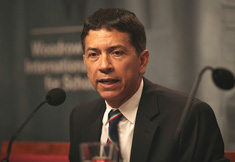
  • Stacy VanDeveer: “Green Economy” May Bring More of the Resource Curse

    ›
    Friday Podcasts  //  July 12, 2013  //  By Jacob Glass
    Stacy VanDeveer podcast

    “We can’t talk about a ‘green economy,’ ‘green technologies,’ or ‘green energies’ only by talking about technologies that are stamped out at one end of a large global process and deployed for cleaner energy,” says Stacy VanDeveer in this week’s podcast.

    “The green economy, or green energy transition, requires a lot of metals, and a whole lot of things that are mined,” he says. “Because of the scale of the industry now, the scale of the environmental and social change being driven by mining globally is actually quite stunning.”

    MORE
  • Susan Bradley on Feed the Future: Solving Hunger Requires Cross-Cutting Development Initiatives

    ›
    Friday Podcasts  //  June 21, 2013  //  By Jacob Glass
    Susan Bradley podcast

    “Sustainable food security means that food production has to be climate smart,” says Susan Bradley in this week’s podcast. “In order to achieve climate smart food security, we are going to have to build resilience and adaptive capacity into agriculture.”

    Bradley, division director for the USAID’s Bureau for Food Security, is working to implement the U.S. government’s Feed the Future Initiative. Unveiled by the Obama Administration in 2009, the $3.5 billion “whole of government” initiative aims to alleviate hunger and increase food security around the world.

    MORE
  • Lisa Dabek on How Papua New Guinea’s Tree Kangaroo Conservation Project Does More Than Conserve

    ›
    Friday Podcasts  //  June 14, 2013  //  By Schuyler Null

    “All through Papua New Guinea, in every province, there is logging and mining, but we are the first conservation area,” says Lisa Dabek in this week’s podcast.

    Dabek is the director of the Tree Kangaroo Conservation Project (TKCP), an effort of the Seattle Woodland Park Zoo that works to protect tree kangaroos while empowering communities in Papua New Guinea’s YUS Conservation Area to manage their natural resources, health care, and food security.

    MORE
  • Joan Castro on Engaging Youth to Create Change in the Philippines

    ›
    Beat on the Ground  //  Friday Podcasts  //  May 24, 2013  //  By Schuyler Null & Carolyn Lamere

    “Exposing young people to information about PHE [population, health, and environment] and food security dynamics can be a powerful tool to steer their interests and commitment to care for the environment and become sexually responsible individuals,” says PATH Foundation Philippines, Inc. (PFPI)’s Joan Castro in this week’s podcast.

    PFPI’s Youth EMPOWER project has trained close to 300 “youth peer educators” in the southern Philippines to promote environmentally sustainable livelihoods, clean up the environment, raise awareness of reproductive health, and encourage participation in local government.

    MORE
  • Leslie Mwinnyaa: Young People Drive Integrated Development in Ghana’s Ellembelle District

    ›
    Beat on the Ground  //  Friday Podcasts  //  May 17, 2013  //  By Schuyler Null & Carolyn Lamere

    “I have been amazed and inspired by the youth that I’ve worked with, with their dedication and motivation to help their countrymen and to try to make their communities better places,” says Leslie Mwinnyaa in this week’s podcast.

    When Mwinnyaa arrived in the Ellembelle district of coastal Ghana as a Peace Corps volunteer she found a multitude of development challenges. Fishermen routinely use illegal techniques like chemicals, lights, and dynamite that decimate fish stocks; “sand winning” and mangrove clearing increases erosion, leaving communities vulnerable to flooding and reducing breeding grounds for local fish; poor waste and refuse management contributes to disease and poor health; and teenage girls have twice the national rate of pregnancy.

    MORE
  • From Alcohol to HIV/AIDS, Anita Raj on How Gender Inequities Affect Maternal Health in India

    ›
    Dot-Mom  //  Friday Podcasts  //  May 10, 2013  //  By Carolyn Lamere

    Anita-Raj-podcast“Improving the equity of women, the treatment of women and girls, the value of women and girls in society is a very important means of improving population health,” says Dr. Anita Raj of the University of California, San Diego. Traditional societal expectations of women and girls in India contribute to high early marriage rates, low birth spacing, high rates of sexually transmitted infections, and high rates of abuse. Efforts to improve maternal and child health should take these and other gender inequities into consideration. “The need to work on these issues and work on them immediately cannot be overstated,” she said.

    MORE
  • Jay Silverman on the Impact of Domestic Violence on Maternal and Child Health

    ›
    Dot-Mom  //  Friday Podcasts  //  May 3, 2013  //  By Carolyn Lamere

    “Violence against women is obviously a major factor in maternal and reproductive health,” says Jay Silverman, co-director of the Program on Gender Inequities and Global Health at the University of California, San Diego, in this week’s podcast. From hypertension to early delivery, “all of these things occur at significantly higher rates among women who have an abusive partner.” Silverman gives an overview of the “state of knowledge” about the effect of abuse on mothers and children and suggested that interventions during antenatal care that targets both women and their partners can reduce this important source of child and maternal morbidity.

    MORE
  • Clive Mutunga: Addressing Population Growth Can Build Resilience to Climate Change in Kenya and Malawi

    ›
    Friday Podcasts  //  April 26, 2013  //  By Carolyn Lamere

    “We know that a number of these countries in Africa have the least to do with climate change in terms of emissions, but they are the most vulnerable, and they are the ones with the least capacity to deal with the effects of climate change,” says Clive Mutunga in this week’s podcast. Mutunga, a senior associate at Population Action International, discusses the results of a study PAI conducted looking at the entwined and related impacts of climate change and population growth, as well as other factors like water scarcity, on Kenya and Malawi.

    MORE
Newer Posts   Older Posts
View full site

Join the Conversation

  • RSS
  • subscribe
  • facebook
  • G+
  • twitter
  • iTunes
  • podomatic
  • youtube
Tweets by NewSecurityBeat

Trending Stories

  • unfccclogo1
  • Pop at COP: Population and Family Planning at the UN Climate Negotiations

Featured Media

Backdraft Podcast

play Backdraft
Podcasts

More »

What You're Saying

  • Volunteers,At,The,Lagos,Food,Bank,Initiative,Outreach,To,Ikotun, Pan-African Response to COVID-19: New Forms of Environmental Peacebuilding Emerge
    Rashida Salifu: Great piece 👍🏾 Africa as a continent has suffered this unfortunate pandemic.But it has also...
  • A desert road near Kuqa An Unholy Trinity: Xinjiang’s Unhealthy Relationship With Coal, Water, and the Quest for Development
    Ismail: It is more historically accurate to refer to Xinjiang as East Turkistan.
  • shutterstock_1779654803 Leverage COVID-19 Data Collection Networks for Environmental Peacebuilding
    Carsten Pran: Thanks for reading! It will be interesting to see how society adapts to droves of new information in...

What We’re Reading

  • Rising rates of food instability in Latin America threaten women and Venezuelan migrants
  • Treetop sensors help Indonesia eavesdrop on forests to cut logging
  • 'Seat at the table': Women's land rights seen as key to climate fight
  • A Surprise in Africa: Air Pollution Falls as Economies Rise
  • Himalayan glacier disaster highlights climate change risks
More »
  • woodrow
  • ecsp
  • RSS Feed
  • YouTube
  • Twitter
  • Facebook
  • Home
  • Who We Are
  • Publications
  • Events
  • Wilson Center
  • Contact Us
  • Print Friendly Page

© Copyright 2007-2021. Environmental Change and Security Program.

Woodrow Wilson International Center for Scholars. All rights reserved.

Developed by Vico Rock Media

Environmental Change and Security Program

Woodrow Wilson International Center for Scholars

Ronald Reagan Building and International Trade Center

  • One Woodrow Wilson Plaza
  • 1300 Pennsylvania Ave., NW
  • Washington, DC 20004-3027

T 202-691-4000