-
Green Solutions for Africa’s Urban Food Security
›September 26, 2012 // By Payal Chandiramani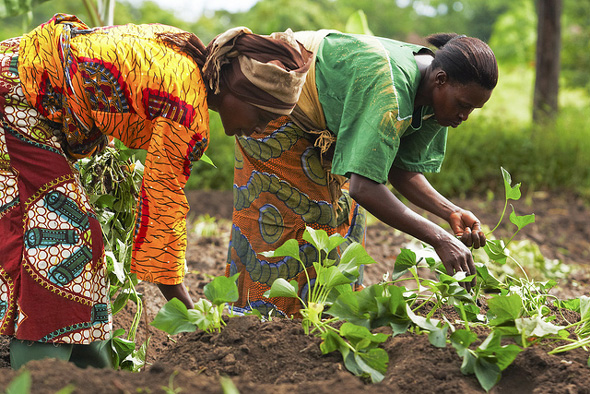
Following the steady economic growth that many African countries have experienced in recent years and continued population growth, urbanization has accelerated rapidly on the continent as people turn to cities to take advantage of new economic opportunities. But growing cities have led to another problem. According to a new Food and Agriculture Organization (FAO) report, Growing Greener Cities in Africa, urban populations are exceeding the capacity of African cities to provide food for them, putting nearly 300 million people at risk of hunger and malnutrition, and greener strategies – urban agriculture and better water use – could help considerably.
-
Counting the World: UNFPA Highlights the Challenges of Census-Taking
›The United Nations biannual population projections are some of the most (if not the most) widely used numbers in demography. Researchers and policymakers alike rely on the figures to plan for present and future challenges. But few consider the story behind the statistics. Where does the data come from? The United Nations Population Fund (UNFPA) recently released a short documentary on conducting censuses in challenging environments, with a spotlight on Indonesia, Chad, the Palestinian Territories, Belarus, and Bolivia.
-
Ecological Footprint Accounting: Measuring Environmental Supply and Demand
›September 12, 2012 // By Kate Diamond
Twenty-five years have passed since the Brundtland Commission first brought sustainable development to international prominence. Today, the United Nations appears on track to replace the soon-to-expire Millennium Development Goals with “Sustainable Development Goals,” marking the extent to which the international community has embraced the concept. And yet, in spite of its prominence, a specific and measureable definition of sustainability remains lacking.
-
Nile Basin at a Turning Point as Political Changes Roil Balance of Power and Competing Demands Proliferate
›September 4, 2012 // By Carolyn LamereIn 1979, Egyptian President Anwar Sadat famously said that “the only matter that could take Egypt to war again is water.” Sadat’s message was clear: the Nile is a matter of national security for Egypt.
Indeed, Egypt relies on the Nile for 95 percent of its water. But it is not the only state with an interest in the world’s longest river. There are 11 states in the Nile River basin, which stretches from Africa’s Great Lakes region – Tanzania, Uganda, Kenya, Rwanda, Burundi, and the Democratic Republic of the Congo – to the Ethiopian and Eritrean highlands through South Sudan, Sudan, and Egypt to the Mediterranean Sea.
-
Coming of Age: Reason for Optimism in Burma’s Turn Towards Democracy
›Burma (also known as Myanmar), a country plagued by internal political turmoil and direct or tacit military rule since 1962, had its first general elections in 50 years in 2010 and long-time jailed opposition leader Aung San Suu Kyi won a seat in the National Assembly, but questions remain as to how much power the military is willing to cede. Demography provides reason for hope that this turn towards democracy is more than temporary.
-
Another Year, Another Debate: Is the Failed States Index Simply Misnamed?
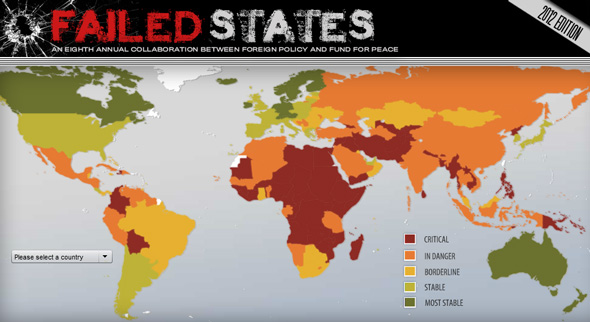
›Every year, there are mixed reactions over the rankings and the efficacy of the Fund for Peace’s Failed States Index (FSI), the eighth edition of which was released in June. But this year, the criticism seems especially intense.
“Failed means there is no way back. Failed means a binary division between those countries that are salvageable and those beyond redemption. It is a word reserved for marriages and exams. It does not belong in a pragmatic debate,” wrote Claire Leigh for The Guardian in June.
-
Stress Levels of Major Global Aquifers Revealed by Groundwater Footprint Study
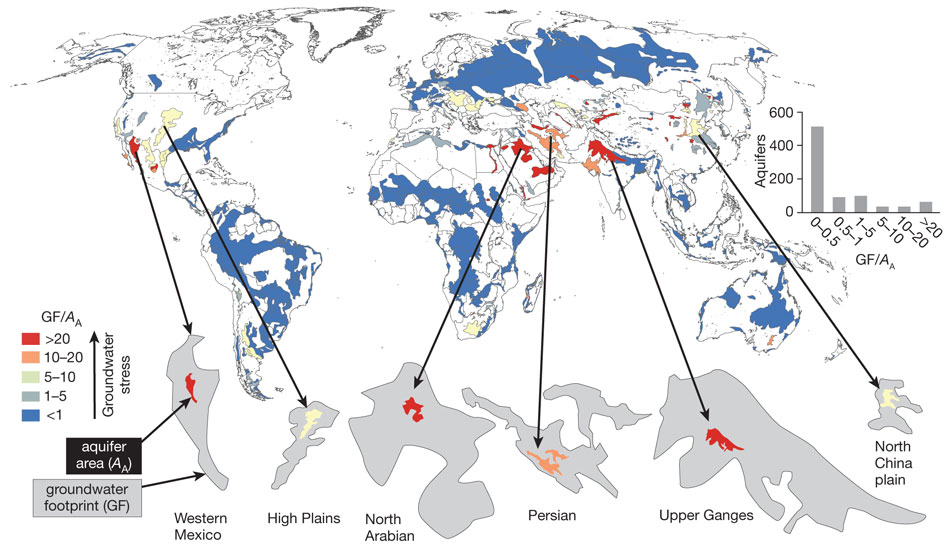
›In the “first spatially explicit comparison of groundwater use, availability, and environmental flow for aquifers globally,” a new article in Nature finds that the “size of the global groundwater footprint is currently about 3.5 times the actual area of aquifers.” An aquifer’s footprint is the theoretical size it would need to be to sustainably support use at its current rate, so groundwater footprints being much larger than their corresponding aquifers is a sign of overuse.
-
Inside U.S. Climate Security Policy: Geoff Dabelko Interviewed by ISN
›August 20, 2012 // By Kate DiamondClimate change “has been thought of in many quarters as something that affects folks ‘over there,’ and not as much domestically, and I think that’s a mistake,” said ECSP’s Geoff Dabelko in a recent podcast with the Zurich-based International Relations and Security Network. “I think folks are coming to a realization that there are very high economic, political, and ultimately security stakes for the United States.”
Showing posts from category featured.