-
Urbanization and the Global Climate Dilemma
›
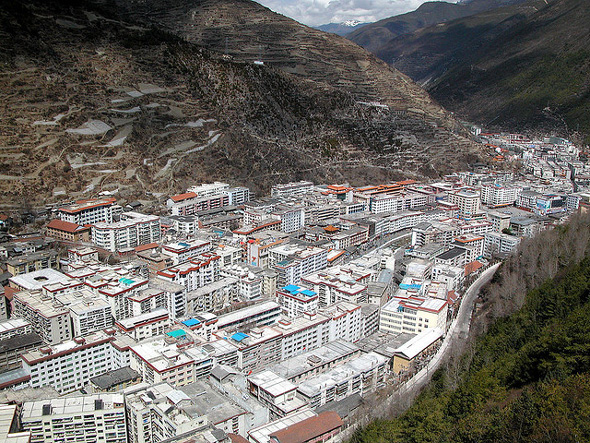
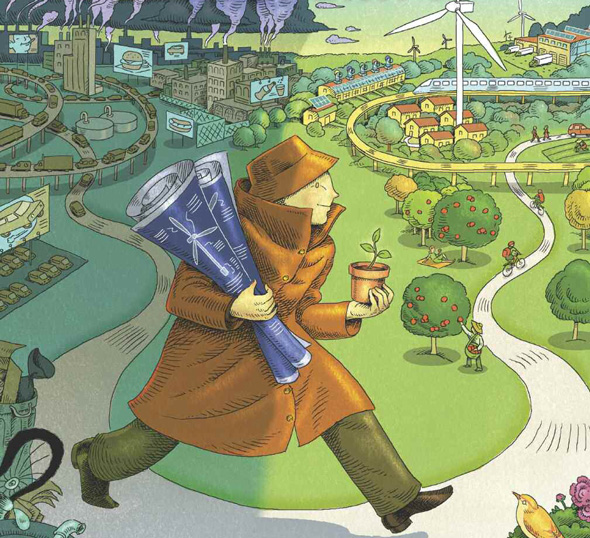
Urbanization and climate change may be the two most important trends to shape global development in the decades ahead. On the one hand, urban cities have the potential to serve as engines of change, driving economic growth in some of the world’s least developed countries and pulling more people out of poverty than at any other time in history. On the other hand, climate change could undercut all of this by exacerbating resource scarcity and putting vulnerable communities at risk from sea level rise and more frequent and intense storms.
-
Linking Water, Sanitation, and Biodiversity Conservation in Sub-Saharan Africa
›July 25, 2012 // By Kate DiamondWater, poverty, and the environment are “intrinsically connected,” and the development programs targeting them should be as well, writes David Bonnardeaux in Linking Biodiversity Conservation and Water, Sanitation, and Hygiene: Experiences From sub-Saharan Africa, a new Africa Biodiversity Collaborative Group briefing. In a review of 43 programs across sub-Saharan Africa, including four in-depth case studies, Bonnardeaux finds that natural synergies between water, sanitation, and hygiene (WASH) programming and conservation work provide opportunities for greater effectiveness in addressing both.
Integrating WASH and Conservation: A Natural Match
“WASH interventions are generally reliant on natural resources and processes, whether indirectly or directly,” he writes, and “WASH services produce outputs that are potentially detrimental to the environment if not managed properly.” At the same time, poor ecosystem management can “threaten biodiversity and jeopardize the vital services that these ecosystems in turn provide to humanity, in the form of regulation of stream flow, erosion prevention, water filtration, aquifer recharge, carbon sequestration, wildlife habitat, outdoor recreation, and flood abatement.”
Given the connections between the two, WASH and conservation efforts would benefit from programmatic integration, according to Bonnardeaux. To bring the two closer together, he recommends three tools for policymakers and development programmers: integrated river basin management and basin planning; payments for watershed services (also known as payments for environmental services); and population, health, and environment (PHE) programming.
A Whole-of-Basin Perspective
“The causal link between WASH and ecosystem health and integrity is most accentuated when
dealing with freshwater ecosystems,” writes Bonnardeaux.
In Tanzania’s Pangani River Basin, one of his in-depth case studies, a growing reliance on hydropower, urbanization, and increased agricultural demand is altering a valuable ecosystem marked by endemism and iconic landscapes, including Mount Kilimanjaro.
In response, the government and international organizations are partnering through the Pangani River Basin Management Project to developing a greater understanding of the basin’s hydrology and ecosystem, how local populations interact with that ecosystem, and how potential development scenarios could impact the basin in the future. That knowledge, paired with an intensive training program for local water officials, is enabling stronger integrated resource management, which in turn could lay the groundwork for integrating WASH and conservation interventions, writes Bonnardeaux.
Economic incentives – in this case, payments for watershed services – offer another valuable tool for building support for conservation efforts, especially when upstream communities bear a disproportionate burden of safeguarding watersheds.
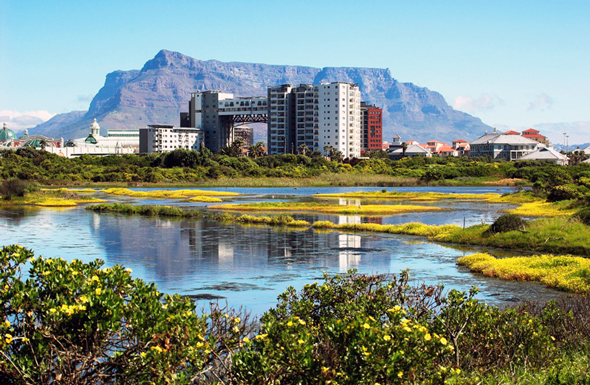
In South Africa, another case study country, “increased economic development and urbanization have taken its toll on” the country’s wetlands, while unemployment and poverty have remained a persistent problem in slum areas, writes Bonnardeaux. Through the government-run Working for Wetlands program, both the environmental and socioeconomic problems of development are being targeted for improvement. The program hires “the most marginalized from society” to clear wetlands of invasive plants in order to improve its natural filtration capabilities and, in turn, improves the quality of water feeding the burgeoning urban areas.
Although Working for Wetlands, now 17 years old, has been “hugely successful,” Bonnardeaux warns that such economic incentive programs are, more often than not, extremely difficult to carry out effectively. “While there is great potential for this incentive-based conservation approach,” Bonnardeaux notes, “the reality is there are many barriers to its effective implementation.”
Building Long-Term Support for Conservation With Near-Term PHE Successes
Building support for conservation can be a difficult task. The impacts of conservation programming are “often undervalued,” Bonnardeaux writes, in part because results tend to become apparent only over the longer term. By pairing conservation efforts with nearer-term programming, like PHE efforts targeting immediate health needs, development workers can foster the kind of local support that is essential for pursuing long term goals.
The Jane Goodall Institute’s Lake Tanganyika Catchment Reforestation and Education Project (TACARE), in northwest Tanzania, offers a case in point. Established in 1994, TACARE began as a conservation program meant to protect the areas around Gombe National Park, where Goodall first began her chimpanzee research in the 1960s. Local communities, however, were more interested in better health, “with an emphasis on clear water and reduction in water-borne diseases like cholera,” writes Bonnardeaux.
By adopting local health and poverty priorities, he writes, TACARE was able to establish trust and goodwill with the communities it served, which in turn enabled it to pursue longer-term conservation goals aimed at protecting the region’s natural biodiversity.
Bonnardeaux’s work shows that regardless of how policymakers choose to combine WASH and conservation goals, well-implemented integration can yield immense benefits for practitioners, funders, and local communities.
“Linking various sectors such as WASH, forestry, agriculture, population, and community development,” he writes, “can result in cost and effort sharing which in turn can increase the effectiveness of the project including improved conservation and improved livelihoods and health.”
Sources: Bonnardeaux 2012.
Photo Credit: “Intaka Island towards Table Mountain,” courtesy of flickr user Ian Junor. -
In Mongolia, Climate Change and Mining Boom Threaten National Identity
›July 23, 2012 // By Kate Diamond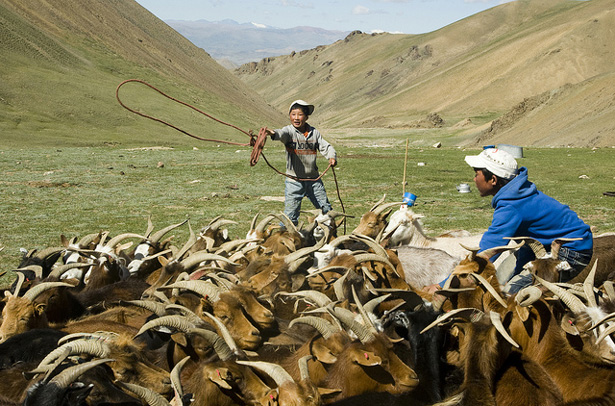
Mongolia, a vast, sparsely populated country almost as large as Western Europe, is at once strikingly poor and strikingly rich. Its GDP per capita falls just below that of war-torn Iraq, and Ulan Bator has some of the worst air pollution ever recorded in a capital city. At the same time, Mongolia sits atop some of the world’s largest mineral reserves, worth trillions of dollars, and its economy, already one of the world’s fastest growing, could expand by a factor of six by the end of the decade as those reserves are developed.
-
Visualizing Complex Vulnerability in Africa: The CCAPS Climate-Conflict Mapping Tool
›“Every crisis is complex, and the Sahel is no exception,” wrote USAID Assistant Administrator Nancy Lindborg in a recent Huffington Post article that called for “smarter programming and a coordivenated response” to chronic crises. “A regional drought has been overlaid with instability stemming from the coup in Mali and conflict in the northern part of that country where armed militant groups have forced the suspension of critical relief operations” and led to refugee movement into neighboring countries simultaneously challenged by drought and crop infestation. Understanding the complexity of this type of crisis, let alone visualizing the multiple factors that come into play, is a growing challenge for policymakers and analysts.
Enter version 2.0 of a mapping tool created by the Climate Change and African Political Stability Program (CCAPS) housed in the Robert S. Strauss Center for International Security and Law, based at the University of Texas, Austin.
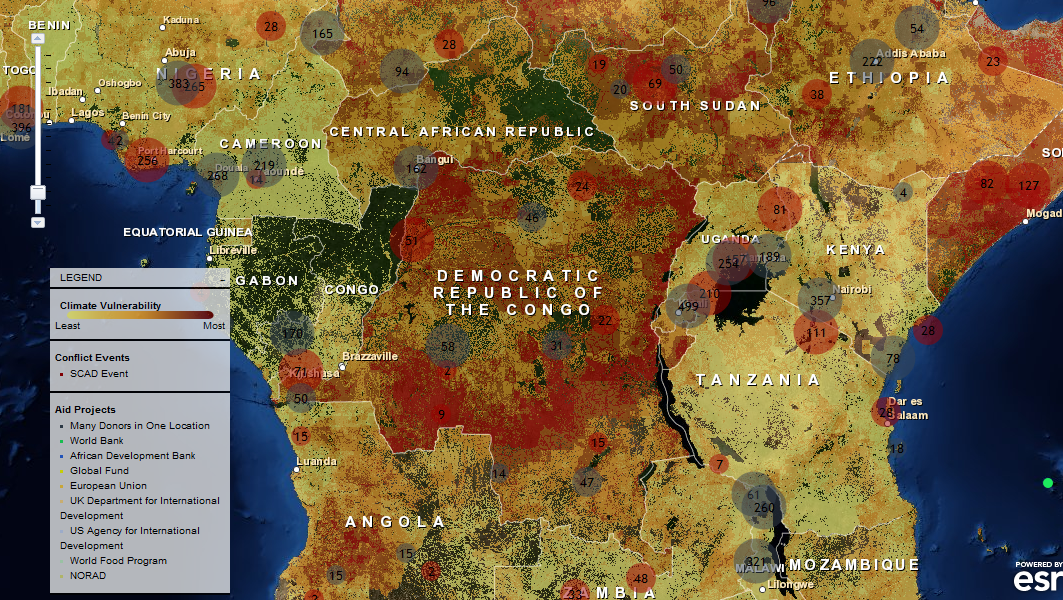
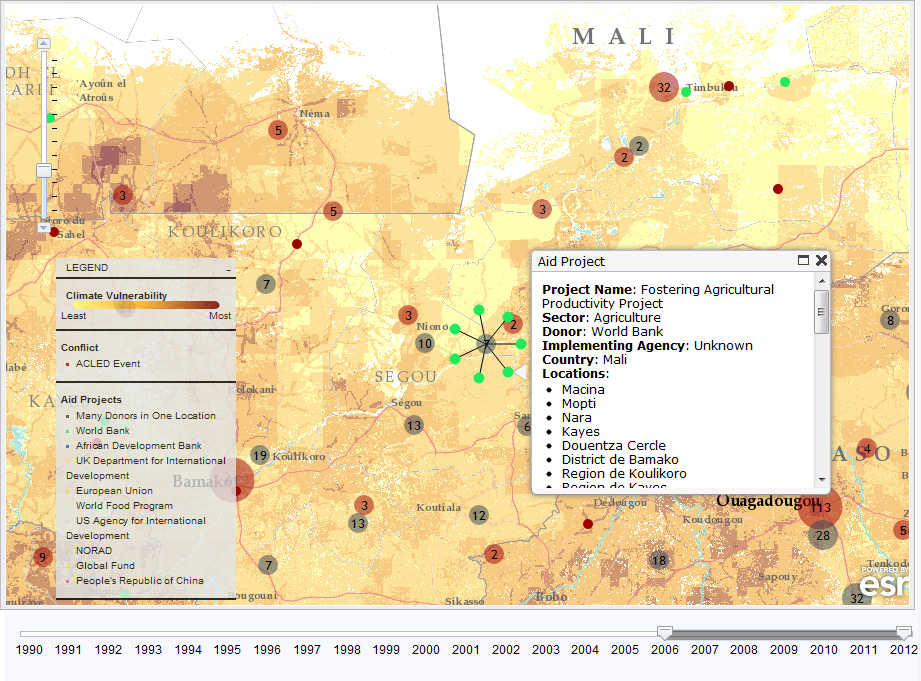
In collaboration with the College of William and Mary, Trinity College, and the University of North Texas, and with funding by the U.S. Department of Defense’s Minerva Initiative, CCAPS originally launched the mapping tool in March of this year. The map is powered by mapping and data tools from Esri and allows users to view any combination of datasets on international development projects, national governance indicators, incidences of conflict, and climate vulnerability data.
With an intuitive interface and compelling visuals, the mapping tool is a valuable resource for policy analysts and researchers to assess the complex interactions that take place among these environmental, political, and social factors. Advanced filters allow the user to identify a subset of conflicts and aid projects and there are nine base map styles from which to choose.The mapping tool is anything but static. The team is constantly working to refine and enhance it through the inclusion of additional indicators and improvement of the interface. The updated version now includes CCAP’s new Social Conflict in Africa Database, which tracks a broad range of social and political unrest, and their partners’ real-time conflict dataset, the Armed Conflict Location and Event Dataset (ACLED), which tracks real-time conflict data. Impressively, the ACLED data will be updated weekly.
I asked CCAPS program manager Ashley Moran to clarify how the governance indicators work in the model. She explained:The national governance indicators are included in one of four baskets that make up the climate vulnerability model…and represent four potential sources of vulnerability: physical exposure to climate-related hazards, population density, household and community resilience, and governance and political violence. They used the term “basket” since most include several indicators that reflect the full dimensions of that source of vulnerability. The fourth basket includes five national governance indicators and one indicator of political violence.
Moran also shared plans to add more detailed national governance data to the map:We are developing a mapping tool specifically for the climate vulnerability model, which will allow users to see the component parts of the model. It will allow users to re-weight the baskets (e.g. if a user thought governance should have more weight within the model since the government response to climate hazards is key), and it will also allow users to examine an area’s vulnerability to just one or two baskets of the user’s particular interest (instead of all four baskets combined as the tool does now). When we launch this, a user will essentially be able to see the vulnerability model disaggregated into its component parts, so they’ll be able to map just the governance data in the model, if they want.
In the coming months, the CCAPS team will add more detailed historical and projected data on climate vulnerability, data on disaster response capacity, as well as international aid projects coded for climate relevance.
Each of these datasets on their own are a wealth of vital information, but understanding how they intersect and the potential impact of their interactions is crucial to improving our understanding of them individually and collectively and creating responses that are timely and long-lasting.
If you’re in the San Diego area next week, check out Ashley Moran’s presentation of the mapping tool at the Esri International User Conference and the Worldwide Human Geography Data Working Group.
Sources: The Climate Change and African Political Stability Program, The Huffington Post.
Image Credit: CCAPS -
Center for American Progress Takes on Climate Change, Migration, and Why They Matter to U.S. National Security
›July 19, 2012 // By Kayly OberIn early 2012, the Center for American Progress (CAP) released Climate Change, Migration, and Conflict: Addressing Complex Crisis Scenarios in the 21st Century. Although generally in line with climate-migration pieces before it (“It is difficult to fully understand the detailed causes of migration and economic and political instability, but the growing evidence of links between climate change, migration, and conflict raise plenty of reasons for concern”), the report strays from the usual by focusing on U.S. national security interests and four particular sub-regions of concern.
Northwest Africa
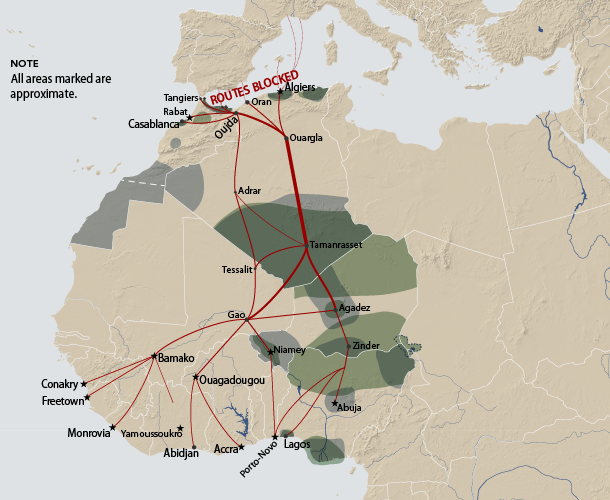
The first region examined – and the one perhaps most on the radar of security analysts at the moment – is Northwest Africa. Here the already-tenuous political stability left in the wake of the Arab Spring will most certainly be exacerbated by climate change, authors Michael Werz and Laura Conley write. “Northwest Africa is crisscrossed with climate, migration, and security challenges…rising coastal sea level, desertification, drought, and the numerous other potential effects of climate change have the potential to increase the numbers of migrants.” All of these factors combine to create what Werz and Conley define as an “arc of tension,” that will strengthen organizations that thrive on chaos, like Al Qaeda in the Islamic Maghreb, which has already taken advantage of the regional power vacuum left by Muammar Gaddafi’s ouster.
CAP investigates this arc of tension more fully in a more focused, separate brief on Northwest Africa, drilling down on Nigeria, Niger, Algeria, and Morocco. They find that these countries already grapple with a complex set of issues, including population pressures, drought, land degradation, large-scale migration, and natural resource conflicts. Climate change exacerbates all of these. Particularly worrying is the threat it poses to traditional pastoral and agricultural livelihoods, which could translate into “increasing numbers of disenfranchised youth, who security experts believe are more easily recruited to assist [terrorist groups] in return for money and food.”But environmental pressures and related conflict are not new in these areas, so how do we parse out the slow-onset climate change factors from the usual variety? That question is left unanswered and remains an open – and hotly debated – problem for researchers. The multi-faceted nature of migration, in particular, makes it hard to define the exact causes of movement.
On a larger scale, flagging the environment as the principal reason for migration has its problems, especially under the umbrella of “refugee” status. According to respected migration experts, using the term “refugee” in the case of environmental or climate scenarios is incorrect, since the environment is often simply one “push” factor, while economic opportunities make for a heavier “pull.” Furthermore, applying the term refugee in this case, they say, is misleading and undermines true political refugees.
CAP uses the less polarizing term “climate migrants” in their paper, saying “no universally accepted concepts, much less legal categories, exist to describe or define climate migrants. There is agreement, however, that factors such as drought, flooding, severe weather, and environmental degradation can cause human mobility in large numbers that are certain to increase in the near future.”
South Asia
In a case like Bangladesh and India, the second sub-region to be examined, the international community is preoccupied with rising sea levels, which is considered a more concrete example of climate change affecting migration. Ultimately, as CAP notes, it’s also a security issue:In December 2008 the National Defense University in Washington, D.C., ran an exercise that explored the impact of a flood that sent hundreds of thousands of refugees into neighboring India. The result: the exercise predicted a new wave of migration would touch off religious conflicts, encourage the spread of contagious diseases, and cause vast damage to infrastructure.
While true that India is “not in a position to absorb climate-induced pressures,” as Werz and Conley write, it’s not quite true that “foreign climate migrants” would be necessarily be an immediate problem, as they suggest.
India has a history of taking in Bangladeshi migration, with an estimated 10 to 20 million illegal Bangladeshis currently living in India, according to the Institute for Defence Studies and Analyses, an Indian think tank. Traditionally, Bangladeshis have migrated for a myriad of socioeconomic reasons, but most alluring are land availability and a stronger Indian economy. In any case, Bangladesh-India migration would not be new phenomenon.
The environment has also been a part of the equation, but in the case of large-scale sea level rise, its effect on migration can be a bit more nuanced. As the International Food Policy Research Institute noted in its study “Environmental Migrants: A Myth?,” Bangladeshis often have “risk-sharing and informal lending arrangements” to deal with idiosyncratic shocks, which include flooding. Instead, crop failure actually has the strongest effect on mobility. This suggests that it’s not just sea level rise that observers worried about environmentally-driven migration need to track in Bangladesh, but also drought and rain-induced flooding.
The Andes
The third region, the Andes of South America, also suffers from a slightly myopic security lens. Here, it’s all about melting glaciers and snowcaps. Retreating glaciers would spell disaster for countries which rely heavily on seasonal melt for agriculture and hydroelectric power. Most vulnerable are those with weak governance systems and infrastructure like Peru, Bolivia, Ecuador, and Colombia. For reference, hydropower supplies a whopping 80 percent of Peru’s electricity. However, there are more subtle impacts that could portend bigger trouble for the region.
Regional security experts concede that higher temperatures are already affecting crop production in rural Colombia, harming the ability to consolidate the security gains made by Plan Colombia over the last decade, for example. And a recent report from EUROCLIMA, the European Union’s program on climate change in Latin America, paints an even bleaker picture for agricultural production in the face of desertification and drought:Natural ecosystems, agriculture, water resources, and human health in Latin America have been impacted by unusual extreme weather events reported in the past years. For example, droughts related to El Niño impacts on the flows of the Colombia Andean region basins (particularly in the Cauca river basin), are causing a 30 percent reduction in the mean flow, with a maximum of 80 percent loss in some tributaries. Consequently, soil moisture, and vegetation activity are strongly reduced.
Perhaps more worrying is the impact on the biodiversity in the region. Considering that Latin America represents 16 percent of the world’s surface but 40 percent of its biodiversity this could have serious implications for the biomedical field and others. In a recent Nature study, scientists discovered that in situations where glacial coverage is reduced to the point where it only covers 30 to 50 percent of the drainage basin, several species begin to disappear. They calculated that the entire melting of the glaciers in these areas would result in a huge loss of biodiversity, where between 11 and 38 percent of animal and plant species could go extinct, including many of endemic species that can be found only in these areas.
China and the Third Pole
Finally, China is now in its fourth decade of ever-growing internal migration, some of it driven in recent years by environmental change. Today, across its vast territory, China continues to experience the full spectrum of climate change-related consequences that have the potential to drive migration. CAP finds that the consequences of climate change and continued internal migration in China include “water stress; increased droughts, flooding, or other severe events; increased coastal erosion and saltwater inundation; glacial melt in the Himalayas that could affect hundreds of millions; and shifting agricultural zones” – all of which will affect food supplies and the country’s seemingly relentless pace of development. Still, the most unique factor of migration in China is the power of the central government to be the main “push factor,” as in the case of the Three Gorges Dam.
Agreeing to Agree
Though they might sacrifice some nuance in the regional breakdowns, the core of CAP’s argument for why climate migration matters to U.S. national security is solid. The United States has a “vested interest in helping ensure that areas with weak or absent governance structures – where poverty, environmental degradation, and grievances over central governments and energy production coincide – do not become future recruiting grounds for extremists,” write Werz and Conley. “The possible impacts of climate-related migration in such fragile situations could be destabilizing.” Invest in people rather than just military might; invest in poverty reduction, economic development, and alternative livelihoods.Jon Barnett on migration as adaptation
In the context of climate change, this means accepting that migration is a form of adaptation. As Jon Barnett notes in an interview with ECSP:In some circumstances it might be appropriate to [invest in traditional adaptation projects like] infrastructure and hard options where we’re very certain about the nature of the risk…but in other cases, expanding the range of choices and freedoms and opportunities that people have to deal with climate change in the future is perhaps the better strategy.
This requires higher-level thinking by states to concede that migration will happen and it isn’t necessarily a bad thing. Migration bolsters origin communities through remittances and education and technology sharing. But this thinking has yet to permeate policymaking, with obvious political reasons. Until then, states that are committed to preventing migration are actually cutting off important community responses.
Ultimately, what we consider adaptation and development needs to evolve. By investing in an integrated, multi-sector development approach, we can prevent violent responses to migration at the source rather than relying on reactionary and military solutions. Or, as CAP’s Michael Werz and Laura Conley put it more boldly, “our security can no longer be guaranteed by military strength or economic clout alone, but only by our ability to compel collective action.”
Photo credit: “Villagers going to the local market in Bogoro walk past a Bangladeshi patrol unit of the United Nations Mission in the Democratic Republic of the Congo (MONUC) as the country prepares for the second round of elections. 12/Oct/2006. UN Photo/Martine Perret,” courtesy of United Nations Photo Flickr.
Sources: Center for American Progress, Institute for Defence Studies and Analyses, Inter-American Development Bank, International Food Policy Research Institute, Nature, The World Bank.
Video Credit: “The Nexus of Climate Change, Migration and Security,” courtesy of the Center for American Progress. Image: “The Arc of Tension,” courtesy of the Center for American Progress. -
Fiona Harvey, The Guardian
Re|Source 2012 Conference: Global Fight for Natural Resources “Has Only Just Begun”
›July 18, 2012 // By Wilson Center StaffThe original version of this article, by Fiona Harvey, appeared in The Guardian.
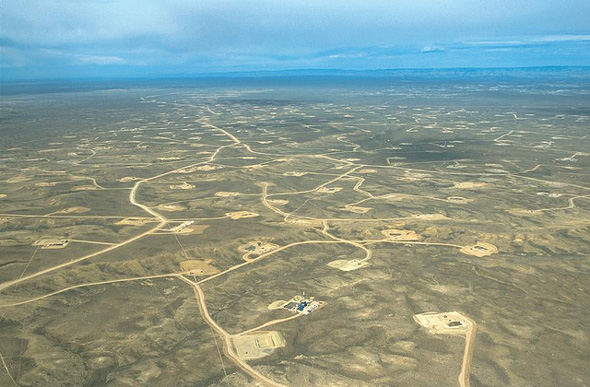
The global battle for natural resources – from food and water to energy and precious metals – is only beginning, and will intensify to proportions that could mean enormous upheavals for every country, leading academics and business figures told a conference in Oxford on Thursday.
Sir David King, former chief scientific adviser to the UK government, who convened the two-day Re|Source 2012 conference, told The Guardian: “We are nowhere near realizing the full impact of this yet. We have seen the first indications – rising food prices, pressure on water supplies, a land grab by some countries for mining rights and fertile agricultural land, and rising prices for energy and for key resources [such as] metals. But we need to do far more to deal with these problems before they become even more acute, and we are not doing enough yet.”
Countries that are not prepared for this rapid change will soon – perhaps irrevocably – lose out, with serious damage to their economies and way of life, the conference was told.
Amartya Sen, a Nobel prize-winning economist, said that the free market would not necessarily provide the best solution to sharing out the world’s resources. Governments would need to step in, he said, to ensure that people had access to the basics of life, and that the interests of businesses and the financial markets did not win out over more fundamental human needs.
Continue reading on The Guardian.
Photo Credit: “Aerial view of the Jonah natural gas field, upper Green River valley, Wyoming, 2001,” courtesy of flickr user SkyTruth and Peter Aengst/The Wilderness Society. -
Nine Strategies to Stop Short of Nine Billion
›Although most analysts assume that the world’s population will rise from today’s seven billion to nine billion by 2050, it is quite possible that humanity will never reach this population size.
My chapter in this year’s State of the World 2012: Moving Toward Sustainable Prosperity, “Nine Population Strategies to Stop Short of 9 Billion,” outlines a series of strategies that would prompt significant declines in birth rates. Based purely on the intention of women around the world to have small families or no children at all, these initiatives, policies, and changes in attitude could end population growth before mid-century at fewer than nine billion people.
Examples from around the world demonstrate effective policies that not only reduce birth rates, but also respect the reproductive aspirations of parents and support an educated and economically active society that promotes the health of women and girls. Most of these reproduction policies are relatively inexpensive to implement, yet in many places they are opposed on the basis of cultural resistance and political infeasibility.
In creating this list, I sought to eschew the language and approaches of “population control” or the idea that anyone should pressure women and their partner on reproduction. Instead, I hoped to highlight strategies that could put human population on an environmentally sustainable path:- Provide universal access to safe and effective contraceptive options for both sexes. With two in five pregnancies reported as mistimed or never wanted, lack of access to good family planning services is among the biggest gaps in assuring that each baby will be wanted and welcomed in advance by its parents.
- Guarantee education through secondary school for all, especially girls. In every culture surveyed to date, women who have completed at least some secondary school have fewer children on average, and have children later in life, than do women who have less education.
- Eradicate gender bias from law, economic opportunity, health, and culture. Women who can own, inherit, and manage property; divorce; obtain credit; and participate in civic and political affairs on equal terms with men are more likely to postpone childbearing and to have fewer children compared to women who are deprived of these rights.
- Offer age-appropriate sexuality education for all students. Data from the United States indicates that exposure to comprehensive programs that detail puberty, intercourse, options of abstinence and birth control, and respecting the sexual rights and decisions of individuals can help prevent unwanted pregnancies and hence reduce birth rates.
- End all policies that reward parents financially based on the number of children they have. Governments can preserve and even increase tax and other financial benefits aimed at helping parents by linking these not to the number of children they have, but to parenthood status itself.
- Integrate lessons on population, environment, and development into school curricula at multiple levels. Refraining from advocacy or propaganda, schools should educate students to make well-informed choices about the impacts of their behavior, including childbearing, on the environment.
- Put prices on environmental costs and impacts. In quantifying the cost of an additional family member by calculating taxes and increased food costs, couples may decide that the cost of having an additional child is too high. Such decisions, freely made by women and couples, can decrease birth rates without any involvement by non-parents in reproduction.
- Adjust to an aging population instead of boosting childbearing through government incentives and programs. Population aging must be met with the needed societal adjustments, such as increased labor participation, rather than by offering incentives to women to have more children.
- Convince leaders to commit to stabilizing population through the exercise of human rights and human development. By educating themselves on rights-based population policies, policymakers can ethically and effectively address population-related challenges by empowering women to make their own reproductive choices.
Kathleen Mogelgaard assisted with research for this piece.
Robert Engelman is the president of the Worldwatch Institute and contributing author to State of the World 2012: Moving Toward Sustainable Prosperity.
Sources: Bloom et al. (2011), Guttmacher Institute, Kohler et al. (2008), Population Reference Bureau, UN, UNFPA, The Wall Street Journal, Yadava and Yadava (1999).
Image Credit: Worldwatch Institute, State of the World 2012: Moving Toward Sustainable Prosperity. -
Pop at Rio+20: Despite Failure Narrative, Progress Made at Rio on Gender, Health, Environment Links
›July 13, 2012 // By Sandeep BathalaA month ago this weekend I boarded a plane to Rio de Janeiro for the UN Conference on Sustainable Development. Over the past few weeks, I have had some time to reflect on the amazing (and exhausting) experience afforded to me. Unfortunately, the final Rio+20 outcome document (considered by some to be misnamed as “The Future We Want”) failed to recognize the connections between reproductive rights and sustainability. However, since I returned I’ve also found myself in conversations with colleagues eager to celebrate the successes of the conference.
Jason Bremner, program director at Population Reference Bureau, reminds me that the initial “zero draft document” that was circulated prior to Rio had absolutely no mention of reproductive health, family planning, or population. “Though the ultimate conference document wasn’t a success by many measures, I commend the efforts of the many advocacy organizations that resulted in the inclusion of reproductive health and family planning as a key aspect of sustainable development,” he said.
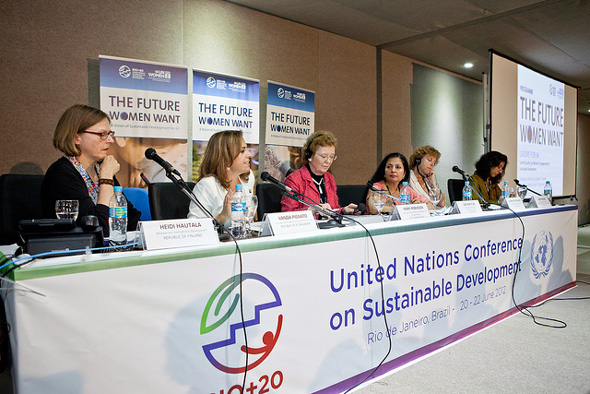
Other wins were recognized at Rio as well. On a panel organized by the International Planned Parenthood Federation, Brazilian Minister of Policies for Women Eleonora Menicucci de Oliveira pointed out that the presence of women this year was much stronger than at the 1992 conference. And she stressed that the overall importance placed on the reduction of poverty will have a big impact for women.
Though the official language was weakened in the final outcome document, there was much more support expressed at side events and off the record conversations. Speaking at the same event as Oliveira, Christian Friis Bach, Minister for Development Cooperation in Denmark, said that “one leader after another has stood up for reproductive rights, and we’ve started a campaign which will go on until ICPD+20.”
In fact, as the Wilson Center’s Brazil Institute Director Paulo Sotero points out, there was a great deal of progress made by non-government representatives alongside the main conference:I left Rio more hopeful about the future than the official part of Rio+20 would allow. As governments clearly fumbled in the face of the complex challenges of imagining and building a more equitable and sustainable economic growth model in the decades ahead, I saw senior business executives and leaders of civil society engaged in intelligent and productive dialogue about difficult issues at hundreds of thematic panels held at the Corporate Sustainability Forum and other sessions held in Rio.
I felt the same energy. And many groups there seemed to already be planning for next steps.
On the first day of side events I attended, members of the Population and Climate Change Alliance discussed strategies to ensure that in the post-2015 (i.e. post-Millennium Development Goals) international development agenda sexual and reproductive health and rights are explicitly recognized as core to sustainable development. The panel included Mialy Andriamahefazafy of Blue Ventures Madagascar, Joan Castro of PATH Foundation Philippines, Inc., and Negash Teklu of PHE Ethiopia Consortium, who all shared examples of efforts in their countries to integrate reproductive health with other sustainable development programs.Joan Castro on PATH Foundation’s work in the Philippines
The Rio+20 conference was, at the very least, a re-affirmation of the tenets set down by the ‘92 Earth Summit – that is, that there is middle ground between full-tilt economic development and uncompromising environmentalism, called “sustainable development,” and we ought to be moving towards it. It was also a fantastic gathering place for disparate groups of people to come together on to similar issues and to build momentum and networks on their issues.
For those hoping to see a stronger link recognized between reproductive rights, population, and the environment, the good news is that elsewhere, awareness and momentum seems to be growing. Just this week, The Bill and Melinda Gates Foundation joined the United Kingdom, United States, France, Germany, the Netherlands, South Korea, Norway, Sweden, and Australia to pledge more than $2.6 billion towards meeting global unmet for contraceptives. And the connection to development was explicit: “Contraceptives are one of the best investments a country can make in its future,” reads the summit website.
Coincidence to have followed so closely behind a “disappointing” Rio outcome? Perhaps not.
Sources: The Bill and Melinda Gates Foundation, Estado, UN Conference on Sustainable Development.
Photo Credit: “UN Women Leaders Forum at Rio+20,” courtesy of UN Women.
Showing posts from category environment.