Showing posts from category global health.
-
Gender, Family Planning Should Be Part of Climate Discussions, Says Mary Robinson
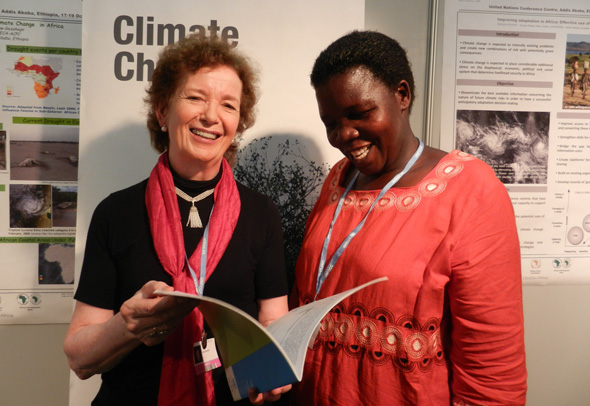
›December 6, 2011 // By Brenda ZuluSpeaking at a side event on “Healthy Women, Healthy Planet” in Durban, South Africa, Mary Robinson, chair of the Global Leaders Council for Reproductive Health, said they were seeing more female leadership at this year’s UN climate change conference (COP-17).
But Robinson, who is also chair of the Mary Robinson Foundation – Climate Justice, said there needs to be more explicit gender language in the COP-17 text to ensure that green climate funds support gender equity and money gets to women on the ground for adaptation.
“Our foundation has been helping to bring out women’s leadership at the top level in this conference to match women’s leadership at the community level,” explained Robinson, pointing out that the heads of the last three COPs are women.
Though the role of gender in climate adaptation and mitigation will likely not be prominently discussed on the floor at COP-17, Robinson said she looked forward to side conversations about a stronger focus on these issues.
Family planning, she argued, should also play a larger role. “There have been so many attempts to deflect from commitments and get into other kinds of issues that bring about some kind of stigma in this area,” said Robinson. But “those of us on the Global Leaders Council on Reproductive Health fundamentally believe in the central role played by reproductive health, access to knowledge about how to space children, and having choices about number of children.”
There are about 215 million women in the world who do not want to get pregnant but are not using modern contraception. Family planning and reproductive health services help build up a woman’s resilience to climate changes, Robinson explained.
These services are vital to improving women’s health and enable women to seek educational and work opportunities, unleashing their potential to help solve problems associated with climate change.
Brenda Zulu is a member of Women’s Edition for Population Reference Bureau and a freelance writer based in Zambia. Her reporting from the COP-17 meeting in Durban (see the “From Durban” series on New Security Beat) is part of a joint effort by the Aspen Institute, Population Action International, and the Wilson Center.
Sources: World Health Organization.
Image Credit: “Mary Robinson and Constance Okollet” at COP-17, used with permission courtesy of the Mary Robinson Foundation – Climate Justice (MRFCJ). -
New Population, Health, and Environment Program for Lake Victoria
›With some of Africa’s highest population densities, ethnic diversity, and biodiversity, the Great Lakes region is one of the most volatile intersections of human development and the environment. A new population, health, and environment (PHE) initiative from Pathfinder International, announced Monday at the International Conference on Family Planning in Senegal, aims to help address these issues by supporting sustainable resource management and women’s right to choose when and how often they have children.
Jointly funded by the David and Lucile Packard Foundation and the John D. and Catherine T. MacArthur Foundation, with additional support from USAID’s Office of Population and Reproductive Health, the project will focus on Ugandan and Kenyan sections of the Lake Victoria basin.
Lake Victoria is the second largest freshwater source in the world, a biodiversity hotspot, and an important regional waterway, but regional population growth among the highest in Africa and economic development have led to declining water quality, reduced fish stocks, and industrial pollution. The basin as a whole supports upwards of 35 million people.
“This new project is a welcome development for many reasons,” said ECSP Director Geoff Dabelko. “It brings the integrated PHE approach to one of the world’s greatest lakes, it enables respected health NGO Pathfinder to pursue PHE efforts, and marks the return of a leading private donor, the MacArthur Foundation, to a group of foundations willing to support this innovative approach.”
Sono Aibe, senior advisor for strategic initiatives at Pathfinder emphasized the integrated challenges facing the region. “In these remote, resource dependent areas of the world, the interconnectedness between the health of people and the health of the environment is undeniable,” she said in a press release. “When women are empowered to participate in the sustainable management of natural resources alongside men and youth, as well as have access to sexual and reproductive health care services, their lives will improve and so will the condition of the ecosystems that they depend on.”
The project’s objective, according to Pathfinder, is to reduce threats to biodiversity, conservation, and ecosystem degradation by increasing access to family planning and sexual/reproductive health services. The project plans to develop scalable approaches that can be adopted by communities, local governments, and national governments. Technical support is to be provided by the BALANCED Project, ExpandNet, and the Population Reference Bureau.
“Lessons learned from this new project will help us better develop and design projects for vulnerable communities in fragile ecosystems, while simultaneously advocating for increased government support for integrated programs throughout the Lake Victoria Basin,” said Lucy Shillingi, Pathfinder’s country representative for Uganda.
The Lake Victoria effort will build upon the experiences of other integrated PHE efforts in the region, such as Rwanda’s SPREAD Project, Uganda’s Conservation Through Public Health, and Tanzania’s TACARE and Coastal Management Partnership.
Sources: Lake Victoria Basin Commission, Pathfinder International, UNEP. -
Sarah Lindsay, Ministerial Leadership Initiative
At Family Planning Plenary, Youth’s Messages Captivate Audience
›December 2, 2011 // By Wilson Center StaffThe original version of this article, by Sarah Lindsay, appeared on the Ministerial Leadership Initiative’s Leading Global Health blog.
With more than 2,200 family planning policymakers, researchers, and advocates watching the opening plenary of the International Conference on Family Planning (ICFP) – including some in seaside tents outfitted with big-screen TVs – two youth leaders captivated the audience.
The featured speakers included international dignitaries, headlined by the president of Senegal, but the younger leaders made a dramatic plea with an adamant demand: involve youth in family planning decision making.
As many family planning advocates say, family planning can improve the lives of future generations. Based on this argument, the youth leaders said they should be fully included in the discussions in making policy, and not have policymakers make decisions for them.
Both speakers, Saudou Node and Mohammed Barry, expressed disappointment that more has not been done to ensure universal access to family planning. Node told the plenary that projects and policies created to increase family planning access often never make it to the field.
Continue reading on Leading Global Health. For more on ICFP 2011, see Sarah’s full series of posts. -
Jeanne Nyirakamana, PHE Champion
Reaching Rural Rwandans With Integrated Health and Livelihood Messages
›This PHE Champion profile was produced by the BALANCED Project.
Rwanda is one of the most densely populated countries on the planet, with more than 11 million people in one of Africa’s smallest countries, most of whom depend on the land as subsistence farmers. The country has diverse mountain, lake, and savannah landscapes, and the Virunga Mountain chain in the northwest part of the country is home to one-third of the world’s threatened mountain gorilla population. At the same time, the population throughout the country suffers from high rates of unmet need for contraception, and three percent of the adult population lives with HIV/AIDS. In a land under such intense pressure on natural resources, rural livelihood initiatives are critical to ensuring people have options for meeting their daily health and well-being needs.
For the past three years, Jeanne Nyirakamana has served as head of the health program for the Sustaining Partnerships to Enhance Rural Enterprise and Agribusiness Development (SPREAD) Project. Supported by the U.S. Agency for International Development through Texas A&M; University, the SPREAD Project is integrating a dynamic coffee production and quality improvement program in Rwanda with health outreach to improve community well-being. The health component works to improve the lives of coffee farmers and cooperative members by providing them with health information and services related to family planning, maternal and child health, prevention of sexually-transmitted infections (including HIV), and water and sanitation.
Training Peer Educators
Working closely with the coffee program, Nyirakamana’s team has trained more than 540 men, women, and youth peer educators who have reached more than 95,000 coffee farmers with education and services. Key communication messages highlight the links between sound decision-making and health-seeking behaviors, productive farms and agribusinesses, and strong and healthy families.
The program also leverages and supports local health resources through referrals to existing public health services, organization of mobile clinics, and community-based distribution of a socially marketed water purification solution (Sur Eau) and condoms (Prudence). According to Nyirakamana, one of the project’s greatest successes is the increased acceptance of family planning by farmers and their families and the more than 7,500 farmers who have been tested for HIV. In order to draw in as many coffee farmers as possible, many of the health and livelihood activities take place at the stations where the coffee beans are washed, at other buildings used by the coffee farmer cooperative, or during combined community meetings or home visits. At the washing stations, Nyirakamana’s team supports local health center staff to provide voluntary counseling and testing (VCT) and de-worming services while at the same time SPREAD-trained peer educators and coffee/health extension agents disseminate family planning information.
The cooperatives’ buildings have clean water, hand-washing stations, and small kiosks where condoms and Sur Eau are sold. These community health agents work with SPREAD to ensure that the greater community, not just the coffee farmers, has access to health knowledge and services. They learn how to teach the community about a range of health issues and each month they submit reports showing how many people they reached and with what kinds of messages. They are also becoming increasingly engaged in coffee and agribusiness activities. Through the success of their health activities, these agents are seen as vital community resources.
Integrated Results
By implementing this integrated population, health and environment (PHE) approach, the SPREAD Project staff is ensuring the health of the people and environment and success of the agribusiness. “You cannot care for the environment without first caring for the people who live and use that environment, so when you transmit dual messages [agriculture and health] you are able to hit two birds with one stone,” said Nyirakamana.
According to a 2010 evaluation of the project, farmers and their families reported improvements in personal and household hygiene; an increase in understanding and acceptance of family planning; uptake of HIV and VCT services; and use of condoms and other local health services. As well, they noted shifts in gender norms affecting household revenue use, alcohol, and reproductive health. The agribusiness stakeholders value the integrated approach as a means to more holistically meet farmers’ goals of increased incomes and improved lives and livelihoods.
This PHE Champion profile was produced by the BALANCED Project. A PDF version can be downloaded from the PHE Toolkit. PHE Champion profiles highlight people working on the ground to improve health and conservation in areas where biodiversity is critically endangered.
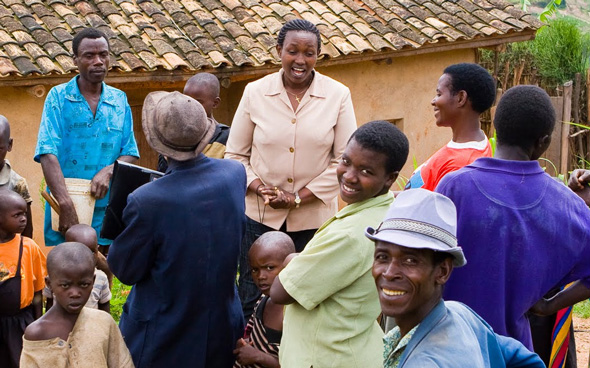
Photo Credit: BALANCED Project. -
UNiTE To End Violence Against Women
›November 25, 2011 // By Schuyler NullToday is the International Day to End Violence Against Women, an awareness and advocacy campaign organized by a host of UN agencies and offices “to galvanize action across the UN system to prevent and punish violence against women.”
Gender equity and inequity play a role in a myriad of international development, health, security, and even environmental issues, from rape as a weapon of war; demography’s effects on political stability; maternal health and its impact on child development; women’s rights as a social stability issue; and the disproportionate effect of climate change on rural women.
The numbers around gender-based violence are staggering. According to the UN:
Here are some of New Security Beat’s posts on gender-based violence and inequity and their intersection with development, the environment, and security:- 70 percent of women experience physical or sexual violence from men in their lifetime.
- Approximately 250,000 to 500,000 women and girls were raped in the 1994 Rwandan genocide, and in the eastern Democratic Republic of Congo (DRC), at least 200,000 cases of sexual violence, mostly involving women and girls, have been documented since 1996, though the actual numbers are considered to be much higher.
- In the United States, one-third of women murdered each year are killed by intimate partners; in South Africa, a woman is killed every six hours by an intimate partner; in India, 22 women were killed each day in dowry-related murders in 2007; and in Guatemala, two women are murdered, on average, each day.
- Over 60 million girls worldwide are child brides, married before the age of 18, primarily in South Asia (31.1 million) and sub-Saharan Africa (14.1 million).
Gender-Based Violence in the DRC: Research Findings and Programmatic Implications:
Dr. Lynn Lawry, senior health stability and humanitarian assistance specialist at the U.S. Department of Defense, presented findings from the first cross-sectional, randomized cluster study on gender-based violence in the DRC at the Wilson Center this year. The first of its kind in the region, the population-based, quantitative study covered three districts in the DRC and a total of 5.2 million adults, comprehensively assessing gender-based violence, including its prevalence, circumstances, perpetrators, and physical and mental health impacts.
Pop Audio: Judith Bruce on Empowering Adolescent Girls in Post-Earthquake Haiti: “The most striking thing about post-conflict and post-disaster environments is that what lurks there is also this extraordinary opportunity,” said Judith Bruce, a senior associate and policy analyst with the Population Council. Bruce spent time last year working with the Haiti Adolescent Girls Network, a coalition of humanitarian groups conducting workshops focused on the educational, health, and security needs of the country’s vulnerable female youth population.
The Walk to Water in Conflict-Affected Areas: Constituting a majority of the world’s poor and at the same time bearing responsibility for half the world’s food production and most family health and nutrition needs, women and girls regularly bear the burden of procuring water for multiple household and agricultural uses. When water is not readily accessible, they become a highly vulnerable group. Where access to water is limited, the walk to water is too often accompanied by the threat of attack and violence.
Weathering Change: New Film Links Climate Adaptation and Family Planning: “Our planet is changing. Our population is growing. Each one of us is impacting the environment…but not equally. Each one of us will be affected…but not equally,” asserts the new documentary, Weathering Change, launched at the Wilson Center in September. The film, produced by Population Action International, explores the devastating impacts of climate change on the lives of women in developing countries through personal stories from Ethiopia, Nepal, and Peru.
Sajeda Amin on Population Growth, Urbanization, and Gender Rights in Bangladesh:
The Population Council’s Sajeda Amin describes the Growing Up Safe and Healthy (SAFE) project, launched in Dhaka and other Bangladeshi cities last. The initiative aims, to increase access to reproductive healthcare services for adolescent girls and young women, bolstering social services to protect those populations from (and offer treatment for) gender-based violence, and strengthen laws designed to reduce the prevalence of child marriage – a long-standing Bangladeshi institution that keeps population growth rates high while denying many young women the opportunity to pursue economic and educational advancement.
No Peace Without Women: On October 31, 2000, the UN Security Council adopted Resolution 1325, which called for women’s equal participation in all efforts to maintain and promote peace and security; however, little progress has been made over these last 10 years and women remain on the periphery when it comes to post-conflict reconstruction and development. A report from the humanitarian organization CARE concedes that “much of the action remains declarative rather than operational.”
Addressing Gender-Based Violence to Curb HIV: At last year’s International AIDS Conference in Vienna an astonishing development in the campaign to stem the spread of HIV/AIDS was unveiled – a microbicide with the ability to reduce the risk of transmission of HIV. This welcome development coincides with an intensified focus on women’s health and security needs among donors, especially the United States.
The Future of Women in the MENA Region: A Tunisian and Egyptian Perspective: Lilia Labidi, minister of women’s affairs for the Republic of Tunisia and former Wilson Center fellow, joined Moushira Khattab, former minister of family and population for Egypt, this summer at the Wilson Center to discuss the role and expectations of women in the Egyptian and Tunisian revolutions, as well as issues to consider as these two countries move forward.
Sources: UN Secretary-General’s Office. -
Reducing Urban Poverty: A New Generation of Ideas
›Download Reducing Urban Poverty: A New Generation of Ideas from the Wilson Center.
In 2008 the global population reached a remarkable turning point; for the first time in history, more than half of the world’s people were living in cities. Moving forward into the 21st century, the world faces an unprecedented urban expansion with projections for the global urban population to reach nearly five billion by the year 2030. Virtually all of this growth will occur in the developing world where cities gain an average of five million residents every month, overwhelming ecosystems and placing tremendous pressure on the capacity of local governments to provide necessary infrastructure and services. Failure to incorporate urban priorities into the global development agenda carries serious implications for human security, global security, and environmental sustainability.
Recognizing a need to develop and strengthen urban-focused practitioner and policymaking ties with academia, and disseminate evidence-based development programming, the Wilson Center’s Comparative Urban Studies Project, USAID’s Urban Programs Team, the International Housing Coalition, the World Bank, and Cities Alliance teamed up to co-sponsor an academic paper competition for graduate students studying urban issues. The first competition took place in the months leading up to the 5th World Urban Forum, held in Rio de Janeiro in March 2010.
This publication, Reducing Urban Poverty: A New Generation of Ideas, marks the second annual academic paper competition. “Reducing urban poverty” was chosen as the theme with each author focusing on one of three topics: land markets and security of tenure; health; and, livelihoods. A panel of urban experts representing the sponsoring institutions reviewed 70 submitted abstracts, from which 16 were invited to write full length papers. Of these, six were selected for this publication. We congratulate the graduate students who participated in this competition for their contribution to our understanding of the complex relationship between urbanization and poverty.
These papers highlight the new research and innovative thinking of the next generation of urban planners, practitioners, and policymakers. It is our hope that by infusing the dialogue on these issues between the academic and policy worlds with fresh perspectives, we will foster new and innovative strategies to reduce global urban poverty.
Sources: UNFPA, UN-HABITAT. -
Healthy People, Healthy Ecosystems: Results From a Public-Private Partnership
›“A lot of people probably don’t think that an organization with a name like ‘World Wildlife Fund’ would have a program on population, health, and the environment,” said WWF’s Tom Dillon at the Wilson Center, but actually it is very natural. “Most of the people we work with are in rural areas, and they depend on their natural resources for their own livelihoods and for their own well-being. Of course, if you are in that situation, in order to be a steward of the environment, you’ve got to have the basics. You have got to have your own health.”
Dillon was joined by staff from WWF, as well as Scott Radloff, director of USAID’s Office of Population and Reproductive Health, and Conrad Person, director of corporate contributions at Johnson & Johnson, to talk about the results of a three-year partnership between USAID, WWF, and Johnson & Johnson. The joint effort, a formal Global Development Alliance, provided health and family planning services, clean water, and sanitation to communities in three of WWF’s priority conservation landscapes: The Salonga National Park in the Democratic Republic of Congo (DRC), the Lamu Archipelago in Kenya, and the Terai Arch Landscape in Nepal.
By creating an innovative public-private partnership that linked health objectives, particularly related to family planning and maternal and child health, to environmental and conservation activities, “this alliance was ahead of its time,” said Radloff.
Human Health Linked to Environmental Health
The project had four objectives, said Terri Lukas, WWF’s population, health, and environment (PHE) program manager: improve family health; reduce barriers to family planning and reproductive health services; improve community management of natural resources and habitat conservation; and document and promote successful approaches.
“Human health cannot be separated from environmental health anywhere,” Lukas said, “but most especially when we are working with very poor people who live very close to nature.”
Projects Provide Integrated Services
The Salonga National Park in the DRC is home to many endangered species, including the bonobo, one of the four great apes. Local communities are very isolated, and lack access to safe drinking water and sustainable livelihoods, as well as basic health and family planning services, according to Lukas. The PHE project was able to train 135 voluntary community health workers in family planning and maternal and child health care, including 55 women. One year after the training, health workers were distributing contraception to more than 300 new users per month, Lukas said.
The alliance has also integrated health and family planning services into conservation programs in Kenya’s Kiunga Marine National Reserve, in part, “to demonstrate to the people that we care about them as well as the environment, and also to show them the synergies that exist between the health issue and the environment issue,” said WWF Program Coordinator Bahati Mburah. The region has been suffering through a year-and-a-half-long drought, and has one of the highest population growth rates in east Africa, placing considerable pressure on natural resources.
“We talk to [the fisher folk] about health and family planning, and how they are related to the management of fisheries,” said Mburah. With improved transportation and mobile outreach services provided by the project, 97 percent of women are now able to access family planning services within two hours of their home, she said.
The third site is in the Terai region along the southern border of Nepal. In this lowland region, the alliance is attempting to safeguard and restore forest areas in order to allow wildlife to move and breed more freely, while at the same time improving the health and economic prospects of the people. By linking these goals, support for conservation efforts increased from 59 percent to 94 percent of households, with 85 percent attributing positive attitude changes to increased access to health services and safe drinking water, according to Bhaskar Bhattarai, project coordinator for WWF-Nepal.
Documenting and Promoting Successful Approaches
Cara Honzak, WWF’s senior technical advisor on population, health, and environment, said the global objective of the alliance was to document and promote successful PHE approaches. Comprehensive baseline and endline surveys provided critical evidence that integrated PHE programming increases family planning use in remote areas, improves conservation buy-in within communities, and leads to increased participation of women in community leadership and decision-making.
“We have played a key role in producing some of the evidence that has been used throughout Washington [D.C.], especially to provide information to government bodies that are making decisions about bringing more money into family planning, health, and particularly in the environmental sector,” said Honzak.
“After two decades in the field, and working in this area, I wasn’t expecting many surprises. I couldn’t have been more wrong,” Lukas said. “These three years have changed almost everything about the way I now view health development…I have long called myself a conservationist, but now I say to my international health colleagues: we are all conservationists, and if we aren’t, we should be.”
Event Resources- Bhaskar Bhattarai presentation
- Cara Honzak presentation
- Terri Lukas presentation
- Bahati Mburah presentation
- Photo gallery
- Video
-
Emily Puckart, MHTF blog
Maternal Health in Kenya: New Research Unnecessary, Time to Address Existing Gaps
›The original version of this article, by Emily Puckart, appeared on the Maternal Health Task Force blog.
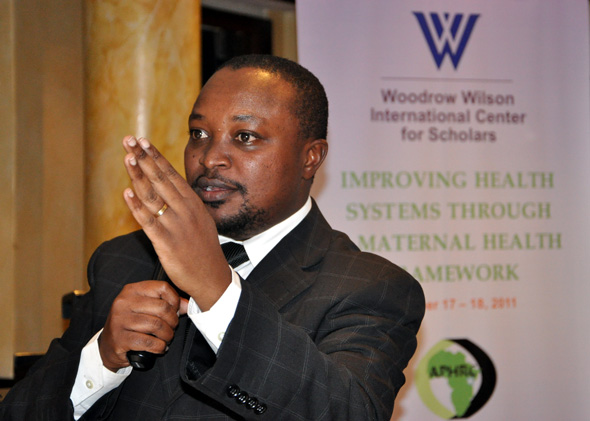
During the recent Wilson Center/African Population and Health Research Center meeting in Nairobi on improving health systems through a maternal health framework, participants focused on knowledge gaps in the Kenyan health system that can negatively affect maternal healthcare. This focus on gaps sparked discussion around research needed (or not needed) in the maternal health field, supply gaps, and gaps between addressing technical, medical issues of maternal health (like preeclampsia or postpartum hemorrhage), and larger society-wide gaps like gender equity. The gaps highlighted by participants at the Nairobi dialogue included:- Gaps in knowledge: During the dialogue, members of the Kenyan maternal health community discussed the possibility of strengthening community health workers as an information delivery platform. Participants wondered about the possibility of using community health workers to distribute information both downward to the end user (patients), and then again to gather information from end users and distribute it upwards through the system to reflect the opinions of the direct users of the healthcare system.
- Supply gaps: Participants argued that while there is a large body of information in terms of maternal health supplies at the national level in Kenya, there is not as much data on supplies at the actual health facility level, where it is much needed and would be very helpful to successfully treat patients.
- Gaps in healthcare delivery: There is a strong need to address inequality in the distribution of health services as there are unequal services in rural and urban areas. Within those broad areas there may be further inequalities, as even in urban areas, slum areas or neighborhoods on the edges of cities may have less access to quality healthcare than populations that live in wealthier areas of the city or closer to the city center. Further there are broader questions of gender and access to care. Where women are not able to control household finances, they may be unable to access and pay for lifesaving care. Participants framed the question in a rights framework, “Do we value the lives of women less than men?”
- Health workforce gaps: There is a mismatch between the supply of health workers and the absorption of those trained health workers in Kenya. Many of them are not incentivized professionally or financially to stay in the system where they are trained. These health workers may leave for other countries or prefer to stay in urban areas depriving rural areas of a surplus of trained health workers.
- Gaps between words and actions: Several of the small working groups pointed to accountability as a serious issue, as there are gaps between the words of politicians on health issues and actual actions. The gap between the government promised funding for health and the actual lower amount of spending was consistently highlighted during the Nairobi dialogue as a serious gap in holding governments accountable for their promises.
The lively conversation provoked by a broad discussion of gaps in the Kenyan health system provided fertile ground to develop action points on maternal healthcare that participants then presented on the second day of the meeting to several Kenyan members of parliament. Ideally, this will be the first discussion of many as maternal health advocates, field workers, and researchers coalesce around ways to address the gaps in maternal healthcare in Nairobi and elsewhere.
Emily Puckart is a senior program assistant at the Maternal Health Task Force (MHTF).
Photo Credit: Jonathan Odhong, African Population and Health Research Center.