Showing posts from category global health.
-
Jake Naughton, Pulitzer Center for Crisis Reporting
Pulitzer Center Launches Collaborative Reporting Project on Reproductive Health
› The original version of this article, by Jake Naughton, appeared on the Pulitzer Center for Crisis Reporting blog.
The Pulitzer Center launched its collaborative reproductive health-reporting project at this year’s International Conference on Family Planning (ICFP) in Dakar, Senegal. The project brings together four journalists from Africa and four from the United States who will collaborate to enhance local and international reporting about reproductive health across the continent.
The African journalists are Mae Azango of Liberia, Estelle Ellis of South Africa, Sam Olukoya of Nigeria, and Ken Opala of Kenya. Their U.S. counterparts are Christian Science Monitor correspondent Jina Moore; New Yorker editorial staffer Alexis Okeowo; and the Pulitzer Center’s managing director Nathalie Applewhite and visual media coordinator Jake Naughton.
More than two thousand reproductive health professionals and hundreds of journalists from all over the world participated in the conference, which sought to shine a spotlight on the unmet need for family planning services worldwide, and to focus on integrating family planning into general health services.
Continue reading on the Pulitzer Center for Crisis Reporting blog.
Video Credit: “Meet the Journalists: Dakar,” courtesy of the Pulitzer Center. -
Watch: Dr. Vik Mohan on Integrating Family Planning and Conservation in Madagascar
›The integration of population, health, and environment programming “enables us to create synergies that mean we are more effective at achieving both health and conservation goals,” said Dr. Vik Mohan, director of sexual and reproductive health programming for Blue Ventures, in an interview with ECSP at the 2011 International Conference on Family Planning.
After Blue Ventures established their first clinic in 2007 in the village of Andavadoaka, on Madagascar’s southwest coast, “we felt immense pressure to scale up our intervention,” said Mohan. “We started with one clinic in one village, and now we have a multi-site service covering all 40 villages that we partner with for our community-based conservation work,” he said.
According to data compiled by Blue Ventures, the average total fertility rate in the region is 6.7 children per woman. The London-based eco-tourism-turned health and environment NGO offers a variety of family planning services to meet local demand, including mobile outreach clinics and community-based distribution of contraceptives. They also partner with Marie Stopes International to offer long-acting and permanent methods of contraception for those that want it.
“This Model Can Be Taken to Scale”
By integrating conservation and reproductive health messaging and service delivery, “we are getting greater buy-in from the community because they all see the added value of the breadth of things that we offer them,” Mohan said. “Men who came to hear about fisheries management get to hear about family planning technologies, practically for the first time in their lives.”
The fishermen are able to see the links between food security and population growth through their own experience, he added. “We believe very passionately this model can be taken to scale,” Mohan said. “This is something that could be easily replicated in other regions. Definitely in other coastal regions, but almost certainly in other remote areas – perhaps areas of high biodiversity where there are existing projects, perhaps conservation projects – but where there is an unmet need for healthcare and family planning in particular.”
“My advice to other organizations, whether you are doing healthcare or whether you are doing conservation, is just think holistically,” said Mohan. “If you are a conservation organization that recognizes that there is an unmet healthcare need for the communities that you work with, then…don’t be afraid to ask those questions, and don’t be afraid to build capacity to meet the need, if you find one. Or, don’t be afraid to partner with health NGOs to enable that need to be met.”
For more on Blue Ventures’ integrated efforts, see also ECSP FOCUS Issue 23, “To Live With the Sea: Reproductive Health Care and Marine Conservation in Madagascar,” co-authored by Vik Mohan. -
Famine and Food Insecurity in the Horn of Africa: A Man-Made Disaster?
›This year’s drought in the Horn of Africa has been the region’s worst in decades and has exploded into a humanitarian catastrophe affecting millions. In Somalia, where the drought is layered on top of two decades of conflict and an extremely weak state, the impact of the drought has been most damaging. Somalia is the only country in the region where the UN has declared famine zones. And, even though the UN recently upgraded three of Somalia’s six famine areas to “lesser emergencies,” four million Somalis – more than half the country’s population – remain in urgent need of food and general humanitarian aid.
The drought may have been what sparked the current crisis, but other, longer-term factors, like a sustained lack of agricultural development, extreme rural poverty, and changing weather patterns, not to mention Somalia’s lack of functioning government, set the stage.
A Long-Term Crisis in the Making
“Lack of rainfall over several seasons is the most immediate and most visible cause of the current humanitarian crisis in the Horn of Africa,” said Jim Hansen of the Consultative Group on International Agricultural Research (CGIAR) in a brief video produced this summer by the International Research Institute for Climate and Society at Columbia University (watch above). Much of the Horn’s population “depends on rain-fed agriculture and pastoralism for their livelihoods and sustenance,” said Hansen. Already “quite poor and…locked in poverty for quite a long time,” environmental and resource degradation, paired with rapid population growth, have compounded their vulnerability to extreme events, he said.
Throughout the region, resilience to crises like the current drought has been weakened by decades of poor agricultural planning, “driven more by shifts in ideology than any real evidence among some of the key international development organizations,” said Hansen. That poor planning has made communities more dependent on humanitarian aid when poor weather hits, which in turn forces aid groups to redirect resources away from longer-term development and towards short-term disaster relief instead, Hansen said.
While these problems exist across the Horn of Africa, Hansen points out that the crisis has been most damaging in Somalia, which he attributes to the country’s weak governance and to international aid groups’ limited ability to operate in the country.
“Northern Kenya, southern Ethiopia, and Somalia have similar severity of drought, but the humanitarian crisis is much more severe – the loss of livelihood and life is greater in Somalia largely because the government is weaker,” he said.
The Government’s Role
Owen Barder, a senior fellow at the Center for Global Development, draws a more direct line between governance and famine in the Horn. “In Somalia…there’s a complete breakdown of government, and the consequence is the famine that we’re seeing,” said Barder during a Center for Global Development podcast. The country has been without a functioning government since 1991, when civil war broke out. It has since become “the most food-insecure nation in the world” and, as described by Foreign Policy, “the international community’s longest-running failure.”
Barder raised two points about the government’s role in famine. One, that access to information – in this case an early warning system monitoring drought conditions – can minimize the humanitarian impact of any given natural disaster; and two, that a country’s government must be able to translate that information into action in order for it to actually make a difference.
Barder is not alone in emphasizing the state’s role as a driver of the famine. Edward Carr, a AAAS science fellow with USAID, wrote in July, when the UN first declared famine in Somalia, that attributing the famine solely to drought is “a horrible abdication of responsibility for the human causes of this tragedy.”
Charles Kenny, also a senior fellow at the Center for Global Development, went even further on Foreign Policy, arguing that famine, or “mass starvation as an intentional act of governance,” should be categorized as a crime and prosecutable at the International Criminal Court.
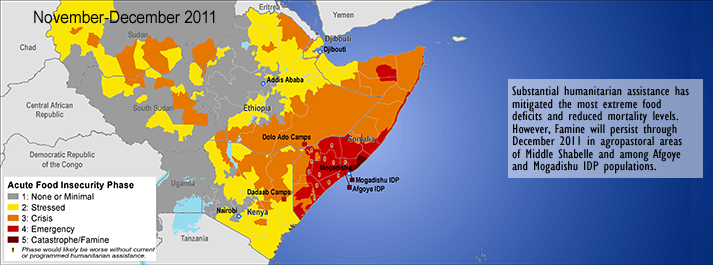
Al Shabab and the Months AheadAs of late November, the United Nations estimated that tens of thousands had died in Somalia alone since drought began this spring. Though USAID’s Famine Early Warning Systems Network (FEWSNET) reports that famine has now subsided in three of the six southern regions it initially struck, a quarter of a million Somalis remain at risk of “imminent starvation,” according to the UN.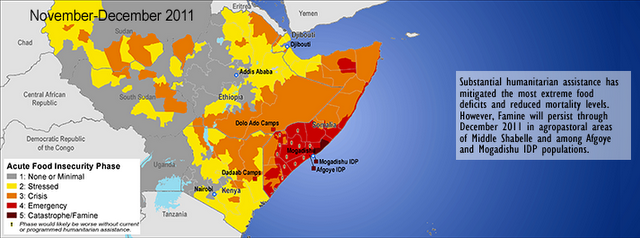
According to FEWSNET, famine should not reappear in the foreseeable future, assuming aid groups can maintain current distribution levels – a key caveat. Ten days after FEWSNET issued its analysis, however, Al Shabab, the Al Qaeda-linked militant organization that controls much of southern Somalia, banned 16 aid groups, including UNICEF and the World Health Organization, from operating in the areas under its control. UNICEF spokesman Jaya Murthy told the BBC that the move would put “about 160,000 severely malnourished children…at imminent risk of death.”
Fighting in southern Somalia between Al Shabab and Kenyan and Ethiopian forces is adding another layer to the country’s humanitarian crisis. The UN Office of the High Commissioner for Refugees reported that, as of late November, the fighting had become the primary driver of internal displacement, replacing drought and famine as the key drivers during the first three quarters of the year. The UNHCR estimated that, between the drought and the conflict, 1.46 million Somalis have been displaced.
Meanwhile, the rainy season is picking up, and although that’s good news for farmers and pastoralists, it also means that Somalis will be vulnerable to diseases like measles, typhoid, and cholera, which can spread quickly through overcrowded, under-supplied IDP camps. Somalis still living under Al Shabab’s control are prohibited from getting vaccinations, amplifying their vulnerability to disease in the coming months.
These latest developments offer strong evidence that policy decisions can exacerbate the human toll of natural disasters. From Barder’s perspective, that is reason for optimism. “We have the information, we have the capacity to prevent it from happening,” he said.
For more on Somalia’s underlying demographic issues, see Elizabeth Leahy Madsen’s post “In Somalia, Beyond the Immediate Crises, Demography Reveals a Long-Term Challenge.”
Sources: AlertNet, Associated Press, BBC, Famine Early Warning Systems Network, Foreign Policy, Huffington Post, The New York Times, UNHCR, UN News Centre, Voice of America.
Video Credit: “Jim Hansen on Food Security in East Africa,” courtesy of the International Research Institute for Climate and Society on vimeo; image credit: FEWSNET/USAID. -
Youth Need More Information on Climate, Population Links
›December 9, 2011 // By Brenda ZuluYouth need more information about climate change, but also on its links to reproductive health and gender, said Esther Agbarakwe, technical advisor for the Africa Youth Initiative on Climate Change. Speaking at the joint Aspen Institute, Population Action International, and Wilson Center side event, “Healthy Women, Healthy Planet,” at the COP-17 climate conference, Agbarakwe pointed out that “there are critical issues, like demography, the number of young people, and young women in this population, that should be discussed.” But, she said, they would likely not be brought up in any official manner at the conference because of fears about “population control.”
In Nigeria, young people, and particularly young girls, are frequently excluded from formal discussions about climate change and sustainable development. Growing up, Agbarakwe said she was aware of environmental change due to pollution in the Niger Delta, but her parents did not talk to her about reproductive health. In her community, many young girls had unplanned pregnancies and boys dropped out of school. It was only through a child rights activists’ club that she learned about how she could protect herself.
“That is why there is need to have young women in this discussion,” she said.
Giving a Voice to the Most Affected
Wendy Mnyandu, a student from Durban’s Zwelibanzi High School attending the side event, noted in an interview that climate changes have affected mothers more because they are dependent on the forest for energy.
“It is important for villagers to adapt to new technologies [such as] cook stoves, where they can use less fuelwood that will not take away the forest,” she said.
At the Wilson Center earlier this year, Agbarakwe explained how insufficient rain has led to longer trips to collect water, increasing women’s vulnerability. A friend of hers was raped while walking to the next village to fetch water after her own community’s well dried up – an ordeal that was not only emotionally and physically traumatizing, but also isolated her from her community and jeopardized her future plans and dreams.
“It is important for more men to talk about this topic,” said Roger-Mark De Souza, vice president of research at Population Action international, who also spoke at the side event. “I am talking on behalf of my mother, my daughters, my wife, and my granddaughters, for their voices are not often heard. I am a father of two young teenage boys and they know how to talk about this. By talking about it, we can see how family planning is very effective,” he said.
Talking About Population to Climate Experts, and Vice Versa
“Just last week I was in Dakar, Senegal, at the International Conference on Family Planning,” said De Souza. “I was talking to specialists and I was getting them interested in climate change.” Similarly, “more and more we find that climate change activists and specialists are appreciating that climate change is important to women and their wellbeing,” he said.
Population Action International (PAI) has mapped agricultural production, water stress, and increased vulnerability to climate change. “We see that there are 26 global hotspots where these issues are critical. What we have also done is look at these hotspots to determine where there is a very high unmet need for family planning,” said De Souza. PAI is using these maps to show the climate change community that a cost-effective investment in family planning could increase resilience in these areas.
De Souza said that in order to build support for programs that address these issues, it is important to look at national adaptation programs of action and their funding needs. “Funding is critical, and these types of interventions produce results – we need to understand where those missed opportunities are and tell that story to our policymakers and our delegations that are here in Durban and to keep with that message when we go back home,” he said.
Empowering Young African Women
Agbarakwe became interested in these issues after meeting former president of Ireland Mary Robinson, who also spoke at the side event. “I had met a Nigerian young man who challenged me that it was difficult for a woman to realize her career dreams because one day she will have to be married and bear children,” said Agbarakwe:When I saw my passion, I was confused and asked questions of Robinson on what she would do if she found herself at the crossroads like me. She told me as a young woman, I will find myself at a crossroad. That is why I am very determined about this issue, and that is what is needed, because when young women are empowered they actually can make decisions.
Robinson, the chair of the Global Leaders Council for Reproductive Health, said in an interview that she was heartened to see the number of youth at the side event. In Durban, she spoke with a group of young women who were part of Oxfam’s Project Empower:We met young women and several of them had come from the Eastern Cape [of South Africa]. They had come to Durban to look for work. Instead they found themselves in rural poverty. They had dreams of a better life for themselves, but their daily reality they talked to us about was nobody’s dream. They talked to us about negative impacts of their communities – the violence against women that is very prevalent, the unplanned pregnancies, and the reality of women who even have to use their bodies to gain money.
African women are looking for contraceptives, such as the female condom, where they can be in control, said Robinson; there are about 215 million women in the world who do not want to get pregnant but are not using modern contraception. “If we were to solve that problem, women [would not only] be better mothers, but also be better leaders in their communities,” she said.
The good thing was that they were ready to talk about the problems and did not consider themselves to be victims. They were strong women. They had learned to say ‘no’ and to say ‘respect me.’ They talked about going into some of the clinics and facing encounters with the police and that the police did not respect them. ‘We do not accept that anymore. We know now that we are members of the community who wish to be respected,’ they explained.
Brenda Zulu is a member of Women’s Edition for Population Reference Bureau and a freelance writer based in Zambia. Her reporting from the COP-17 meeting in Durban (see the “From Durban” series on New Security Beat) is part of a joint effort by the Aspen Institute, Population Action International, and the Wilson Center.
Sources: Population Action International, World Health Organization.
Photo Credit: “Viet Nam and Primary Education,” courtesy of flickr user United Nations Photo; video courtesy of Population Action International. -
Sanitation and Water MDGs in the Middle East and North Africa: Missing the Target?
›Goal 7, Target 10 of the United Nations Millennium Development Goals (MDGs) is to “halve, by 2015, the proportion of people without sustainable access to safe drinking water and basic sanitation.” The Joint Monitoring Programme (JMP), established by the UN to monitor progress towards this goal, has twice concluded (in 2008 and 2010) that the Middle East and North Africa (MENA) are in good shape to meet this target. However, a new article in Development and Change, “The Politics of Assessment: Water and Sanitation MDGs in the Middle East,” by Neda Zawahri, Jeannie Sowers, and Erika Weinthal, argues that the JMP’s “reliance on classifying ‘improved’ and ‘unimproved’ water and sanitation infrastructure, through infrequent household surveys, has produced misleading assessments that fail to capture the extensive water quality and sanitation problems plaguing the MENA.”
The authors compared the findings of the JMP with a variety of data sources – participatory assessments, reports from other UN agencies, donor projects, domestic ministries and agencies, and academic research – and found major contradictions between the progress reported by the JMP and the situation on the ground. In one example, the authors write that “while the JMP considers piped household water as an improvement in water coverage, it fails to differentiate between ‘full’ coverage and ‘partial’ coverage, that is, household water supplies available only a few hours a week.” And the authors point out that according to UN-Habitat, “the availability of piped water does not necessarily translate into safe drinking water, as water may become contaminated before it reaches the tap.”
As a result of the weakness of the indicators used by the JMP, household surveys conducted by the JMP in the MENA region “[do] not adequately capture the quality of drinking water,” the authors write, and efforts to address this inadequacy through more comprehensive testing of municipal water samples were deemed “too complex to be routinely employed through the world” and “prohibitively expensive.”
“International organizations and national leaderships in the MENA lack substantial incentives to adopt more accurate assessments for safe water and sanitation,” Zawahri et al. conclude. The need to generate comparable data across time and space has trumped the importance of “gauging access, quality, and affordability of water and sanitation.” -
Jason Bremner, Behind the Numbers
PHE Champions Bring Their Experiences From the Field to the International Family Planning Conference in Senegal
›December 8, 2011 // By Wilson Center StaffThe original version of this article, by Jason Bremner, appeared on the Population Reference Bureau’s Behind the Numbers blog.
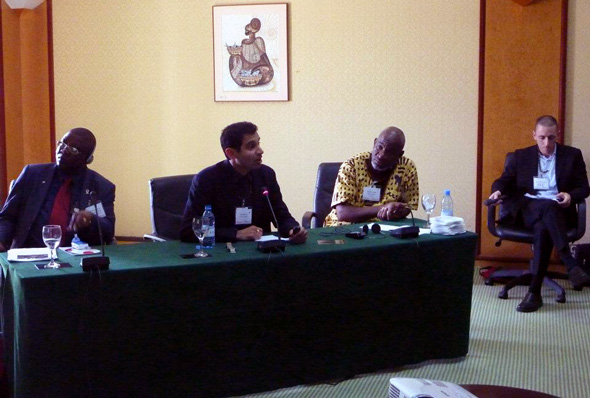
This past week at the 2011 International Conference on Family Planning, four practitioners from the field traveled from remote parts of the Democratic Republic of Congo, Ethiopia, Madagascar, and Tanzania to Dakar, Senegal, to share their successes and challenges in reaching remote communities with an integrated package of health, livelihood, and environment services. Together they made up the panel, “Reaching the Hardly Reached: Delivering Family Planning Through Population, Health, and Environment Integration.”
The panelists came from four environmental organizations whose starting point for working in these remote places was the protection of the biodiversity and natural resources upon which all life depends. Dr. Vik Mohan, physician and medical director for Blue Ventures, talked about how he and his organization transitioned from focusing initially on the conservation of coastal marine reserves and coral reefs to now working to improve health care, including access to family planning.
Blue Ventures, in response to community and women’s needs, opened a family planning clinic, and on the opening day, 20 percent of the women of reproductive age in the community came out to request contraceptives. Today they offer a whole spectrum of short- and long-acting contraceptive methods through partnerships with Marie Stopes International, Population Services International, and various funders. Blue Ventures reported that contraceptive prevalence had risen from 8 percent when they began in 2007 to 35 percent today.
Continue reading on Behind the Numbers.
Photo used with permission courtesy of PRB. Left to right: Didier Mazongo, WWF; Vik Mohan, Blue Ventures; Baraka Kalangahe, Tanzania Coastal Management Partnership; and Jason Bremner, PRB. -
New UNEP Climate Report Says Women Face “Disproportionately High Risks”
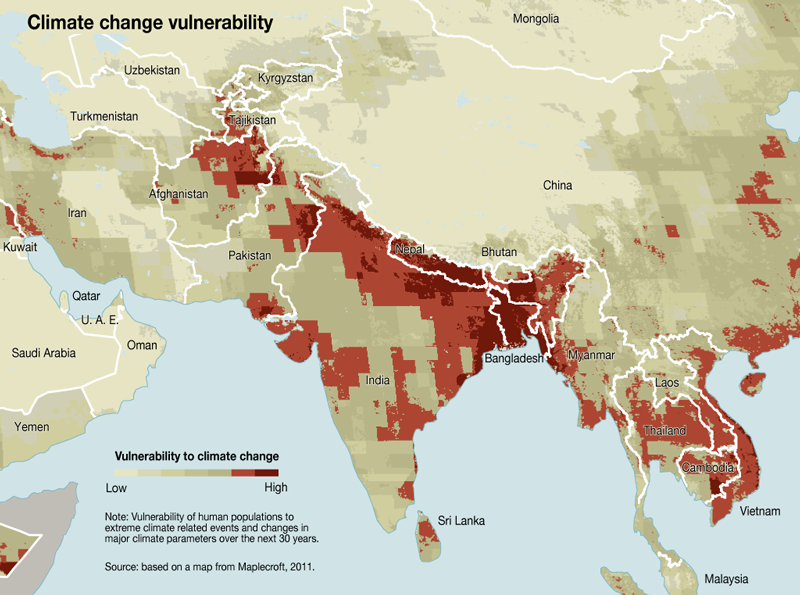
›December 8, 2011 // By Brenda ZuluA new United Nations Environment Programme (UNEP) report, Women at the Frontline of Climate Change: Gender Risks and Hopes, released at COP-17, says that women, particularly those living in mountainous regions in developing countries, “face disproportionately high risks to their livelihoods and health from climate change, as well as associated risks such as human trafficking.”
Droughts, floods, and mudslides are affecting a growing number of people worldwide, in part because of climate change, but also because population growth is highest in some of the most vulnerable areas of the world. For example, in the 10 years from 1998-2008, floods affected one billion people in Asia, but only four million people in Europe.
According to UNEP, women often bear the brunt of such disasters: “In parts of Asia and Africa, where the majority of the agricultural workforce are female, the impacts of such disasters have a major impact on women’s income, food security, and health,” as they are responsible for about 65 percent of household food production in Asia and 75 percent in Africa. In addition, they are often more likely than men to lose their lives during natural disasters.
UNEP Executive Director Achim Steiner said in a press release that “women often play a stronger role than men in the management of ecosystem services and food security. Hence, sustainable adaptation must focus on gender and the role of women if it is to become successful.”
“Women’s voices, responsibilities, and knowledge on the environment and the challenges they face will need to be made a central part of governments’ adaptive responses to a rapidly changing climate,” he added.
Investing in low-carbon, resource-efficient green technologies, water harvesting, and alternatives to firewood could strengthen climate change adaptation and improve women’s livelihoods, says UNEP.
“If Insufficient, Family Planning Funds Should Be Scaled Up”
UNEP spokesperson Nick Nuttall said in an interview that there are wide differences between how people consume natural resources, with North Americans and Europeans consuming far more than someone in a developing country. We should move toward more efficient use of natural resources, make the transition to a low-carbon economy, and scale up renewable energies, which can reduce demand for fossil fuels to meet economic growth and population increases, he said.
Asked whether climate change funds should therefore support family planning, Nuttall said the UN supports the right of couples and women to choose the size of their families and that many UN agencies and NGOs provide that support already.
But, he said, “there are funds available for family planning and, if insufficient, they should be scaled up to meet the demands and requests of developing countries. Given that this is an issue far wider than climate change, these existing funding streams should be where the financial support comes, rather than from a climate fund.”
Brenda Zulu is a member of Women’s Edition for Population Reference Bureau and a freelance writer based in Zambia. Her reporting from the COP-17 meeting in Durban (see the “From Durban” series on New Security Beat) is part of a joint effort by the Aspen Institute, Population Action International, and the Wilson Center.
Sources: UNEP.
Image Credit: “Climate change vulnerability,” courtesy of Riccardo Pravettoni, UNEP/GRID-Arendal. -
African Women, Most Vulnerable to Climate Change, Are Agents of Change
›December 6, 2011 // By Brenda ZuluIt is the poorest people whose lives are most undermined by changes in the weather, said Chair of the Global Leaders Council for Reproductive Health Mary Robinson at a side event on “Healthy Women, Healthy Planet” during COP-17 in Durban, South Africa. “When farmers don’t know how to predict the seasons, when there is more flooding than there was, when there are longer periods of drought and then flash flooding,” she said, people need more resilience. “They have to be even stronger in being able to cope with the drought and flooding.”From Population Action International’s Weathering Change – Fatima’s Story.
“In the past, February and March were planting months, while June and July were harvest months in the first season,” explained Constance Okollet, chairperson of the Osukura United Women Network in eastern Uganda, in an interview. “The second season started in August and September as planting months, but now we don’t have any seasons anymore.”
Okollet said that since 2007, there have been floods in her area that have destroyed homes and fields and forced some to leave their homes. “I actually had to leave when the floods destroyed my house and when I went back there was nothing; and immediately after that there was a drought after planting,” she said.
“These days we gamble with agriculture, as we are not sure when to plant. What we see now is, if it is not torrential rains, then it is a storm. During the rainy season, you find a lot of winds. We never used to see them and now we have mudslides, which are occurring every year. With heavy rains it has been difficult for people to dry cassava and groundnuts. Last month, I lost two fields of groundnuts because the rain has been very heavy,” Okollet said. “In the community, we used to harvest heavily, but it is not the same anymore.”
African women are often particularly vulnerable to such environmental disruptions. Okollet pointed out that women walk long distances to look for water and feed children before they go to school. “Women always eat little and leave the rest for their children,” she said. “Children are sick and there is a lot of death in the village because of hunger and lack of food security.”
Water-borne diseases, such as cholera, erupt after floods contaminate the water, and getting health care can be difficult for women because the health center is very far away.
Okollet said that when all this was happening, she and her fellow network members thought that maybe God was punishing them. “We only knew what was happening when Oxfam talked to us about climate change,” she said.
The Osukura United Women Network has asked the Ugandan government for help supplying early-maturing crops that will adapt to the seasonal change. The group is working to sensitize their community to the importance of hygiene and sanitation as well as working with men in the community to build wells and latrines.
“We need women to be agents of change in their local communities,” said Robinson.
Brenda Zulu is a member of Women’s Edition for Population Reference Bureau and a freelance writer based in Zambia. Her reporting from the COP-17 meeting in Durban (see the “From Durban” series on New Security Beat) is part of a joint effort by the Aspen Institute, Population Action International, and the Wilson Center.
Video Credit: “Fatima’s Story – Weathering Change Extra,” courtesy of vimeo user Population Action International.