-
The Year Ahead in Political Demography: Top Issues to Watch
›June 8, 2012 // By Elizabeth Leahy Madsen2011 and the first half of 2012 have been a remarkable period for political demography, with theories about the relationships between age structure and governance validated in real time by the events of the Arab Spring. Although such game-changers are rarely predictable, the year ahead promises to be eventful as well, with new demographic research and major policy initiatives on the horizon. Below are brief assessments of some of the top issues to watch between now and next summer.
1. The Evolving Story of the Arab Spring
The Arab Spring was anticipated by few observers, but for a handful of political demographers it was a watershed of sorts. As readers of this blog know, political demography research shows that countries with very young age structures are prone both to higher incidence of civil conflict and – most relevant to the outcomes of the Arab Spring – to undemocratic governance. This nuance escaped many observers of the region’s drama. Violence and conflict erupted not from raging citizens in the streets but from military and militia forces unleashed by autocrats unwilling to cede their grip on power. Young people, and their fellow protestors of all ages, were acting as a force for positive change in their demonstrations against corrupt and unrepresentative leadership. The difference in outcomes across the region, according to Richard Cincotta, can be attributed to the fact that as age structures mature, elites become less willing to trade their political freedoms to autocratic leaders in exchange for the promise of security and stability.
When considered with this important distinction in mind, the initial events following the uprising in Tunisia that quickly spread across the region played out in a neatly linear fashion. Among the five countries where revolt took root, those with the earliest success in ousting autocratic leaders also had the most mature age structures and the least youthful populations.
In Tunisia, with a median population age of 29, one month passed between a fruit seller’s self-immolation and Zine El Abedine Ben Ali’s flight to exile. In Egypt and Libya, where median age is close to 25 years (identified by Cincotta as a threshold when countries are at least 50 percent likely to be democratic), Hosni Mubarak and Moammar Gaddafi took three weeks and eight months, respectively, to lose their titles. Ali Abdullah Saleh in Yemen (median age 17), took one year to be convinced to formally resign, while in Syria (median age 21), the 15-month uprising continues to be brutally repressed by Bashar Assad’s forces.
Of course, overthrowing a dictator, while inspiring and liberating to those whose rights have been repressed, is only the first step in achieving democracy. In the coming year, the countries that have already taken steps toward solidifying regime change will face continued tests as internal tensions surface. Even in Tunisia, recent clashes signal that political divisions and economic uncertainty have not been resolved. With potentially divisive elections ahead in Egypt and Libya, a holdover from the Saleh regime leading Yemen, and Syria’s fate unknown, the coming year should offer political demographers further evidence of the soundness of the age structure and democracy thesis.
2. New Commitments to Family Planning
Reproductive health and demography go hand-in-hand, and two milestones for family planning advocates are fast approaching: the 20th anniversary of the 1994 International Conference on Population and Development in Cairo, and the 2015 endpoint of the Millennium Development Goals.
These historic commitments by governments will be joined by a major initiative to generate new funding and political will this summer at an international family planning summit in London on July 11. The summit will be co-hosted by the Bill and Melinda Gates Foundation (Melinda made an impassioned TEDxChange speech in support of the issue in April), and the UK’s Department for International Development, for whom family planning is a priority in efforts to reduce maternal and child mortality.
Details of the summit have yet to be finalized and publicly released, but financial commitments from donors and developing countries are anticipated toward meeting a new and ambitious goal of generating $4 billion to fund contraceptives for 120 million women in developing countries by 2020. Assuming these are new users, rather than those who would be expected by projecting recent growth in contraceptive use forward, this would represent more than half of the estimated 215 million women with an unmet need for family planning.
Why does new family planning funding matter for political demography? Rates of contraceptive use are lowest and fertility highest in countries with youthful age structures. Such population dynamics exacerbate the challenges governments face in providing education, health, and basic infrastructure services, as well as supporting an economic climate conducive to industry diversification and job creation. In turn, the likelihood of civil conflict and undemocratic governance is higher in such countries.
While policies that recognize the benefits of family planning may be solid, funding and implementation often fall woefully short. In the least developed countries, less than one-third of reproductive-age women are using any contraception, and the rate has grown by just 0.4 percentage points annually over the past decade. Meanwhile, funding from all sources is less than half the amount required to meet unmet need. If the July summit motivates a new groundswell of financial support, 2012 could incite major strides toward improvements in individual health and well-being as well as demographic momentum in the remaining high-fertility countries.
3. Demographic Diversity in Sub-Saharan Africa
The current era of global demographic diversity has been distinguished by both record-low fertility rates in parts of Europe and eastern Asia and persistently high fertility across most of western, central, and eastern Africa. More than one-quarter of women in sub-Saharan Africa would like to postpone or avoid pregnancy, but are not using contraception, demonstrating a large unmet need for family planning.
The U.S. government-funded Demographic and Health Survey (DHS) program is the largest single source for detailed data on health status and behavior in high-fertility developing countries, and in turn informs estimates and projections of demographic trends. Recently, DHS reports have been released showing that contraceptive use over the past five years is growing much faster than the regional average in Ethiopia, Malawi, and Rwanda. In turn, fertility rates have dropped, ranging from a relatively modest 0.3 children per woman in Malawi and an unprecedented 1.5 children per woman in Rwanda.
These findings suggest that the pattern of demographic stagnation in sub-Saharan Africa may be shifting, perhaps due to governments’ and donors’ investments in family planning. However, newer survey results for Mozambique, Uganda, and Zimbabwe present a more mixed picture, with modest gains in contraceptive use in Uganda, offset by declines in the other two countries.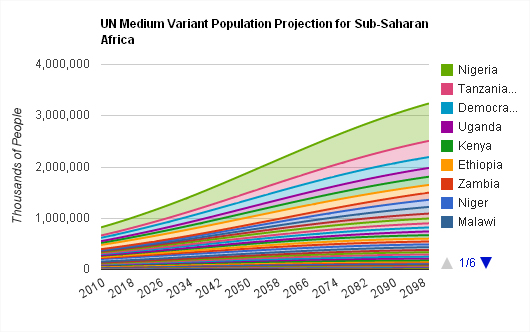
Click here for the interactive version (non-Internet Explorer users only).
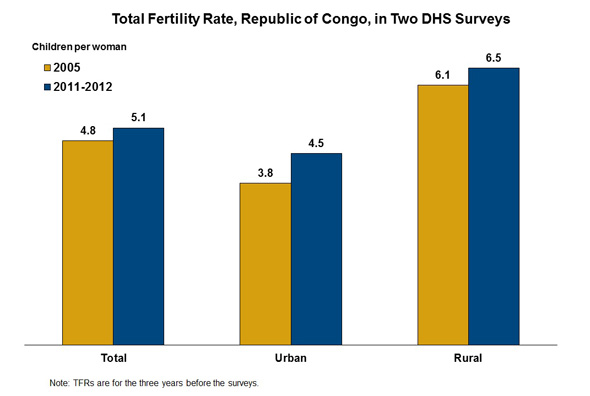
Additional recent survey results show that use of modern contraceptive methods has barely increased in Senegal (from 10 percent in 2005 to 12 percent in 2010-11). And while modern contraceptive use increased in the Republic of Congo from 13 percent in 2005 to 20 percent currently, fertility also rose slightly, from 4.8 to 5.1 children per woman.
Approximately 10 countries in sub-Saharan Africa are slated for DHS fieldwork this year, including one of the continent’s giants, the Democratic Republic of the Congo, and several of the highest-fertility countries in the region. (Outside of sub-Saharan Africa, the demographic heavyweights in this year’s group of DHS reports are Bangladesh, Indonesia, and Pakistan.)
The upcoming surveys will provide greater clarity about whether the promising signs of family planning adoption and the potential for progress through the demographic transition in Ethiopia, Malawi, and Rwanda are initiating widespread change across the continent, or whether the need for commitments such as those generated by the London summit is even stronger.
4. New Population Projections
DHS reports are critical inputs for the world’s most comprehensive and readily accessible set of demographic data, the UN Population Division’s World Population Prospects. This database is fully updated and revised biannually, in large part due to the steady stream of newly available estimates from the DHS and related sources, such as national censuses. The next revision of World Population Prospects, based on estimates for mid-year 2012, is expected to be published in spring 2013.
The previous revision of World Population Prospects was notable for its methodological overhaul. In addition to extending the projections until 2100, the Population Division shifted to a probabilistic technique (as opposed to assuming convergence at a single fertility rate of 1.85 children per woman) that generates 100,000 possible fertility trajectories for each country and selects the median as the medium fertility variant, commonly cited as the most likely projection. Still, the basic parameters remain the same: With fertility rates the strongest driver of population projections, low, medium, and high fertility variants are constructed around the assumption that countries will converge towards replacement level fertility, around 2.1 children per woman.
In some cases, this results in projections that are vastly at odds with recent trends. For example, in Japan, fertility has fallen by 38 percent, from replacement level in the early 1970s to 1.3 children per woman in 2010, but the UN projects it to immediately reverse course and begin rising to 1.8 by mid-century. If the projection holds, Japan’s population will decline relatively modestly, from 127 million to 109 million. But if fertility stays constant at current levels, the population will fall below 100 million. For low-fertility countries like Japan, all UN scenarios assume constant or rebounding fertility rates, even though continued decline may be a plausible outcome in some cases.
When next year’s projections are released, a cluster of media articles will report the projected world population for 2050. In last year’s revision, the medium fertility variant resulted in a projection of 9.3 billion, an increase from the 9.1 billion projected two years earlier based on higher projected fertility in the future. Such reports often overlook the range of population totals possible depending on fertility paths: If the global fertility rate varies by 0.5 children per woman in either direction, the total population could be more than one billion higher or lower in 2050, with an even wider range possible by 2100.
Most of the projected growth in world population, and its potential range, will be driven by the high-fertility countries concentrated in sub-Saharan Africa. Population projections for these countries vary tremendously based on fertility scenarios informed by the recent DHS results described above.
In Nigeria, Africa’s most populous country, fertility has fallen over the past 40 years, but by a gradual 15 percent. The UN projects it to drop more than twice as fast, by more than two children per woman (39 percent), in the next four decades. In any scenario, Nigeria is on track for rapid population growth, but the potential range based on fertility outcomes is wide. If fertility declines as projected in the medium variant, the country would grow from 158 million to 390 million. And although unlikely, the constant fertility projection of 504 million Nigerians in 2050 should be kept in mind given the slow pace of fertility decline to date.
Population projections are highly wonky, but their careful production and regular revision are essential for accurate planning of economic and social needs in countries around the world. While governments with dedicated census agencies, such as those in the U.S., Japan, or India, rely on internally-generated estimates, the UN projections serve as the primary indication of population trends in countries with spottier data coverage and have tremendous utility in gauging future needs for infrastructure, housing, health care across the life cycle, education, jobs, and other investments.
By no means is this an exhaustive list of factors that will affect political demography research and policy over the coming year. Other events to watch for include the Rio+20 conference on sustainable development in June, where the priority issues of jobs, energy, infrastructure, and resources will be shaped by demographic trends, and continued attention to prospects for the demographic dividend in Africa. Political demography is inherently cross-disciplinary, and the field’s researchers and practitioners will be engaged on multiple fronts in the year ahead.
Elizabeth Leahy Madsen is a consultant on political demography for the Wilson Center’s Environmental Change and Security Program and senior technical advisor at Futures Group.
Sources: Al Jazeera, Bongaarts (2008), Cincotta (2008), Cincotta (2012), Cincotta and Leahy (2006), Grist, Guttmacher Institute, MEASURE DHS, The New York Times, NPR, Population Reference Bureau, UN Population Division, The Washington Post.
Image Credit: “The Face of a Tyrant,” courtesy of flickr user freestylee (Michael Thompson); video courtesy of TED; chart created by Schuyler Null, data from UN Population Division. -
Family Planning and Results-Based Financing Initiatives
›“Family planning means healthier moms and kids – and it’s good for development too,” said Lindsay Morgan, a senior health analyst at Broad Branch Associates, a healthcare advocacy group. But any number of hurdles can keep women from accessing family planning services. Morgan spoke at a May 21 discussion about results-based financing (RBF) programs, which aim to address hurdles on both the supply and demand sides of the equation in developing countries by incentivizing the provision of a variety of quality services while removing barriers to access for women in need of those services.
Removing Barriers to Providing and Using Family Planning Services
Incentives in RBF programs can come in a variety of forms – like subsidies or fees paid to clinics or vouchers sold to women, said Morgan. In Burundi, for example, under a pilot program rolled out across three provinces in 2006, health facilities receive payments for each patient that uses a modern method of contraception. In 2009, the government and international partners began scaling up the program to a nationwide level. In addition to expanding the program’s geographic reach, the scale-up incorporated new payment criteria to better incentivize quality of care (as opposed to just quantity) and longer-lasting methods of contraception.
Since the RBF pilot began, maternal and child health indicators have improved. The number of children being fully immunized is up, as is contraceptive prevalence, said Morgan. Additionally, those immediate results can lead to a slew of additional benefits down the line. For instance, improving modern contraceptive prevalence is one of the most cost-effective interventions available for reducing maternal death, she said.
In nearby Kenya, the health ministry leads a voucher system across four districts and two Nairobi slums to help some of the country’s poorest women afford maternal healthcare, family planning, and gender-based violence services.
The program is “written into large policy documents [and] strategic pieces,” including Vision 2030, a long-term government-wide strategy document “unveiled in 2008 as a way to reach middle-income country status by 2030,” said Ben Bellows, a reproductive health associate at Population Council Kenya. The government’s emphasis on the voucher program as more than just a health initiative is an acknowledgment of the downstream impact that improved maternal and reproductive health can have on the country’s development, he said.
“An Equity Gap in Family Planning”
However, the fact that the voucher program is needed at all is evidence of “an equity gap in family planning,” Bellows said. Access to family planning services can be significantly skewed depending on a woman’s income level, he said, pointing to a recent article in The Lancet assessing health inequalities in 12 different maternal and child health services across 54 priority Millennium Development Goal countries.
The equity gap reflects “an interesting problem with development,” said Bellows: Though low-income countries are converging with higher income countries, in terms of economic growth rates and income levels “the benefits of growth aren’t being evenly distributed.” The Africa Progress Panel’s annual report, released last month, echoes that point, he said.
“Governments are failing to convert the rising tide of wealth into opportunities for their most marginalized citizens,” the report concludes, and “unequal access to health, education, water and sanitation is reinforcing wider inequalities.”
Kenya’s voucher system is designed to help shrink that gap. Among the poorest of the poor – those benefitting from the system – inequalities are dropping, even if on a broader scale, inequity still exists between poor and wealthy Kenyans. “We’re seeing lower inequalities of service in areas exposed to the voucher,” said Bellows.
“RBF supports progress on a path towards universal health coverage,” said Beverly Johnston, the senior policy advisor at USAID’s Office of Population and Reproductive Health. And within the context of family planning “the whole idea is to level the playing field” so that all contraceptive methods are equally readily available to the women seeking them.
“A Catalyst for Change” in Family Planning
In addition to addressing equal access concerns, RBF programs can serve as “a catalyst for change…to stimulate quality of care and quality of family planning counseling in particular,” said Johnston.
A commonly cited hurdle to better family planning access is social norms that support large family sizes or otherwise limit a woman’s ability to space or limit her pregnancies. Given community health workers’ unique roles within their communities – “often on the front lines…where many of these social taboos and barriers exist,” as Morgan described – simply strengthening their training, and in turn improving the quality of care that women receive, can help counter norms that might otherwise prohibit access to family planning.
As more women receive higher quality care, norms dissipate even further, said Morgan. “There is evidence that [quality of care] is strongly associated with a woman’s decision to choose a method to use, to continue to use it, and to recommend it to others.”
“Rights Are Tantamount”
One trap RBF programs need to be aware of is over-incentivizing expansion of coverage to the detriment of quality or individual women’s concerns about what makes sense for them, said Johnston.
“Rights are tantamount,” she said. In order to ensure that rights are upheld, programs must reflect and be sensitive to local histories and local needs – particularly given the fact that some countries have had “a history of coercive programs and policies.”
Ultimately, “we really look at RBF as just one tool,” said Johnston. “RBF is not for every place and every context,” and neither is family planning’s place in RBF programming.
As one tool of many, RBF programs are gaining prominence as a way to meet MDGs related to maternal and child health. Bellows sees RBF’s importance lasting long past that 2015 deadline, though.
“The high inequity that we witness across many low-income countries, and the ability of targeted mechanisms [like Kenya’s voucher program] to address that, suggest that this may be a kind of generalized solution,” he said. “Obviously it will be context specific in the way in which it is rolled out, but the strategy of incentivizing clients and providers suggests that there’s some sort of globalized solution that could be considered for this widespread challenge.”
Event Resources
Photo Credit: Sean Peoples/Wilson Center. -
Carl Haub, Behind the Numbers
Republic of Congo Demographic and Health Survey Shows High Maternal Health, But No Fertility Decline
›June 5, 2012 // By Wilson Center StaffThe original version of this article, by Carl Haub, appeared on the Population Reference Bureau’s Behind the Numbers blog.
The Congo (Brazzaville) 2011-2012 Demographic and Health Survey (DHS) is the second DHS taken in the country and the preliminary report has just been released. The survey interviewed 10,819 women ages 15-49 and 5,145 men ages 15-59 from September 2011 to February 2012. A major finding of the survey was that fertility has not declined in the country since the previous DHS in 2005. The total fertility rate (TFR) report in the recent DHS for the three year period before the survey was 5.1 children per woman, 4.5 in urban areas, and 6.5 in rural areas. This appears to represent an increase in the TFR since 2005 but the survey report cautions that there is likely to have been some understatement of the actual level of childbearing in the 2005 survey, particularly among women ages 25-29.
Rural women accounted for two-thirds of those interviewed in the most recent survey. The rather high TFR is reflected in the desire for large families. Among women with five living children, only 37.3 percent said they did not wish to have additional children. An additional 9.8 percent of that group said they were incapable of conceiving, however.
In the survey, 44.7 percent of currently married or in-union women said that they were using some form of family planning and 20 percent were using a modern method. The most common type of modern method was the male condom at 12.3 percent, a rather unusual pattern of contraceptive use in Africa. That was followed by the pill at 2.9 percent and injectables at 2.8 percent. This continues the often-observed preference in sub-Saharan Africa for methods to space births, not necessarily to limit them. The use of modern contraception was 24.6 percent in urban areas and 11.7 percent in rural areas. Modern contraception rose since the 2005 DHS when it was reported at 12.7 percent and the condom was also the most frequently used method at that time. The prevalence of HIV was reported in the 2009 AIDS Indicator Survey at 4.1 percent for women ages 15-49 and 2.1 percent of men of the same age group.
Continue reading on Behind the Numbers.
Sources: MEASURE DHS.
Image Credit: Carl Haub/Population Reference Bureau. -
Bringing Environment and Climate to the 2012 Population Association of America Annual Meeting
›June 5, 2012 // By Sandeep BathalaOver 2,100 participants attended the 2012 Population Association of America (PAA) annual meeting in San Francisco this May. PAA was established in 1930 to research issues related to human population. This year, for the first time, the meeting featured a notable contingent of demographers, sociologists, and public health professionals working on environmental connections.
I followed as many of the environment-population discussions on newly published or prospective research papers as possible (about 20 in total). I found four papers particularly noteworthy for the connections made to women, family planning, and climate change adaptation.
Samuel Codjoe of the University of Ghana spoke about adaptation to climate extremes in the Afram Plains during one of the population, health, and environment (PHE) panels organized by Population Action International. Although developed nations are historically the major contributors of greenhouse gases due to comparatively high levels of consumptions, developing countries are the most vulnerable to the consequences of climate change – in part because of continued population growth. As a result, adaptation strategies in countries like Ghana are particularly important; and given women’s often-outsized role in water and natural resource issues, a focus on gender-specific adaptation even more so.
Codjoe presented an analysis of preferred adaptation strategies to flood and drought, broken down by gender and three common occupations – farming, fishing, and charcoal production). He said he hopes his assessment – part of a collaborative research effort with Lucy K.A. Adzoyi-Atidoh of Lincoln University – will aid in the selection and implementation of successful adaptation options for communities and households in the future.
“Understanding differences in the priorities that women place on adaptation may prove to be important in the effectiveness of climate change adaptation – and the sustainability of communities,” he said.
David López-Carr of the University of California, Santa Barbara, speaking on behalf of a group of researchers with World Wildlife Fund, teased out the gender dynamic further when he presented on ways to help the conservation sector determine next steps for existing PHE projects. Practitioners from seven of the eight PHE projects currently implemented by conservation organizations (defined by having been involved for at least three years in bringing family planning to local communities) recently said the links to women’s empowerment were among the most important aspects of successful projects.
López-Carr therefore emphasized the need for additional research on how PHE projects can support and empower women, both economically and socially. He also noted, like Codjoe, the potential impact women often have on the management of their community’s natural resources, saying this was another area where research on the empowering effect of PHE programs can provide further backing for integrated programs.
Karen Hardee of Futures Group spoke about how the experiences of integrated PHE projects, despite most not being designed to respond to climate change specifically, have lessons to offer climate change efforts. Her work was done in partnership with the Population Reference Bureau, Population Action International, and U.S. Agency for International Development. She concluded that community-based adaptation approaches should consider population dynamics in vulnerability assessments. Meeting unmet need for family planning, she said, can assist communities adapting to climate change by building resilience. And as result, “PHE approaches should be able to qualify for funding under community-based adaptation programs.”
Shah Md. Atiqul Haq of the City University of Hong Kong presented research he conducted in Bangladesh that found that women tended to feel that a large family size was not advantageous during floods. This, he said, was indicative of their increased understanding of vulnerability and an endorsement of providing knowledge and access to family planning services as part of climate change adaptation strategies.
The inclusion of more environment, and particularly PHE, related presentations at this year’s conference was good to see – perhaps a sign that demography is becoming a more complex and comprehensive field, with a focus more on population structure and its interactions with other issues, rather than a singular fascination with growth.
In particular, panelists showed that the nexus between demography, gender equity, and climate change continues to grow in importance, both in the research and practitioner communities.
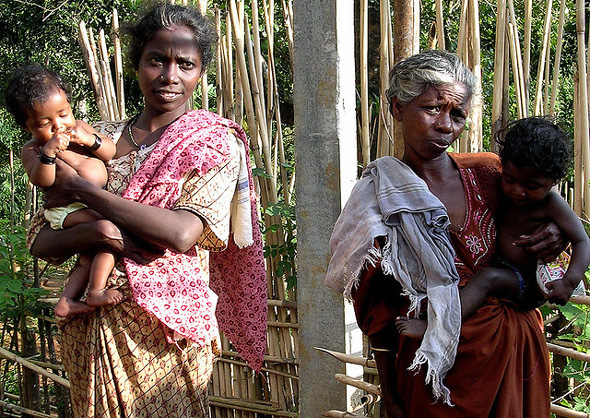
Photo Credit: Tribal women and children in Kerala state, India, courtesy of flickr user Eileen Delhi. -
USAID’s New Global Health Framework and Delivering Equity in Health Interventions
›USAID’s new Global Health Strategic Framework, Better Health for Development, lays out the agency’s major health priorities for the next five years. “Core global health priorities” include reducing maternal mortality, ensuring child survival and nutrition, fostering an “AIDS free generation,” and fighting infectious diseases. Family planning and reproductive health is listed as a key area for bilateral engagement. In particular, the strategy hopes to continue to “graduate” countries from the agency’s family planning program, which since the 1980s has transitioned 21 countries into local ownership of family planning support. The strategy also takes stock of the shifting global health environment, noting the rise of the “BRICS” countries as new donors and the need to strengthen public health systems in developing countries. “Already, private payments account for 50-80 percent of total health spending in Africa and Asia, leading to system inefficiencies, inequitable access, and health costs that prove catastrophic to individuals and families,” the report reads. In order to achieve its priorities within this context, the document sets out a number of strategies, including a focus on program sustainability, the empowerment of women, and integrated approaches to development. Health, it says, “cannot be isolated from other development challenges.”Speaking of health interventions, a team of researchers led by Aluisio Barros of the Federal University of Pelotas, Brazil, recently compared coverage data from more than 50 countries against an index of household wealth to estimate the most and least equitable interventions. The study, “Equity in Maternal, Newborn, and Child Health Interventions in Countdown to 2015: A Retrospective Review of Survey Data From 54 Countries,” published in The Lancet, found that “interventions with similar levels of overall coverage often have very different degrees of inequality.” According to the data, “the most inequitable indicator was skilled birth attendant, followed by four or more antenatal care visits, whereas the most equitable was early initiation of breastfeeding.” For example, though the average for attendance by a skilled birth attendant was 53.6 percent across the entire sample, the wealthiest fifth had an 84.4 percent coverage rate and the poorest stood at 32.3 percent. “Interventions that are usually delivered in fixed health facilities…tend to be the most inequitably distributed,” write the authors, with geographical access, financial barriers, and discrimination appearing as likely obstacles for the poor. The authors conclude that, although “concern about inequalities in maternal and child health in poor countries was conspicuously absent from the global agenda in the past,” the availability of new, intervention-specific data provides a means of targeting equity issues in health delivery more successfully. -
Philippines’ Bohol Island Demonstrates Benefits of Integrated Conservation and Health Development
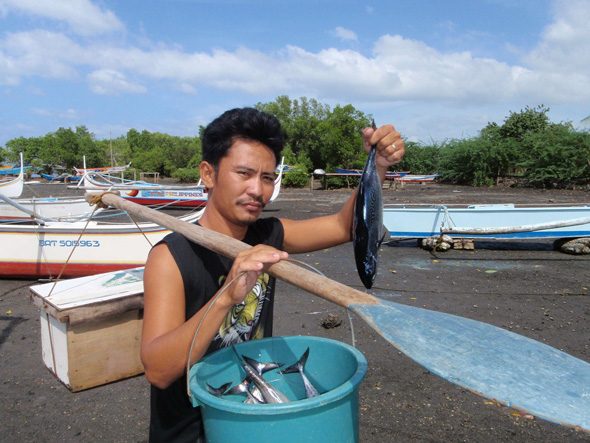
›In March 2012, I participated in a study tour to the island of Bohol, near the unique Danajon double barrier reef ecosystem – the only one of its kind in the Philippines and one of only three in the Indian and Pacific Oceans. Nowhere is the connection between population dynamics and biodiversity more evident than in the Philippines, one of the most densely-populated countries on the planet, with more than 300 people per square kilometer. Nearly every major species of fish in the region shows signs of overfishing, according to the World Bank.
-
“Afghanistan, Against the Odds: A Demographic Surprise” Launches ECSP Report 14
›A few months ago, Elizabeth Leahy Madsen broke down Afghanistan’s first-ever nationally representative survey of demographic and health issues in a two-part series here on the blog. Now, we’ve published her analysis in a rich new policy brief format. It is the first issue of Environmental Change and Security Program Report 14, the latest volume of ECSP’s flagship publication.
In “Afghanistan, Against the Odds,” Madsen examines the surprising results of this fall’s demographic survey and how the country’s statistics compare to neighboring Pakistan.
“Just as Afghanistan and Pakistan’s political circumstances have become more entwined,” writes Madsen, “their demographic paths are more closely parallel than we might have expected. For Afghanistan, given its myriad socioeconomic, political, cultural, and geographic challenges, this is good news. But for Pakistan, where efforts to meet family planning needs have fallen short of capacity, it is not.”
The publication of this brief marks the re-launch of ECSP Report as an online-only volume, with individual issues scheduled to be released throughout the year. Forthcoming ECSP Report 14 briefs will address the demographic roots of the Arab Spring; the links between population dynamics and environmental resources like water, biodiversity, and food; and the potential impact of climate change mitigation efforts on conflict.
Published since 1996 in hard copy and online, the new ECSP Report will now be available on the Wilson Center website, New Security Beat, and Issuu. You can read the previous 13 volumes of the ECSP Report on the Wilson Center website.
Download ECSP Report 14: “Afghanistan, Against the Odds” from the Wilson Center. -
Adenike Esiet: Building Support for Improving Adolescent Sexual and Reproductive Health in Nigeria
›“In Nigeria, young people under the age of 25 are driving the HIV epidemic…and that’s been the opening place for people to begin to say, ‘let’s address the issues of young people’s sexual and reproductive health,’” said Adenike Esiet, executive director of Action Health Incorporated in Lagos, during an interview with ECSP.
On any number of health indicators, girls suffer disproportionately. “For every one boy in the age bracket of 10 to 24 who is HIV positive, there are three girls who are HIV positive,” Esiet said. “Over 60 percent of cases of complications from unsafe abortion reported in Nigerian hospitals are amongst adolescent girls. In fact in literature, 10-15 years ago, this was described as ‘a schoolgirl’s problem’…and it’s still an ongoing problem.” She added: “And for girls too, the issue of sexual violence is huge. It goes largely unreported but it’s occurring at epidemic levels.”
Esiet spoke on an adolescent health panel during the April 25 “Nigeria Beyond the Headlines” event at the Wilson Center. Progress is slow on these issues, in large part because “there’s a whole lot of silence about acknowledging young people’s sexuality,” she said.
Adults “want to believe [adolescents] shouldn’t be sexually active.” But turning a blind eye to adolescent sexuality can mean that efforts “to provide access to education or services is hugely resisted by practitioners who should be doing this.”
Action Health works to fill the gap that emerges. “Our work covers advocacy, community outreach, and service provision for young people,” said Esiet.
“Our primary entry road in to work with young people is creating access to sexuality education and youth friendly services. And in the course of trying to do that, we have to do a whole lot of advocacy with government and also with ministries or education and ministries of health and youth development.”
The group has worked with government officials and agencies to establish a nationwide HIV education curriculum and paired with local healthcare providers to increase access to “youth-friendly” sexual and reproductive health services. Funding shortages and insufficient resources have hampered the curriculum’s success, though, and the pervasive attitude against youth sexuality has limited the reach of services, she said. Ultimately, “there are a whole range of issues that truly need to be addressed” for outreach efforts to be successful.
Showing posts from category global health.