-
USAID’s New Climate Strategy Outlines Adaptation, Mitigation Priorities, Places Heavy Emphasis on Integration
›February 29, 2012 // By Kathleen MogelgaardIn January, the U.S. Agency for International Development released its long-awaited climate change strategy. Climate Change & Development: Clean Resilient Growth provides a blueprint for addressing climate change through development assistance programs and operations. In addition to objectives around mitigation and adaptation, the strategy also outlines a third objective: improving overall operational integration.
The five-year strategy has a clear, succinct goal: “to enable countries to accelerate their transition to climate-resilient low emission sustainable economic development.” Developed by a USAID task force with input from multiple U.S. agencies and NGOs, the document paints a picture of the threats climate change poses for development – calling it “among the greatest global challenges of our generation” – and commits the agency to addressing both the causes of climate change and the impacts it will have on communities in countries around the world.
These statements are noteworthy in a fiscal climate that has put development assistance under renewed scrutiny and in a political environment where progress on climate change legislation seems unlikely.
Not Just Challenges, But Opportunities
To make the case for prioritizing action on climate change, the strategy cites climate change’s likely impact on agricultural productivity and fisheries, which will threaten USAID’s food security goals. It also illustrates the ways in which climate change could exacerbate humanitarian crises and notes work done by the U.S. military and intelligence community in identifying climate change as a “threat multiplier” (or “accelerant of instability” as the Quadrennial Defense Review puts it) with implications for national security.
Targeted efforts to address climate change, though, could consolidate development gains and result in technology “leap-frogging” that will support broader development goals. And, noting that aggregate emissions from developing countries are now larger than those from developed countries, the strategy asserts that assisting the development and deployment of clean technologies “greatly expands opportunities to export U.S. technology and creates ‘green jobs.’”
In addition to providing a rationale for action, the strategy provides new insights on how USAID will prioritize its efforts on climate change mitigation and adaptation. It provides a clear directive for the integration of climate change into the agency’s broader development work in areas such as food security, good governance, and global health– a strong and encouraging signal for those interested in cross-sectoral planning and programs.
Priorities Outlined, Tough Choices Ahead
President Obama’s Global Climate Change Initiative, revealed in 2010, focuses efforts around three pillars: clean energy, sustainable landscapes, and adaptation. USAID’s climate strategy fleshes out these three areas, identifying “intermediate results” and indicators of success – such as the development of Low Emission Development Strategies in 20 partner countries, greenhouse gas sequestration through improved ecosystem management, and increasing the number of institutions capable of adaptation planning and response.
In laying out ambitious objectives, however, the authors of the strategy acknowledge constrained fiscal realities. The strategy stops short of identifying an ideal budget to support the activities it describes, though it does refer to the U.S. pledge to join other developed countries in providing $30 billion in “fast start financing” in the period of 2010 to 2012 and, for those USAID country missions that will be receiving adaptation and mitigation funding, establishes “floors” of $3 million and $5 million, respectively.
The final section of the strategy lists over thirty countries and regions that have already been prioritized for programs, including Bangladesh, India, Kenya, Malawi, and Peru. But “we are unable to work in every country at risk from climate change impacts or with the potential for low carbon sustainable growth,” the strategy asserts. An annex includes selection criteria to guide further funding decisions, including emission reduction potential, high exposure to physical climate change impacts, a suitable enabling environment, coordination with other donors, and diplomatic and geographic considerations.
“Integration” Central to Strategy
The concept of integration figures prominently throughout the 27-page document. For those of us working in the large and growing space where the global challenges of climate change, food security, health, livelihoods, and governance overlap, this attention is heartening. While it may sometimes seem simply fashionable to pay lip service to the idea of “breaking out of stovepipes,” the strategy identifies concrete ways to incentivize integration.
“Integration of climate change into USAID’s development portfolio will not happen organically,” the strategy says. “Rather, it requires leadership, knowledge and incentives to encourage agency employees to seek innovative ways to integrate climate change into programs with other goals and to become more flexible in use of funding streams and administrative processes.”
To this end, USAID plans to launch a group of pilot activities. USAID missions must submit pilot program proposals, and selected programs will emphasize integration of top priorities within the agency’s development portfolio (including Feed the Future and the Global Health Initiative). Among other criteria, pilots must demonstrate buy-in from multiple levels of leadership, and will be selected based on their potential to generate integration lessons and tools over the next several years.
This kind of integration – the blending of key priorities from multiple sectors, the value of documented lessons and tools, the important role of champions in fostering an enabling environment – mirrors work carried out by USAID’s own population, health, and environment (PHE) portfolio. To date, USAID’s PHE programs have not been designed to address climate challenges specifically, and perhaps not surprisingly they aren’t named specifically in the strategy. But those preparing and evaluating integration pilot proposals may gain useful insights on cross-sectoral integration from a closer look at the accumulated knowledge of more than 10 years of PHE experience.
Population Dynamics Recognized, But Opportunities Not Considered
Though not a focus of the strategy, population growth is acknowledged as a stressor – alongside unplanned urbanization, environmental degradation, resource depletion, and poverty – that exacerbates growing challenges in disaster risk reduction and efforts to secure a safe and sufficient water supply.
Research has shown that different global population growth scenarios will have significant implications for emissions growth. New analysis indicates that the fastest growing populations are among the most vulnerable to climate change and that in these areas, there is frequently high unmet need for family planning. And we have also clearly seen that in many parts of the world, women’s health and well-being are increasingly intertwined with the effects of changing climate and access to reproductive health services.
In its limited mention of population as a challenge, however, the strategy misses the chance to identify it also as an opportunity. Addressing the linked challenges of population growth and climate change offers an opportunity to recommit the resources required to assist of the hundreds of millions of women around the world with ongoing unmet need for family planning.
The strategy’s emphasis on integration would seem to be an open door to such opportunities.
Integrated, cross-sectoral collaboration that truly fosters a transition to climate-resilient, low-emission sustainable economic development will acknowledge both the challenge presented by rapid population growth and the opportunities that can emerge from expanding family planning access to women worldwide. But for this to happen, cross-sectoral communication will need to become more commonplace. Demographers and reproductive health specialists will need to engage in dialogues on climate change, and climate specialists will need both opportunities and incentives to listen. USAID’s new climate change integration pilots could provide a new platform for this rare but powerful cross-sectoral action.
Kathleen Mogelgaard is a writer and analyst on population and the environment, and a consultant for the Environmental Change and Security Program.
Sources: FastStartFinance.org, International Energy Agency, Maplecroft, Population Action International, The White House, U.S. Department of Defense, USAID.
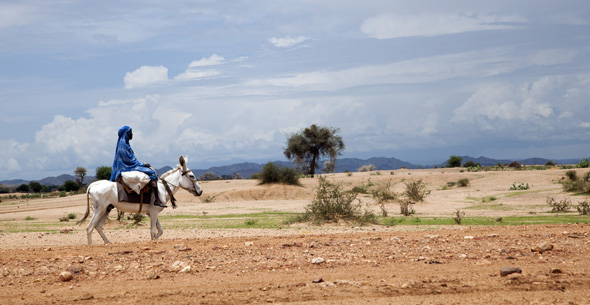
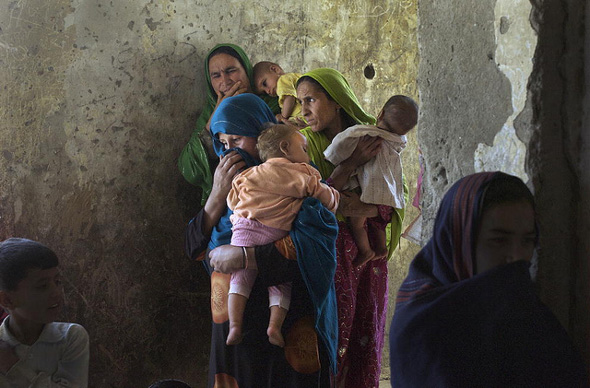
Photo Credit: “Displaced Darfuris Farm in Rainy Season,” courtesy of United Nations Photo. -
Programming to Address the Health and Livelihood Needs of Adolescent Girls
›“There are 750 million adolescent girls in the world today, and this is by far one of the world’s most marginalized and vulnerable demographics,” said Denise Dunning, the Public Health Institute’s program director for emergency contraception in Latin America during a February 2 panel at the Wilson Center. Dunning, who also leads the Adolescent Girls’ Advocacy and Leadership Initiative (AGALI), was joined by Margaret Greene, director of Greeneworks, and Jennifer Pope, the deputy director of sexual and reproductive health at Population Services International, to discuss how to better reach underserved adolescent girls in developing countries with health and livelihood programs.
-
Stuck: Rwandan Youth and the Struggle for Adulthood (Book Preview)
›Several years ago, I wrote that the central irony concerning Africa’s urban youth was that “they are a demographic majority that sees itself as an outcast minority.” Since that time, field research with rural and urban youth in war and postwar contexts within and beyond Africa has led me to revise this assertion. The irony appears to apply to most developing country youth regardless of their location.
-
Assigning Value to Biodiversity, and the 2011 Human Development Report
›New research in the journal BioScience reports the aggregate economic benefits of conserving high priority biodiversity areas outweigh the opportunity costs of alternative land uses by a multiple of three (where priority is assigned according to a global index of the mapped distributions of 4,388 threatened terrestrial species). The authors of “Global Biodiversity Conservation and the Alleviation of Poverty,” led by Will Turner, estimate the value of highly diverse habitats to the global poor in terms of direct benefits and potential external payments for ecosystem services. They find these environmental flows in excess of $1 per person, per day, for 331 million of the world’s poorest individuals and conclude by arguing that, “although trade-offs remain…results show win-win synergies…and suggest biodiversity conservation as a fundamental component of sustainable economic development.” (For further discussion of development around biodiversity hotspots, see Population Action International’s work on population growth.)The 2011 UNDP Human Development Report, Sustainability and Equity: A Better Future for All, builds from the understanding that a “failure to reduce…grave environmental risks and deepening social inequalities threatens to slow decades of sustained progress by the world’s poor majority.” A resilient thread in the report highlights the importance of working to ensure women’s equality and reproductive rights for sustainability, claiming that “meeting unmet need for family planning by 2050 would lower the world’s carbon emissions an estimated 17 percent below what they are today.” The report closes with a wide range of policy suggestions that work towards the goal of equating sustainability and equity, including a supportive discussion of a currency transaction tax as a novel and feasible method of providing climate financing.
These pieces address contradictions between environmentally sustainable behavior and the development imperative. Though both acknowledge that the traditional development model of high intensity economic growth has imperiled the environment upon which the livelihoods of many hundreds of millions depend, they suggest practical ways forward. The Human Development Report in particular adopts some of the strongest language yet, claiming that, “the message is clear: our development model is bumping up against concrete limits.” This honest attempt to work through, rather than around, the tension between development and sustainability is perhaps an indication that we are at last beginning to take seriously the concept of sustainable development. -
Afghanistan and Pakistan: Demographic Siblings? [Part Two]
›February 15, 2012 // By Elizabeth Leahy MadsenLate last year, Afghanistan’s first-ever nationally representative survey of demographic and health issues was published, providing estimates of indicators that had previously been modeled or inferred from smaller samples. My first post on the survey focused on the methodology and results, which found that Afghanistan is not as much of a demographic outlier as many observers had assumed. But perhaps the most surprising finding is how the results compare to those of Afghanistan’s neighbor, Pakistan.
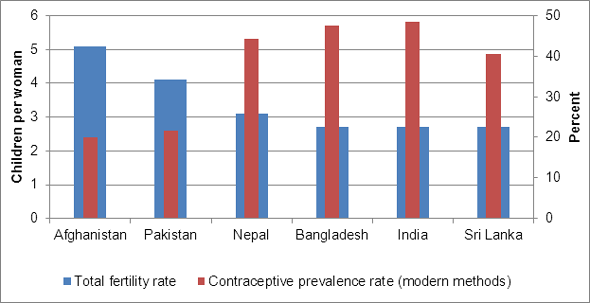
The political future of each country depends largely on the other and, with Afghanistan making progress on reproductive health issues that remain stalled in Pakistan, their demographic trajectories are heading toward closer synchronization as well. In one key measure – use of contraception among married women – Afghanistan is almost identical to Pakistan. The modern contraceptive prevalence rate is 19.9 percent, slightly lower than the rate of 21.7 percent in Pakistan.
While Pakistan faces its own serious political instability, it is widely regarded as more developed than its neighbor. Afghanistan is included in the UN’s grouping of least developed countries, and Pakistan is not. Pakistan’s GDP per capita is almost twice as high. On the surface, this should suggest lower fertility. There is a general negative relationship between economic development and fertility, though demographers are quick to point out its complexities, and David Shapiro and colleagues have found that countries with larger increases in GDP actually experience slower fertility declines.
Pakistan’s fertility rate of 4.1 children per woman is in fact 20 percent lower than Afghanistan’s, but the similarities in contraceptive use, which is one of the direct determinants of fertility, suggest that this gap could be shrinking. If Afghanistan’s median age at marriage (18 compared to 20 in Pakistan) was higher and more women were educated (76 percent of women have never been to school compared to 65 percent in Pakistan), the two fertility rates might be closer.
Pakistan’s Entrenched Challenge
Why are these indicators closer than might be expected? Relative to the other countries in South Asia, Pakistan has had considerably less success in promoting family planning use. Bangladesh has a per capita income about half that of India and one-quarter that of Sri Lanka, yet the three countries’ fertility rates are identical. Nepal has the lowest income in the region – even slightly below Afghanistan – yet more than 40 percent of married women use modern contraception and fertility is three children per woman. And then there is Pakistan. Despite a per capita income 90 percent that of India, only 22 percent of married women use modern contraception and fertility remains persistently high at over four children per woman.
The weaknesses of Pakistan’s family planning program have been well-documented. Government commitment has been lacking and cultural expectations and gender inequities are a powerful force to promote large family size. The country’s most recent DHS report cited disengagement with the program among local agencies, low levels of outreach into communities, and weak health sector support as likely causes for the stagnation of contraceptive use. In summer 2011, the Pakistani government abolished the federal Ministry of Health and empowered provincial governments with all responsibilities for health services. This transfer of authority could pay dividends by increasing local ownership of health care, but some in and outside Pakistan have raised concerns about the loss of regulatory oversight and information sharing entailed in total decentralization.
Compared to the Afghanistan survey, the most recent Pakistan Demographic and Health Survey provides more detail on women’s motivations and preferences regarding fertility and family planning. Overall, 55 percent of married women in Pakistan have a “demand” for family planning; that is, they wish to avoid pregnancy or report that their most recent pregnancy or birth was mistimed or unwanted. More than half of these women are using family planning, while the remaining 25 percent of married women have an “unmet need.”
Unintended pregnancies and births play a major role in shaping Pakistan’s demographic trajectory. The DHS survey finds that 24 percent of births occur earlier than women would like or were not wanted at all. If unwanted births were prevented, Pakistan’s fertility rate would be 3.1 children per woman rather than 4.1. Yet 30 percent of married women are using no contraceptive method and do not intend to in the future. The most common reasons for not intending to use family planning are that fertility is “up to God” and that the woman or her husband is opposed to it.
Linked Destinies
Just as Afghanistan and Pakistan’s political circumstances have become more entwined, their demographic paths are more closely in parallel than we might have expected. For Afghanistan, given the myriad challenges in the socioeconomic, political, cultural, and geographic environments, this is good news; for Pakistan, where efforts to meet family planning needs have fallen short of capacity, it is not. While Afghanistan is doing better than expected, Pakistan should be doing better.
Regardless, both countries are at an important juncture. With very young age structures and the attendant pressures on employment and government stability, each government must reduce unmet need for family planning or face mounting difficulties to providing for their populations in the future. In addition to rolling out health services, turning the share of women without education from a majority into zero would be an excellent way to start.
Elizabeth Leahy Madsen is a consultant on political demography for the Wilson Center’s Environmental Change and Security Program and senior technical advisor at Futures Group.
Sources: Afghanistan Ministry of Public Health, Bongaarts (2008, 1978), Cincotta (2009), Embassy of Afghanistan, Haub (2009), International Monetary Fund, MEASURE DHS, Nishtar (2011), Population Action International, Savedoff (2011), Shapiro et al. (2011), UN-OHRLLS, UN Population Division, U.S. Census Bureau, The Washington Post.
Image Credit: Chart arranged by Elizabeth Leahy Madsen, data from MEASURE DHS. -
Afghanistan’s First Demographic and Health Survey Reveals Surprises [Part One]
›February 14, 2012 // By Elizabeth Leahy MadsenLate last year, Afghanistan’s first-ever nationally representative survey of demographic and health issues was published, providing estimates of indicators that had previously been modeled or inferred from smaller samples. It shows that Afghan women have an average of five children each, lower than most experts had anticipated, and that their rate of modern contraceptive use is just slightly lower than that of women in neighboring Pakistan.
-
Caryle Murphy for the Middle East Program
Saudi Arabia’s Youth and the Kingdom’s Future
›Saudi Arabia is passing through a unique demographic period. …Approximately 37 percent of the Saudi population is below the age of 14. Those under age 25 account for around 51 percent of the population, and when those under 29 are included, young people amount to two-thirds of the kingdom’s population. (In the United States, those 14 years and younger are 20 percent of the population; those 29 and below make up 41 percent.)
-
Papua New Guinea Youth Conflict Study Reveals Effects of Civil War on Young Men
›Demographic security is fast becoming a central concept in discussions about the relationship between youth and violence, and, although quantitative work has been the normal mode of research in the field, recent evidence from Papua New Guinea’s autonomous region of Bougainville shows the value of understanding local-level nuance.
Policies to support youth in post-conflict situations are important for building peace, particularly given the “youth bulge” thesis that suggests that large cohorts of marginalized young people are contributing to a demographic “arc of instability” across the developing world. However, the statistical evidence showing correlations between youth bulges and an increased risk of instability has been criticized for failing to account for the agency of youth themselves. For instance, Marc Sommers points out that there is “scant information on how and why most marginalized African youth resist engagement in violence even when it would seem to provide immediate benefits.” This lack of detailed, evidence-based knowledge can frustrate efforts to develop effective youth policies, particularly in post-conflict settings, where the risk of the persistence or even return of violence, is arguably increased by the presence of youth bulges.
Bougainville’s “Crisis Generation”
Hoping to address this lack of knowledge about how and why young people engage in peace or violence in post-conflict settings, I recently spent several weeks in Bougainville. My aim was to study how young men make lives for themselves in the social circumstances that exist nine years on from a civil war that lasted more than a decade and claimed more lives than any Pacific conflict since World War II. The qualitative evidence I collected on these pathways informed analysis in an article co-authored with Jon Barnett in the Journal of Political Geography, “Localising Peace: The Young Men of Bougainville’s ‘Crisis Generation’” (subscription required).
With a 2010 median age of just 20.4 years (projected to remain less than 25 until at least 2030) and more than 60 percent of its population less than 30 years old, Papua New Guinea is among the world’s youngest states, according to UN population data. Despite a wealth of natural resources, the state faces severe challenges to providing education, jobs, and security for a young population whose growth has for many years severely outpaced the capacity of its formal institutions. Papua New Guinea, and the region of Bougainville within it, is a state where demographic strains are reasonably expected to continue to pose risks to an already fragile state.
Bougainville’s 18-to-30-year olds, known among their peers and elders as the “crisis generation,” are those with living memory of the violence but who were too young to have fought on either side. They continue to face challenges with trauma, accessing education and work, achieving social standing, and escaping from histories of violence. These sometimes impede their capacity to participate meaningfully in local society and can lead them towards sporadic acts of violence.
Understanding the Pathways to Violence
For many young men in Bougainville, achieving critical social measures of success – such as amassing the wealth required for marriage – has become nearly impossible due to high unemployment and restricted access to education. Marriage matters, since land rights in Bougainvillean societies are generally derived matrilineally, and therefore young men who are unable to marry tend to lack secure access to land.
Education is a critical institution for young men in Bougainville. Unfortunately, the formal sector that might employ young men upon completing secondary education is very small, and therefore much of the time and money spent pursuing that education is wasted. The education system itself lacks the resources to meet the needs of all those who seek secondary education. To cope with the demand, youth are asked to sit for exams in grade 8 and again in grade 10, a practice which creates high failure rates and whittles down the student cohort from several thousand at primary level to only a few hundred at the completion of secondary schooling (few of whom then receive meaningful employment). For many, this failure to obtain a return on years of school fees places significant strain on the relationships between youth and their familial and social networks.
Some adapt to these challenges by “upgrading” their poor education through distance learning or by seeking out vocational training as a way to obtain skills relevant for rural life. But some are seen as wedged between a set of unworkable options: “Many of them are existing in a vacuum,” said one civil society leader. “They see things outside but they cannot grab them and they cannot ground themselves.”
As a result, many turn to homebrew alcohol and marijuana and a select few seek social standing by adopting displays and acts of violence that imitate the personas of former rebels. Of these choices, the first attracts the stigma of “lazy,” and the second, “dangerous.” In both cases, these stigmas risk overshadowing the legitimate challenges facing young men by distilling the complexity of the world into a simple morality crisis that itself creates divides both between and within generations.
Building Policy Prescriptions
Unfortunately, the sorts of life and trauma counseling services capable of engaging these young men remain under-supported. As one youth worker claimed of the youth who have no memory of life before the war, “They don’t know how it was before the Crisis. They think things have always been this way; that this is normal.”
In a more southern district, one young man explained of his more notorious peers, “It’s these guys roaming around, mixing with ladies and drinking, they cannot reason so they use the gun, the knife – offensive weapons. And when they are sober they regret. These people spoil the peace process here in Bougainville.”
Providing viable alternatives to these lifestyles is crucial and can only be achieved by asking young men themselves about their world, about the challenges they face, and about the strategies they take to maneuver through them. By understanding the social, cultural, and geographical specifics of a local context, this form of analysis provides a valuable starting point for determining and evaluating policy interventions that statistics alone cannot provide.
In Bougainville’s case, an expansion of vocational training and the provision of trauma counseling, regardless of whether a person was a combatant or not, are two desperately needed interventions that have the potential to increase the capacity of young men to achieve success through peaceful means.
Sources: Conciliation Resources, The Sydney Morning Herald, UN Population Division.
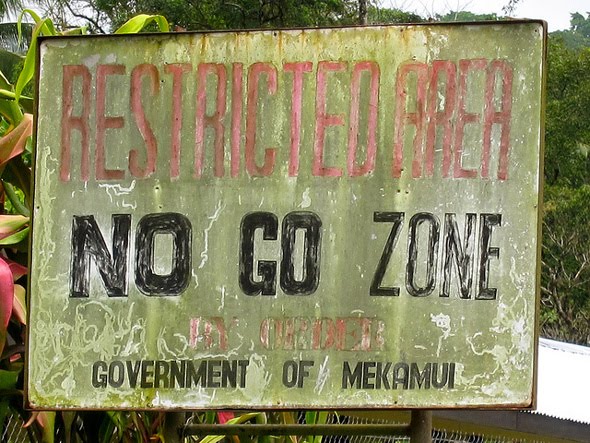
Photo Credit: “Mekamui/Panguna” and crossing from Buka to Bougainville, courtesy of flickr user madlemurs.
Showing posts from category gender.